


Table of Contents
Researcher

Source: X(@jessepollak)
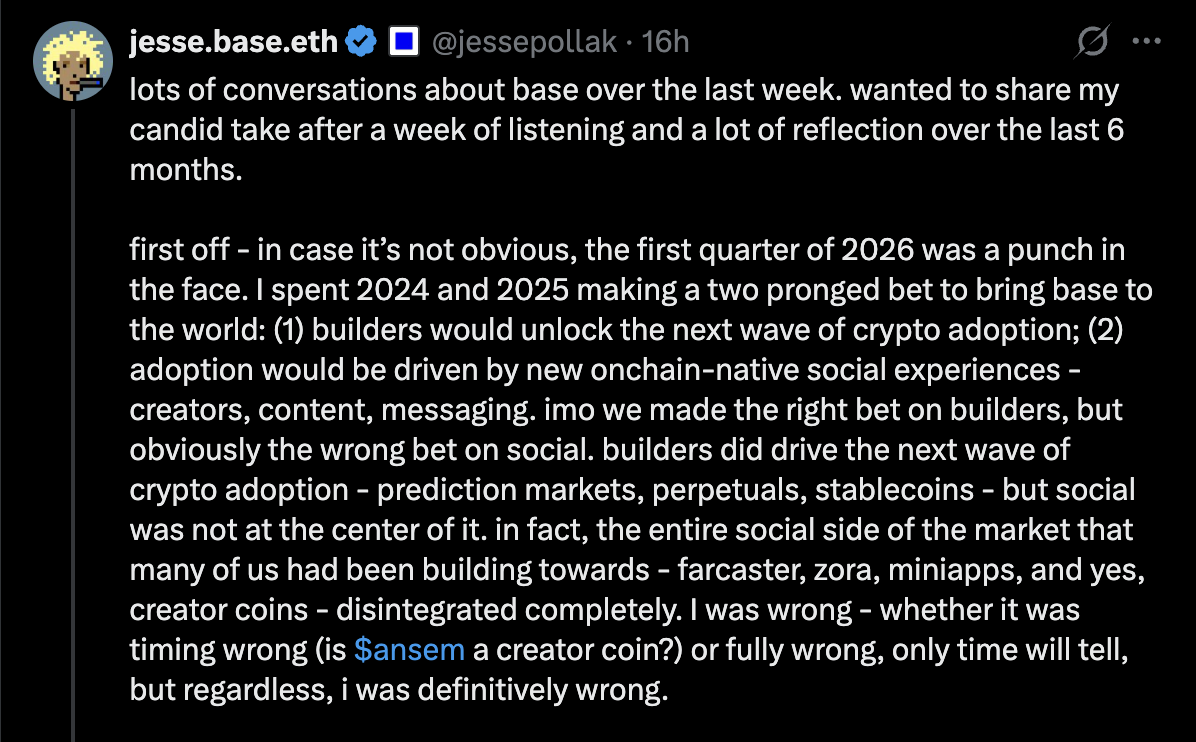
On July 15, Jesse Pollak (@jessepollak), the creator of Base, published a lengthy post.
Robinhood Chain quickly emerged as a potential competitor to Base after its mainnet launch, helped by a wave of memecoin activity. At the same time, Base had reached a point where it needed to show what came next amid debate over onchain social products and creator coins. In that context, Jesse acknowledged that his previous strategy had failed and said he would return his focus to the chain.
The post also prompted debate over the future of Base App, along with various interpretations surrounding $JESSE. There are many points to discuss, but this article focuses on three: his courage in admitting failure, Base’s next playbook, and the agents at the center of that playbook.
1. Change begins with admitting mistakes
What surprised me most was that he began by saying, “I was wrong, and I am sorry,” before presenting the new strategy.
For better or worse, the crypto market tends to reward strong conviction and an aggressive posture. In this environment, publicly admitting that one’s judgment was wrong is difficult. This is especially true for someone leading a large ecosystem that involves many builders, investors, and users.
Even in light of the outcome, the onchain-native social strategy he pursued was a defensible choice at the time. Social media continues to gain influence, and crypto services such as Fomo (@fomo) and Polymarket (@Polymarket) have used social distribution and virality as growth engines. Given this context, the hypothesis that an onchain-native social experience could broaden crypto adoption had a reasonable basis.
The causes of the failure could be examined at greater length across product, distribution, timing, and user demand. What matters here is that he did not disguise the failure. He acknowledged that the onchain social and creator coin strategy he had strongly promoted in 2024 and 2025 did not produce the adoption he expected.
I do not think the idea of onchain social is entirely finished. Even if its current form failed, it could reemerge through different products and distribution models and be reassessed.
(In that sense, I am also looking forward to Cobie’s (@cobie) next counterpunch after taking over Base App.)
Jesse said leadership of Base App would return to Coinbase and that he would focus on chain infrastructure. He acknowledged the misjudgment, reassigned roles, and disclosed the next priorities. As the leader of a major protocol, making an announcement like this with his reputation on the line was notable.
“but if there’s one thing i’ve learned from the last decade of building in this space, it’s that when things feel the worst, the best thing to do is just put your head down and build.”
2. Base is already on the front line of the next battle
Jesse identified Trading, Payments, and Agents as Base’s areas of focus. This article examines agents, and more specifically, agentic payments and commerce.
To use his terms, Trading covers all assets, from tokenized stocks to memecoins and appcoins. Payments refers to stablecoins that individuals and businesses can use around the world. Agents form a cross-cutting layer across Trading and Payments and can accelerate both. Jesse does not frame Agents as a third independent business alongside them. His view is that crypto is native money for computers, while artificial intelligence will create trillions of new economic actors.
Source: Artemis (@artemis)
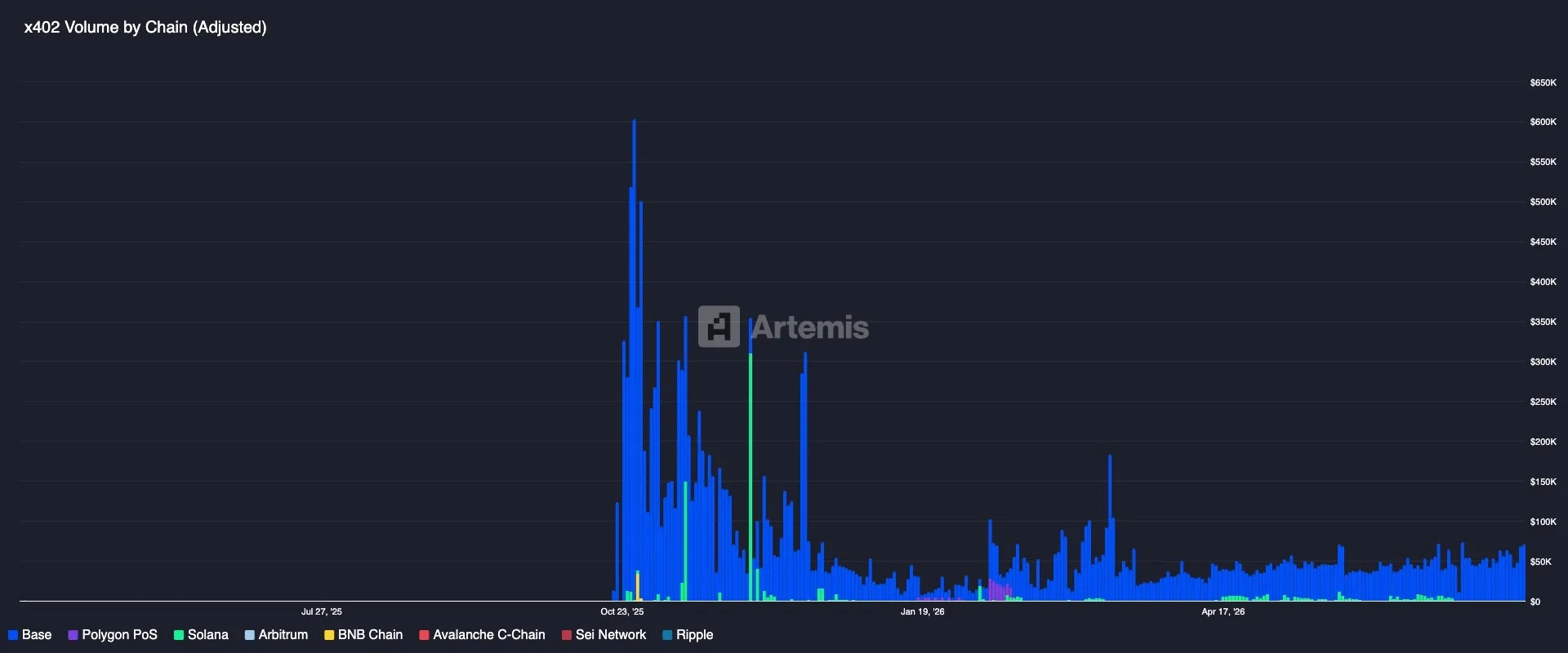
At least in onchain agent payments and the agent-native ecosystem, Base is among the leading networks.
The Coinbase Developer Platform team released x402 in May 2025. Coinbase and Cloudflare later laid the groundwork for establishing the foundation. On July 14, 2026, the protocol contribution was completed, and the x402 Foundation formally began operating under the Linux Foundation with 40 members. x402 is no longer tied to any particular company or chain. Even so, much of its early deployment and payment activity took shape on Base, and many x402 implementations have been built there. This is difficult to deny. (s/o to @kleffew94)
Projects such as Virtuals Protocol (@virtuals_io) and Bankr (@bankrbot), which grew on Base before expanding to multiple chains, should be viewed in the same context.
This indicates that Base has an early lead in its agent ecosystem and builder density. The fact that agents, builders, and capital likely to drive future trading are gathering in one place is an important leading indicator.
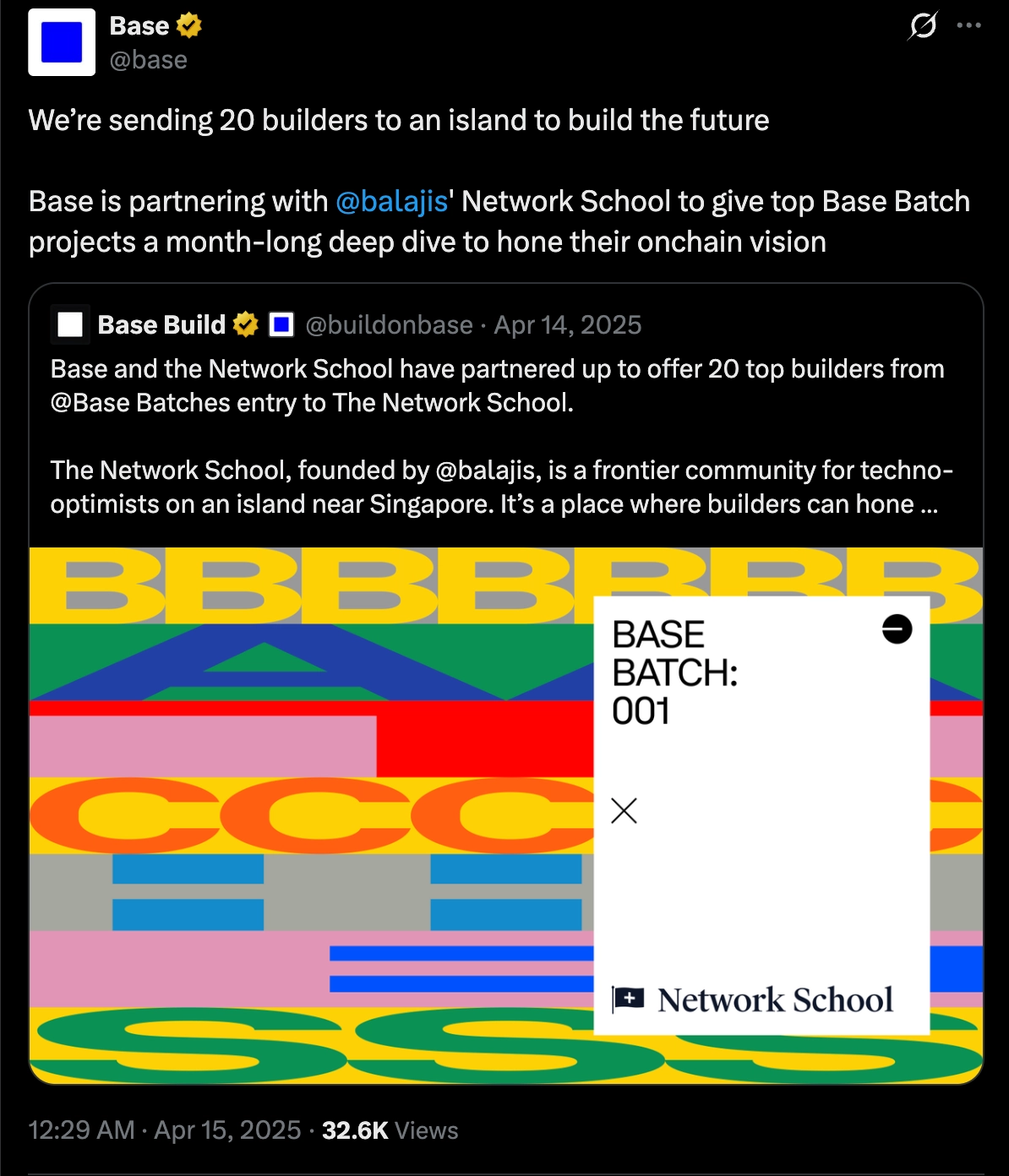
Jesse’s builder-led growth strategy also deserves attention. Through Base Batches, Base offered grants and investment opportunities to early-stage teams. In 2026, it also linked the robotics track operated by Virtuals to a demo day at Network School (@ns).
Source: X (@base)
Hackathons and grant programs do not always produce sustainable products. Developer support measures input. It does not itself constitute an outcome.
Even so, in the early stages of platform competition, it matters where builders gather and which chain they choose as their default deployment venue. Lowering the cost of experimentation before the market takes shape increases the chance that the killer app for the next meta will emerge from that ecosystem. Base’s efforts are meaningful in this respect.
Taken together, Base has secured a high early market share in onchain agent payments and has steadily worked to attract developers and agent projects.
Jesse has decided to put more weight behind this direction. He said Base would continue supporting builders through Base Layer, Base Batches, and the Base Ecosystem Fund, as well as through the distribution channels of Coinbase and Base App.
The direction is now clear: Base will refocus its resources on trading, payments, and agents. It is a signal that Base will concentrate its efforts on what it does best.
However, declaring a direction and building a real moat are entirely different matters. To turn its current early lead into long-term value capture, I believe Base must answer at least the following three questions from the perspective of the agent ecosystem.
3. Three questions for Jesse
Q1. What stage of agentic commerce is Base targeting?
The first question concerns how Base defines agentic commerce. Base’s playbook and its approach to ecosystem support will necessarily differ depending on whether it targets simple assistance and delegation or fully autonomous transactions.
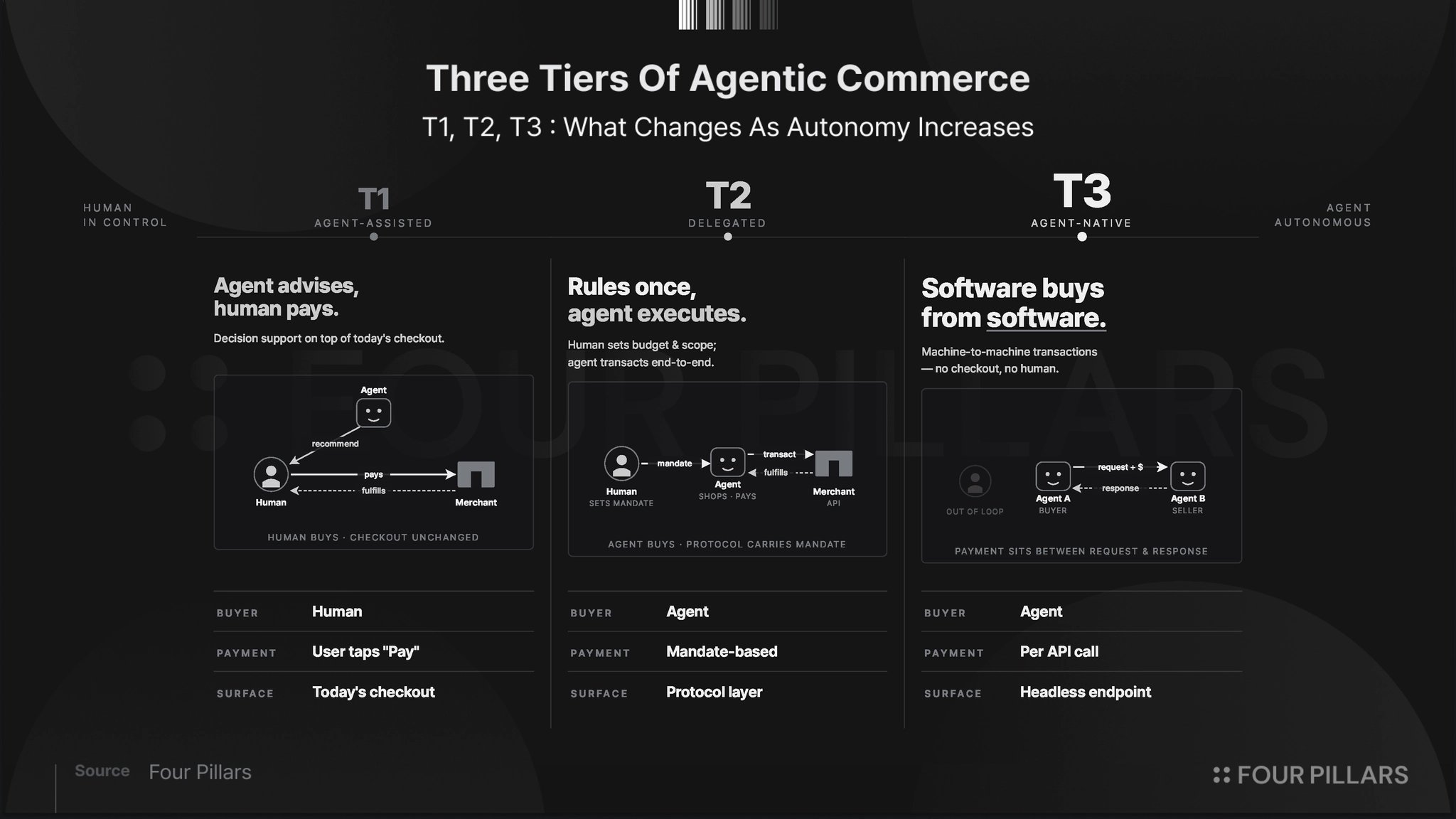
Consider the two scenarios. If the short-term target is delegated commerce (T2), collaboration with major commerce platforms such as Shopify or integration with existing commerce standards such as Google’s UCP would have greater impact. If Base instead aims for fully autonomous, agent-native commerce (T3), support for headless merchant endpoints and agent-native builders would become the center of its strategy. I also consider x402 one of the main infrastructure components for this direction.
The difference between the two paths is clear. Since much of existing commerce is likely to remain in the T2 category for some time, the first path can produce visible results, including transaction value and partnerships, relatively quickly. If the market’s center of gravity begins to move toward fully autonomous transactions, Base will eventually need to recalibrate. Focusing on T3 from the start may make it difficult to produce financially meaningful results in the near term. Transaction counts may rise quickly, but early activity is likely to consist mostly of micropayments. Even so, over the long term, this path most directly targets what I see as the endpoint of the agent economy. Base’s current center of gravity also appears closer to this approach.
Q2. Can Base capture meaningful value in agent commerce?
Put simply, Base needs to make a clearer case for why agentic commerce should use Base or crypto at all. Micropayments and low fees are attractive, but they do not create a sufficient moat on their own. Card networks and existing payment providers are responding to the same problem with delegation tokens and payment interfaces designed for agents. Stripe and Tempo’s MPP, which combines cards and stablecoins within a single protocol, is part of this trend. To be blunt, card networks that already have powerful “money machines” are unlikely to simply hand the agent payment market to crypto.
Crypto’s moat must come from permissionless participation and its trust model. Cost alone is insufficient. Agents and endpoints should be able to transact without separate accounts or merchant agreements. Software should be able to hold assets directly, and transaction conditions should be enforceable in code. These strengths are clearest in the fully autonomous, agent-native commerce model described above as T3. I wonder whether Jesse also sees this area as crypto’s ultimate moat.
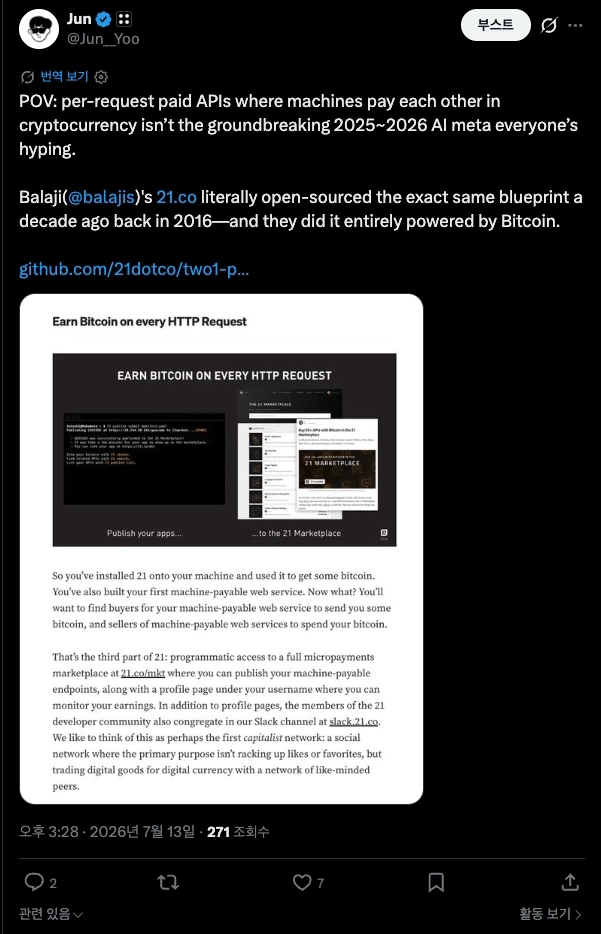
Bitcoin-based micropayments were attempted a decade ago. They failed to solve high payment costs, volatility, and difficult wallet onboarding. More importantly, the source of demand for repeated small payments, namely today’s agents, was not yet clear.
Today, all three conditions exist at the same time: Base offers low fees and high network performance, stablecoins are available, and AI agents need to purchase external resources.
I believe this gives us a basis to revisit questions that could not be answered in the past.
Q3. What is Base’s strategy in this area, and how will it support the agent ecosystem?
Builder support through Base Batches and Network School may be one answer to this question. I would like to ask more specifically: Will Base concentrate its support on a small number of core projects and infrastructure, or will it support the broader agent ecosystem? Will it prioritize delegated agents connected to existing commerce, or will it make headless merchants and fully autonomous agents its main targets?
If Base targets the latter, grants and hackathons would be insufficient. It would also need tools that make paid endpoints easy to deploy, a distribution layer through which agents can discover services, programmable wallets, identity and reputation systems, and stablecoin liquidity. I would like to hear Jesse’s view on which of these areas Base should build directly and which it should leave to ecosystem builders.
Once again, I respect Jesse’s decision to publicly admit his mistake and apologize. Reading his post made me think about the position Base is seeking in the agent economy.
The author of this report may have personal holdings or financial interests in assets or tokens discussed herein. However, the author affirms that no transactions have conducted using material non-public information obtained in the course of research or drafting. This report is intended solely for general information purposes and does not constitute legal, business, investment, or tax advice. It should not be used as a basis for making any investment decisions or as guidance for accounting, legal, or tax matters. Any references to specific assets or securities are made for informational purposes only and should not be construed as an offer, solicitation, or recommendation to invest. The opinions expressed herein are those of the author and may not reflect the views of any affiliated institutions, organizations, or individuals. The opinions and analyses expressed herein are subject to change without prior notice. In addition, beyond the individual disclosures included in each report, Four Pillars, may hold existing or prospective investments in some of the assets or protocols discussed herein. Furthermore, FP Validated, a division of Four Pillars, may already be operating as a node in certain networks or protocols discussed herein or may do so in the future. Please see below links in the footer for FP Validated's participating network disclosures and for broader disclosure details.


