Table of Contents
- 1. Major News
- [Crypto] Bitmine’s $6.3 Billion Net Loss: Crypto Liquidity Dries Up as Ethereum Loses Its Biggest Buyer
- [Institution] OKXICE, the First Tokenized Stock Venue, Set to Launch Without Large Caps
- Others
- 2. Data Spotlight
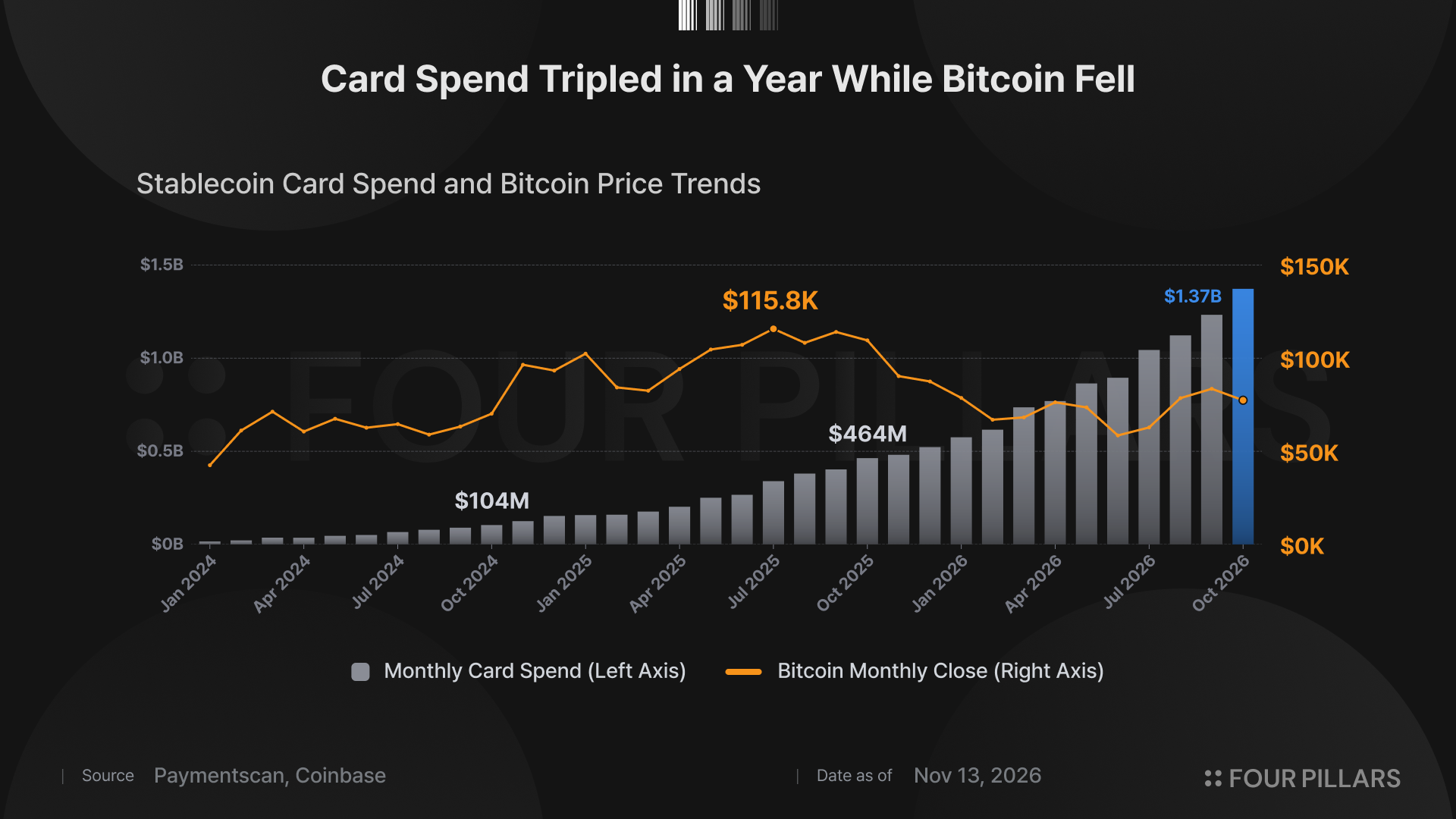
- Crypto Card Spend Tripled in a Year. Where Does Card Program Make Money? (Link)
- 3. Four Pillars Weekly
- : : Redefining Everything: The Sui Stack (Link)
- : : INFINIT: Shaping the Future of Asset Management (Link)
- : : Gotchi Labs: What It Takes for AI to Become a Daily Habit (Link)
- : : QFEX Managed Account: Why the House Doesn’t Have to Win (Link)
- : : HYPE 26Q3 Report (Link)
- : : Onchain Real Estate Market, Two Working Models (Link)
- Comments
- 4. Macro & Onchain Metrics
Researcher

1. Major News
[Crypto] Bitmine’s $6.3 Billion Net Loss: Crypto Liquidity Dries Up as Ethereum Loses Its Biggest Buyer
What Happened?
Bitmine, the largest corporate holder of ETH, reported a net loss of more than $6.3 billion for the fiscal year ended August 31. According to its annual report, about $6.23 billion of that came from unrealized fair value losses on its digital asset holdings. Over the same period, ETH fell 44%, from about $4,390 to $2,466. As of November 8, Bitmine held 6,070,092 ETH, or 4.97% of the total supply.
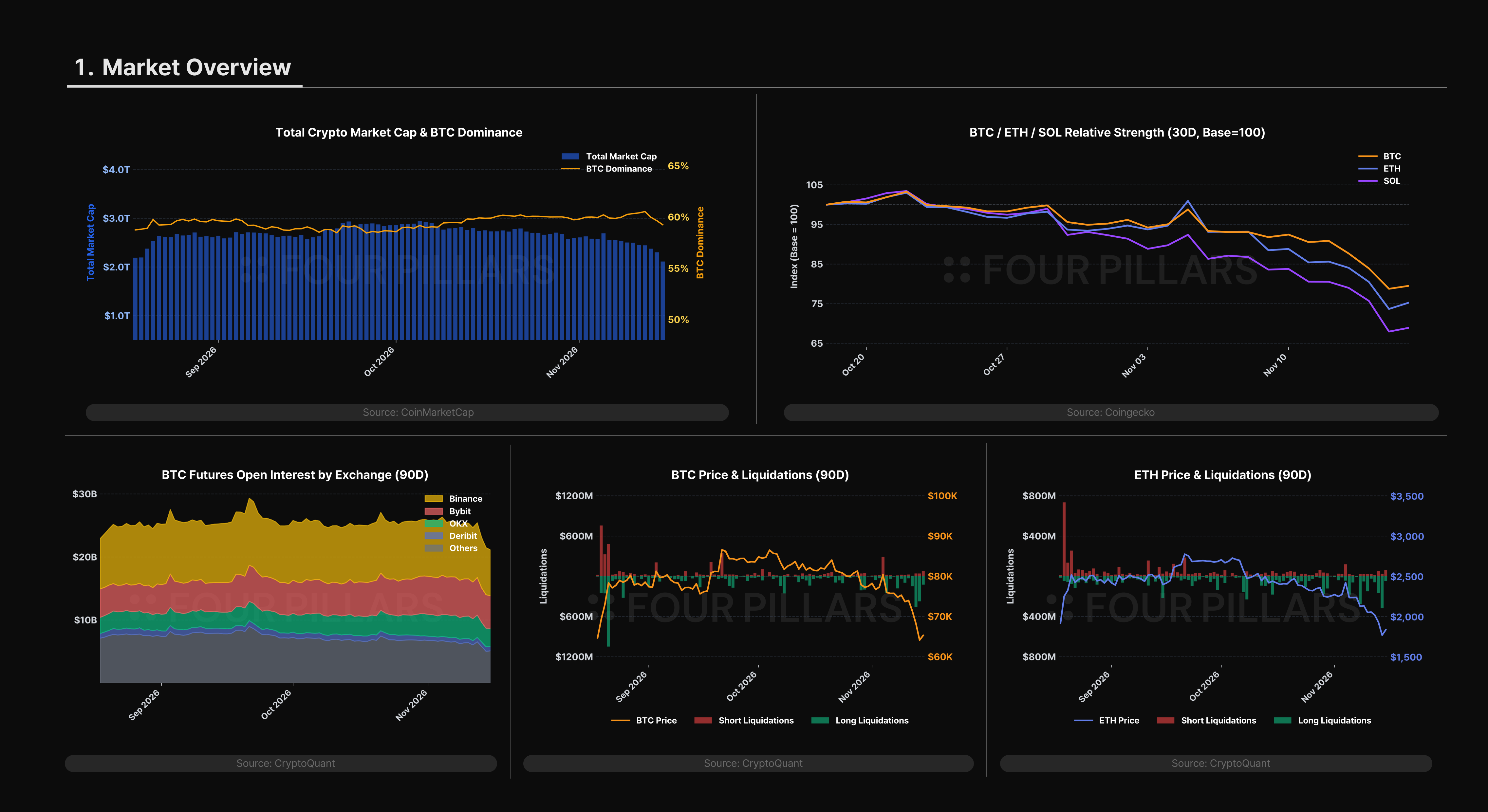
The broader market also fell sharply last week. BTC dropped to around $62,000 on November 15, its lowest level since July, while ETH slid more than 18% over the week to around $1,800. October inflation came in above expectations, raising the odds of a Fed rate hike in December, and tech stocks tumbled on the 12th after Nvidia CEO Jensen Huang resigned. Liquidations reached about $2 billion over 24 hours as a result.
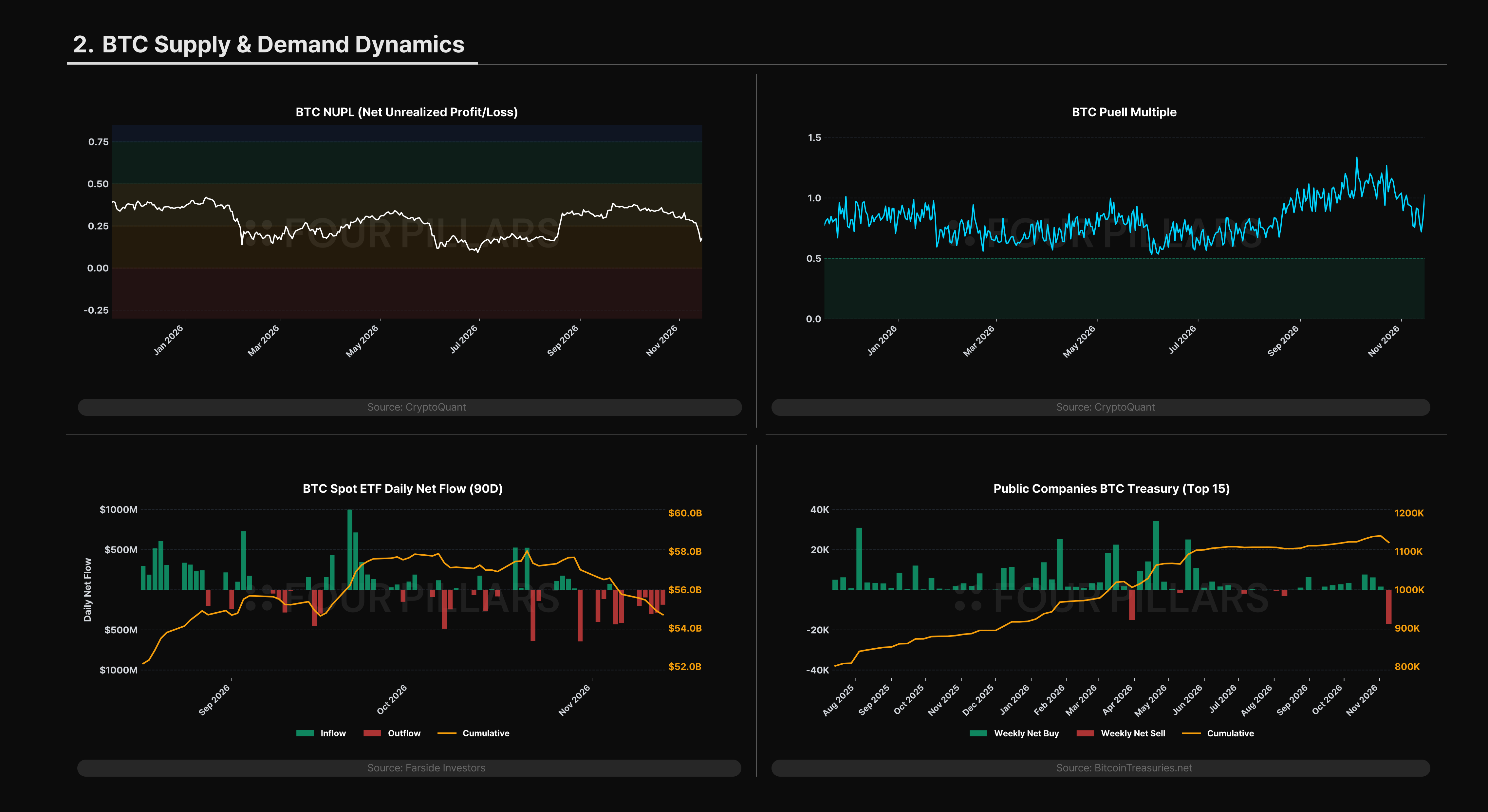
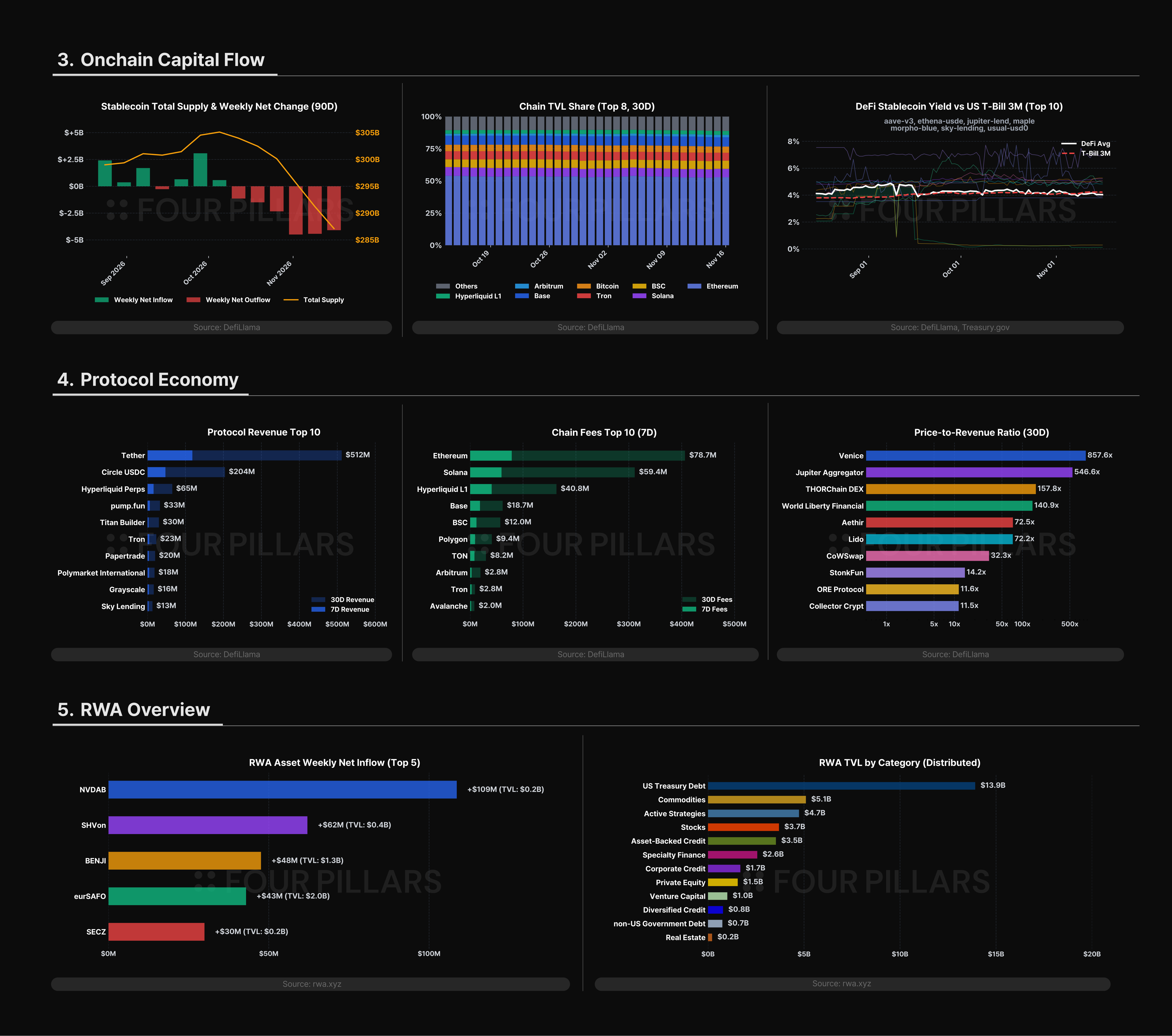
There are also growing concerns that capital itself is leaving the crypto market. According to Glassnode, the supply of major stablecoins fell by about $14.2 billion in the 30 days through November 9, the fastest decline since June 2022, pushing total supply below $280 billion. U.S. spot bitcoin ETFs also posted net outflows of more than $1 billion for a second straight week.
In this environment, the financial position of digital asset treasury companies (DATs) is bound to weaken. On top of that, MSCI will remove Strategy from its USA Index and Metaplanet from its Japan Small Cap Index after the close on November 30. With their shares already trading below the value of their holdings and index-driven selling now piling on, there are concerns that DATs could enter a phase where further purchases are no longer possible and they may instead have to sell their holdings.
Researcher’s Comment
Several factors have been cited for the latest decline, from rate hike expectations and the tech sell-off to security concerns following the Binance hack. What sets this correction apart, however, is how quickly capital itself is flowing out, which has drawn particular concern. Unlike in the past, when money rotated into stablecoins and waited on the sidelines as prices fell, the buying power available for a rebound is now shrinking.
DATs, the major buyers of the last cycle, are also in no position to keep buying. DATs grew by issuing new shares to buy assets whenever their stock traded above the value of their holdings, and Bitmine alone raised $13.2 billion through its ATM program last fiscal year. According to DefiLlama, however, Bitmine’s mNAV, its market capitalization divided by the value of its holdings, stands at 0.89, below 1. At that level, every new share issued dilutes holdings per share, which effectively takes equity raises off the table. Even if it could raise funds, Bitmine is just 0.03 percentage points away from its target of holding 5% of the supply. As the ETH market loses its biggest buyer, the question of what can support the price of ETH without large-scale buying is resurfacing.
On top of the supply-demand pressure, a more fundamental question has resurfaced: how should ETH be valued? Take Bitmine as an example. Staking accounts for 97% of its revenue, yet its annual revenue of about $125 million falls far short of offsetting more than $6.2 billion in unrealized losses. Fee burns tell a similar story, with the annual burn falling from about 1.48 million ETH in 2022 to about 19,200 ETH so far this year. Vitalik Buterin also argued on November 8 that the model explaining ETH’s value through fee burns was never as solid as it appeared, and that ETH should instead be viewed as a store of value (SoV). In his view, the stability that comes from decentralization, censorship resistance, and security is what underpins ETH’s value.
It remains unclear, however, whether this view will win over the market and actually serve as support for the price of ETH. For one, a store of value earns credibility by holding up relatively well in a downturn, yet ETH fell considerably more than BTC last week. The fundamentals Buterin pointed to are also long-term efforts that will take time. Post-quantum migration is one of them, and Ethlabs’ proposal to move the transition target up to 2027 is an effort to improve the network’s odds of survival. The growth of RWA issuance on Ethereum is a positive sign in that it represents demand from outside crypto, but it will not produce fee spikes like those of the past.
Since it will take time for fundamentals to be reflected in prices, the direction of the market, ETH included, will inevitably be driven by capital flows for now. Whether stablecoin supply returns to growth, how much selling the MSCI removal on November 30 triggers, and whether the FOMC actually raises rates in December are all on the market’s calendar through year-end.
[Institution] OKXICE, the First Tokenized Stock Venue, Set to Launch Without Large Caps
What Happened?
On November 11, OKXICE, a joint venture between OKX and NYSE parent ICE, announced it will open its tokenized securities venue on the 23rd. It is the first venue to use the five-year temporary Innovation Exemption the SEC introduced in September. The exemption allows tokenized securities venues (TSVs) to operate through AMMs without registering as exchanges, and verified U.S. users will be able to trade tokenized stocks around the clock from their own wallets in the OKX app.
The listing lineup, however, has changed significantly from the original plan. Under the Innovation Exemption, issuers can object to third-party tokenized versions of their shares being listed, and as of November 5, 67 companies including Meta, Tesla, Netflix, and Costco had exercised that right. As a result, the launch lineup was finalized at more than 70 assets, made up of crypto-related stocks such as Coinbase, Circle, Robinhood, and Strategy, along with 59 Direxion ETFs.
Others are following in OKXICE’s footsteps. On November 9, Formation Securities notified the SEC of its plan to operate a Solana-based TSV, with trading expected to begin in early 2027 with shares of Galaxy Digital, Exodus, and Forward Industries.
Researcher’s Comment
With OKXICE about to launch, its listing lineup lays bare where companies currently stand on tokenized stocks. The issuer objection clause in the Innovation Exemption played a major role in shaping the first venue’s lineup. A third-party tokenized stock cannot be listed on a venue if the issuer objects within 30 days of being notified, and every member of the Magnificent Seven (Mag7) exercised that right. As a result, the first tokenized stock venue will open with only crypto-related stocks and ETFs, without the large-cap tech names likely to draw the most demand.
The issuers’ reasons for objecting were largely similar. Applied Optoelectronics, one of the objectors, said it was difficult to gauge how tokenization would affect its share price, liquidity, and volatility, and that investors might mistakenly believe the company was directly involved. For issuers, the benefits are unclear, while they still bear the risk of their shares trading in an unfamiliar market. When AMC pushed back against Robinhood’s stock tokens in September, it had few options beyond threatening legal action, but under the Innovation Exemption, issuers’ veto power is guaranteed by rule.
Since venues must win over issuers before they can expand their listings, their approaches are starting to diverge. Formation chose to seek issuer consent from the outset and to list shares tokenized by Superstate and Securitize in partnership with issuers. Galaxy Digital, one of its first listings, has already brought its own shares onchain through Superstate. Seeking consent first slows down listings, but it spares the venue from having its lineup reshuffled by objections.
In a market where issuer consent has become the deciding factor, incumbent exchanges are the strongest competitors to TSVs. Because they already have listing relationships with large-cap issuers, winning consent is far easier for them. Nasdaq has criticized the Innovation Exemption for allowing trading outside the National Market System (NMS) and said it will keep its own shares (NDAQ) off TSVs, yet it is also preparing its own tokenized stocks with Kraken that would trade within the existing regulatory framework. ICE, separately from OKXICE, also selected Avalanche this week as the settlement ledger for an NYSE-affiliated platform that will launch once it receives regulatory approval.
Once these platforms go live, large-cap issuers will likely find it less burdensome to join incumbent exchanges’ tokenized offerings than unfamiliar TSVs. As a result, the TSV route under the Innovation Exemption could remain a market without large caps, or lose much of its relevance altogether.
Others
Crypto
- Major stablecoin supply drops about $14.2 billion in 30 days, the largest decline since 2022
- Hyperliquid overtakes Bybit, Kraken, and OKX in open interest
- DTCC plans to bring its tokenization service to Solana in 2H 2027
- MegaETH Foundation rebrands as MEGA and commits $30 million to new products starting with AI inference, then cuts 20% of staff three days later
- Securitize and Ethena launch a facility for BlackRock BUIDL holders to swap into stablecoins after hours
- Pyth Network adds NYSE stock and ETF data
Institution
- Elizabeth Warren plans scrutiny of Trump family crypto ventures as incoming Senate Banking chair
- SEC files brief backing the CFTC in single-stock perpetual futures lawsuit
- DOJ wins court approval to seize over $1.2 billion stolen in the Binance hack
- Goldman Sachs, Citi, Santander, Deutsche Bank and other banks commit about $270 million to a joint dollar stablecoin venture
- Deutsche Bank launches digital asset custody for institutional clients in Europe
- NYSE picks Avalanche as the settlement ledger for its 24/7 tokenized securities platform
Tech
- Ethlabs proposes “pqai27,” pulling Ethereum’s post-quantum target forward from 2029 to 2027
- Moody’s and Chainlink complete a testnet pilot for multi-chain credit rating distribution via CCIP
Investment
- MSCI to drop Strategy and Metaplanet from its indexes on November 30
- Bitmine posts $6.3 billion annual net loss as ETH falls 44%
- JPMorgan raises Strategy stake 36% in Q3, holds $540 million in BlackRock’s bitcoin ETF
Asia
- Nomura weighs sale of crypto unit Laser Digital, with Marex eyeing a bid
- Thailand launches WORPT, letting tourists pay in baht converted from crypto
- Kazakhstan’s central bank plans tokenized government bonds in Q1 2027
2. Data Spotlight
Crypto Card Spend Tripled in a Year. Where Does Card Program Make Money? (Link)
3. Four Pillars Weekly
: : Redefining Everything: The Sui Stack (Link)
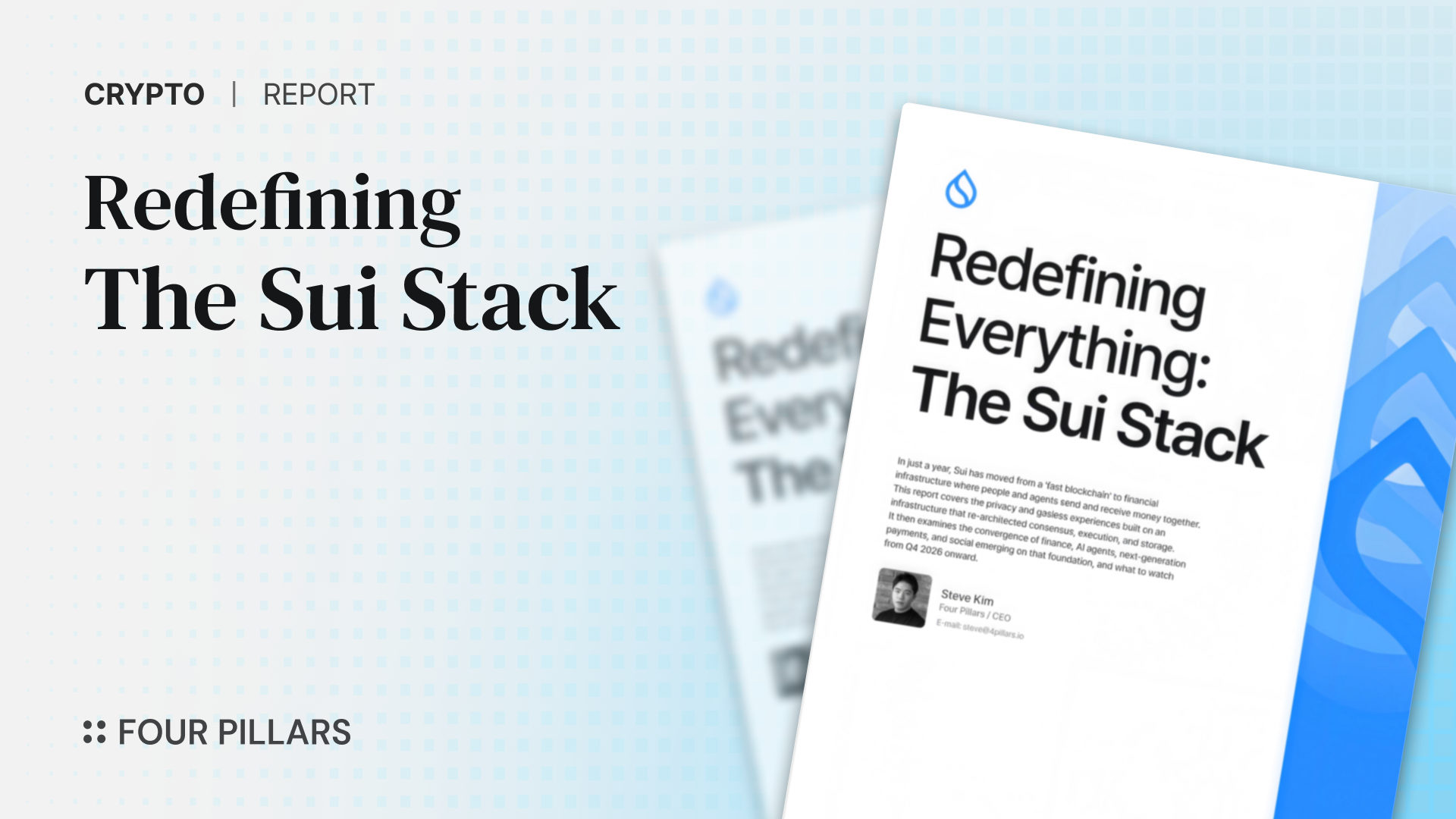
- Sui uses an object-based model to identify which assets are affected by each transaction. Transactions involving independent assets can be processed in parallel, while those modifying the same assets are executed according to their dependencies. Mysticeti V2 reduces time to finality, while Programmable Transaction Blocks (PTBs) allow multiple operations to be bundled into a single transaction and executed atomically. This architecture enables Sui to process complex financial transactions efficiently.
- Sui is expanding its infrastructure beyond transaction execution. Walrus provides decentralized data storage, while Seal handles encryption-based access control. Other privacy technologies address the confidentiality of computation and financial information, and zkLogin and sponsored transactions simplify login and reduce the burden of gas fees. Sui's approach is to bring capabilities that previously required multiple external services into a single ecosystem.
- Sui's financial infrastructure is also taking shape, with stablecoins, DeepBook, and Bitcoin-backed financial products emerging as key components. Stablecoins serve as payment and settlement assets, while DeepBook provides liquidity that can be shared across applications. Bitcoin-backed assets further expand collateral options, creating opportunities to connect trading, lending, and payments within the same environment.
- These capabilities extend beyond DeFi, particularly into the emerging AI agent ecosystem. AI agents can access data and execute transactions or payments within predefined permissions, while social applications can integrate trading and payments into community interactions. By combining data management with financial infrastructure, Sui is extending its reach beyond conventional financial applications.
- Sui's ambition goes beyond becoming a faster Layer 1. It is bringing transaction execution, data storage, access control, and financial infrastructure together within a single ecosystem. Rather than competing solely on the performance of individual technologies, Sui is broadening the scope of competition to include how much of the infrastructure required to operate real-world applications a blockchain ecosystem can provide.
: : INFINIT: Shaping the Future of Asset Management (Link)
- Over the past 250 years, asset management has evolved through investment funds, ETFs, and robo-advisors. More recently, AI-powered vaults have emerged as a new model combining blockchain-based financial infrastructure with AI-driven investment decisions.
- INFINIT has focused on abstracting the complexities of DeFi through AI agents. It is now expanding beyond automated trade execution into an AI-powered Trading Strategy Platform designed to abstract the asset management experience itself.
- Through INFINIT OS, the platform provides shared infrastructure for custody, accounting, and settlement. The INFINIT Standard adds strategy manager verification and risk management requirements, allowing professional investment strategies to be offered through onchain vaults.
- Its debut trading strategy, run by Apex Quant Capital strategy manager, APEX Multi-Strategy pursues returns from relative performance differences across asset classes using an AI-powered dollar-neutral long-short strategy. During its first term, it reported an APR of approximately 35% alongside lower volatility than the S&P 500.
: : Gotchi Labs: What It Takes for AI to Become a Daily Habit (Link)

- Gotchi Labs aims to connect specialized AI agents across everyday activities. By drawing on relevant Shared Consumer Context within users' permissions, these services can reduce the need to explain personal circumstances and preferences each time a user moves to a new service.
- Sleepagotchi, its first live vertical, has attracted 612,000 registered users, with peak daily active users exceeding 80,000. Its combination of wearable data and AI-powered coaching provides a foundation for expansion into fitness, meal planning, shopping and scheduling.
- Premium subscriptions and AI Credits address differences in demand for features and usage. Brand product discovery and partner services create further opportunities for transaction fees and promotional revenue.
- $CHI is an optional utility token rolled out in phases to support service access, partner features, and defined governance, with the core app fully usable without any token or wallet.
: : QFEX Managed Account: Why the House Doesn’t Have to Win (Link)
- Someone’s profit is someone else’s cost, and a perp DEX vault is no different: its income from spreads, liquidations and fees is paid by users on the same exchange.
- An exchange that runs a vault ends up with incentives that don’t line up with better liquidity. Tighter spreads shrink the vault’s income, and outside market makers deepen the book but also compete for that income.
- QFEX’s Managed Account runs a market-neutral long/short strategy that earns from alpha rather than from users’ costs. It forecasts relative performance across US equity perpetual futures, going long the names it expects to be stronger and short those it expects to be weaker. The book is balanced to target zero net exposure and zero index beta, keeping the effect of market direction to a minimum.
- Unlike a vault, the Managed Account pays the spread. It trades as a taker, crossing the spread at each scheduled rebalance. To protect its returns and grow its capacity, QFEX has to bring in outside market makers to tighten quotes. Those tighter quotes go to everyone trading the same symbols. The more the product grows, the less users pay to trade.
: : HYPE 26Q3 Report (Link)
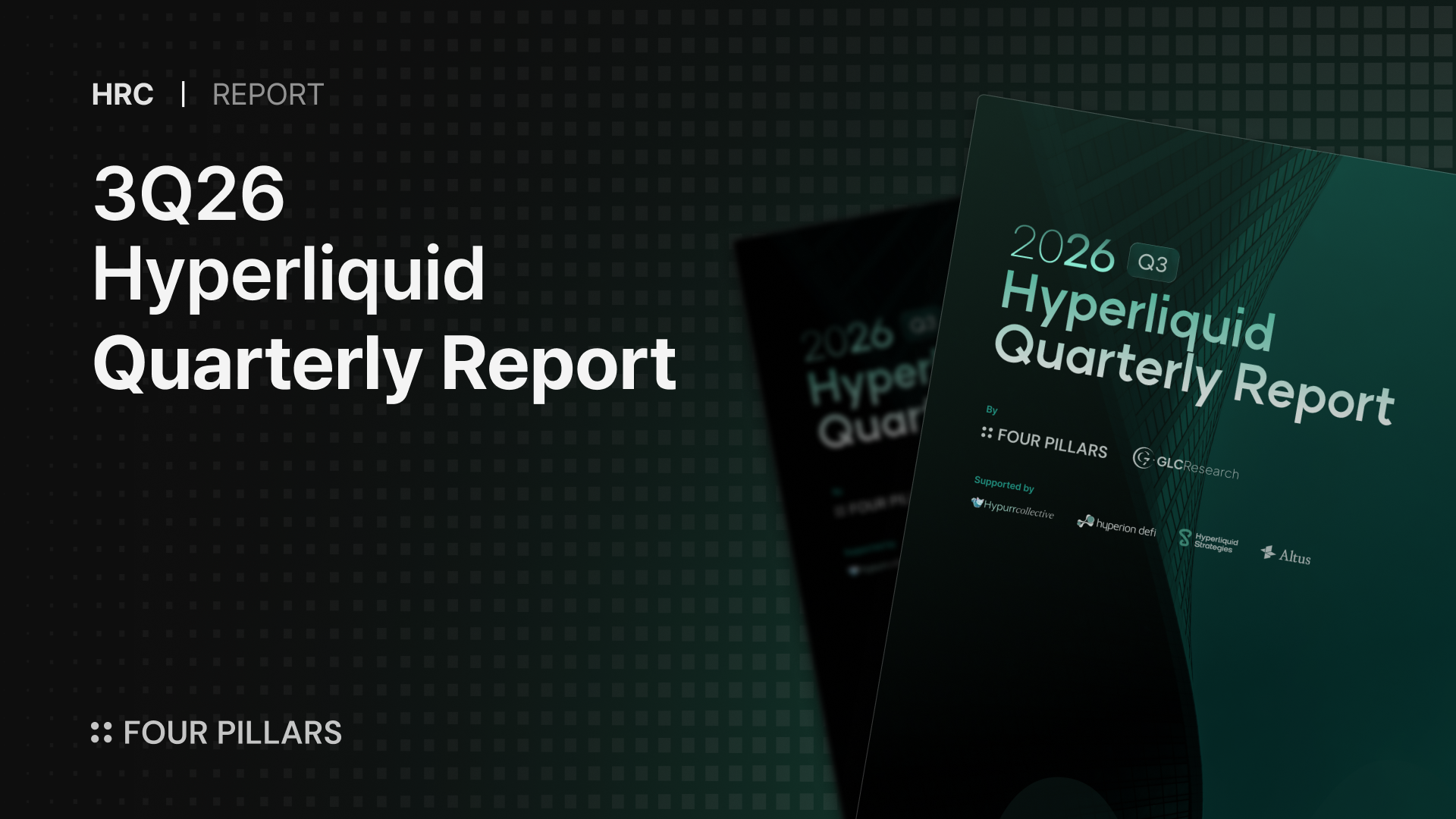
- USDC reserve income accounted for half the quarterly increase in revenue. Hyperliquid generated $190.9M in Q3 protocol revenue, up 21.7% QoQ and down 36.5% YoY. Trading and network revenue rose 10.7% to $173.6M. The remaining $17.3M came from USDC reserve income accrued from August 27. The Assistance Fund received its first payment in early October, making it available for Q4 buybacks. In Q3, the fund spent $148.7M on HYPE, 5.7% more than in Q2, but bought 26.4% fewer tokens as its average purchase price rose to $72.93.
- Equities overtook commodities on HIP-3. Equity perpetuals traded $153.8B, up 161% QoQ, and accounted for 58.8% of HIP-3’s $262B in quarterly volume. Korean stocks helped drive the increase. They also exposed a weakness in how these markets price risk outside local trading hours. A July reference-price incident in the SK hynix perpetual triggered $57.4M of liquidations. Market operations remain concentrated, with trade[XYZ] handling 97.5% of HIP-3 volume in September.
- The native crypto market recovered alongside the expansion into equities. Native perpetuals volume rose 72% from July to September. As a result, HIP-3’s share of perpetuals volume fell from 51% in July to 25% in September, even as its quarterly volume set a record. Across Hyperliquid, daily traders averaged a record 65,161, up 20% QoQ. Builder-code fees earned by third-party apps rose 50% to $25M. Coinbase’s decision to route Base App perpetuals to Hyperliquid gave users another way to trade against the same order books.
- Payward put forward a concrete proposal for US access. On August 19, President Trump said the CFTC was working to bring Hyperliquid to the US. On September 16, Payward, Kraken’s parent, announced plans for Bitnomial, a US-regulated derivatives exchange, to operate a HIP-3 venue on Hyperliquid. For an established exchange group, the commercial decision is significant. Payward would use a potential competitor’s infrastructure to serve its own clients. Regulatory approval was still pending at quarter-end, and US clients could not yet trade on the venue.
- This report was produced by the Hyperliquid Research Collective (HRC), an independent research initiative founded by Four Pillars and GLC Research.
: : Onchain Real Estate Market, Two Working Models (Link)

- Tokenized real estate stood at about $203 million in July 2026, inside a tokenized asset market of roughly $35 billion.
- Models built on existing cash flows have scaled, led by Figure with about $20 billion of home loans, while fractional ownership platforms such as RealT and Kasa Korea closed.
- Onchain products have fallen short on yield, liquidity and price gains, with verifiable yields between about 3% and 6%.
- Growth will come from two models: leveraged trading and hedging on home price indices, and onchain private credit.
Comments
4. Macro & Onchain Metrics
Some of the charts below are powered by CryptoQuant. For those interested in exploring the underlying data in greater detail, CryptoQuant provides access to a comprehensive suite of onchain and market analytics used by institutional participants.
The author of this report may have personal holdings or financial interests in assets or tokens discussed herein. However, the author affirms that no transactions have conducted using material non-public information obtained in the course of research or drafting. This report is intended solely for general information purposes and does not constitute legal, business, investment, or tax advice. It should not be used as a basis for making any investment decisions or as guidance for accounting, legal, or tax matters. Any references to specific assets or securities are made for informational purposes only and should not be construed as an offer, solicitation, or recommendation to invest. The opinions expressed herein are those of the author and may not reflect the views of any affiliated institutions, organizations, or individuals. The opinions and analyses expressed herein are subject to change without prior notice. In addition, beyond the individual disclosures included in each report, Four Pillars, may hold existing or prospective investments in some of the assets or protocols discussed herein. Furthermore, FP Validated, a division of Four Pillars, may already be operating as a node in certain networks or protocols discussed herein or may do so in the future. Please see below links in the footer for FP Validated's participating network disclosures and for broader disclosure details.