Table of Contents

*Special thanks to Paymentscan for providing this amazing data. Check out their latest report "How to Launch a Stablecoin Card Program."
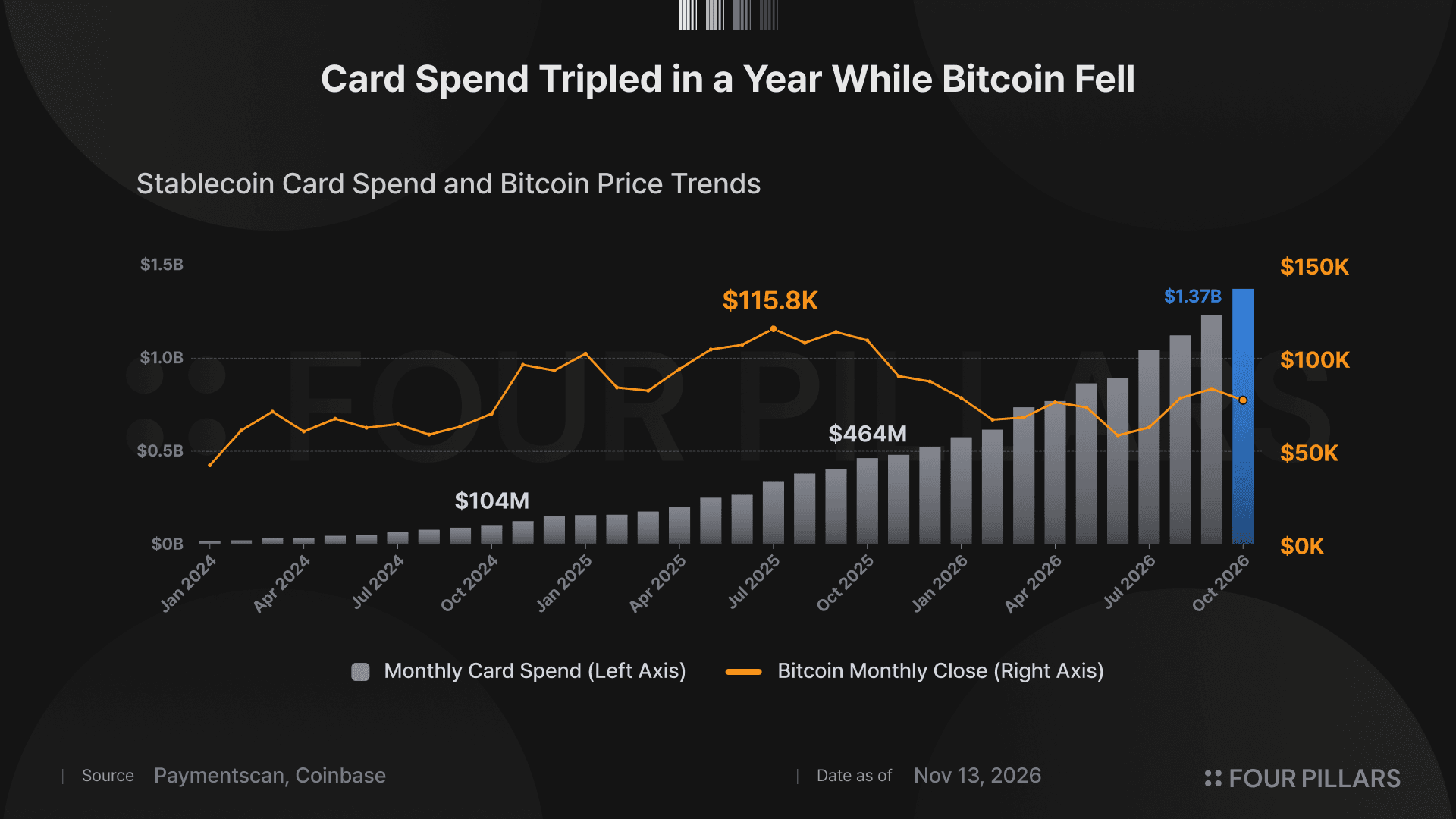
Stablecoin cards processed $1.37 billion in October 2026, about three times the $464 million of October 2025 and roughly 13 times the $104 million of October 2024. Bitcoin's monthly close fell about 29% over the same twelve months.
Now there are 9 issuers and 48 card programs and card spend rose in 33 of the past 34 months, so this business kept growing through a weak market.
Paymentscan, the leading data provider of crypto card payment, released its guide, “How to Launch a Stablecoin Card Program,” walks through each decision a first time program manager faces.
So, the important question for potential card programs to ask is can we make money?
1. Where the Players Make Money
Two groups sit behind every stablecoin card. Issuers such as Rain, StraitsX, and Wirex hold the Visa or Mastercard membership, and those three processed 96% of the $3.4 billion in attributable spend last quarter.
Programs such as RedotPay, EtherFi, and KAST own the customer and rent everything else, so the sections below look at what a program can actually earn.
1.1 Interchange Covers Very Little
Gross interchange runs from 0.2% in Europe to 1.5% in Latin America, with a blended average near 0.7%. The issuer keeps most of it, so an early program nets about 0.1% of spend, or $1,000 per $1 million.
Cashback takes back more than interchange gives. October cashback reached 1.2% of spend at EtherFi, 1.4% at Wirex One, 2.5% at Plasma One, and 2.9% at Ethena Pay. Token treasuries and staking requirements fund the gap, which makes rewards a customer acquisition cost.
However, the cost of operating these issuance program (KYC, phyical cards, operation, etc) and FX risk is also a cost.
*The cashback data is from paymentscan, and some offchain data could be missing.
1.2 Balances Are the Revenue Source
EtherFi cardholders held $318 million in card accounts at the end of October, with $294 million supplied as collateral on Aave. Plasma One cardholders held $33 million, with $14 million in its yield vault. The leading programs operate as deposit businesses that use the card to gather funds.
For instance, an European fintech earning 3% on balances worth two months of spend collects $5,000 of yield per $1 million of monthly spend, about 60% of its revenue. Interchange contributes only $1,200 and FX fees add $2,000, for total revenue of $8,200 (Paymentscan, section 3).
Applying the same 3% to real programs shows the scale. EtherFi's $318 million of card balances would earn about $9.5 million a year, and Plasma One's $33 million about $1 million. Issuers are building for this model: Stripe pays yield on balances through OUSD, and StraitsX lets programs fund in its own XUSD and XSGD at close to zero cost.
1.3 A Few Heavy Spenders Carry the Volume
The median cardholder spent about $120 in October, while the average was about $1,600. Fewer than a quarter of cardholders spent $1,000 or more, and they generated over 90% of spend. Card fees, KYC checks of $3 to $4 per user, and support costs apply to every cardholder, so most users cost more than they earn (Paymentscan, section 3).
The same pattern holds across programs. The median program reaches $660,000 of monthly spend by month six and about $2.8 million by month twelve. Break even requires about $9 million once team and marketing are counted, and only a third of programs launched since 2024 have recorded a month at that level.
2. So, Don't Just Launch it.
Card spend is growing fast, but a card alone rarely pays for itself.
A firm planning a program should decide where its revenue will come from before it signs with an issuer. Some list of idea to give a program a real chance of reaching the monthly spend that break even requires.
- Build asset management around the card. Balances earn more than payments. EtherFi holds $318 million of card balances and supplies $294 million of it to Aave, and Ethena Pay pays 2.9% cashback, far above the interchange a program keeps. Offer vaults, tokenized assets, or credit so users keep at least two months of spend in the account.
- Add agentic payments early. Rain launched Agent Vaults on November 10, which let an AI agent pay by card at more than 175 million merchant locations, send bank payouts in 50 currencies, or transfer stablecoins. Agent spend adds volume without recruiting more retail cardholders. Wirex, Stripe, and Interlace support agentic programs as well.
- Fix FX before expanding beyond the dollar. A dollar only card costs users 2% to 3% on foreign spend, and network fees alone reach 1.1% to 1.4% when currencies differ. Choose an issuer with local issuance, account range processing, or multi currency settlement in your main markets. StraitsX, for example, can act as a local card range in 100 countries.
- Start with an existing user base and its heavy spenders. Fewer than a quarter of cardholders generate over 90% of spend. The fastest launches, including KAST, Coca, Tria, and Plasma One, reached $9 million to $15 million a month by month six because each began with a community, a user base, or a token to reward.
I believe the strength of crypto is composability, and that through crypto cards the barriers of spend, store, earn, invest could be broken down.
Next year, you can pay buy a car in TSLA stock.