Table of Contents


Ethereum staking yields carry a hidden cost: the entry queue. A deposit earns nothing until its validator is activated.
As of October 19, 2026, the entry queue wait was about 21 days and the network APR was about 2.45% (observed on September 21). If that rate holds, the rewards missed while waiting come to about 14bp of principal.
On February 12 this year, about 4.1 million ETH piled into the entry queue and the wait stretched to 71 days. At the APR of the time, 2.68%, the opportunity cost was about 52bp. This is not a realized loss. It is the reward gap against being able to stake immediately.
LSTs spread the queue cost across the pool, but charge a fee
Liquid staking tokens (LSTs) are one way to cut this cost. Deposit ETH into a pool such as Lido and you receive stETH right away and start sharing rewards, regardless of where your stake sits in the validator queue.
The queue cost does not disappear, though. While newly deposited ETH waits and earns nothing, rewards from existing validators are still split across all stETH holders. When inflows are large and the queue is long, the pool's APR can be temporarily diluted. Each depositor's queue cost is spread over the whole pool.
Liquid staking also charges a fee. Lido takes 10% of staking rewards, about 24.5bp a year at the current APR. The queue cost is paid once, at entry. The fee is paid for as long as you hold. So the better option depends on how long you expect to hold.
Effective APR depends on more than the headline rate
To compare native staking and LSTs, effective APR can be written as:
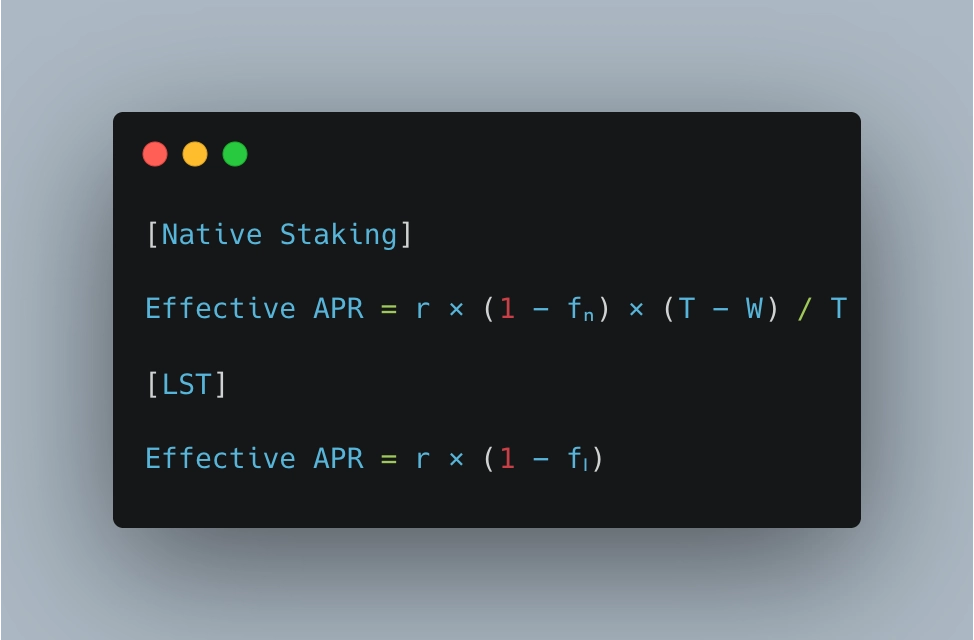
Here r is the network APR, fₙ and fₗ are the reward fees for native staking and the LST, W is the entry queue wait in days, and T is the total holding period in days. The LST formula leaves out the temporary APR dilution from new inflows. Both formulas assume the holding period is longer than the wait and that all deposits earn rewards once the wait ends.
Native staking earns nothing during the wait. An LST shares rewards from day one but bears pool dilution and a fee. A longer queue widens the LST's short-term edge, but over longer periods the accumulated fee matters more.
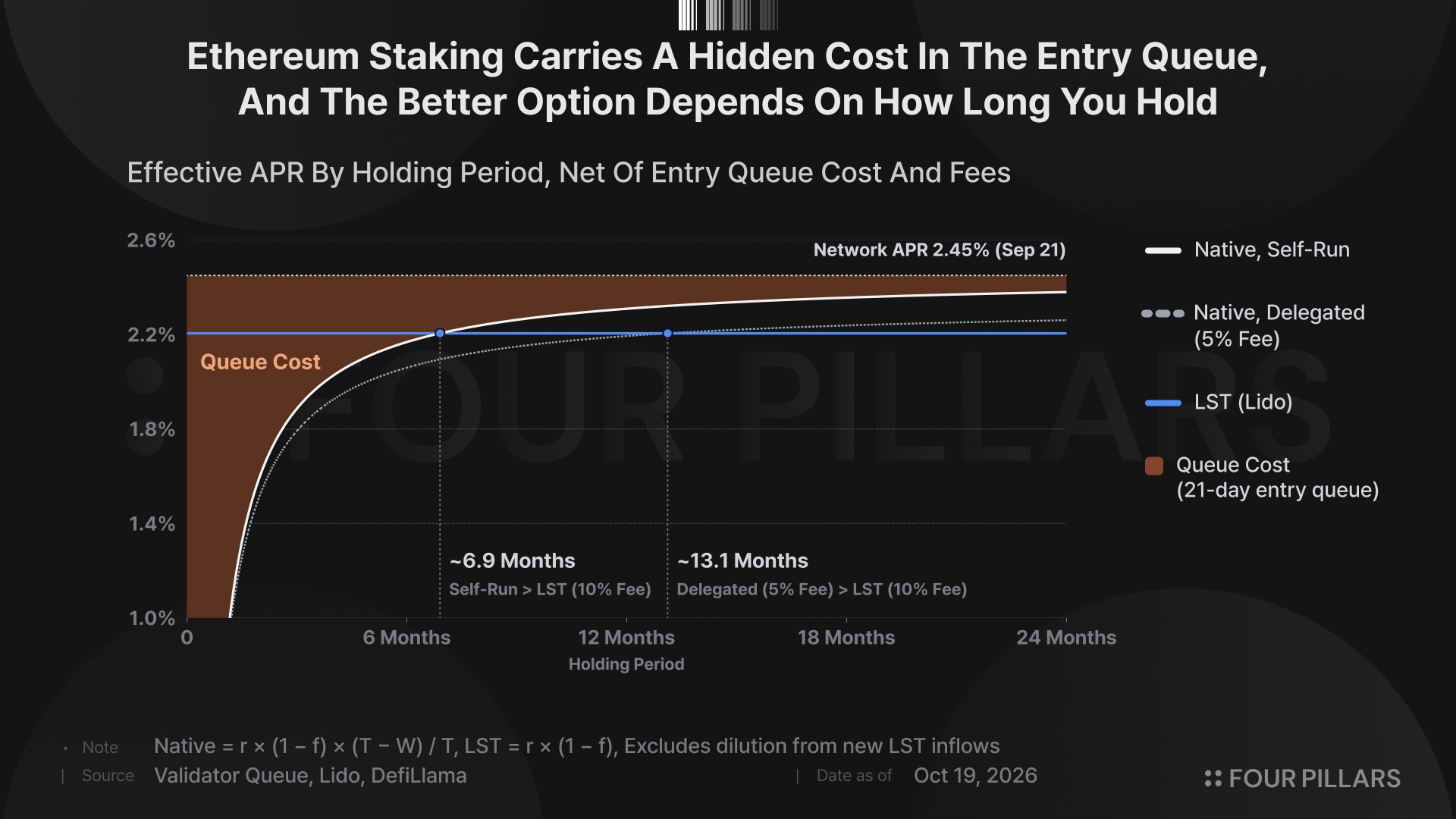
With a 21-day wait, for example, running your own validator beats Lido only after about 7 months, and delegating to an operator that charges 5% only after about 13 months. Exit earlier and the LST comes out ahead. These break-even points are 10 and 19 times the wait. They do not depend on the APR and scale only with the length of the queue. At the 71-day wait of February 12, you would have had to run your own validator for about two years to beat an LST.
Choosing a staking method
Ethereum staking has a hidden cost in the entry queue, and most staking providers leave it out of the APR they quote. LSTs spread that cost across the pool, which lowers the burden on each depositor.
With the queue as long as it is now (about 21 days), a pool like Lido is likely the best choice for staking under six months, despite its relatively high fee. The longer the queue, the stronger that case. When the queue is short, or when you stake for longer, a lower-fee provider or running your own validator pays more.
Individuals and institutions choosing a staking method should not compare headline APRs alone. They need to weigh the entry wait, how long they plan to stake, fees and market liquidity together.
The author of this report may have personal holdings or financial interests in assets or tokens discussed herein. However, the author affirms that no transactions have conducted using material non-public information obtained in the course of research or drafting. This report is intended solely for general information purposes and does not constitute legal, business, investment, or tax advice. It should not be used as a basis for making any investment decisions or as guidance for accounting, legal, or tax matters. Any references to specific assets or securities are made for informational purposes only and should not be construed as an offer, solicitation, or recommendation to invest. The opinions expressed herein are those of the author and may not reflect the views of any affiliated institutions, organizations, or individuals. The opinions and analyses expressed herein are subject to change without prior notice. In addition, beyond the individual disclosures included in each report, Four Pillars, may hold existing or prospective investments in some of the assets or protocols discussed herein. Furthermore, FP Validated, a division of Four Pillars, may already be operating as a node in certain networks or protocols discussed herein or may do so in the future. Please see below links in the footer for FP Validated's participating network disclosures and for broader disclosure details.