Table of Contents

Korea-only listings fell as the regulatory framework took shape
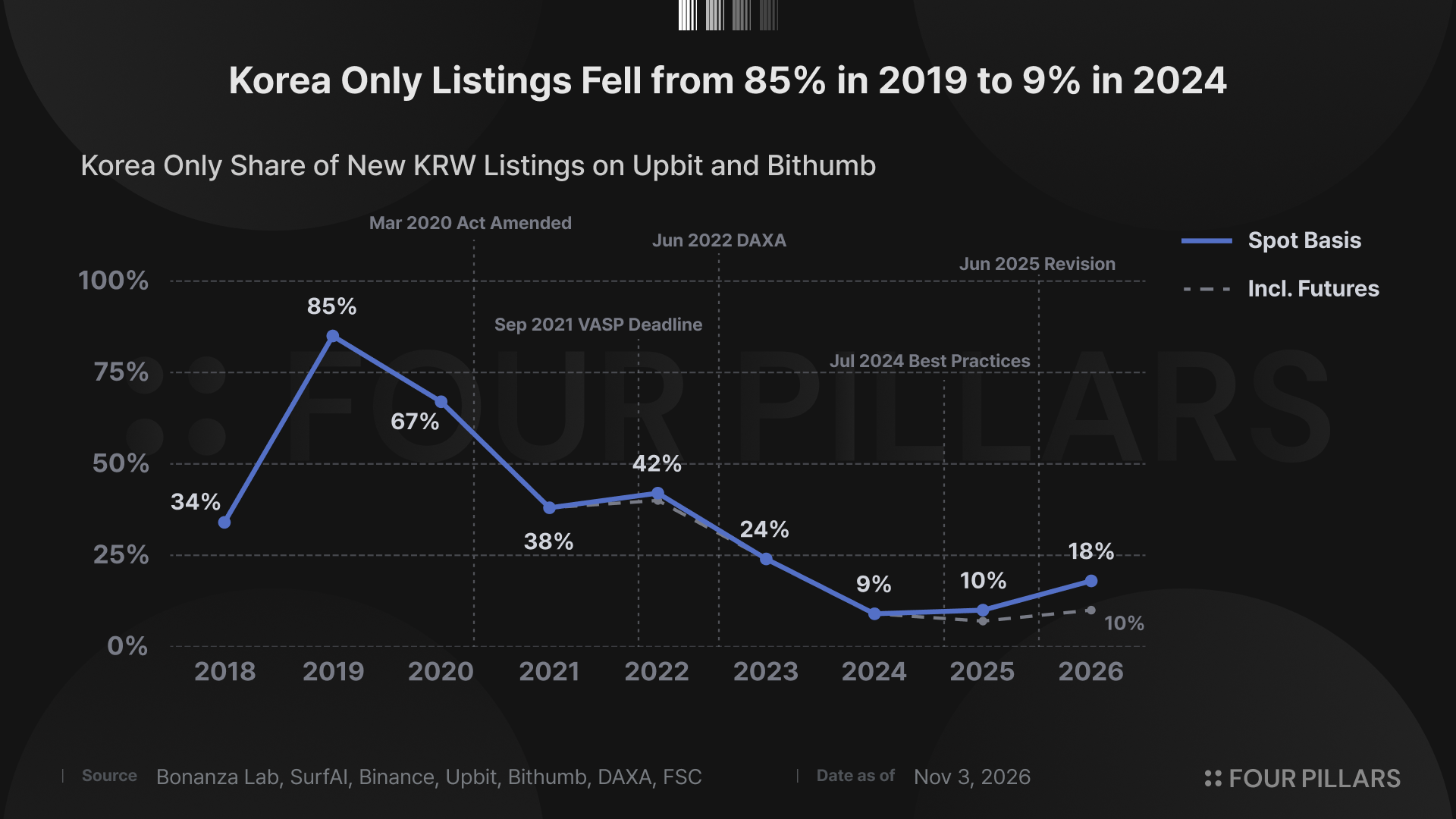
The chart above shows the share of Korea-only listings among new KRW market listings on Upbit and Bithumb. Here, a Korea-only listing refers to the listing of an asset that began trading in Korea before it reached the spot markets of four global exchanges, Binance, OKX, Bybit, and Coinbase, or that was never listed on any of the four.
This share had fallen from 85% in 2019 to 9% in 2024. Set against the milestones of Korea's virtual asset regulatory framework, the decline in the share of Korea-only listings lines up with the period in which the regulatory framework took shape.
The change began with the Act on Reporting and Using Specified Financial Transaction Information (the Specific Financial Information Act). An amendment imposing registration and anti-money laundering (AML) obligations on virtual asset service providers passed the National Assembly in March 2020, and exchanges had to complete their registration by September 2021. For KRW markets, real-name bank accounts became a legal requirement, so exchanges had to follow the AML standards of the traditional financial sector. We estimate that these standards also shaped listing decisions. In fact, the number of Korea-only listings itself fell from 19 a quarter to 3 in Q3 2021, the quarter of the registration deadline, and listings thereafter centered on assets that had traded overseas first.
Next came listing review standards that exchanges follow jointly. In 2022, the five KRW exchanges formed the Digital Asset eXchange Alliance (DAXA) and drew up common review guidelines, and the listing best practices took effect in July 2024. The best practices do not make an overseas listing a requirement, but they allow assets that have traded for two years or more on a qualified overseas exchange to be treated as meeting the white paper and disclosure requirements.
In 2026 (through October), the share of Korea-only listings rose again to 18%, but once assets that first traded on overseas futures markets are also excluded from the Korea-only count, the share stays low at 10%.
Listings grew, and their timing shifted with market conditions
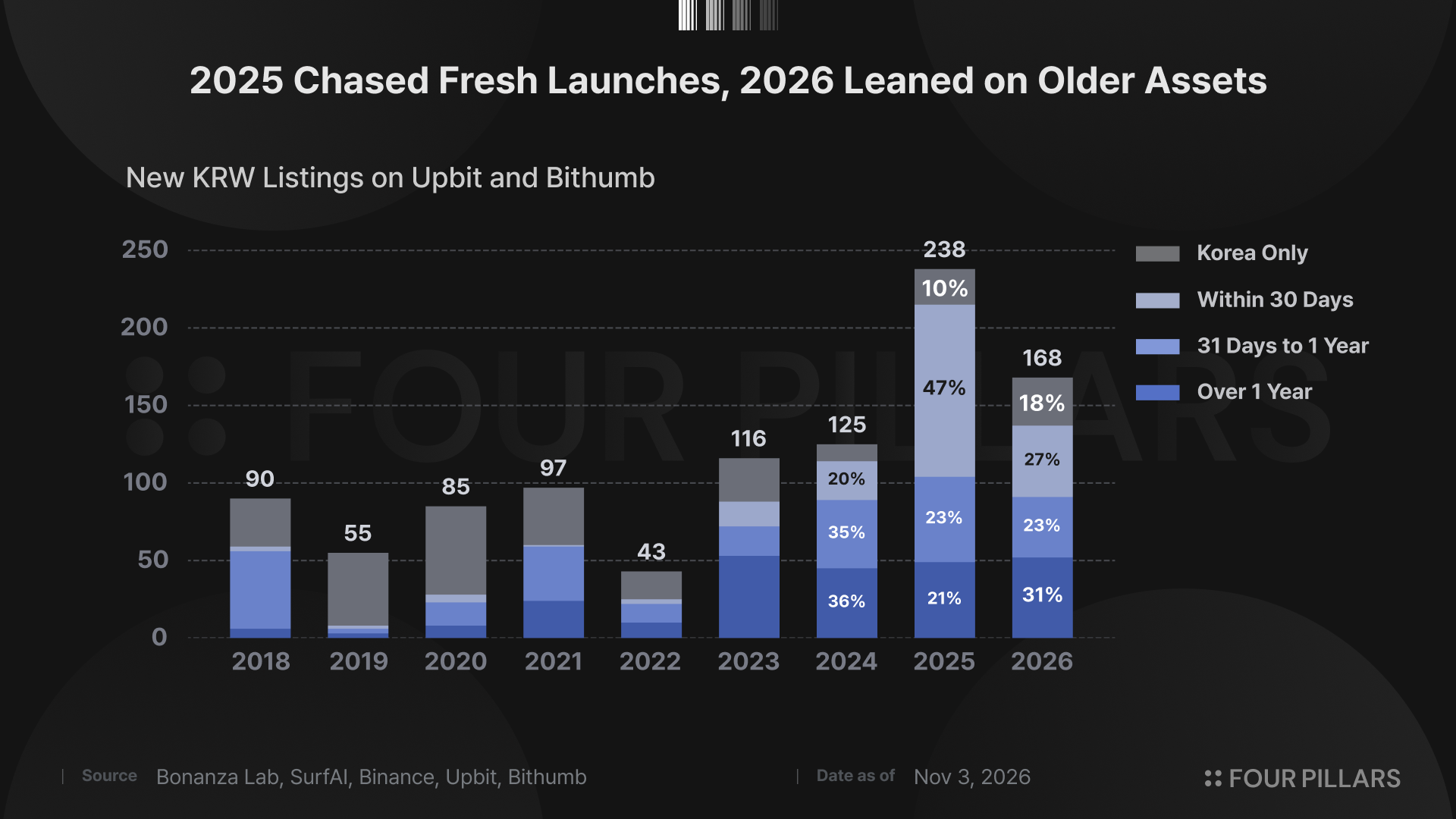
The share of Korea-only listings fell, but the total number of listings did not. New KRW market listings across Upbit and Bithumb rose from 43 in 2022 to 116 in 2023 and 125 in 2024, and reached 238 in 2025.
How long an asset trades overseas before it is listed in Korea varied with market conditions. In 2025, when the KRW price of Bitcoin held near its highs, 111 assets were listed in Korea within 30 days of their overseas listing, 47% of the total. In 2026, by contrast, assets that had traded overseas for more than a year were the largest group at 52 (31%), and even assets that had traded overseas for more than six years, such as $CRV and $RSR, were listed in Korea.
Korean listing practice has therefore shifted. It keeps the framework centered on assets traded overseas first, which took hold as regulation took shape, while bringing listing timing forward or pushing it back depending on market conditions.
Stability improved, but the challenge for exchanges is moving beyond listings
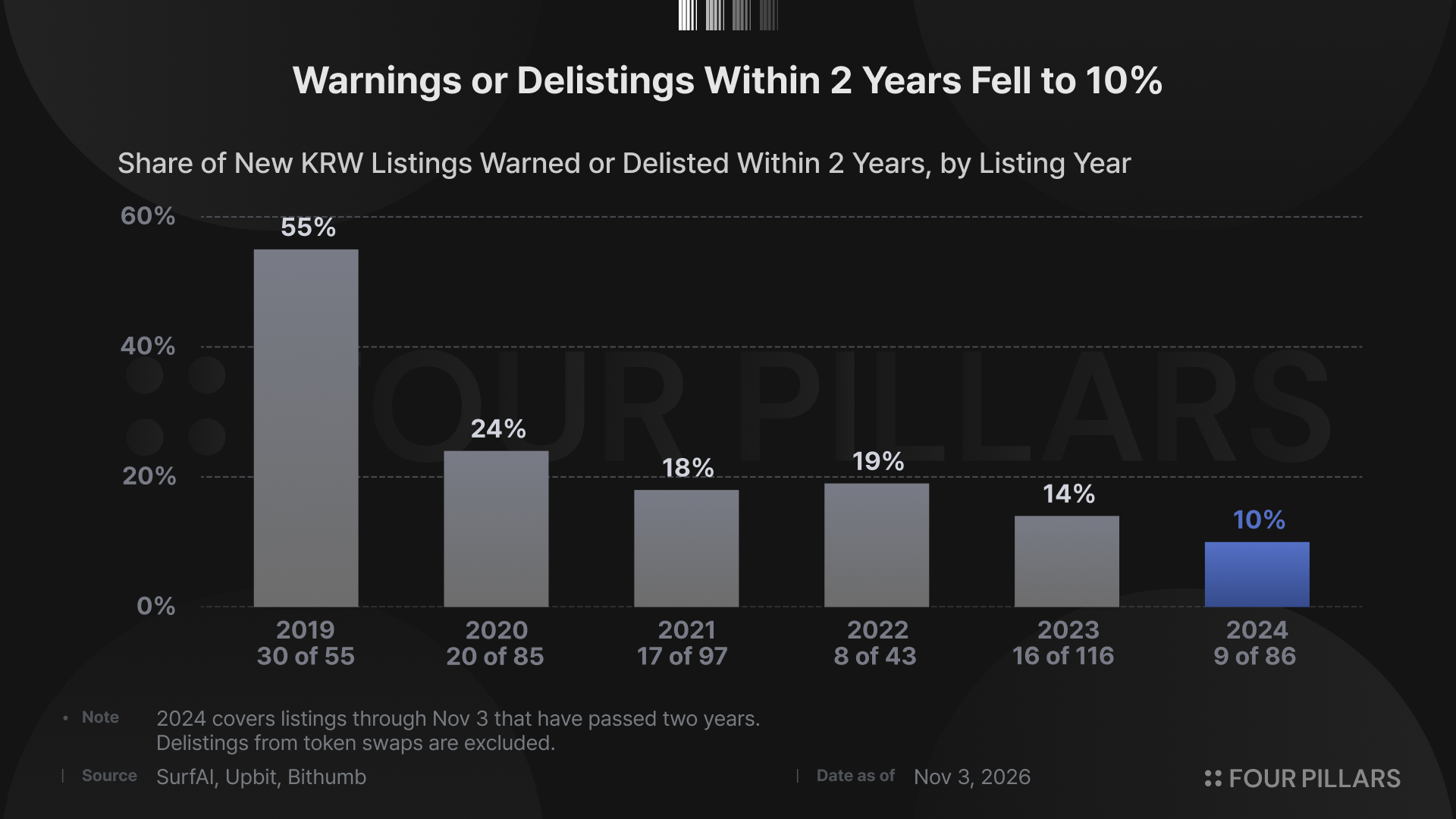
As the share of assets traded overseas first grew, post-listing stability has also improved. The share of listings designated as an investment warning or announced for delisting within two years fell from 24% for 2020 listings to 10% for 2024 listings.
This rate differs depending on whether a listing was Korea-only or an asset traded overseas first. Across all assets listed from 2020 through 2024, 44 of 148 Korea-only listings (30%) were designated as an investment warning or announced for delisting within two years. For assets traded overseas first, the figure was 26 of 279 (9%), less than a third of the Korea-only rate.
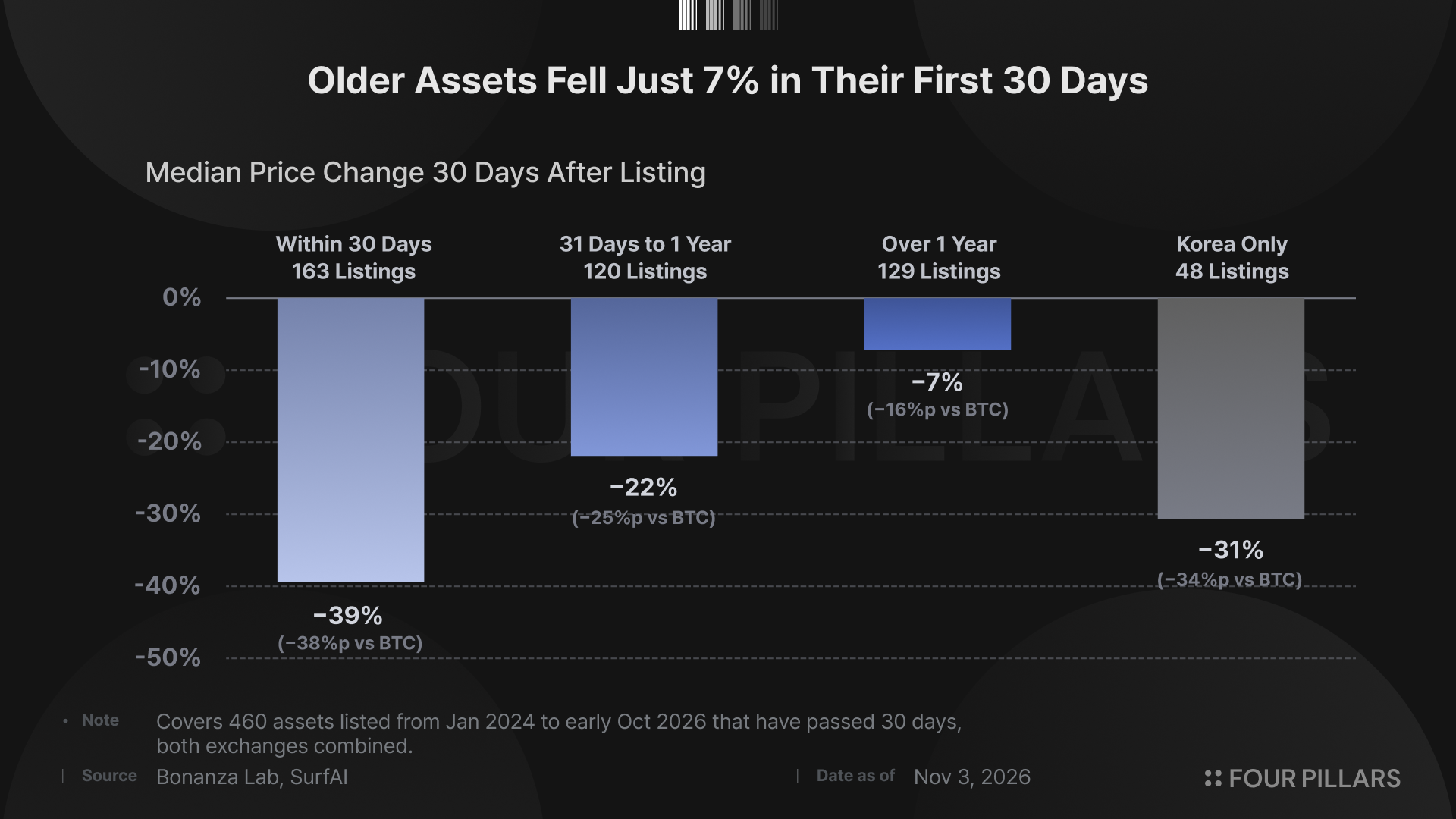
Meanwhile, how long an asset had traded overseas made a difference in post-listing price performance. At the median, assets listed within 30 days of their overseas listing fell 39% over the 30 days after listing, while assets that had traded overseas for more than a year fell only 7%.
In short, assets traded overseas first were less often designated as an investment warning or delisted after listing, and among them, the longer an asset had traded overseas, the less its price fell right after listing. As the listing best practices eased the review burden for such assets, the center of gravity of Korean listings appears likely to stay with assets that have long traded overseas, even as listing timing moves back and forth with market conditions.
However, a listing structure that prioritizes overseas trading history is not purely good news for exchanges. This is because assets that have long traded overseas generate relatively little trading on their first day of listing.
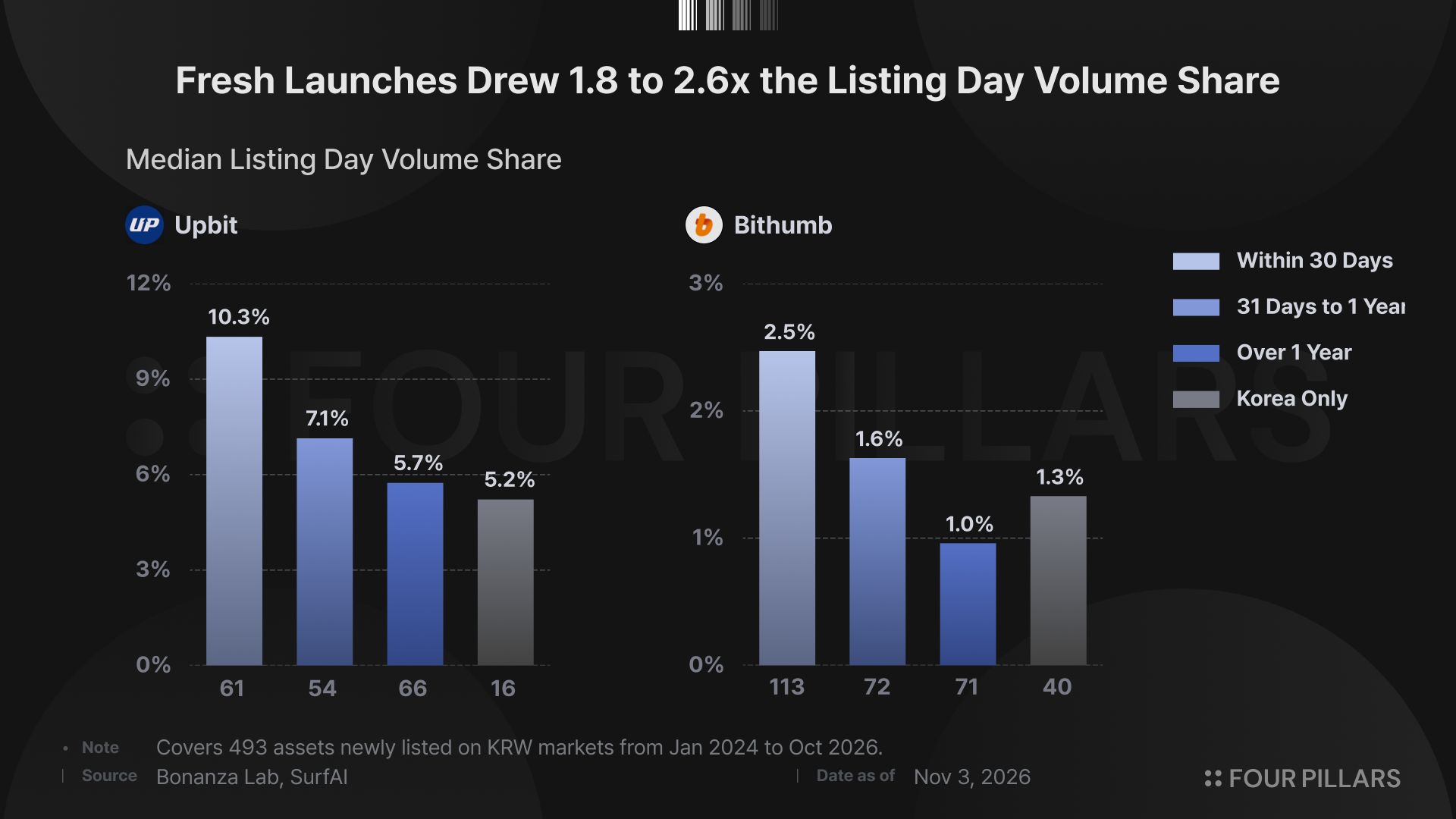
Since most exchange revenue comes from trading fees, the lighter first-day trading that listings bring in can weigh on the exchange business. Of course, if the market regains momentum, listings of assets fresh off their overseas launch could increase and ease this burden. But relying only on a listing structure that swings with the market makes it hard to build a stable business.
Listing stability has improved as the regulatory framework took shape. The challenge now facing Korean exchanges is to create new trading demand and new sources of revenue beyond listings.
This article was written with data provided by Bonanza Lab.
- Website: https://bonanzalab.io
The author of this report may have personal holdings or financial interests in assets or tokens discussed herein. However, the author affirms that no transactions have conducted using material non-public information obtained in the course of research or drafting. This report is intended solely for general information purposes and does not constitute legal, business, investment, or tax advice. It should not be used as a basis for making any investment decisions or as guidance for accounting, legal, or tax matters. Any references to specific assets or securities are made for informational purposes only and should not be construed as an offer, solicitation, or recommendation to invest. The opinions expressed herein are those of the author and may not reflect the views of any affiliated institutions, organizations, or individuals. The opinions and analyses expressed herein are subject to change without prior notice. In addition, beyond the individual disclosures included in each report, Four Pillars, may hold existing or prospective investments in some of the assets or protocols discussed herein. Furthermore, FP Validated, a division of Four Pillars, may already be operating as a node in certain networks or protocols discussed herein or may do so in the future. Please see below links in the footer for FP Validated's participating network disclosures and for broader disclosure details.