Table of Contents
Researcher

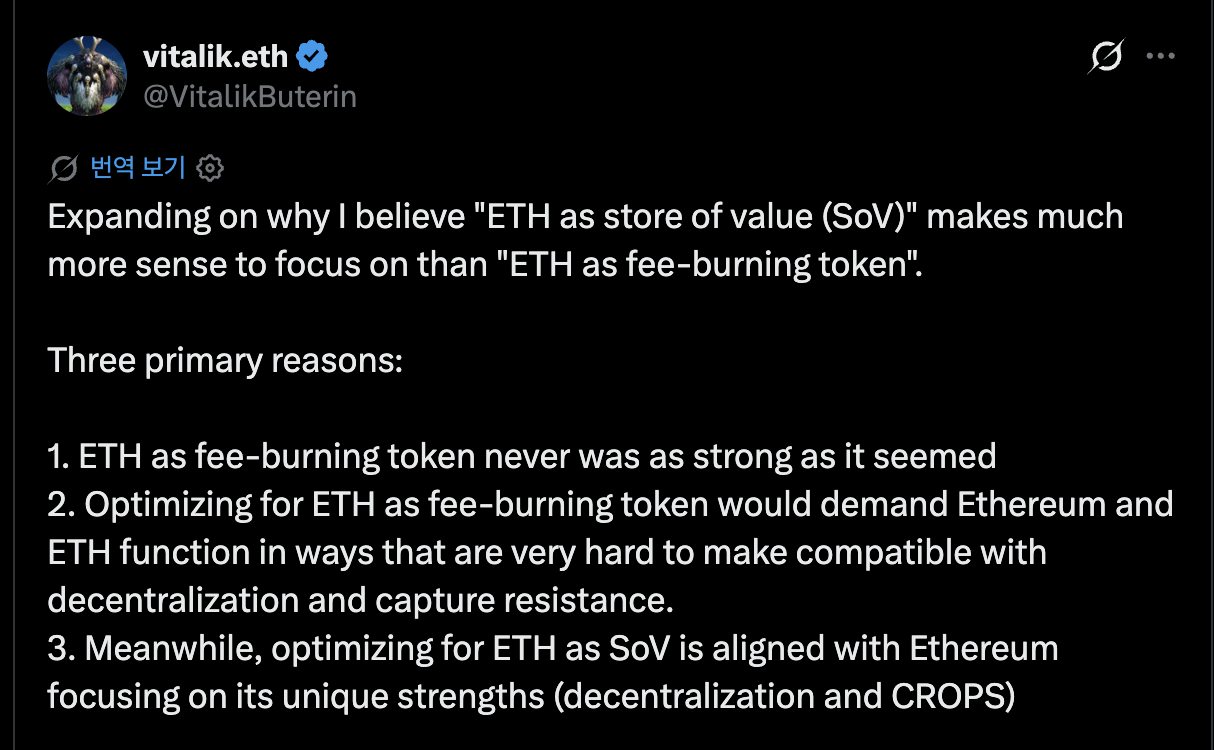
On November 8, Vitalik Buterin posted a thread on X arguing that ETH should be seen as a store of value (SoV), not as a "fee-burn token."
The debate over ETH's identity as an asset is not new. Most of it, though, was either marketing positioning or stayed at the level of philosophy. Vitalik's post goes further. It says something about the identity of the Ethereum network itself and where it is headed.
Until now, Ethereum has been treated as a smart contract platform, and the market has priced ETH like a tech stock. Ethereum has led innovation at the technical frontier of the blockchain industry. A tech stock has to keep changing to survive. A store of value has to change as little as possible. Yet Vitalik has now pinned down ETH's identity as a store of value, something even Ethereum had been unsure about. Can the market accept ETH as a store of value when it runs on a network whose roadmap keeps shifting and which aims for a major hard fork every six months?
Vitalik's argument: ETH is a store of value
Vitalik's argument comes down to four points.
- Valuing ETH by its burn actually hurts Ethereum's valuation. The NPV logic, in which annual burn divided by a discount rate sets a floor under market cap, only holds if fees come from outside the ecosystem. But even from 2021 to 2023, when burn was at its peak, most of the demand came from inside crypto. When the ETH price falls, fees fall with it, so the floor drops along with the price.
- Maximizing burn would require Ethereum to act like a centralized corporation. Using the R&D spending of a company with a similar market cap as the benchmark, Ethereum would need about 700,000 ETH a year in in-protocol funding. It would also need someone to step in and change direction as the market shifts. Maximizing fees also runs against scaling Ethereum further to lower gas costs.
- Optimizing for SoV points in the same direction as the properties Ethereum is most valued for today. Ethereum is adopted mainly for decentralization and CROPS (censorship resistance, open source, privacy, security), not for burn. The first test of a store of value is survival. In practice that means conservative cryptography choices, partial ossification, minimal protocol politics, censorship resistance through FOCIL, and nodes light enough to run on a laptop.
- The more assets are issued on L1, the more you can do with ETH. Swapping RWAs and decentralized assets for ETH, or borrowing against ETH to put other assets to work, all add to the utility of holding ETH. Adoption and SoV point the same way.
Vitalik's conclusion is that Ethereum matters because of values specific to it, such as decentralization and CROPS, and that the reason to hold ETH starts from those same values. He wants the network's value and the asset's value to rest on the same foundation.
A network that has to change, and an asset that should not
I agree 100% that fees and burn were never the source of ETH's value. But before ETH can be accepted as an SoV in the usual sense, there are many problems to solve. Three stand out.
First, issuance. Once you give up on the hope that burn will offset issuance, ETH becomes an asset with net issuance every year and no end date. It then has to rely on a new expectation: that network adoption will increase ETH's use and get people to hold it. Fees and burn are clear, measurable numbers. Unfortunately, nothing clearly links RWA growth or institutional adoption of Ethereum to demand for holding ETH. ETH's value comes to rest on the belief that the market will choose to hold ETH, rather than on cash flows anyone can measure.
Second, the supply policy can change. Even now, there is an active discussion about changing Ethereum's inflation policy (EIP-8363). It was dropped from the scope of the Hegota upgrade, but its authors are pursuing it through a separate process. Ethereum has changed ETH's supply policy before. It introduced burn (EIP-1559) in the London hard fork in 2021 and cut issuance sharply with the move to PoS in 2022. If ETH is to be recognized as a store of value, no one should be able to change its supply policy, however decentralized the governance.
Finally, can Ethereum as a technology coexist with ETH as a store of value? Aiming for SoV ultimately means steadily reducing how much Ethereum changes technically. That shift is already under way. The Ethereum Foundation has been getting much smaller, and once the roadmap planned through 2029 (Strawmap) is complete, its end goal is the "walkaway test": Ethereum keeps working even if the Foundation and today's core developers disappear.
The key problem is that Ethereum is, in the end, technology, and technology has to change. Threats such as quantum computing can appear at any time. Just as Ethereum is now moving from re-execution to ZK verification, it will have to keep responding to new technical advances. Technology is never finished, so the Ethereum network can go through large changes again at any time. Along the way, ETH as an asset will keep being tested by whether the roadmap gets delivered, by security threats, and by technical progress. Bitcoin has changed too, with SegWit and Taproot. What matters is whether holders can trust that the promises they rely on will hold, however much the technology changes.
Ethereum is a very complex network. It is more complex than Bitcoin, of course, and its infrastructure and architecture are, surprisingly, more complex than those of most high-performance blockchains, Solana included. Complexity is attack surface and maintenance cost in itself. The bigger and more frequent the changes, the harder those promises are to keep. Whether a network this complex can keep changing and still keep its promises is an open question. Even people who hold ETH as an SoV still expect Ethereum to behave like a tech stock. They want ETH to carry the trust of an asset that does not change, and they want Ethereum to deliver the results of technology that keeps growing.
So Ethereum needs to commit to what will not change about ETH as an SoV, starting with its supply policy. CROPS is a commitment about the network. It makes no promise about ETH. Hope built on guesses like "if network adoption grows, won't ETH get used more?" is not enough. Ethereum needs a case that anyone can accept for why the network's growth translates into ETH's value.
The author of this report may have personal holdings or financial interests in assets or tokens discussed herein. However, the author affirms that no transactions have conducted using material non-public information obtained in the course of research or drafting. This report is intended solely for general information purposes and does not constitute legal, business, investment, or tax advice. It should not be used as a basis for making any investment decisions or as guidance for accounting, legal, or tax matters. Any references to specific assets or securities are made for informational purposes only and should not be construed as an offer, solicitation, or recommendation to invest. The opinions expressed herein are those of the author and may not reflect the views of any affiliated institutions, organizations, or individuals. The opinions and analyses expressed herein are subject to change without prior notice. In addition, beyond the individual disclosures included in each report, Four Pillars, may hold existing or prospective investments in some of the assets or protocols discussed herein. Furthermore, FP Validated, a division of Four Pillars, may already be operating as a node in certain networks or protocols discussed herein or may do so in the future. Please see below links in the footer for FP Validated's participating network disclosures and for broader disclosure details.