Table of Contents
Researcher

Related Projects

1. Compute, a Commodity Without a Benchmark Price
The compute market is one of the most interesting markets in crypto right now. The asset traded in this market is GPU compute time, measured in GPU-hours, the unit for renting one GPU for one hour. Training large language models and running inference requires massive computing power, and the resource behind it is datacenter GPUs such as Nvidia’s H100 and B200.
For AI companies, securing this compute time, whether by buying chips outright or renting them in the cloud, is therefore the top priority. Just as oil sets the cost of transportation and manufacturing, GPU compute time has become the input that determines the cost structure of the entire AI industry.
However, compute differs from other commodities in many ways. Most fundamentally, it cannot be stored. GPU time left unused today does not carry over to tomorrow. It simply disappears. As a result, datacenters earn rental income every hour, developers pay costs every hour, and price exposure runs around the clock without interruption.
Price formation is also opaque. According to estimates cited by the CFTC, compute services sold annually amount to $430B to $1.3T. Yet prices have mostly been set privately within long-term reservation contracts and bilateral negotiations, and there is no benchmark price that everyone references.
Above all, the risk from price swings is difficult to manage. H100 rental rates on online marketplaces fell from $2.50 to $3.19 per hour to $1.92 to $2.00 a year later. Datacenters and lenders that bought chips in advance with borrowed money are exposed to falling rental rates, while developers renting compute are exposed to rising ones. Yet none of them had a listed product to hedge this exposure.
2. In Just a Year, Perpetual Futures Took Shape Ahead of Regulated Futures
On the back of latent demand, derivatives have quickly started to emerge around the compute market this year. In August, CME applied to the CFTC for approval to list futures based on H100 and B200 rental rate indices, and ICE also announced the launch of GPU futures. In the same month, the CFTC requested public comment on compute derivatives.
However, the CME product has yet to list. The CFTC extended its review period to November 9, and the listing date will be set after that. In the meantime, actual trading started first in perpetual futures. Injective launched H100 rental rate perpetual futures back in August 2025, and trade[XYZ] has also listed H100 perpetual futures.
Regulatory discussion is also active. On October 20, the Hyperliquid Policy Center (HPC) asked the CFTC to allow compute perpetual futures to list in the US. The argument is that rental income and costs, which accrue every hour and never expire, are a natural fit for perpetual futures that require no rollover. With regulated futures yet to list, compute is showing the potential to become a commodity market born onchain from the start.
3. Injective SICI: A Compute Index of Five GPUs
Source: Injective
Injective has been one of the fastest movers in AI-related markets. In January 2025, it listed the AIX index, which combines AI-related tokens and equities, followed by H100 rental rate perps in August and pre-IPO perpetual futures on companies including OpenAI and Anthropic in October.
Then on October 26, Injective launched the Super Intelligence Compute Index (SICI) on mainnet, expanding its existing single-chip market into a five-chip basket. The following day, it also unveiled onchain options with SICI as the underlying asset.
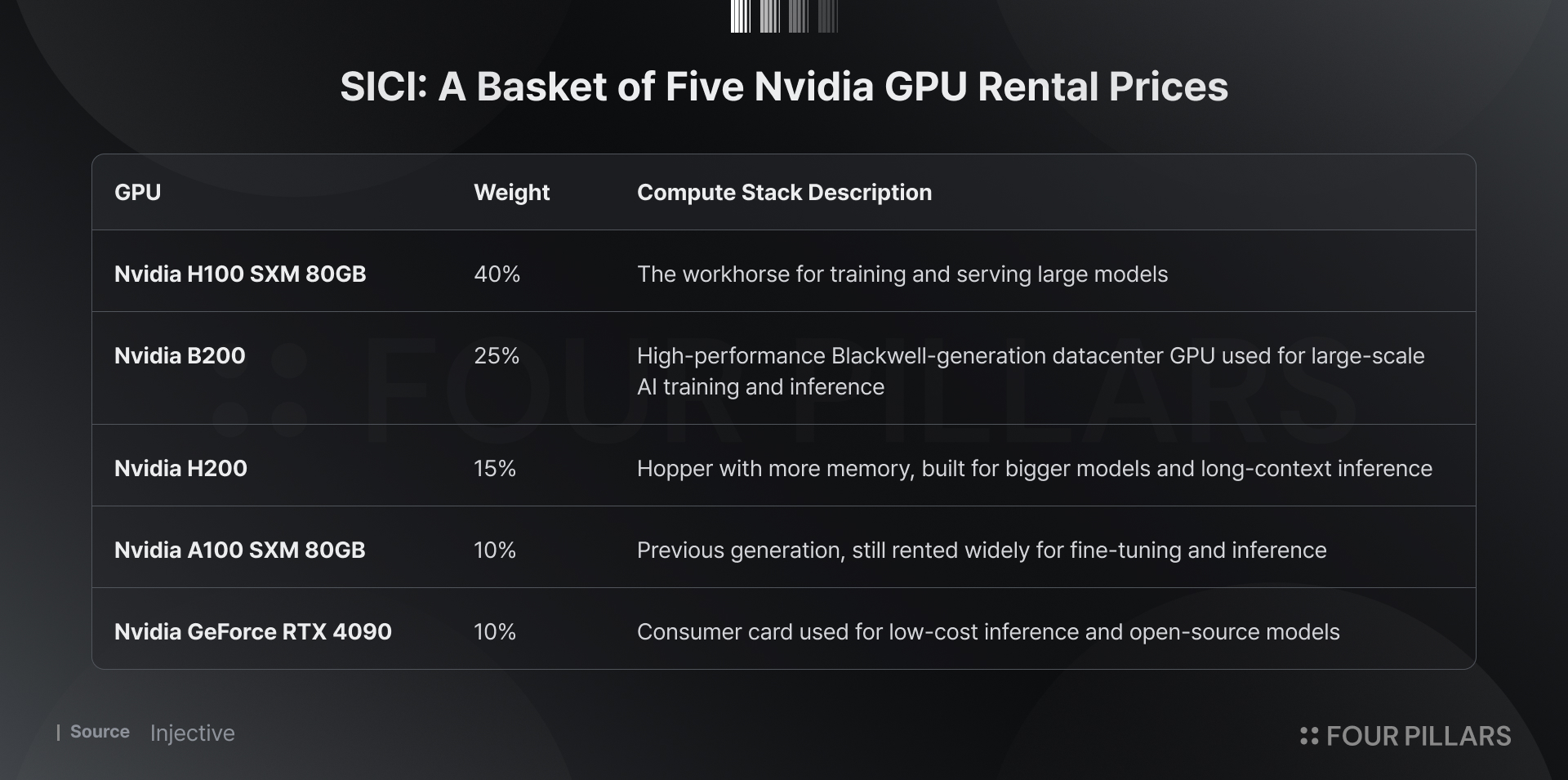
SICI is an index that aggregates the hourly rental rates of five Nvidia GPUs at fixed weights. The H100 and B200, the workhorses of large-model training, account for 65% of the weight, and the consumer-grade RTX 4090 is included to capture small-scale inference demand. The product also supports up to 10x leverage with USDC margin, and index calculation is handled by London-based LO:TECH.
This basket index can be used for both trading and hedging. Traders can go long or short based on where they expect rental rates to move with expanding AI demand or new chip launches. For hedging, a developer renting compute can go long to offset higher costs from rising rental rates, while a provider renting out GPUs can go short to offset lower revenue from falling rental rates.
4. Can It Become the Henry Hub of Compute?
The idea that perpetual futures could serve as benchmark prices for traditional markets has been floated for quite some time. However, against traditional markets like equities or oil that already command massive liquidity, that role has admittedly been limited.
GPU rental rates are a somewhat different case. Because onchain perpetual futures have traded for more than a year ahead of futures on regulated exchanges, the chance that onchain prices become the benchmark is greater than for other assets.
History offers a precedent. When NYMEX listed the first natural gas futures in 1990, it designated Henry Hub, a pipeline hub in Louisiana, as the delivery point at expiry. As trading concentrated in this contract, the Henry Hub price became the benchmark for US natural gas.
In the same way, the index of the contract where compute liquidity first accumulates at scale could solidify into the reference for spot transactions. Of course, once CME’s dated futures list and compute perpetual futures are permitted in the US, institutional flow will inevitably head to regulated exchanges. But if SICI gathers meaningful liquidity before then and establishes itself as the gauge for AI compute prices as a whole, a future in which it serves as an onchain benchmark alongside chip-specific regulated futures is not so far-fetched.
The author of this report may have personal holdings or financial interests in assets or tokens discussed herein. However, the author affirms that no transactions have conducted using material non-public information obtained in the course of research or drafting. This report is intended solely for general information purposes and does not constitute legal, business, investment, or tax advice. It should not be used as a basis for making any investment decisions or as guidance for accounting, legal, or tax matters. Any references to specific assets or securities are made for informational purposes only and should not be construed as an offer, solicitation, or recommendation to invest. The opinions expressed herein are those of the author and may not reflect the views of any affiliated institutions, organizations, or individuals. The opinions and analyses expressed herein are subject to change without prior notice. In addition, beyond the individual disclosures included in each report, Four Pillars, may hold existing or prospective investments in some of the assets or protocols discussed herein. Furthermore, FP Validated, a division of Four Pillars, may already be operating as a node in certain networks or protocols discussed herein or may do so in the future. Please see below links in the footer for FP Validated's participating network disclosures and for broader disclosure details.