


Table of Contents
Researcher

Related Projects

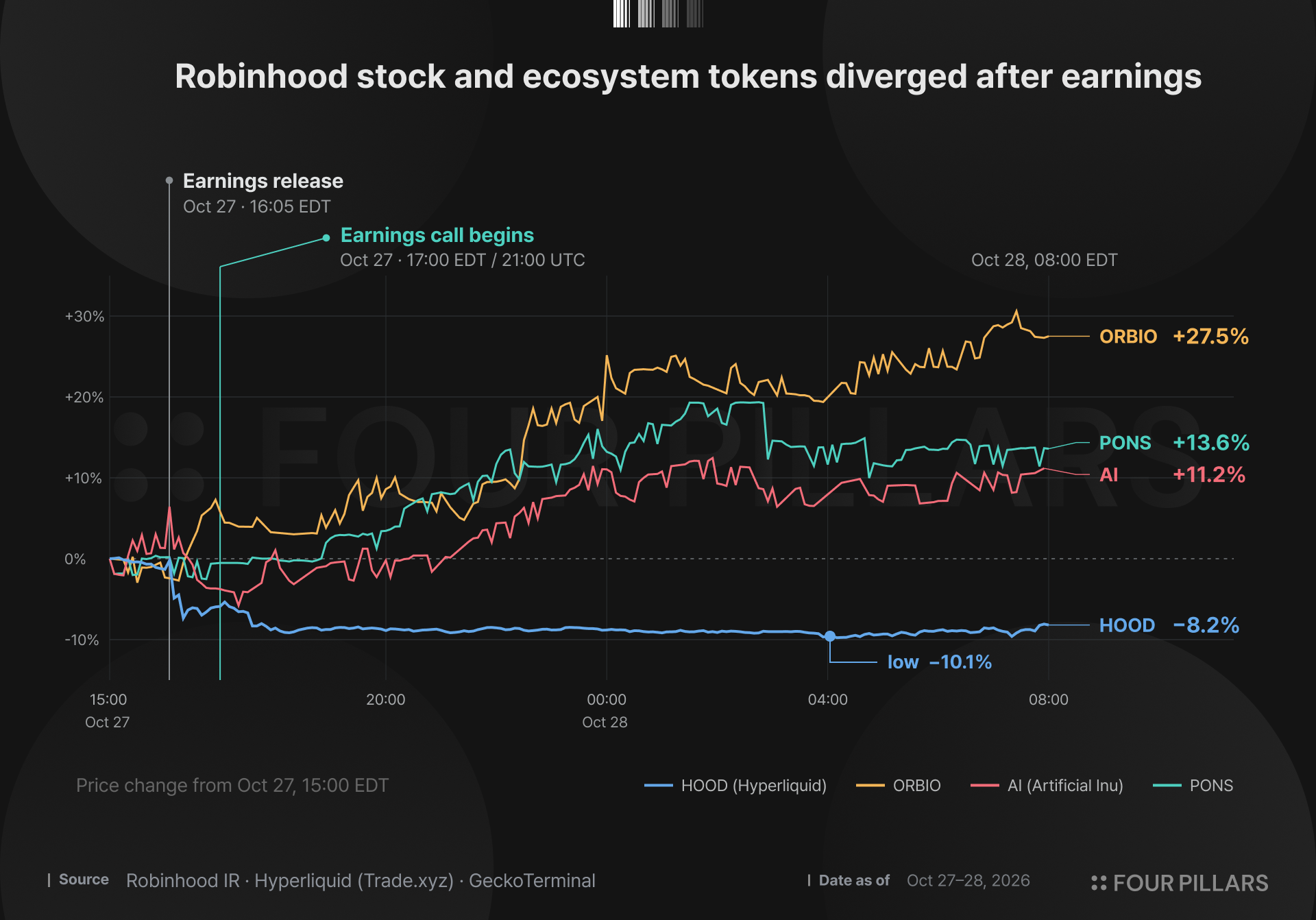
Robinhood reported its Q3 results yesterday, with revenue and earnings per share coming in slightly below expectations. The stock fell more than 8% within a day of the earnings call, but the crypto industry paid more attention to what was said on the call than to the results themselves. After Vlad said the company would significantly increase its investment in Robinhood Chain, major ecosystem tokens such as Pons, AI, and Orbio all rose sharply, by roughly 10% to 30%.
The rally was set off directly by Vlad's remarks. He acknowledged that the growth of the ecosystem built around Robinhood Chain and its wallet had exceeded the company's expectations. He also said builders had been telling the company they were not getting enough support, and made it clear that Robinhood would form a new team and expand its investment in response. The market took this as a signal that Robinhood would directly support native projects on the chain.
Looking at the earnings call as a whole, however, there is a clear gap between what Robinhood wants to grow on its chain and the ecosystem tokens that led this rally. This piece summarizes the priorities Robinhood revealed on the call and compares them with what the market expects from ecosystem tokens.
1. Priorities Signaled by the Earnings Call
1.1 Stock Token TVL Over Sequencer Fees
Tenev said he does not want to build a business that charges high fees for onchain activity, and named stock token TVL as the metric for judging the chain's long-term sustainability. In his view, Robinhood Chain's edge lies in real-world assets (RWA). CFO Shiv Verma also reported that chain fees in the third quarter came to about $50 million gross and about $25 million net. He added, however, that the chain team's goal is not revenue but growth in TVL, developers, and stock tokens.
These comments offer a glimpse into how the Robinhood team views the fee boom in September. As 100y noted in a previous article, Robinhood Chain's daily network fees peaked at about $8.27 million on September 4, then dropped more than 99% to between $30,000 and $40,000 by mid-October. Spot trading volume, by contrast, held at $600 million to $700 million or more per day over the same period. Because Robinhood Chain is built on Arbitrum, its fee rates are set by how congested the block space is. Once the congestion caused by the surge in memecoin launches cleared, fees fell along with it. Robinhood also deliberately raised the gas limit to increase throughput, which lowered fees. This suggests that Robinhood sees the fee income generated by the memecoin craze less as sustainable revenue and more as a drag on user experience.
1.2 Applications Beyond Launchpads
Tenev described the applications that have appeared on the chain so far as relatively simple, such as launchpads and liquidity pools. The next stage he laid out is to make stock tokens programmable like software, so that products that do not yet exist, such as tokenized options contracts, can be built. Robinhood's own roadmap points in the same direction. The company plans to bring as many assets tradable on Robinhood in the U.S. as possible onchain for its international customers, and to offer them as basic building blocks that developers can combine. DeFi perpetual futures, which have surpassed $1 billion in daily volume, were also highlighted as an achievement. Lighter and Arcus, which lead this activity, are both protocols in which Robinhood has made strategic investments.
In other words, it is reasonable to see the builder support Tenev promised as aimed less at growing the current launchpad ecosystem and more at encouraging more complex financial applications built on stock tokens.
1.3 Attracting U.S. Customers
The biggest limitation of Robinhood Chain is that stock tokens cannot be used in the U.S., where Robinhood's core customers are. Robinhood app users currently account for only 1% to 2% of all trading on the chain. The main product available to U.S. customers is essentially Earn, which lets users deposit USDG. The Steakhouse USDG vault behind this product holds about $540 million, close to half of the chain's TVL. Tenev spoke positively of the innovation exemption recently announced by the SEC, but said rulemaking or legislation would be needed for long-term certainty. He also said the company would share more about its U.S. tokenization plans in the near future.
2. Projects Aligned with Robinhood's Direction
That said, it is hard to conclude that Robinhood wants to distance itself from the memecoin ecosystem. For now, memecoins are the most effective way to create demand for stock tokens. Blockworks has previously argued that growth in LONG's trading volume is closely linked to stock token TVL, with a correlation of 0.86. The takeaway is that RWA metrics still depend on memecoin trading.
Seen this way, if Robinhood does support the memecoin ecosystem, it will likely do so not for chain fees but to increase the issuance and circulation of stock tokens. Still, I have my doubts about whether Robinhood will want this pattern to continue. Even if memecoins are the most effective source of demand today, Robinhood has made healthy growth in stock token TVL its key metric. That makes it likely to try, over the long term, to widen the ways stock tokens are used, independent of memecoin trading.
If so, the support Robinhood offers may vary from one ecosystem project to another. Projects that Robinhood would likely support include those that directly use stock tokens as margin, collateral, or underlying assets, regardless of memecoin activity.
1) Lighter
Source: Lighter
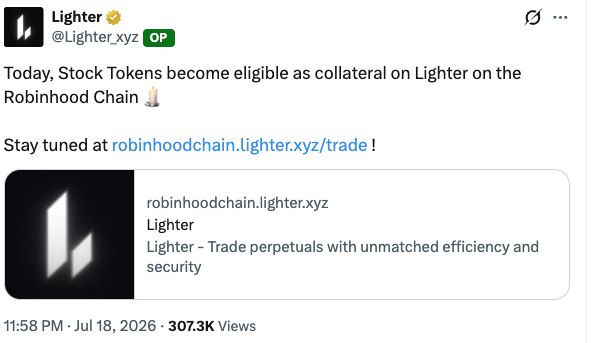
Robinhood made a strategic investment in Lighter and, alongside the launch of Robinhood Chain, integrated Lighter so that users can trade on it directly within Robinhood Wallet. In addition, since July, Lighter has accepted stock tokens on Robinhood Chain as margin for perpetual futures positions. This is a leading example of a more advanced use of stock tokens and fits well with Robinhood's goals. Lighter recently said on an investor call that it plans to file for a U.S. derivatives license in November. If the license is approved, I expect Lighter to become the biggest channel for drawing in additional U.S. users.
2) Priors
Source: Robinhood Crypto
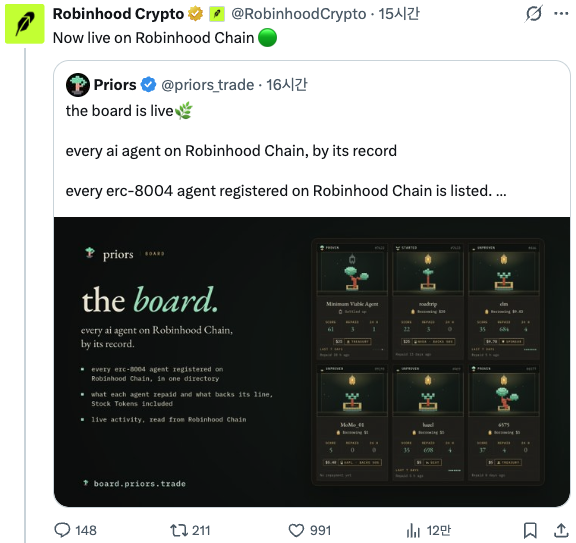
Priors is an onchain credit protocol that lends USDG to AI agents and accepts stock tokens as collateral to increase their credit limits. Robinhood Crypto publicly endorsed the project on the day of the earnings call. It has little to do with memecoins, but it is built to actually put stock tokens to use, which shows what standards Robinhood applies when looking at its ecosystem. Robinhood is pushing agentic trading as one of the key growth drivers for its app. Projects like this, which give agents a direct way to use stock tokens, could serve as a link between the app's agent strategy and the chain.
3) Standard Reserve
Source: 0xBeans
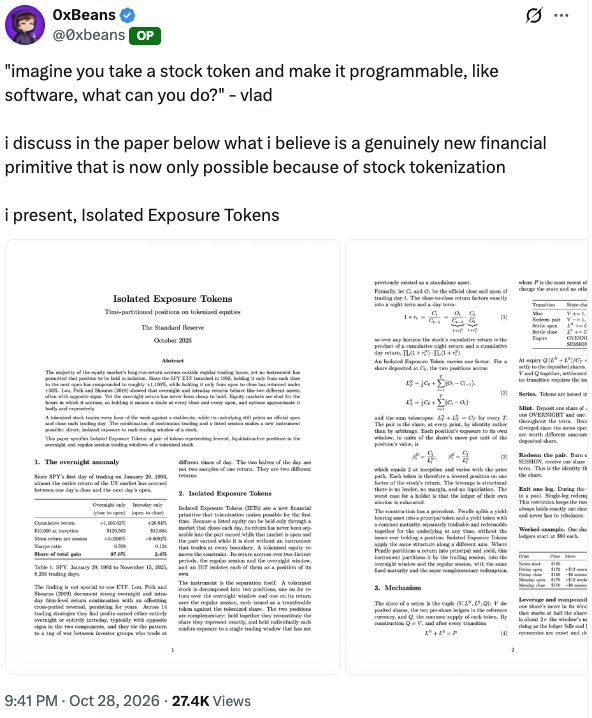
Shortly after the earnings call, 0xBeans cited Tenev's question about what would be possible if stock tokens could be programmed like software, and released a whitepaper under the Standard Reserve name introducing Isolated Exposure Tokens (IET). The design draws on the overnight effect, the finding that most of the U.S. stock market's long-term returns have come between one day's close and the next day's open. It splits one stock token into an OVERNIGHT token, which captures only the price movement from close to open, and a SESSION token, which captures only the movement from open to close. The two tokens can be combined and redeemed for the original stock token at any time, which keeps their combined price pegged to the stock price. Each token carries roughly 2x leveraged exposure at the start, with no borrowing or liquidation involved. The structure applies Pendle's separation of principal and yield to trading hours. It only works when a token that trades around the clock exists alongside an underlying stock with an official open and close. For this reason, although it is still only a whitepaper, it is a good example of an advanced application that only stock tokens can enable.
What About Existing Launchpad Projects?
By contrast, the story is different for tokens whose value depends mainly on fees from speculative token launches. Pons, for instance, uses launchpad fees for buybacks and burns, so its value ultimately depends on how much speculative trading continues to pass through the launchpad. This has little to do with the metrics that management set as goals on the earnings call. I also do not think Robinhood has much reason to go out of its way to promote the project and protect that fee stream. Of course, this could change if Pons comes up with a new way to increase demand for issuing and using stock tokens. Notably, Priors' PRIORS token was also issued through Pons. How well Pons can serve as a starting point for projects that use stock tokens will offer a useful clue to that possibility.
3. Conclusion
The price gains in Robinhood ecosystem tokens after the earnings call seem to reflect the simple fact that Robinhood will commit more resources to its chain. A closer look at the call, however, shows that those resources have fairly specific targets. Robinhood's main goals appear to be healthy growth in stock token TVL, financial applications and perpetual futures that go beyond launchpads, and the onboarding of U.S. users. The focus is on these areas rather than on the memecoin trading that once generated a surge in fees.
I do not think Robinhood will abandon the memecoin ecosystem. Going forward, however, I expect it to treat that ecosystem less as a centerpiece and more as a first-stage foundation for increasing stock token issuance. Its efforts will likely focus on fostering more advanced financial applications and on expanding the use of stock tokens in perpetual futures and options projects.
The author of this report may have personal holdings or financial interests in assets or tokens discussed herein. However, the author affirms that no transactions have conducted using material non-public information obtained in the course of research or drafting. This report is intended solely for general information purposes and does not constitute legal, business, investment, or tax advice. It should not be used as a basis for making any investment decisions or as guidance for accounting, legal, or tax matters. Any references to specific assets or securities are made for informational purposes only and should not be construed as an offer, solicitation, or recommendation to invest. The opinions expressed herein are those of the author and may not reflect the views of any affiliated institutions, organizations, or individuals. The opinions and analyses expressed herein are subject to change without prior notice. In addition, beyond the individual disclosures included in each report, Four Pillars, may hold existing or prospective investments in some of the assets or protocols discussed herein. Furthermore, FP Validated, a division of Four Pillars, may already be operating as a node in certain networks or protocols discussed herein or may do so in the future. Please see below links in the footer for FP Validated's participating network disclosures and for broader disclosure details.


