
Table of Contents
- Key Takeaways
- 1. Who Pays for an Exchange Vault’s Profits?
- 1.1 Five Ways Vaults Make Money
- 1.2 The Users’ Worst Moment, the Vault’s Best
- 2. The QFEX Managed Account
- 2.1 How the Market-Neutral Long/Short Strategy Works
- 2.2 A Quant Firm’s Strategy in a Perp DEX Account
- 3. So How Is This Different from a Vault?
- 3.1 Product Growth and Better Liquidity, Aligned
- 3.2 Market Makers as a Prerequisite, Not a Competitor
- 4. Wealth Management on a Perp DEX
Researcher

Related Projects

Key Takeaways
- Someone’s profit is someone else’s cost, and a perp DEX vault is no different: its income from spreads, liquidations and fees is paid by users on the same exchange.
- An exchange that runs a vault ends up with incentives that don’t line up with better liquidity. Tighter spreads shrink the vault’s income, and outside market makers deepen the book but also compete for that income.
- QFEX’s Managed Account runs a market-neutral long/short strategy that earns from alpha rather than from users’ costs. It forecasts relative performance across US equity perpetual futures, going long the names it expects to be stronger and short those it expects to be weaker. The book is balanced to target zero net exposure and zero index beta, keeping the effect of market direction to a minimum.
- Unlike a vault, the Managed Account pays the spread. It trades as a taker, crossing the spread at each scheduled rebalance. To protect its returns and grow its capacity, QFEX has to bring in outside market makers to tighten quotes. Those tighter quotes go to everyone trading the same symbols. The more the product grows, the less users pay to trade.
1. Who Pays for an Exchange Vault’s Profits?
Someone’s profit is always someone else’s loss or cost. Look at perp DEX vaults with this rule in mind, and something seems a little odd.
These vaults usually earn from spreads, liquidations and fees. A vault quotes a two-sided market and captures the gap between bid and ask. It takes over liquidated positions along with their collateral, and sometimes receives a share of exchange fees. All of this income comes from users trading on the exchange's order book.
Put another way, the vault makes money when perp DEX users trade at a bad price or get liquidated. It earns because users lose.
The spread a maker captures is the execution cost a taker pays. The profit from taking over a liquidation is the collateral the liquidated user lost.
This model goes back to GMX's GLP, the forerunner of today's vaults. GLP was the counterparty to every trader’s PnL. All orders filled against the GLP pool. When traders lost, GLP made money. When traders made money, GLP lost.
Then order book perp DEXs took hold. Orders began matching against each other on the book, and the vault's role shifted to supplying liquidity and absorbing liquidations. The source of its income, however, did not change. It was still the exchange's own users.
Source: X(@annanay)
Is this really the best way for a perp DEX to get the liquidity it needs for trading and liquidations?
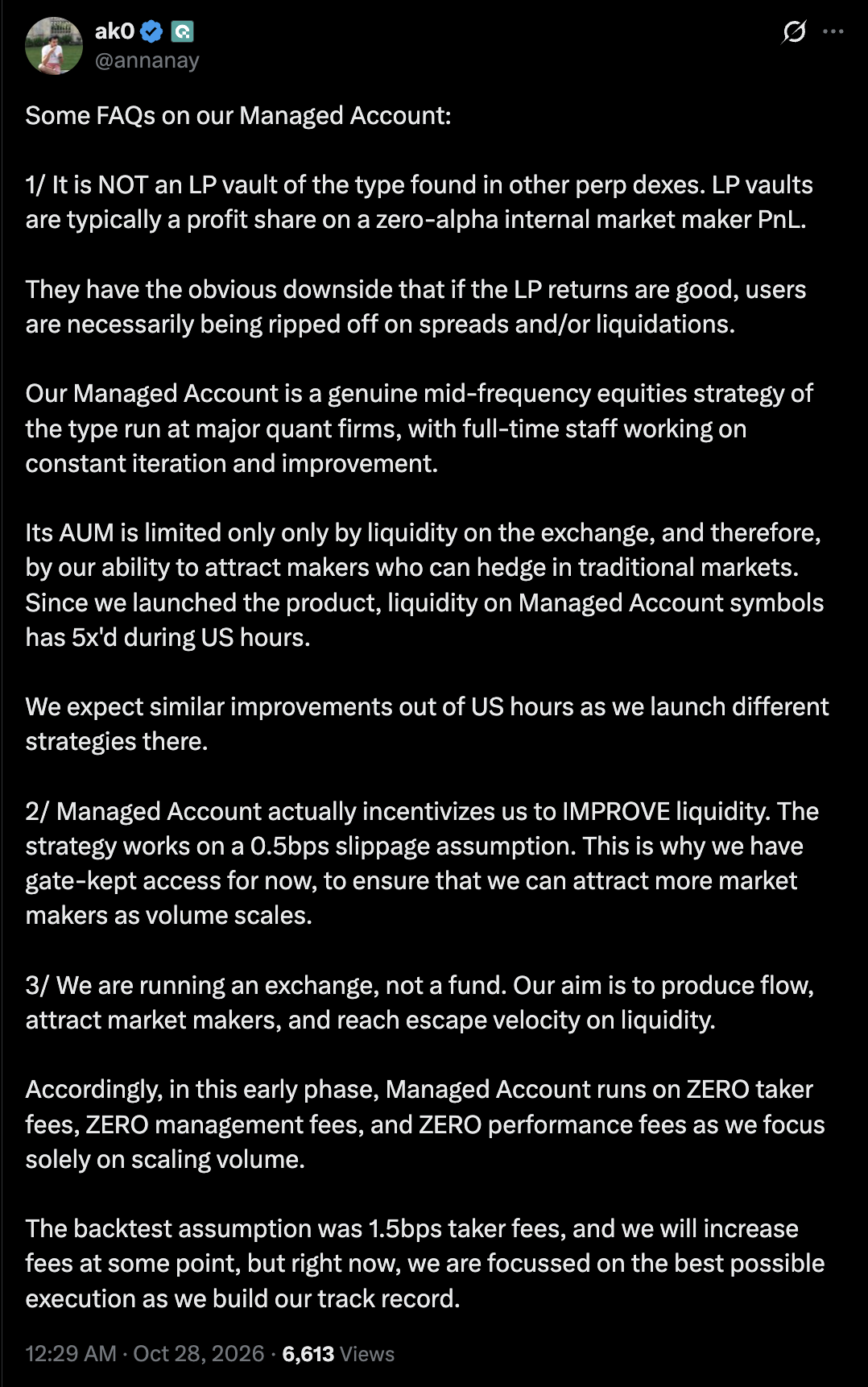
QFEX CEO Annanay Kapila has raised the same question. In his view, an LP vault is little more than a profit share on the PnL of a zero-alpha internal market maker. If vault returns are good, users are necessarily being ripped off by the same amount on spreads or liquidations. QFEX has put forward the Managed Account as its alternative. Let's look at it in detail.
1.1 Five Ways Vaults Make Money
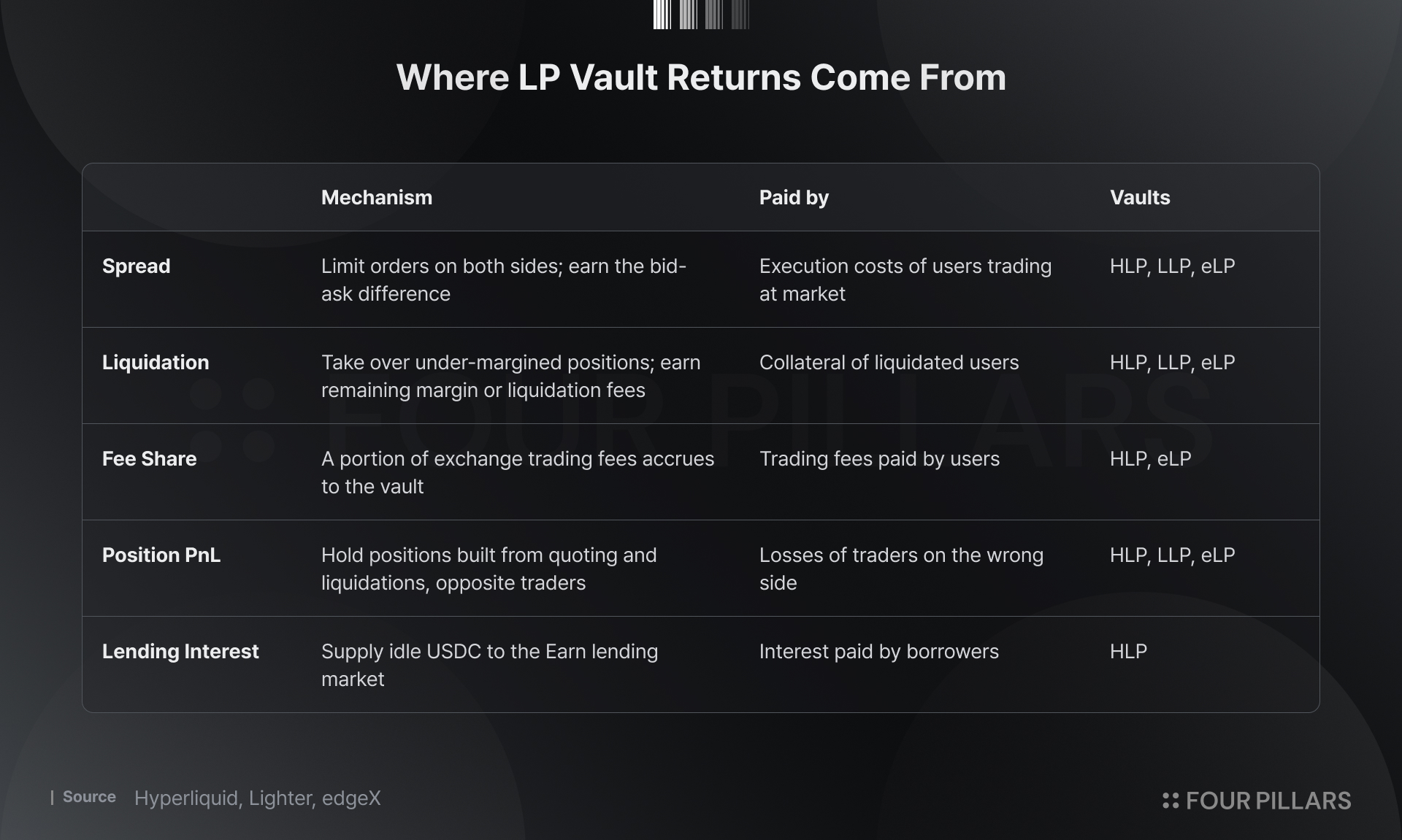
Start with exactly how perp DEX vaults make money today. Hyperliquid's HLP, Lighter's LLP and edgeX's eLP are useful examples, and their income falls into five broad buckets.
- Spreads: The vault posts both bids and offers on the book and earns the difference between the two. Suppose it bids ETH at $2,000.0 and offers at $2,000.2. When one user sells at market and another buys at market, the $0.20 difference (that's 1bp) goes to the vault. (HLP, LLP, eLP)
- Liquidations: The vault takes over positions that have run short of margin and keeps the remaining margin as it closes them out (HLP, LLP), or collects the liquidation fees charged along the way. (LLP, eLP)
- Fee sharing: The exchange allocates part of its trading fees to the vault. This slice is not large: according to DefiLlama, HLP's fee income for all of 2025 was about $18M. (HLP, eLP)
- Position PnL: Vaults don’t usually make directional bets. They end up holding positions as a by-product of quoting and taking over liquidations. If a user sells ETH at market, for example, the vault's bid gets filled and it is now long the ETH it just bought. The same goes for liquidated positions it takes over. Through these positions, the vault effectively becomes the traders' counterparty. Funding on the positions it holds also feeds into its PnL. (HLP, LLP, eLP)
- Lending interest: Hyperliquid runs its own lending market, Earn. Traders borrow USDC against collateral such as HYPE or BTC, and the lenders who supply it earn interest. HLP lends out USDC it isn't using for market making. Unlike the sources above, this one doesn’t depend directly on users' execution costs or trading losses.
Break HLP's profit down and most of it comes from liquidations. HLP runs market making and liquidations through separate sub-vaults. As of November 2026, about 67% of deposits ($100M) sit in the market-making vault, Strategy X. Yet that vault's cumulative profit is only about $740K. The other two market-making vaults, at +$4.23M and −$4.35M, cancel each other out.
The four liquidation vaults, meanwhile, hold about 22% of deposits and have earned $74M in total. That is more than half of HLP's cumulative profit of about $139M.
These numbers alone don’t show that the vault charges users wide spreads on every trade. What does look clear is that the vault makes the most money when users are being liquidated.
1.2 The Users’ Worst Moment, the Vault’s Best
One day shows the problem clearly. On October 10, 2025, a US tariff announcement set off about $19B of leveraged liquidations in a single day, more than $10B of it on Hyperliquid. That same weekend, HLP made about $41.5M, handing depositors about 10% in two days.
The worst day for users was the best day for the vault.
That said, the vault making money is not the problem in itself. Collecting a spread for providing quotes is ordinary market making, and taking over liquidations is necessary. Traders bring liquidations on themselves, after all. If no one takes on the liquidated positions the book can't handle, the losses stay on the exchange as bad debt. If things get worse, this can spill over into auto-deleveraging (ADL), which forcibly cuts the positions of other users who were in profit.
Whether it is an in-house vault or an outside liquidator, someone has to absorb those positions.
Still, does it have to work this way? The vault's profit is the trader’s cost, which puts the exchange's incentives in tension with its traders'. This misalignment shows up in the exchange’s liquidity in two ways:
- Vault growth isn't tied to better liquidity: A vault grows on traders' costs. Deposits follow returns, and vault returns rise as spreads widen and liquidations pile up. So when the book gets deeper, spreads tighten and execution improves, the vault's returns fall and deposits leave. The harder the exchange works to grow its vault, the weaker its reason to deepen liquidity.
- No incentive to attract outside liquidity: The same problem shows up with market makers. The surest way to cut traders’ execution costs is to bring in outside market makers and make them compete on quotes. But as that competition tightens spreads, the vault competing for the same quotes earns less. With two-thirds of HLP’s deposits allocated to market-making vaults, for example, better quotes also cut into the returns of the exchange’s own vault.
QFEX designed the Managed Account mainly to ease this misalignment. With the Managed Account, the exchange cannot grow the product's capacity without first attracting outside market makers and improving liquidity.
2. The QFEX Managed Account
The Managed Account started from a question: how could an exchange give alpha to its users? QFEX also wanted to do it without working against users' interests the way existing vaults do, while still generating volume on the exchange. The Managed Account is the product built to meet both goals. It draws on the systematic trading experience of a team made up mostly of former quants.
Vaults and the Managed Account both exist to secure liquidity for the exchange. They differ in how.
With a vault, the exchange fills the book directly. The Managed Account instead runs a systematic strategy that sends orders continuously. That volume draws in outside market makers, and they fill the book. QFEX's aim is for this flow to keep attracting market makers until liquidity reaches escape velocity and grows on its own.
2.1 How the Market-Neutral Long/Short Strategy Works
The Managed Account is a systematic, market-neutral long/short strategy traded through QFEX perpetual futures.
In equity markets, a stock moves on company news, but also with the market as a whole. When the index rises, most stocks rise. In a downturn, most fall. Directional positions therefore tend to end up as bets on the overall market, however good the stock picks.
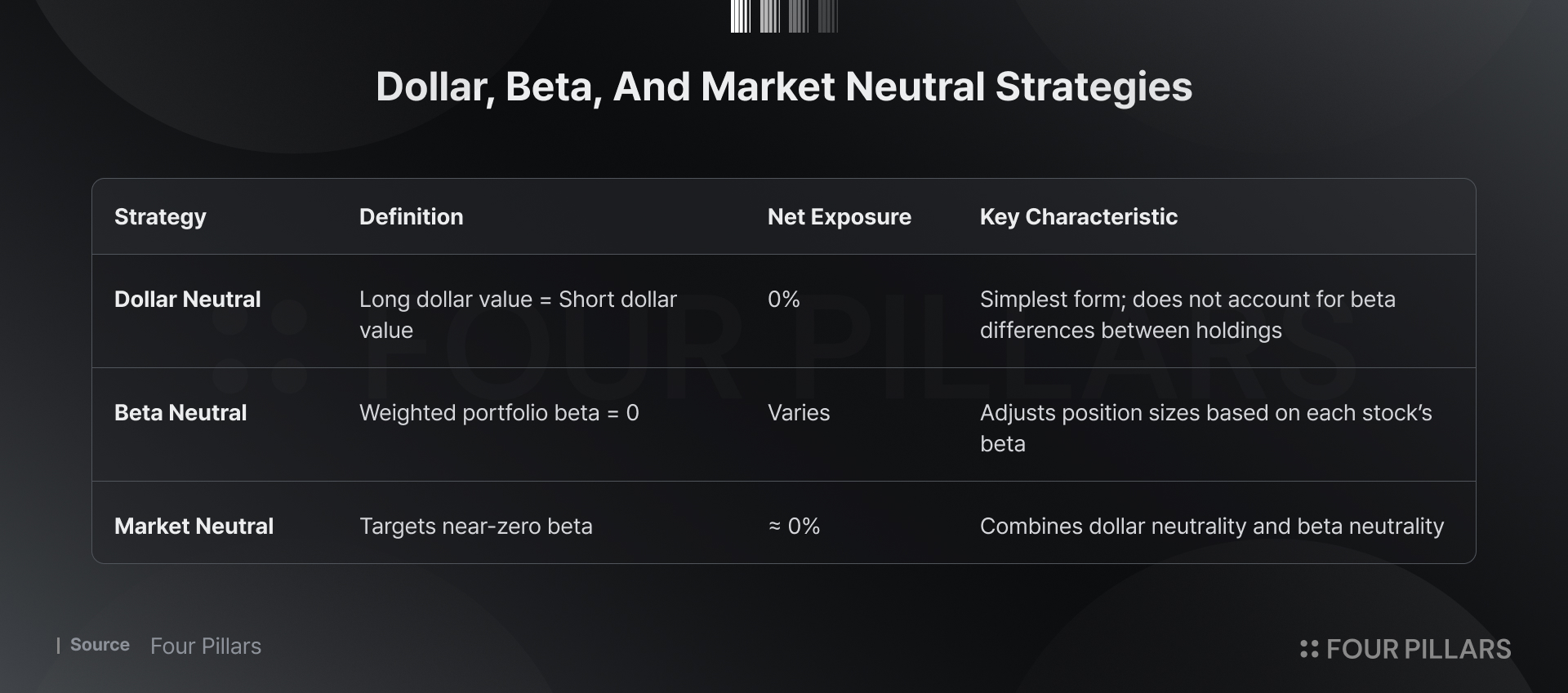
A market-neutral strategy strips out that directional element and seeks returns only from relative performance between stocks. Even in the same sell-off, some stocks fall further than others. Even in the same rally, some rise more. Go long the stock likely to be relatively stronger and short the one likely to be weaker, and you earn the gap between them regardless of market direction.
Suppose you are long $100 of A and short $100 of B, and the whole market falls: A drops 2% and B drops 4%. You lose $2 on the long but make $4 on the short, leaving a $2 profit. This performance gap between stocks is the relative-value opportunity the Managed Account targets.
Matching the dollar amounts on each side does not fully remove the market, though. In the example above, B may have fallen further not because it was weak, but simply because it is more sensitive to the market.
Consider a long position in a stock that moves 2% for every 1% move in the market, paired with a short of the same dollar size in one that moves only 0.5%. In a falling market, the long loses more than the short gains. The position ends up as a bet on the market rising.
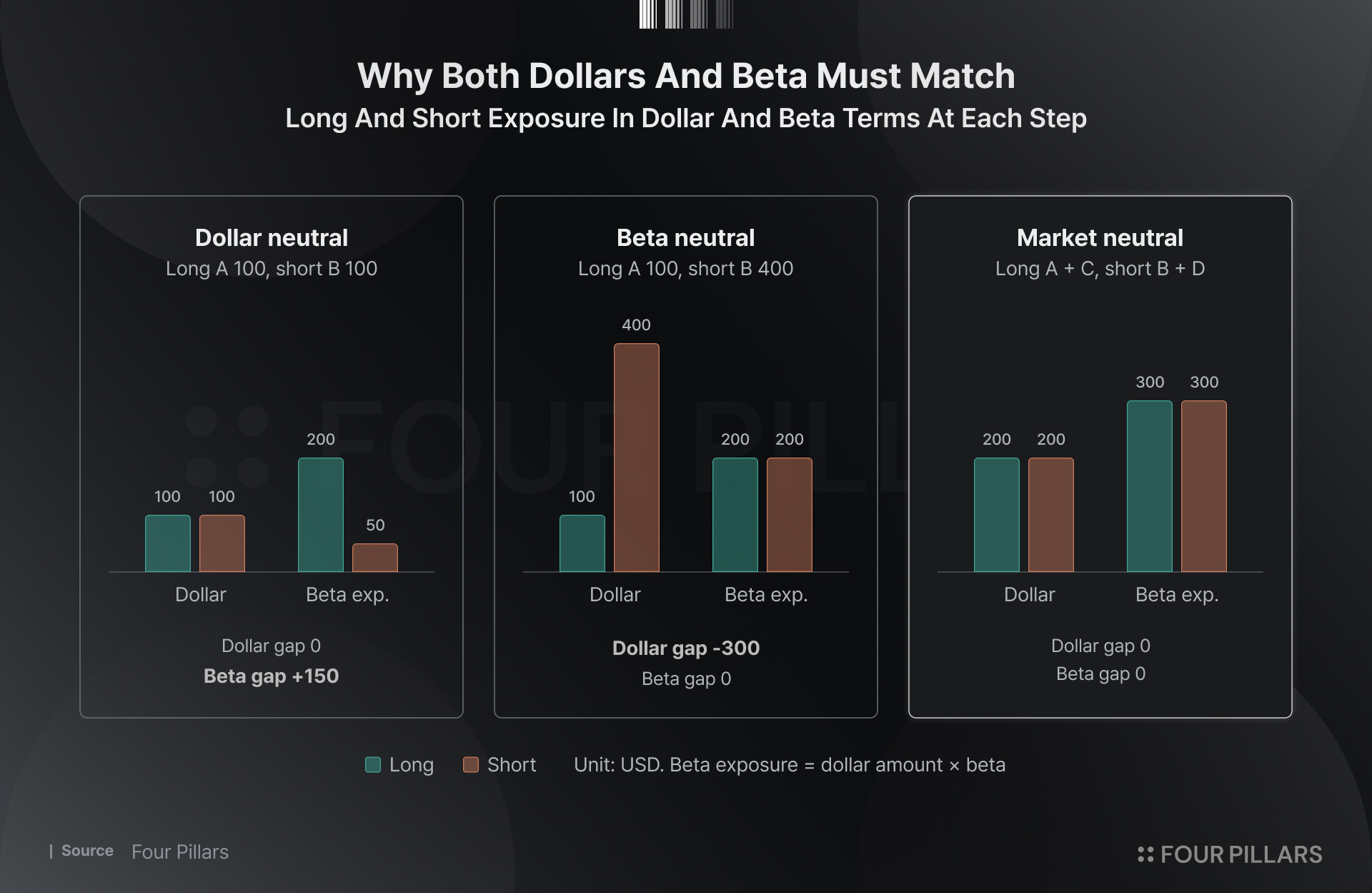
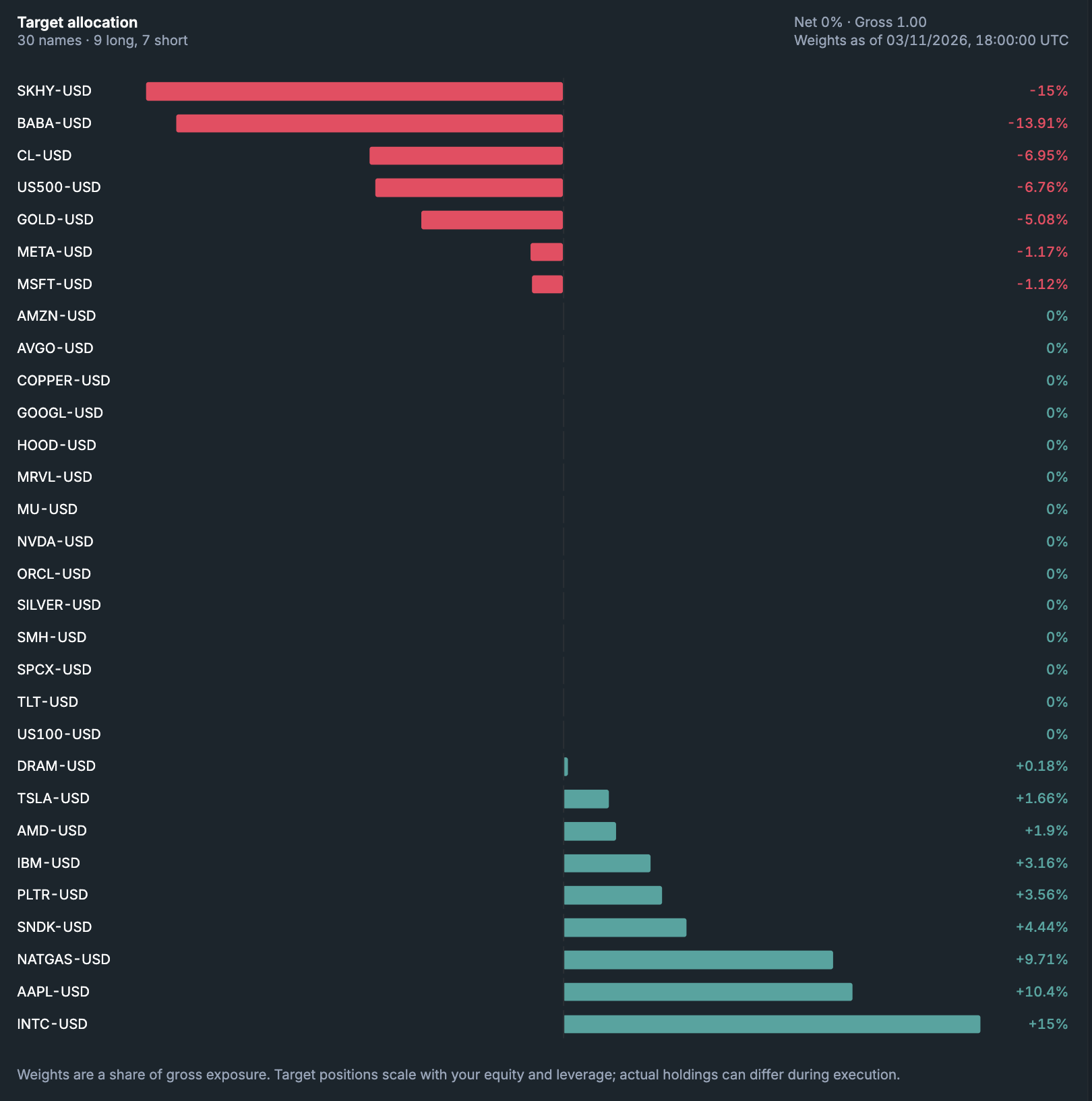
To avoid this, position size multiplied by each stock's market sensitivity (index beta) must match on the long and short sides. In the case above, that means raising the short to $400 or cutting the long to $25. But then the dollar amounts no longer match. The Managed Account therefore adjusts weights across many stocks, optimizing the book before each order to target zero net exposure and zero index beta.
Source: QFEX
A model, not a person, decides which stocks to buy or sell and how much. According to QFEX's documentation, the portfolio is constructed end to end by systematic models:
- Signal generation: Signals are generated from more than 200 features, spanning momentum, mean reversion, volatility, relationships between markets and liquidity.
- Ranking and sizing: Forecasts for each stock are normalized, and positions are ranked and sized according to signal strength and inverse volatility.
- Neutralization: The book is neutralized to target zero net exposure and zero index beta before orders are sent.
- Operation: The strategy runs 24/5 (24 hours a day, five days a week). Positions open on Monday at 10:00 AM and close on Friday at 3:30 PM (ET), and users can trigger a manual position close at any of the three intraday rebalances.
2.2 A Quant Firm’s Strategy in a Perp DEX Account
QFEX describes the Managed Account as a mid-frequency equities strategy of the type run at major quant trading firms. It has a dedicated full-time team that researches, operates and improves the strategy.
The same strategy can also run more efficiently on perpetual futures than it does at a traditional quant firm. Running it directly in US equities means going through a prime broker, where the long and short legs need margin separately and the shorts may require stock borrow.
On QFEX perpetual futures, by contrast, longs and shorts share one cross-margined collateral pool. Collateral is not managed separately for each leg, so gains on one side can offset losses on the other. And because these are perpetual futures, there is no need to borrow stock to go short. The strategy’s market-neutral book can therefore use capital more efficiently than it would through a prime broker.
The strategy only works because QFEX lists perp markets on traditional assets, including US equities, indices, commodities and FX.
A long/short strategy that seeks relative value between stocks is a staple equity strategy at quant trading firms. It needs a broad range of stocks that share the market’s ups and downs yet move differently on company-specific factors.
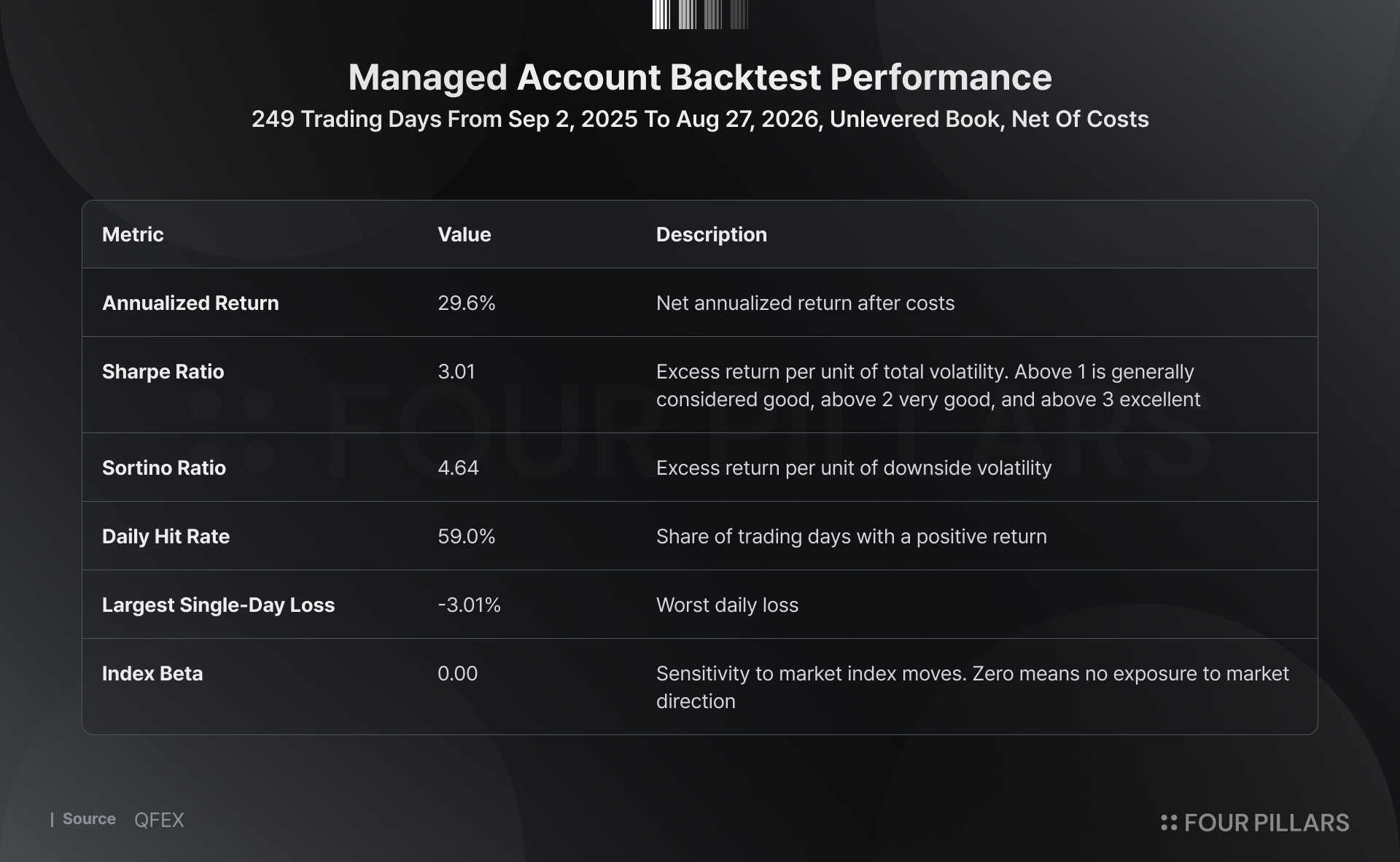
In the backtest, the strategy made money on 59.0% of trading days (its daily hit rate), only just over half. Yet its annualized return was 29.6%. The reason: each forecast needs to be right only slightly more than 50% of the time, and repeating that every day across many stocks lets the gains build up steadily. A zero index beta means the book is built so that market direction does not drive its returns. In live trading, though, beta won’t always sit at exactly zero.
For now, access is invite-only. Users create a Managed Account under their main QFEX account, transfer at least $50K of USD collateral into it, and choose leverage between 1x and the exchange's maximum. From there, the strategy runs automatically 24/5, opening positions on Monday at 10:00 AM and closing them on Friday at 3:30 PM (ET).
The funds stay in the user's own account throughout. QFEX receives trading access only, with no withdrawal rights. Users can view their positions in real time, and there is no lock-up: they can trigger manual closes and withdrawals at any of the three intraday rebalances.
3. So How Is This Different from a Vault?
So what does the Managed Account do differently? The vault’s incentive misalignment leads to two problems: (1) growing the vault product works against better liquidity, and (2) the exchange has little incentive to attract outside market makers.
The Managed Account is designed with the opposite incentives. To grow the product, QFEX has to improve liquidity, and to improve liquidity, it has to bring in outside market makers.
3.1 Product Growth and Better Liquidity, Aligned
Like the exchange’s other users, the Managed Account is better off when execution costs fall. A vault captures the spread on its quotes. The Managed Account crosses it.
And it pays often. In the backtest, the strategy opened fresh positions every day and closed them all before the market close. The same capital therefore went through the book at least twice a day.
Over a year (249 trading days), that is about 500 trips. An extra 1bp (that's 0.01%) on each trip wipes out about 6 percentage points of annual return. The strategy has since moved to holding positions for the week and rebalancing three times a day. It is still a taker, though, crossing the spread every time it adjusts its positions.
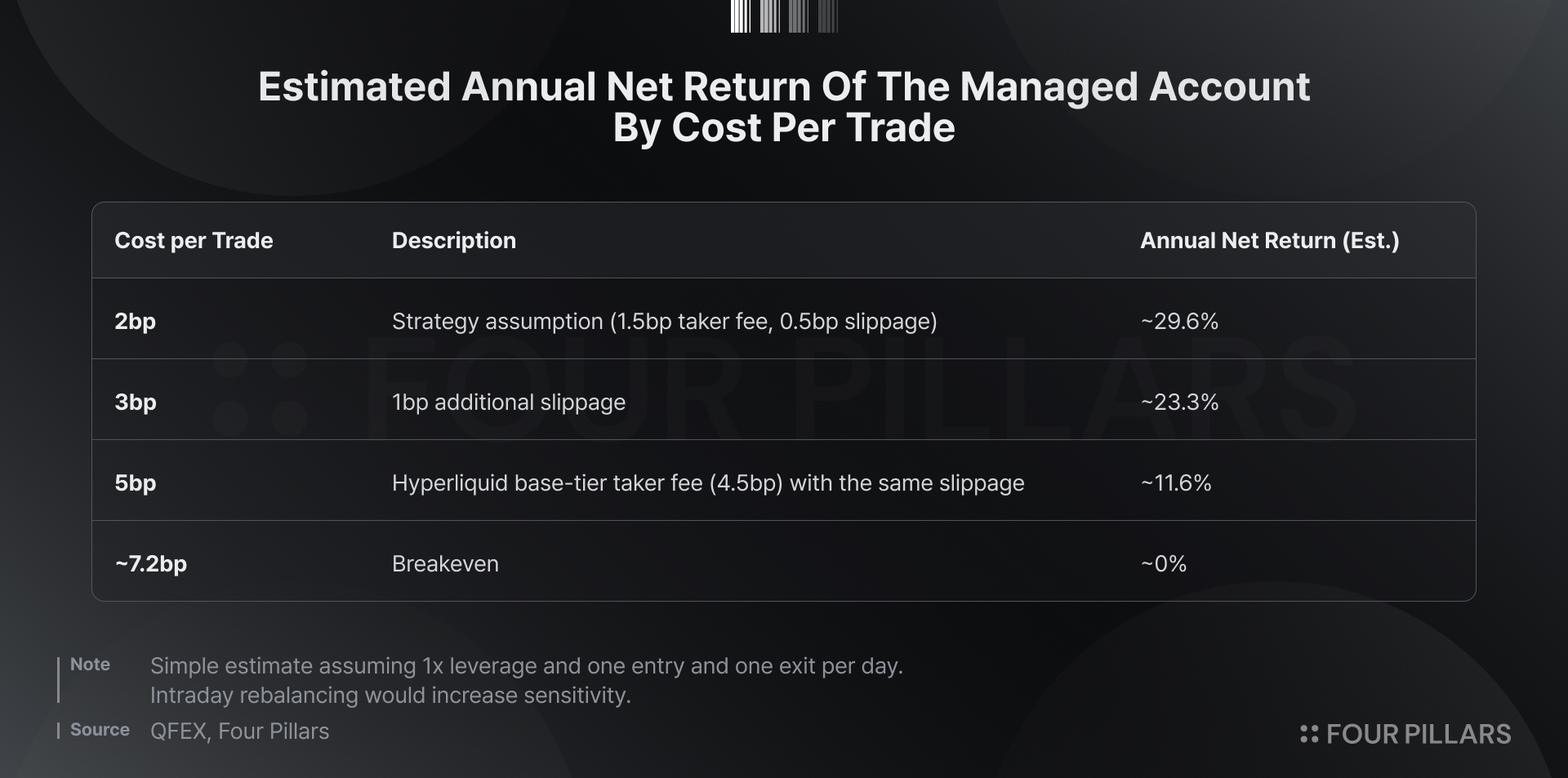
The chart estimates annual returns at different costs per trade, using the backtest figures. At the 2bp transaction cost the strategy assumes, the annual return is about 29.6%. Just 1bp of extra slippage takes it to about 23.3%. At 5bp, around the cost on Hyperliquid's base tier, it falls to about 11.6%, less than half. At 7.2bp, the return is gone.
This is also why QFEX currently charges no fees on the Managed Account. QFEX is running an exchange, not a fund, so liquidity comes before assets under management.
Management and performance fees are currently 0%, and taker fees on strategy trades are 0bp. Generating trading activity and attracting market makers take priority over fee income. Of course, this is an early-phase arrangement. Taker fees are set to be introduced later, and the backtest already assumes 1.5bp for them.
To grow the Managed Account, QFEX has to improve liquidity first, since both the strategy's returns and its capacity depend on execution costs. And the surest way to improve liquidity is to attract outside market makers. Under the vault model, this was exactly where the incentives of the exchange and its users came apart.
3.2 Market Makers as a Prerequisite, Not a Competitor
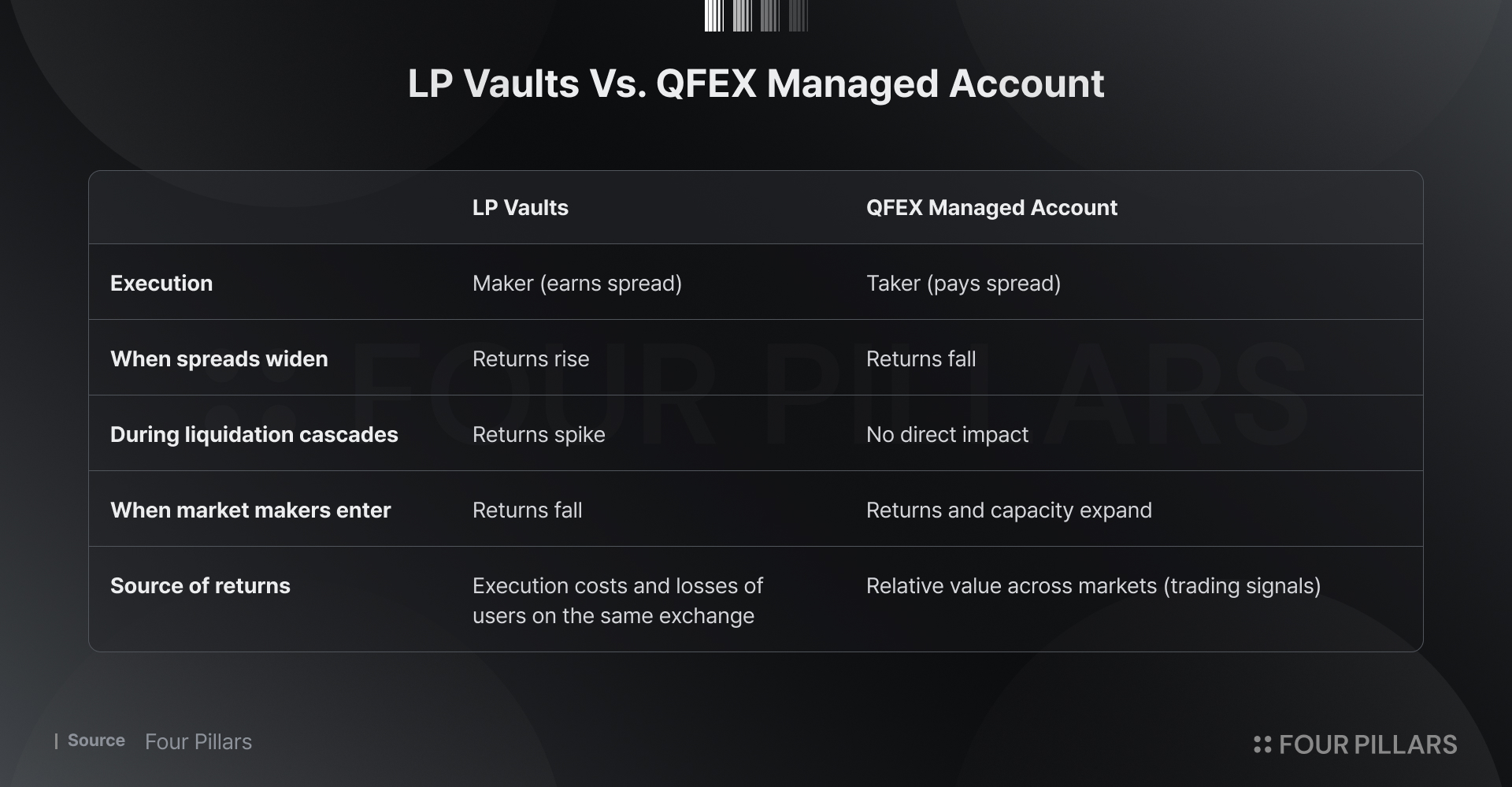
For an exchange that runs a vault, an outside market maker is a competitor taking a share of the vault's income. For QFEX, an outside market maker is a prerequisite. It lifts both the Managed Account's returns and its capacity.
What market makers want from the Managed Account is steady order flow. Strategy orders arrive in consistent size at each scheduled rebalance, which makes them a predictable source of spread income.
More market makers mean tighter spreads, which raise the strategy’s returns and capacity, and that in turn grows market makers’ income. This can become a virtuous cycle.
According to QFEX, as of October 27, 2026, liquidity in Managed Account symbols during US trading hours had increased fivefold since launch. This makes sense since, at the time, the strategy traded during the hours the US cash equity market was open.
During those hours, market makers can take the other side of the strategy's orders and hedge the resulting exposure in the cash market. Imagine the strategy buys NVIDIA perpetual futures. The market maker, now short, can buy NVIDIA shares in the cash market and take the price risk off.
This improved liquidity is not the Managed Account's alone. Every QFEX user trading the same symbols gets better execution.
That is the core difference. With a vault, users' costs are the profit. With the Managed Account, the profit depends on users’ costs coming down.
4. Wealth Management on a Perp DEX
The Managed Account, then, is a product in which an exchange runs its own quant strategy inside each user's account. QFEX says that, as far as it is aware, this is the first time any exchange has opened up systematic quant strategies to its users.
The format itself is not entirely new. The Managed Account can also be seen as a continuation of traditional finance's high-net-worth wealth management and separately managed account (SMA) industry, brought onchain. Whereas SMAs are costly to run account by account and have mostly served high-net-worth clients, the Managed Account offers a relatively low minimum.
Its value as a yield product is not the interesting part. The interesting part is that the product grows in step with the interests of the exchange's users. That doesn't mean it escapes the rule this article started with. Someone's profit is still someone else's loss or cost.
But a vault draws its income from the execution costs and liquidation losses of users on the same exchange. The Managed Account instead earns its alpha by forecasting relative performance between stocks, and it can only grow its capacity if users' execution costs come down.
The vault has long been the standard model for perp DEXs. The Managed Account could offer a new way to share returns and secure liquidity alongside users, rather than at their expense.
Much remains to be verified, of course, such as whether live execution costs stay near the 2bp the strategy assumes and whether net returns hold up once taker fees are introduced.
The report is based on the independent research of the author sponsored/funded by QFEX. The author of this report may have personal holdings or financial interests in assets or tokens discussed herein. However, the author affirms that no transactions have conducted using material non-public information obtained in the course of research or drafting. This report is intended solely for general information purposes and does not constitute legal, business, investment, or tax advice. It should not be used as a basis for making any investment decisions or as guidance for accounting, legal, or tax matters. Any references to specific assets or securities are made for informational purposes only and should not be construed as an offer, solicitation, or recommendation to invest. The opinions expressed herein are those of the author and may not reflect the views of any affiliated institutions, organizations, or individuals. The opinions and analyses expressed herein are subject to change without prior notice. In addition, beyond the individual disclosures included in each report, Four Pillars, may hold existing or prospective investments in some of the assets or protocols discussed herein. Furthermore, FP Validated, a division of Four Pillars, may already be operating as a node in certain networks or protocols discussed herein or may do so in the future. Please see below links in the footer for FP Validated's participating network disclosures and for broader disclosure details.