Table of Contents
- Key Takeaways
- 1. What is ‘Relationship interoperability’ in agentic payments?
- 2. Integration into existing platforms: Adding a payment method while preserving customer relationships
- 3. Integration into card networks: Combining existing card relationships with stablecoin settlement
- 4. A native blockchain path: Connecting wallet authentication to membership information and permissions
- 5. Conclusion: Bridging Rail Neutrality with Relationship Continuity
Researcher

Key Takeaways
- Relationship interoperability is the ability to preserve customer status and rights when an agent acts on the customer’s behalf or the payment rail changes. It matters especially in markets where customers expect membership benefits and purchase protection.
- Existing platforms support stablecoin adoption through their customer account and order management systems, while card networks provide established authorization and dispute resolution processes. Integration with these systems offers a practical path to broader adoption in markets where benefits and purchase protection matter.
- Native blockchain payments may gain traction first in API markets where the transaction centers on access to a purchased resource. Broader commerce requires designs that connect wallet authentication to customer accounts, purchase records, and delegated authority.
- In some markets, such as those for APIs, proof of purchase and continued access may be sufficient, while general commerce may also require membership benefits and purchase protection. Payment systems should remain rail agnostic while providing the level of relationship interoperability suited to each market’s transactions and the rights customers expect.
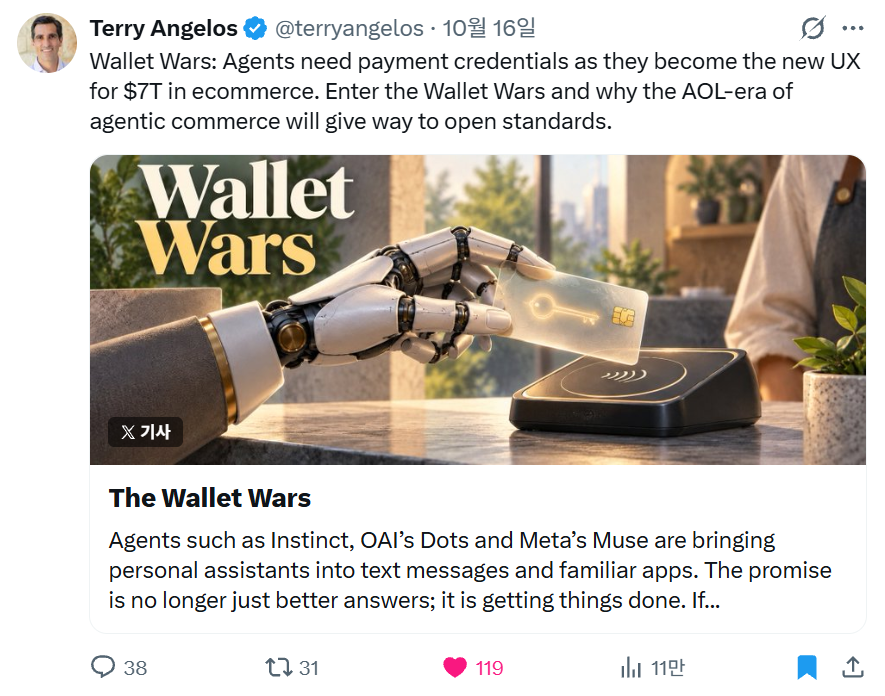
Terry Angelos (@terryangelos) recently appeared on the a16z podcast and published an article titled “The Wallet Wars” covering the discussion. The article takes a broad look at agentic payments, examining competition among companies seeking to support them through two types of interoperability:
- Payment interoperability: Can an agent complete payments across different wallets and merchants?
- Relationship interoperability: Can it transact under the user’s identity while preserving existing card benefits and relationships with merchants?
Using the disposable virtual cards offered by Stripe’s Link as an example, Angelos noted that a payment can succeed while disrupting the user’s existing card rewards, such as miles, or their relationship with the merchant. He emphasized the importance of relationship interoperability and predicted that considerations around payment choice and liability for incorrect payments would make tokens for agents a common approach. These tokens would grant limited permissions while preserving the connection to existing cards.
There is no definitive answer in this field yet. A better model than tokenization may emerge, and agentic payments may become widespread in forms beyond the delegation models envisaged today. Different perspectives therefore coexist. Still, I believe relationship interoperability is an important way to examine agentic payments. In this article, I apply that perspective to crypto payments using stablecoins.
For agentic payments, the central challenge will extend beyond the technical mechanisms for delegating payment authority and executing transactions to preserving customers’ existing rights and relationships throughout the process. With this in mind, I examine three paths for stablecoins: (1) integration into existing payment platforms, (2) integration into card networks, and (3) the development of independent payment paths native to blockchains.
1. What is ‘Relationship interoperability’ in agentic payments?
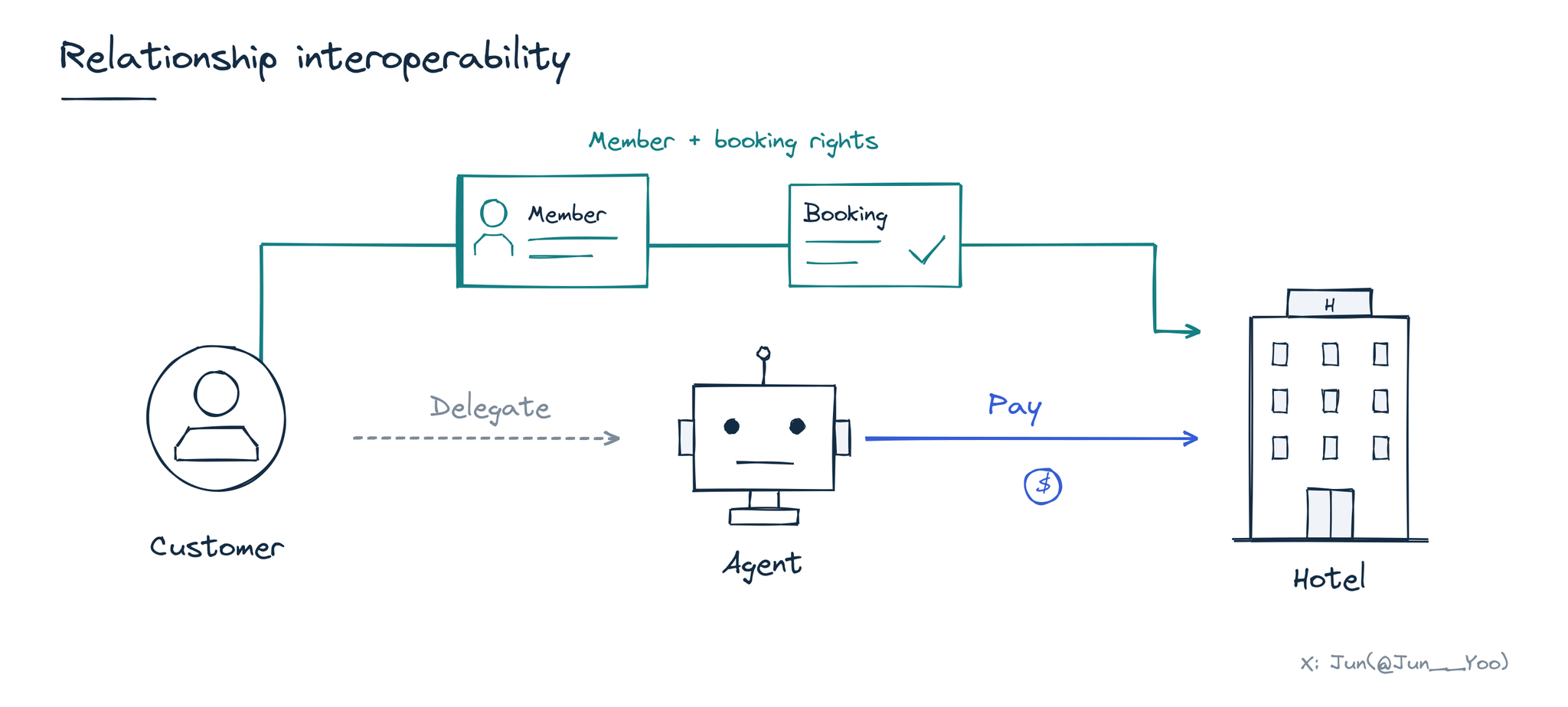
Relationship interoperability refers to the ability, or the systems that enable it, to consistently recognize a customer’s status and associated rights, even when the payment path changes or an AI agent acts on their behalf.
For example, an AI agent may successfully book and pay for a hotel, but the purchase experience remains incomplete if a membership discount is missing or the reservation does not appear in the customer’s account. A purchase involves more than moving funds. It also encompasses whose identity the transaction is made under and what rights and benefits the customer can exercise afterward.
Source: Mastercard
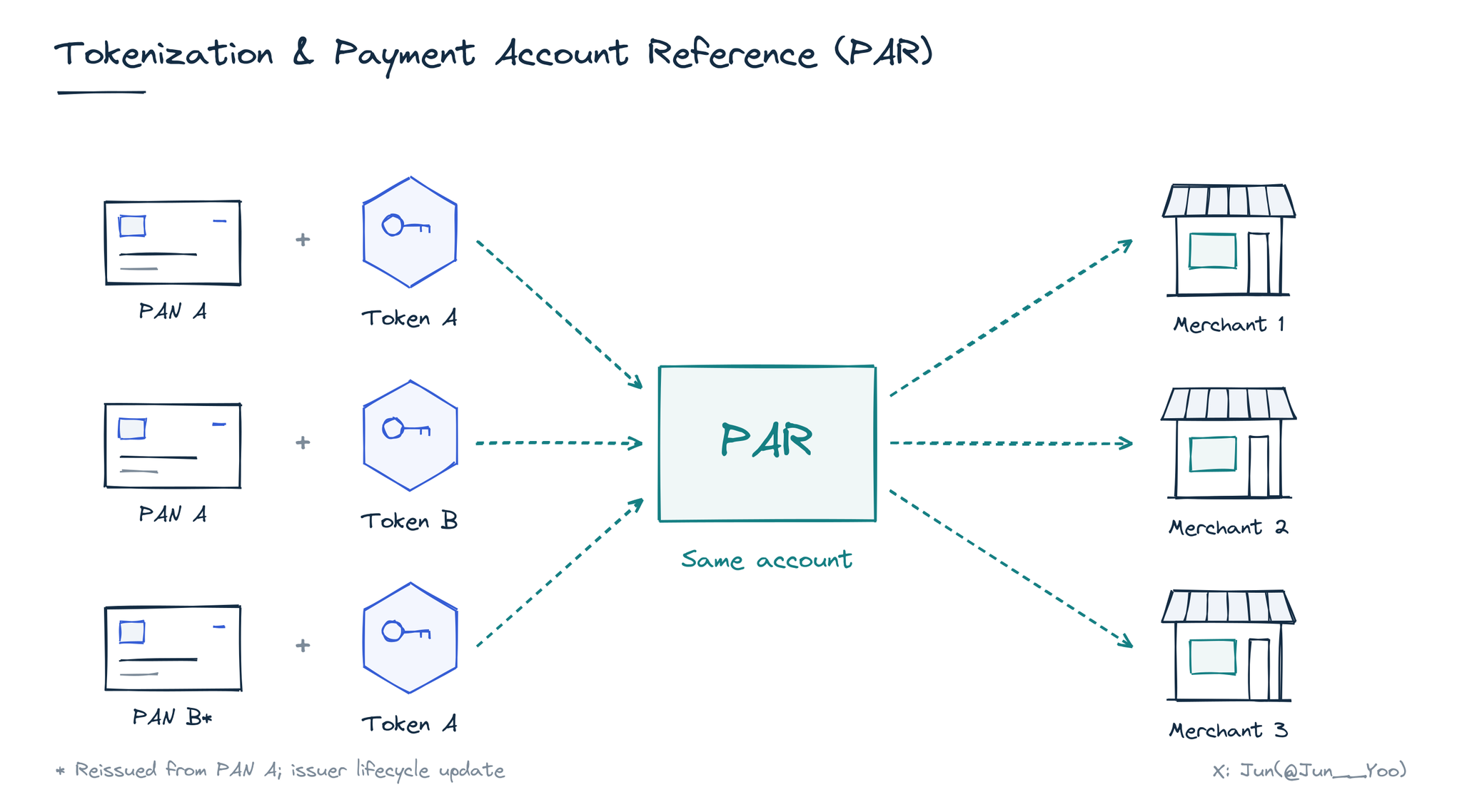
In traditional card payments, card networks, issuers, and merchants have shared responsibility for identifying customers and connecting them to their benefits. Two key mechanisms have allowed them to preserve transaction continuity and benefits while concealing card details for security: network tokenization and the Payment Account Reference (PAR).
Tokenization replaces the actual card number with a virtual token to prevent its exposure while keeping the transaction connected to the original card account. PAR adds a common identifier that links transactions made with different tokens derived from the same card across devices and services. Merchants can therefore recognize the same customer and provide loyalty benefits tied to their card without storing the actual card number.
Merchants also manage order histories and membership information independently through their own customer accounts. This allows the service relationship associated with an account to continue even when the customer changes payment methods. Traditional payment systems have thus supported both security and relationship interoperability by coordinating financial identification at the infrastructure level, through tokens and PAR, with membership management at the service level.
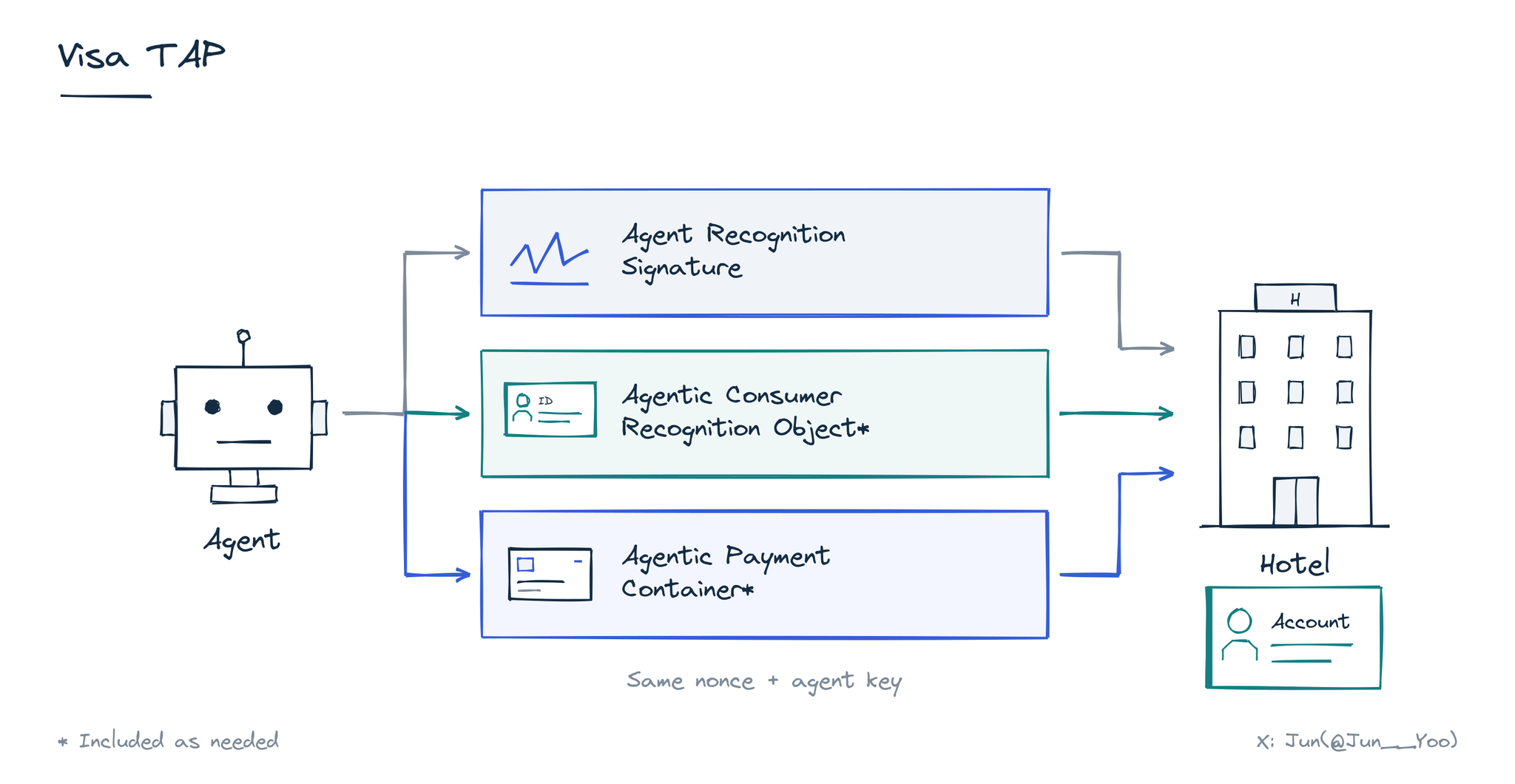
As commerce expands beyond human purchases to transactions carried out by AI agents, efforts to preserve relationship interoperability are increasing. One example is Visa’s Trusted Agent Protocol (TAP), which brings together three key elements in an agent’s transaction request:
- Agent Recognition Signature: Verifies the request’s signature to establish whether it comes from a trusted agent.
- Agentic Consumer Recognition Object: Provides customer identifiers so the merchant can connect the request to an existing customer account.
- Agentic Payment Container: Provides payment credentials or the information needed to verify them.
These three elements are bound together within a single request using the same nonce and the agent’s signing key. Independently of the actual payment authorization, the merchant can compare the identifiers in an idToken backed and signed by Visa against its own customer database. This allows the merchant to recognize an existing member immediately before payment and apply the appropriate member pricing or preferential benefits.
The existing card ecosystem is therefore seeking to extend relationship interoperability into agentic commerce by connecting agent authentication, customer identification, and payment authority within a single context backed by a trusted network. How, then, can payment networks using stablecoins preserve these customer relationships and rights without a centralized trusted institution?
2. Integration into existing platforms: Adding a payment method while preserving customer relationships
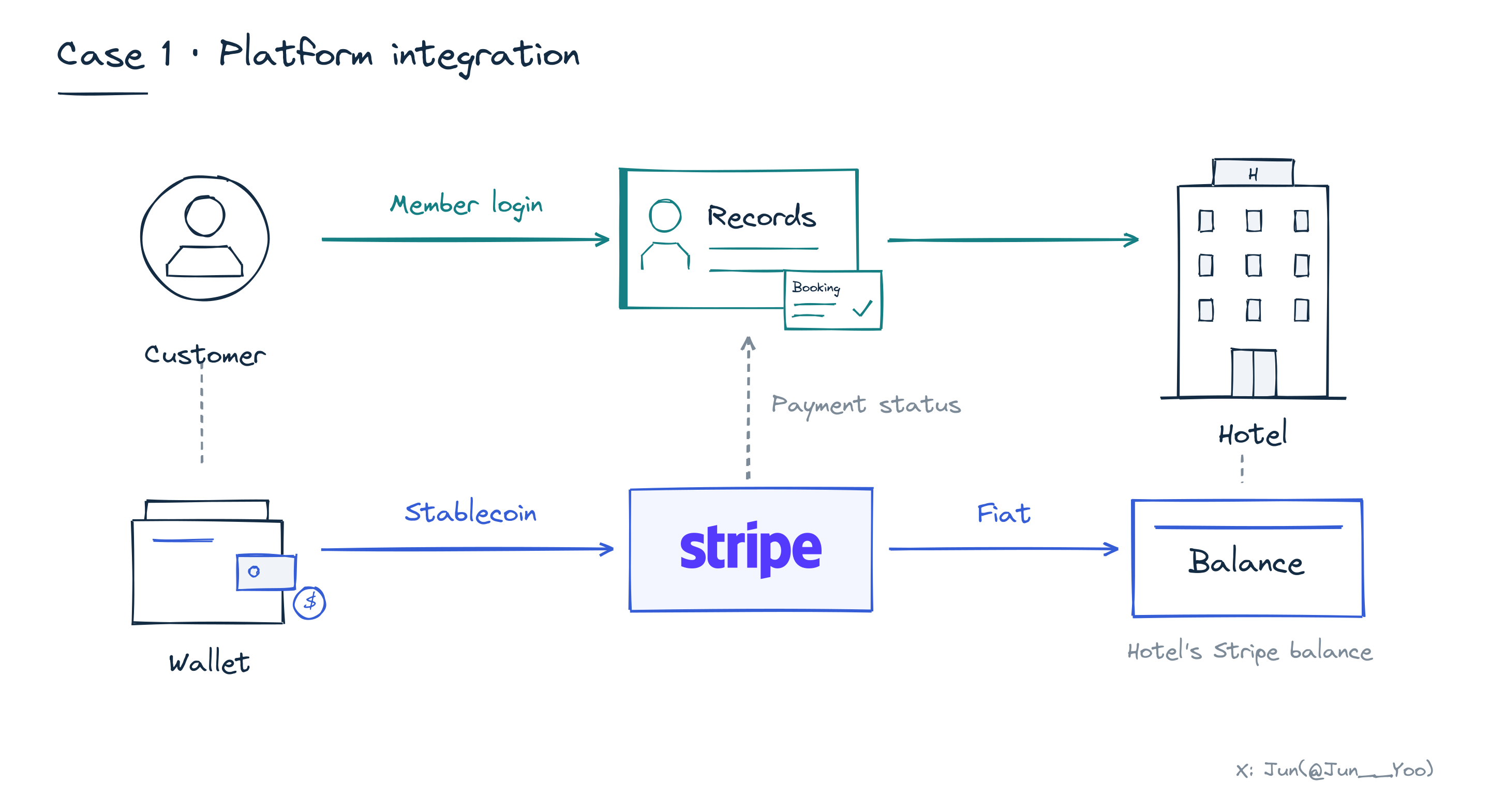
The first approach integrates stablecoin payments into an existing commerce platform’s customer account and order management systems. Because it uses the existing backend infrastructure, it offers the lowest barrier to adoption and a practical implementation path. By mapping payment transactions to existing customer IDs and order IDs, merchants can preserve purchase histories and membership benefits even when payments move to blockchain rails.
Stripe’s (@Stripe, @StripeCrypto) integration with the Machine Payments Protocol (MPP) already follows this structure. It settles stablecoin payments made through Tempo(@tempo) into the merchant’s fiat balance and allows merchants to continue looking up orders and processing refunds through Stripe’s existing APIs and dashboard.
Source: X (@StripeCrypto)
This structure also allows for differentiated rewards that draw on the capital efficiency of stablecoins. Just as Bridge(@Stablecoin)’s Open Issuance returns income from reserve assets to users through incentives, stablecoin balances held in agent wallets could be connected to mechanisms that generate yield in DeFi. Offering users interest income from DeFi that exceeds what is available in traditional finance could substantially increase the incentive to pay with stablecoins.
Native stablecoin payments do not have the chargeback system associated with credit cards built into the protocol. Platforms and merchants must therefore establish their own dispute resolution and refund policies. Even so, this approach can preserve relationship interoperability while minimizing changes to the familiar user experience. I see it as a practical bridge that could help agentic payments gain adoption most quickly.
3. Integration into card networks: Combining existing card relationships with stablecoin settlement
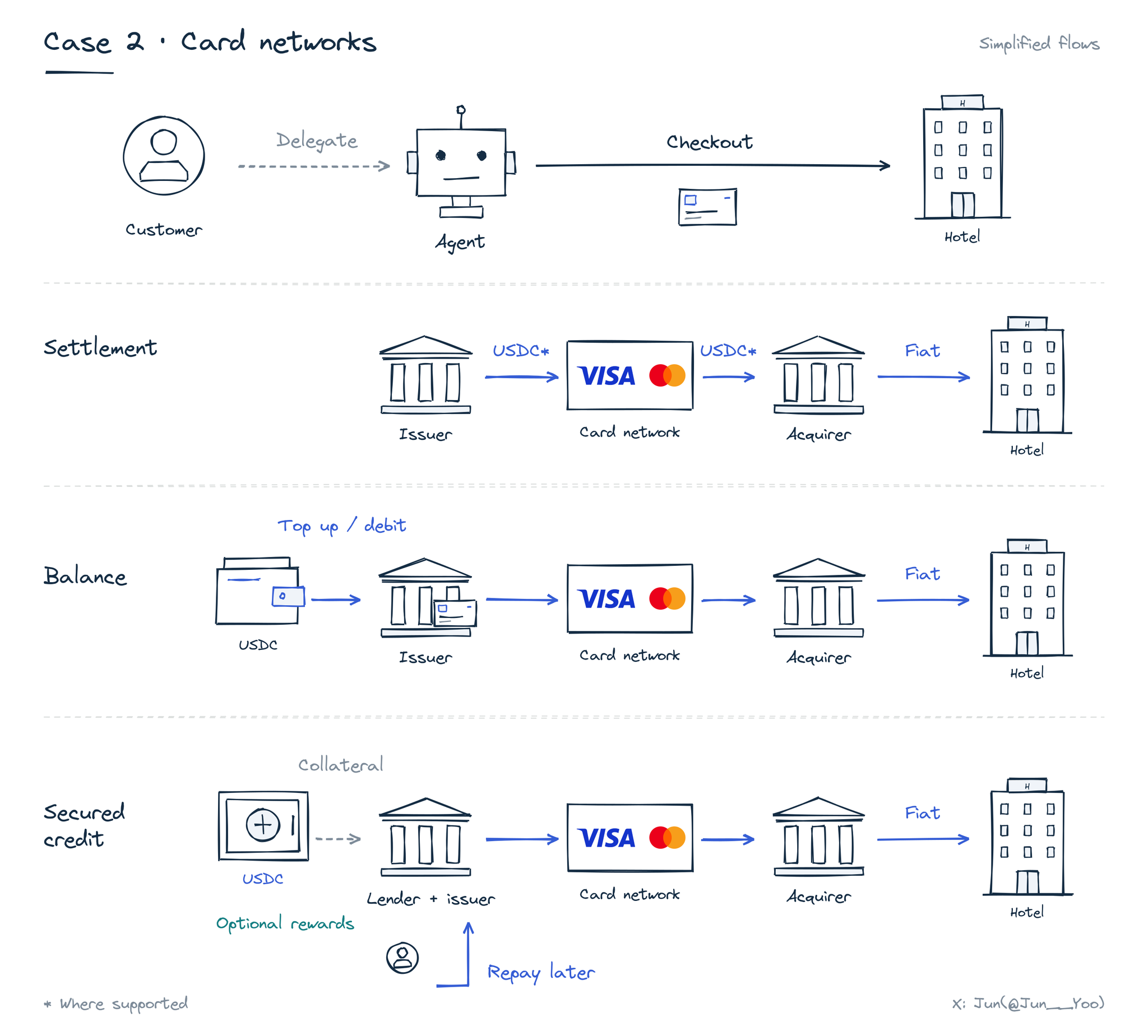
The second approach uses card networks’ payment authorization and dispute resolution systems. Depending on where stablecoins enter the process, it can be divided into three models: settlement, balance spending, and credit.
The settlement model concerns the movement of funds between financial institutions, while the other two concern how consumers fund purchases. These models can therefore be combined.
First, the settlement model introduces stablecoins into the movement of funds between financial institutions. Visa’s USDC settlement program with Cross River Bank and Lead Bank illustrates this approach. Stablecoins replace the backend transfers through which issuers settle with Visa or Visa pays acquirers. Consumers continue using their existing cards and do not need a separate wallet. If extended to agentic payments, merchants could receive fiat or, depending on their agreements with acquirers, receive settlement directly in stablecoins after an agent submits a payment request, as illustrated by Worldpay and Nuvei. This approach combines the settlement efficiency of stablecoins with the existing card network’s payment authorization and dispute resolution systems.
Second, the balance spending model uses a consumer’s stablecoin holdings to fund card purchases immediately. Crypto assets can be converted into fiat and loaded onto a card in advance, as with the Crypto.com Prepaid Card, or stablecoin balances can be deducted and converted in real time at the point of payment, as in the Visa and Bridge model. When an agent pays with the card, the merchant receives payment through the existing card network. Stablecoin settlement between financial institutions can also take place in the backend, as in the collaboration between Bridge and Lead Bank. This is currently the most widely used model for agentic payments through card networks.
Third, the credit model allows consumers to make purchases against crypto collateral or a credit line and repay later. With products such as the Coinbase One Card, consumers can obtain a credit limit secured by stablecoins while earning yield on the collateral. They repay their card balances separately without selling the collateral, while merchants receive settlement according to the card network’s schedule, regardless of whether the consumer has repaid. This model addresses the chargeback and refund issues often cited as weaknesses of blockchain’s immediate finality (atomicity) through deferred settlement that separates payment execution from the final settlement of funds.
Integration with card networks expands the ways stablecoins can be used while drawing on existing merchant networks and dispute resolution systems. Achieving relationship interoperability also requires connecting an agent’s delegated authority to the merchant’s customer accounts and order information. I nevertheless see this as a practical adoption path because it adds the settlement efficiency of stablecoins to the trust and transaction systems that card networks have already established.
4. A native blockchain path: Connecting wallet authentication to membership information and permissions
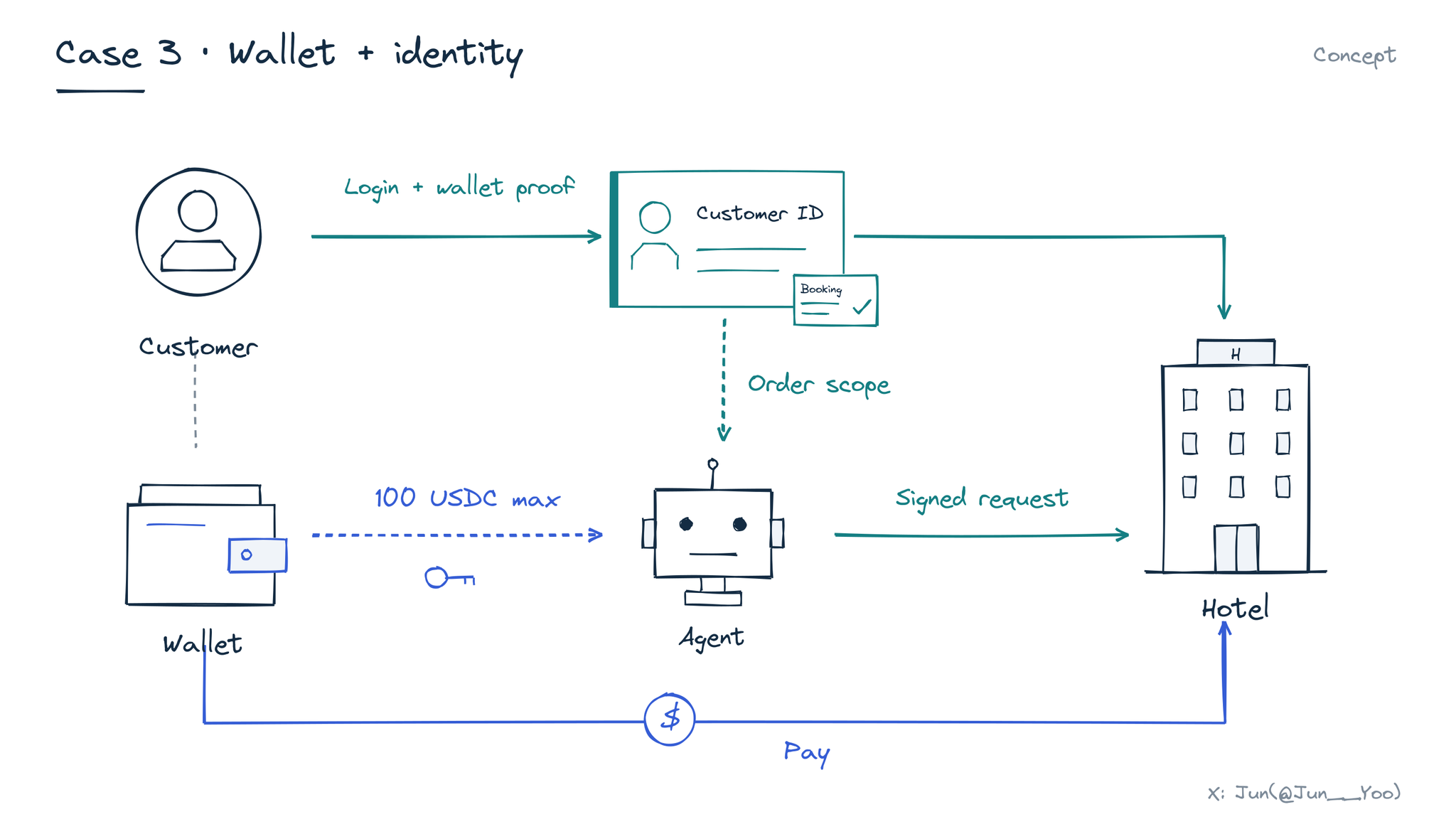
The third approach uses payment protocols built on blockchains, such as x402, that are independent of any single platform. Here, the Web3 wallet becomes the primary means of managing agents, and payments must be explicitly connected to customer relationships through the wallet. x402’s SIWX (Sign-In-With-X) illustrates this direction by verifying control of a wallet so that users can regain access to resources they have purchased.
The design must expand if it needs to establish a customer’s membership tier or the scope of an agent’s delegated authority beyond simply verifying a purchase. It must preserve purchase records and rights using customer IDs and order IDs, while also accounting for wallet changes, account recovery, revocation of delegated authority, and verification of refund addresses.
The level of design required for native blockchain payments therefore depends on how much information the merchant needs from the agent. Where neither KYA nor user KYC is required, wallet identification at the SIWX level may be sufficient. This could apply to API markets, such as headless merchant endpoints, currently excluding expensive APIs such as AI compute. General commerce and other markets, however, may require stronger identity verification and therefore more extensive systems.
5. Conclusion: Bridging Rail Neutrality with Relationship Continuity
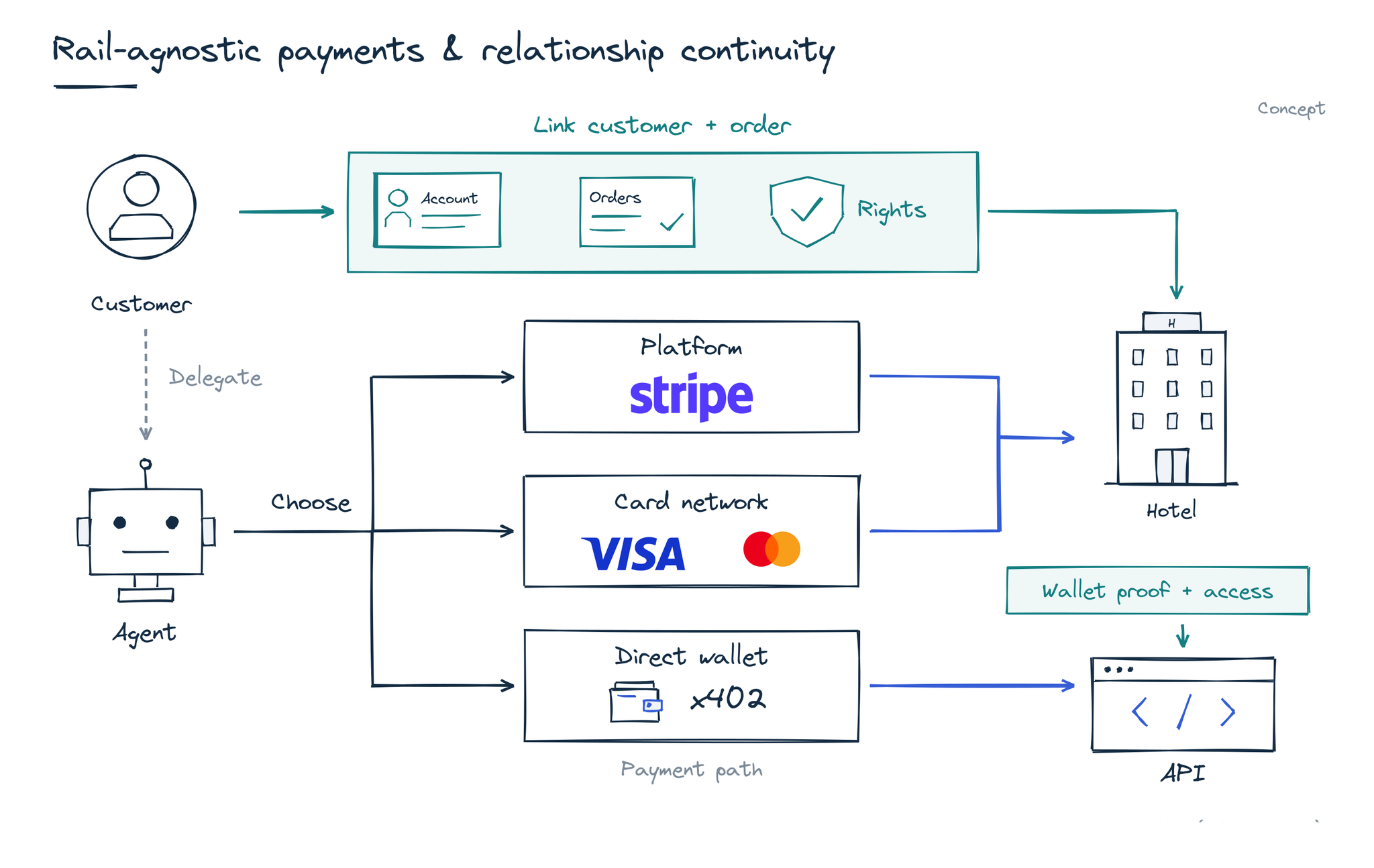
In markets where benefits and purchase protection matter, I see collaboration with existing platforms or card networks as the most practical path to broader adoption. Integrating stablecoins into established systems for identifying customers and managing their rights can preserve a familiar purchase experience while adding the advantages of stablecoins. In API markets where access to a purchased resource is sufficient to establish the transaction relationship, agents make purchases directly, so payment interfaces and processes designed for humans matter less. Native blockchain payment paths that use the programmability of stablecoins to automate service access and payment may take hold earlier in these environments. The appropriate payment path therefore depends on the nature of the transaction and the rights customers expect.
Stablecoins are likely to coexist with existing payment methods, either through integration into platforms and card networks or as independent payment paths. Agents will also select payment methods according to users’ needs and transaction conditions. An important direction here is to remain “rail agnostic,” without depending on a particular payment network.
Access to multiple payment networks alone does not create a complete purchase experience. If changing payment paths disconnects customers from their purchase histories or membership status, or makes it difficult to exercise their rights afterward, the value of greater choice diminishes. As agents use more payment networks, designing for relationship interoperability becomes increasingly important to preserve customer relationships and rights throughout the process.
From this perspective, crypto payments still face unresolved tasks, including connecting customer accounts to purchase records and delegating authority to spend and use services. Whether these functions are implemented on a blockchain or through integration with existing platforms and card networks, the key is to preserve the connection between the customer an agent represents and the rights that result from the transaction.
Without this continuity, stablecoin payments will struggle to move beyond PoC level into actual use in markets where customer relationships and purchase protection matter.
The author of this report may have personal holdings or financial interests in assets or tokens discussed herein. However, the author affirms that no transactions have conducted using material non-public information obtained in the course of research or drafting. This report is intended solely for general information purposes and does not constitute legal, business, investment, or tax advice. It should not be used as a basis for making any investment decisions or as guidance for accounting, legal, or tax matters. Any references to specific assets or securities are made for informational purposes only and should not be construed as an offer, solicitation, or recommendation to invest. The opinions expressed herein are those of the author and may not reflect the views of any affiliated institutions, organizations, or individuals. The opinions and analyses expressed herein are subject to change without prior notice. In addition, beyond the individual disclosures included in each report, Four Pillars, may hold existing or prospective investments in some of the assets or protocols discussed herein. Furthermore, FP Validated, a division of Four Pillars, may already be operating as a node in certain networks or protocols discussed herein or may do so in the future. Please see below links in the footer for FP Validated's participating network disclosures and for broader disclosure details.