


Table of Contents
- 1. Major News
- [Investment] a16z Crypto Rebrands as a16z Frontier, Expanding Investment Scope Beyond Crypto into AI and Other Emerging Technologies
- [Tech] Solana Activates Alpenglow on Mainnet, Ushering in the Era of 150ms Finality
- Others
- 2. Data Spotlight
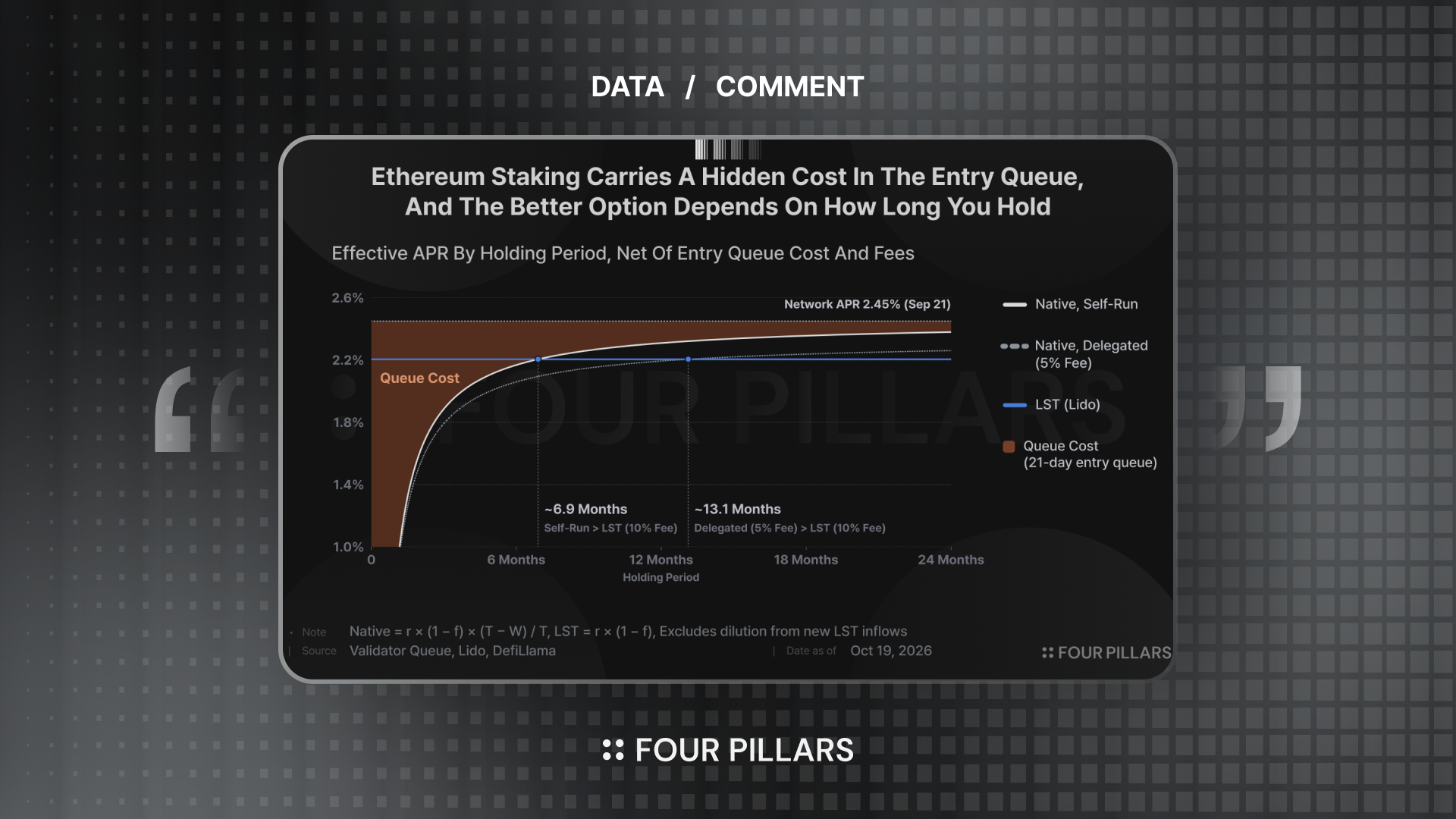
- Ethereum Staking Rewards Carry a Hidden Cost (Link)
- 3. Four Pillars Weekly
- : : Is Robinhood Chain Dead? (Link)
- : : Darkbloom and Yukon: Expanding AI Compute Through Verification (Link)
- : : Standard Reserve: DeFi Was Supposed to Be Fun (Link)
- : : Blackthorn: The Frontier of Confidential AI (Link)
- 4. Macro & Onchain Metrics
Researcher

1. Major News
[Investment] a16z Crypto Rebrands as a16z Frontier, Expanding Investment Scope Beyond Crypto into AI and Other Emerging Technologies
What Happened?
On October 22, a16z Crypto, the crypto investment arm of Andreessen Horowitz (a16z), announced that it would rebrand as a16z Frontier and expand its investment scope beyond crypto into emerging technologies. The change also applies to its fifth crypto fund (Crypto Fund 5), which raised $2.2 billion in May. While continuing its existing crypto investments and regulatory advocacy, the firm plans to back companies developing technologies that could create new markets, including AI, autonomous machines, robotics, and biotechnology.
Chris Dixon, who leads a16z Frontier, cited the mainstream adoption of blockchain technology and the rise of AI as the main reasons behind the expansion. As blockchain becomes increasingly integrated into traditional financial systems, the distinction between crypto companies and conventional fintech firms has become less clear. Meanwhile, AI is reaching a stage where it can create entirely new products and markets rather than simply improve efficiency in existing industries. Dixon highlighted transactions between AI agents and autonomous networks as promising areas, arguing that blockchains could serve as infrastructure for payments and economic coordination within these networks.
Dixon will lead a16z Frontier alongside Marc Andreessen, Ben Horowitz, Eddy Lazzarin, and Guy Wuollet. However, the firm has not disclosed how much capital will be allocated to investments outside crypto. Earlier in July, crypto-focused VC Paradigm also expanded its investment mandate into AI and robotics after raising a new $1.2 billion fund.
Researcher's Comment
The decision by leading crypto VCs to expand beyond the industry reflects the current state of the onchain ecosystem. Growth has increasingly concentrated in two areas: speculative markets such as perpetual futures, prediction markets, and memecoins, and sectors bringing traditional financial demand onchain, such as stablecoins and RWAs. Outside these categories, however, crypto-native projects have struggled to demonstrate sustainable business models. New blockchain infrastructure and applications continue to emerge, but relatively few have translated into meaningful user demand and revenue. For VCs, the reality is that attractive investment opportunities within crypto have become harder to find than in previous cycles.
The shift toward AI is not unique to a16z. Bitcoin mining companies such as IREN, Core Scientific, and TeraWulf are repurposing their existing power and data center infrastructure for AI computing, while crypto-focused investment firms and research organizations are also expanding their AI-related investments and research. This may be a rational decision to capture the enormous technological opportunities presented by AI. At the same time, it also reflects the difficulty of finding opportunities within crypto that offer greater growth potential and profitability than existing businesses.
Interestingly, as crypto moves closer to mainstream adoption, the space for crypto-native businesses appears to be narrowing. Stablecoins and tokenized assets are increasingly being integrated into services offered by traditional financial institutions, while much of the onchain activity that has demonstrated sustainable profitability remains concentrated in financial transactions. The non-financial vision once promoted by crypto, including decentralized social networks, gaming, and consumer applications, has yet to produce markets of comparable significance.
Does this suggest that the crypto industry is ultimately converging toward financial infrastructure? Or is the industry approaching a bottom, with excessive expectations and capital having been washed out, while waiting for entirely new crypto-native markets to emerge? Whether the open internet and decentralized applications that crypto once envisioned will ultimately give way to a financialized industry, or become the foundation for its next phase of growth, remains an open question.
[Tech] Solana Activates Alpenglow on Mainnet, Ushering in the Era of 150ms Finality
What Happened?
On October 21, Solana activated its new consensus protocol, Alpenglow, on mainnet. Developed by Anza, Alpenglow replaces Tower BFT, the consensus mechanism Solana has used since its launch in 2020. The upgrade aims to reduce transaction finality from approximately 12.8 seconds to around 150 milliseconds (ms).
Alpenglow consists of two components: Votor, which handles consensus, and Rotor, which handles block propagation. Under the previous Tower BFT mechanism, validators submitted votes as onchain transactions, and blocks reached finality only after sufficient votes accumulated across multiple slots. Votor, by contrast, allows validators to exchange votes directly and aggregate them into certificates based on BLS aggregate signatures, enabling blocks to reach finality in just one or two voting rounds. By removing vote transactions from blocks, the new mechanism also reduces the communication and processing overhead associated with consensus.
However, only Votor was included in this mainnet upgrade. Rotor, which will be introduced in a later release, is designed to replace Turbine's multi-level tree-based block propagation mechanism with a single relay layer, further reducing data propagation latency. A specific release date has not yet been announced. It is also important to distinguish the 150ms finality target from block production time. The upgrade does not change Solana's transaction execution engine, SVM, or its fee structure.
Researcher's Comment
Alpenglow can be considered one of the most significant technical upgrades in Solana's history. While Solana's previous improvements have largely focused on increasing network throughput, reducing block production times, and optimizing validator clients, Alpenglow replaces the underlying consensus mechanism that determines when transactions become final. Despite Solana's fast transaction processing, finality previously took approximately 12.8 seconds, leading many applications to rely on the faster but weaker confirmed state. Alpenglow addresses this gap by combining fast transaction processing with stronger finality guarantees.
The most immediate practical benefits are expected in payments and onchain finance. For stablecoin payments and physical point-of-sale (POS) transactions, the time required to reach finality directly affects the user experience. Services that depend on finalized states before proceeding to the next operation, such as exchange deposits and withdrawals, cross-chain asset transfers, and onchain collateral management, could also see significantly shorter waiting times. This is particularly relevant for institutional finance, where the time required for a transaction to become irreversible matters more than how quickly it is initially processed. In this respect, Alpenglow could strengthen Solana's competitiveness as financial infrastructure.
However, faster consensus does not automatically translate into higher application throughput or greater user adoption. End-to-end latency still depends on several factors, including transaction propagation, execution, and RPC infrast
Others
Crypto
- Aerodrome and Velodrome merge to launch Aero across seven blockchain networks
- Phantom rolls out Kalshi prediction markets to US users, says it's 'confident and comfortable' amid state lawsuits
Institution
Tech
- Anza's Alpenglow goes live on Solana, cutting finality to 150 milliseconds
- Initia halts network after security incident as attacker reportedly mints tokens
Investment
- Standard Chartered signs definitive agreements to acquire Zodia Custody
- Fireblocks denies report of $2.5 billion acquisition talks with Visa
Asia
- HSBC rolls out its first HKD stablecoin RedCoin to retail users
- Singapore, Malaysia and Thailand central banks expand cross-border stablecoin initiative involving Ripple, Visa and Mastercard
2. Data Spotlight
Ethereum Staking Rewards Carry a Hidden Cost (Link)
3. Four Pillars Weekly
: : Is Robinhood Chain Dead? (Link)
- Launched in July 2026, Robinhood Chain saw daily network fees surge to $8.27M in early September, fueled by the frenzy around stock token-memecoin pairs. However, as memecoin activity cooled and network congestion eased, fee revenue plunged more than 99% from its peak.
- Despite the sharp decline in network fees, Robinhood Chain's core ecosystem remains surprisingly resilient. The USDG Vault continues to hold around $540M in TVL, tokenized stocks maintain roughly $150M in outstanding supply, and memecoins still account for a significant share of spot DEX trading volume.
- Lighter and Arcus, two perpetual DEXs strategically backed by Robinhood, are emerging as potential drivers of the ecosystem's next growth cycle, with trading volumes and open interest (OI) steadily increasing through points programs. The real test will be whether they can retain users and liquidity after their TGEs and airdrops.
- For Robinhood Chain to experience another explosive growth cycle, it needs more than just a stable foundation. Stronger builder support, sustainable activity across existing protocols, and differentiated financial products will be critical. In particular, entirely new onchain financial primitives, much like stock token-memecoin pairs, could become the catalyst for its next wave of growth.
: : Darkbloom and Yukon: Expanding AI Compute Through Verification (Link)

- Darkbloom pools verified idle Macs into an inference network, offering owners additional income and developers an option to lower inference costs.
- Yukon enables researchers and AI agents to run experiments in parallel and reuse verified improvements, while the resulting verifiers and evaluation experience could become a technical moat.
- ECDSA.fail reduced circuit resource costs by 86.1% as of July 26, 2026, while the initial MLX.fast Laguna challenge achieved a 2.6-fold speedup by its August announcement. (Link)
- Applying optimizations verified through MLX.fast to similar operating environments in Darkbloom could increase throughput and improve price competitiveness without adding more Macs. (Link)
: : Standard Reserve: DeFi Was Supposed to Be Fun (Link)

- Standard Reserve (SR) is a DeFi protocol that uses capital raised through trading its STANDARD token to provide liquidity for tokenized stocks on Robinhood Chain. The ambition is to turn speculative activity into a business that earns revenue from equity trading.
- SR revisits the failed token economies of the last DeFi cycle with adaptive issuance, token burns, and buybacks that respond to capital flows. In its first five weeks, license burns exceeded issuance, while seven of ten epochs directed fees toward buybacks.
- We spoke directly with SR co-founder 0xBeans for this report. He shared details not found in the public documentation, including arrangements with arbitrage firms, the extent of Robinhood's support, and plans to secure stock-token mint and redemption rights.
- The investment thesis rests on SR becoming a major liquidity provider for tokenized equities, with trading revenue flowing back to STANDARD. Today that distribution is still partly discretionary; the team is seeking mint/redeem access to make more of the process enforceable.
: : Blackthorn: The Frontier of Confidential AI (Link)
- In most AI services, the prompts users submit are processed in plaintext inside the provider's trust boundary. Regulation, the value of data, and the actual behavior of enterprises all point to a structural demand for confidential AI. Yet the number of confidential GPUs that can actually be rented today is estimated at roughly 600 to 4,500 worldwide, which is only about 0.04% of the GPUs capable of confidential computing.
- Existing confidential AI architectures place x86 CPU trusted execution environments (TEEs) such as Intel TDX and AMD SEV-SNP at the center of the trust chain. Since 2020, however, these chips have been repeatedly broken by attacks that include key extraction and attestation forgery. Arcium Blackthorn is designed as an architecture that removes the CPU TEE from the trust chain entirely and replaces it with multi-party computation (MPC) that provides malicious security.
- Blackthorn reduces the trust chain to just two elements: the device identity key burned into the silicon of NVIDIA GPUs, and the cryptographic threshold of the Cerberus MXE(Multi-party eXecution Environment). The host CPU serves only as a relay that forwards doubly encrypted ciphertext, and deployment requires nothing more than a software upgrade, with no new hardware. This opens confidential inference to the bare-metal Hopper and Blackwell fleets that neoclouds and enterprises already operate, a pool far larger than the roughly 2,000 confidential GPUs on the market today. GPUs running under virtualization, which still cannot enter confidential computing mode, stay outside this pool.
- Blackthorn still assumes hardware trust in the GPU's confidential computing mode, and its most important remaining task is validation on real hardware. Arcium's long-term roadmap points to purely cryptographic execution built on Manticore, with no hardware trust at all. Until that performance gap closes, Blackthorn is positioned as the real-time confidential AI architecture deployable today with the lowest trust requirements.
4. Macro & Onchain Metrics
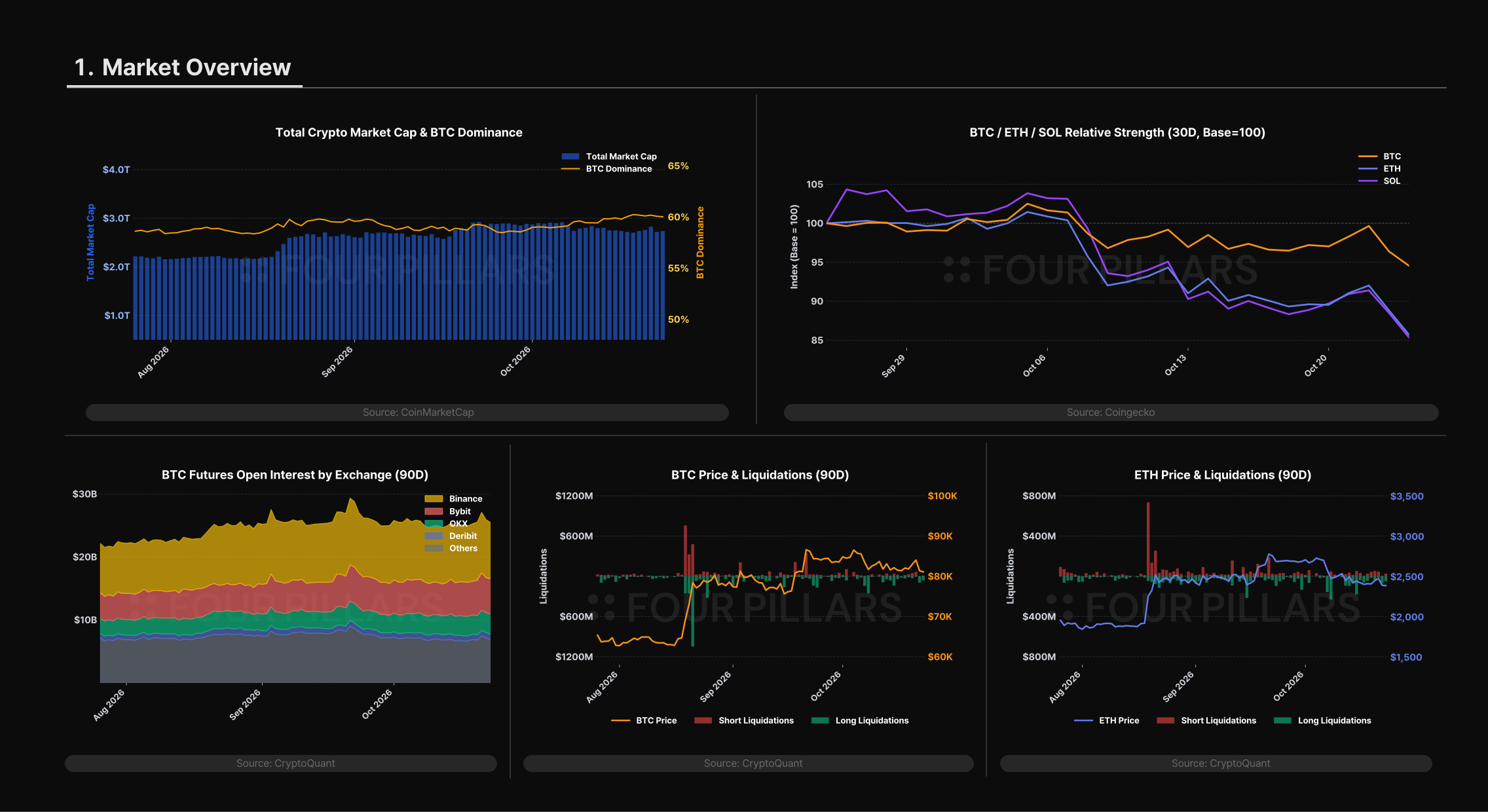
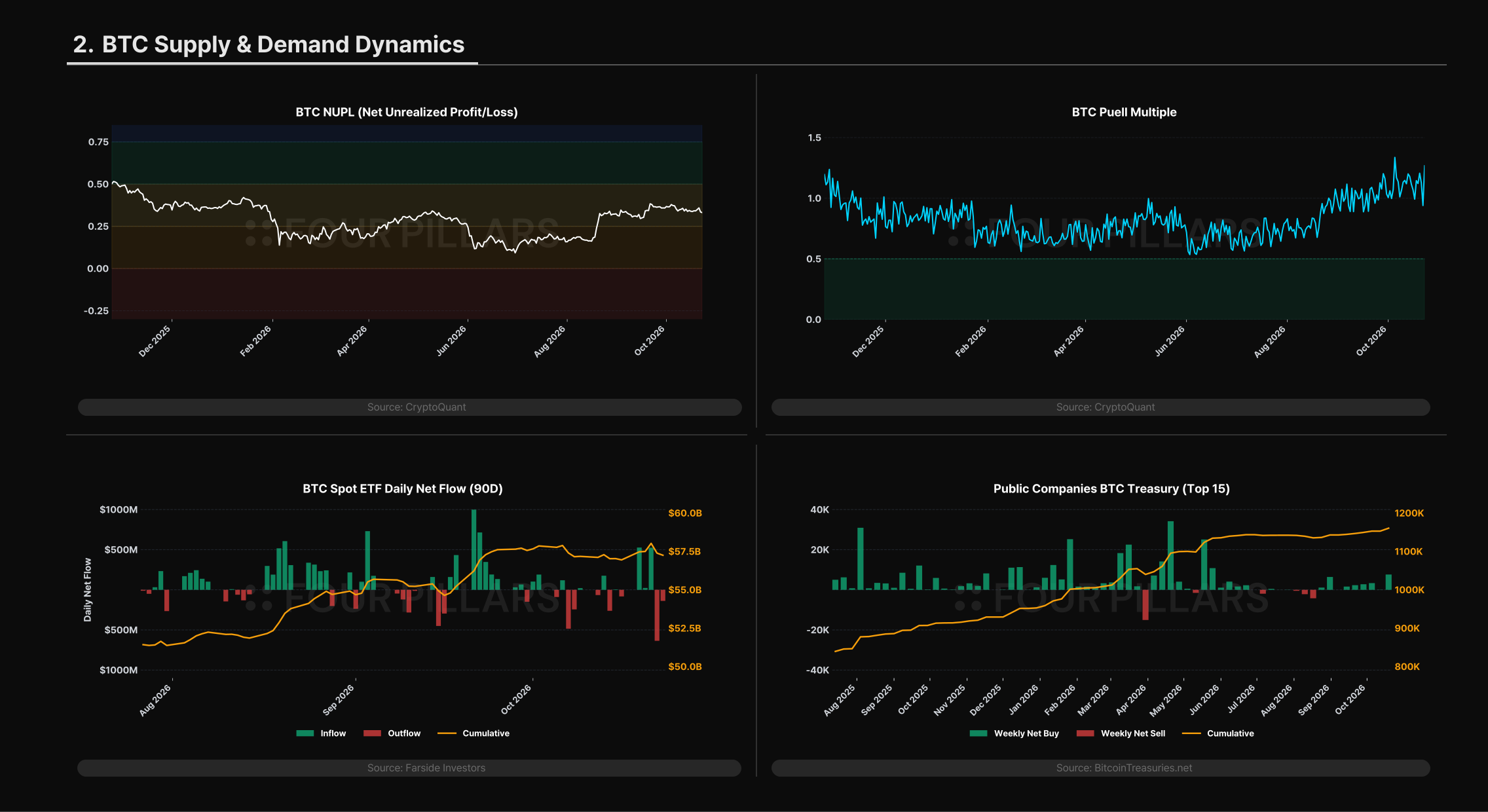
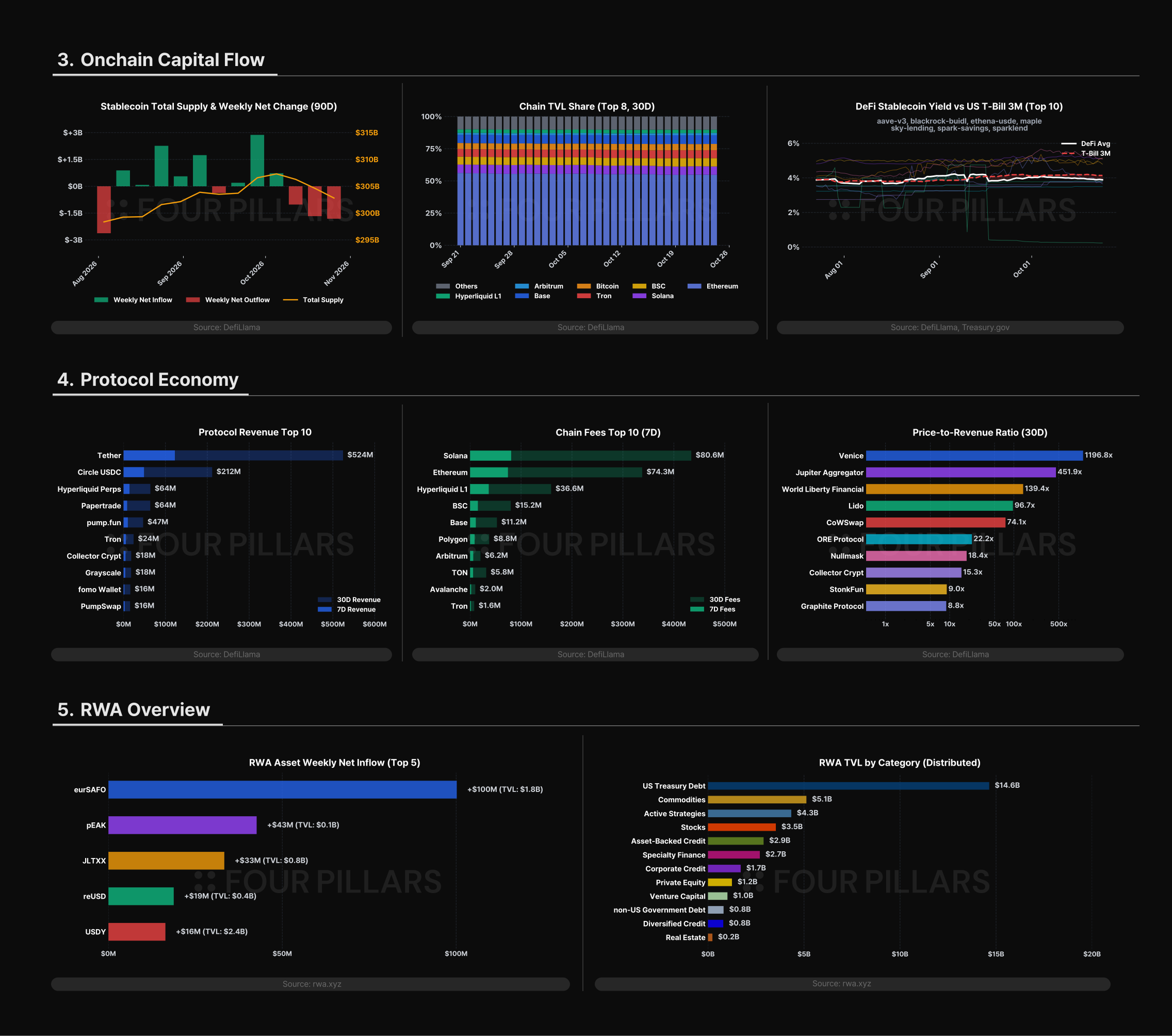
Some of the charts below are powered by CryptoQuant. For those interested in exploring the underlying data in greater detail, CryptoQuant provides access to a comprehensive suite of onchain and market analytics used by institutional participants.
The author of this report may have personal holdings or financial interests in assets or tokens discussed herein. However, the author affirms that no transactions have conducted using material non-public information obtained in the course of research or drafting. This report is intended solely for general information purposes and does not constitute legal, business, investment, or tax advice. It should not be used as a basis for making any investment decisions or as guidance for accounting, legal, or tax matters. Any references to specific assets or securities are made for informational purposes only and should not be construed as an offer, solicitation, or recommendation to invest. The opinions expressed herein are those of the author and may not reflect the views of any affiliated institutions, organizations, or individuals. The opinions and analyses expressed herein are subject to change without prior notice. In addition, beyond the individual disclosures included in each report, Four Pillars, may hold existing or prospective investments in some of the assets or protocols discussed herein. Furthermore, FP Validated, a division of Four Pillars, may already be operating as a node in certain networks or protocols discussed herein or may do so in the future. Please see below links in the footer for FP Validated's participating network disclosures and for broader disclosure details.


