

Table of Contents
Researcher

Key Takeaways
- Standard Reserve (SR) is a DeFi protocol that uses capital raised through trading its STANDARD token to provide liquidity for tokenized stocks on Robinhood Chain. The ambition is to turn speculative activity into a business that earns revenue from equity trading.
- SR revisits the failed token economies of the last DeFi cycle with adaptive issuance, token burns, and buybacks that respond to capital flows. In its first five weeks, license burns exceeded issuance, while seven of ten epochs directed fees toward buybacks.
- We spoke directly with SR co-founder 0xBeans for this report. He shared details not found in the public documentation, including arrangements with arbitrage firms, the extent of Robinhood's support, and plans to secure stock-token mint and redemption rights.
- The investment thesis rests on SR becoming a major liquidity provider for tokenized equities, with trading revenue flowing back to STANDARD. Today that distribution is still partly discretionary; the team is seeking mint/redeem access to make more of the process enforceable.
DeFi used to keep us up at night. In 2020 and 2021, every few weeks someone shipped a mechanism that changed how we thought about money. Vote-escrow, bonding, liquidity mining. Some of it was brilliant, some of it was catastrophically stupid, but it all demanded us to think.
Five years later, we have better infrastructure, deeper capital, and an endless parade of launchpads, perp DEXs, and stablecoins. Somewhere along the way, we mistook the failure of badly designed token economies for proof that designing token economies was itself a mistake. The experimentation that once defined DeFi gave way to safer, more predictable businesses.
Standard Reserve (SR) is a rare attempt to pick up where that era left off. It takes the mechanisms that broke last cycle, redesigns them around the failures we now understand, and puts the resulting capital to work making markets for tokenized stocks on Robinhood Chain. It is the kind of ambitious, unapologetically DeFi experiment we rarely see anymore.
We have no idea whether it will succeed. But for the first time in years, we found ourselves excited to read a whitepaper again.
Here is why.
1. The Lost Art of Mechanism Design
1.1 The Genesis of Standard
SR co-founder 0xBeans left college to join Coinbase during the 2018 bear market, then moved onchain around 2020 to work on open-source DeFi. He spent years building games and mechanisms in smart contracts, including a 2022 residency with Paradigm. The two later founded Frame, whose technology became part of Abstract after an acquisition by Igloo.
That experience shaped SR in a way its whitepaper does not fully explain. In our conversation, Beans described the frustration of building inside a larger organization, where decisions increasingly depended on people outside the founding team. He left, chose not to raise outside funding for SR, and went back to building directly onchain.
The design draws openly from earlier DeFi experiments. Olympus inspired its issuance and protocol-owned liquidity (POL), while other mechanisms came from the AMM experiments of the last cycle. But Beans's more interesting question is what happens if the incentives that once supported markets for freshly minted tokens can instead attract assets with value outside crypto. As he put it to us, if those designs managed to operate for years using internally created incentives, why couldn't improved versions support liquidity for stocks such as SK Hynix or Alibaba? He does not claim to have proved the answer.
Liquidity is where that question becomes a business. Most tokens launch with so little of it that buying or selling in size moves their price violently. Beans wanted SR's launch to show what deep, protocol-owned liquidity could change. His longer-term objective is less circular, in his words: "We need revenue, not just from the circular mechanism, but from external places."
That external business begins with tokenized stocks. In Beans's view, tokenization and liquidity are inseparable. A stock token without a liquid market is difficult to build anything on top of: no useful derivatives, lending markets, or trading pairs. Issuers he has spoken with tend to measure success in assets under management, not how well their tokens trade. Someone else has to solve the liquidity problem. More importantly, without a reliable market in which collateral can be sold, lending against those stocks is difficult to support.
He wants SR to be that someone. An issuer brings a stock onchain; SR seeds a market for it, attracts outside liquidity, and earns a fee as trading passes through the pool. Over time, charter holders could launch instruments built on those markets and share in their fees, while the reserve could extend lending against tokenized stocks. Those are ambitions, not products operating at scale today, but they explain why SR is being built as more than a token with a treasury.
There is also evidence of execution. Beans authored URC-5, a standard merged into Uniswap's URC repository on October 18. Tokens using pool restrictions have historically broken routing when aggregators could not tell which pools were permitted; URC-5 gives routers a way to simulate that restriction before submitting a trade. Beans says roughly 300 tokens adopted the standard shortly after the merge. It is open-source, so adoption does not belong to SR alone, but it solves a problem the team encountered firsthand. In the same five-week period, SR launched S-Bills, moved reserve assets into stocks, opened three stock markets, and introduced a launchpad that recorded ~2,000 token launches in its first week.
1.2 Speculation, Banked
For all its moving parts, SR's design has a straightforward structure. It collects capital, rewards the participants who operate the system, and deploys that capital into external markets. The flow of ETH through STANDARD's trading pool determines how the system responds.
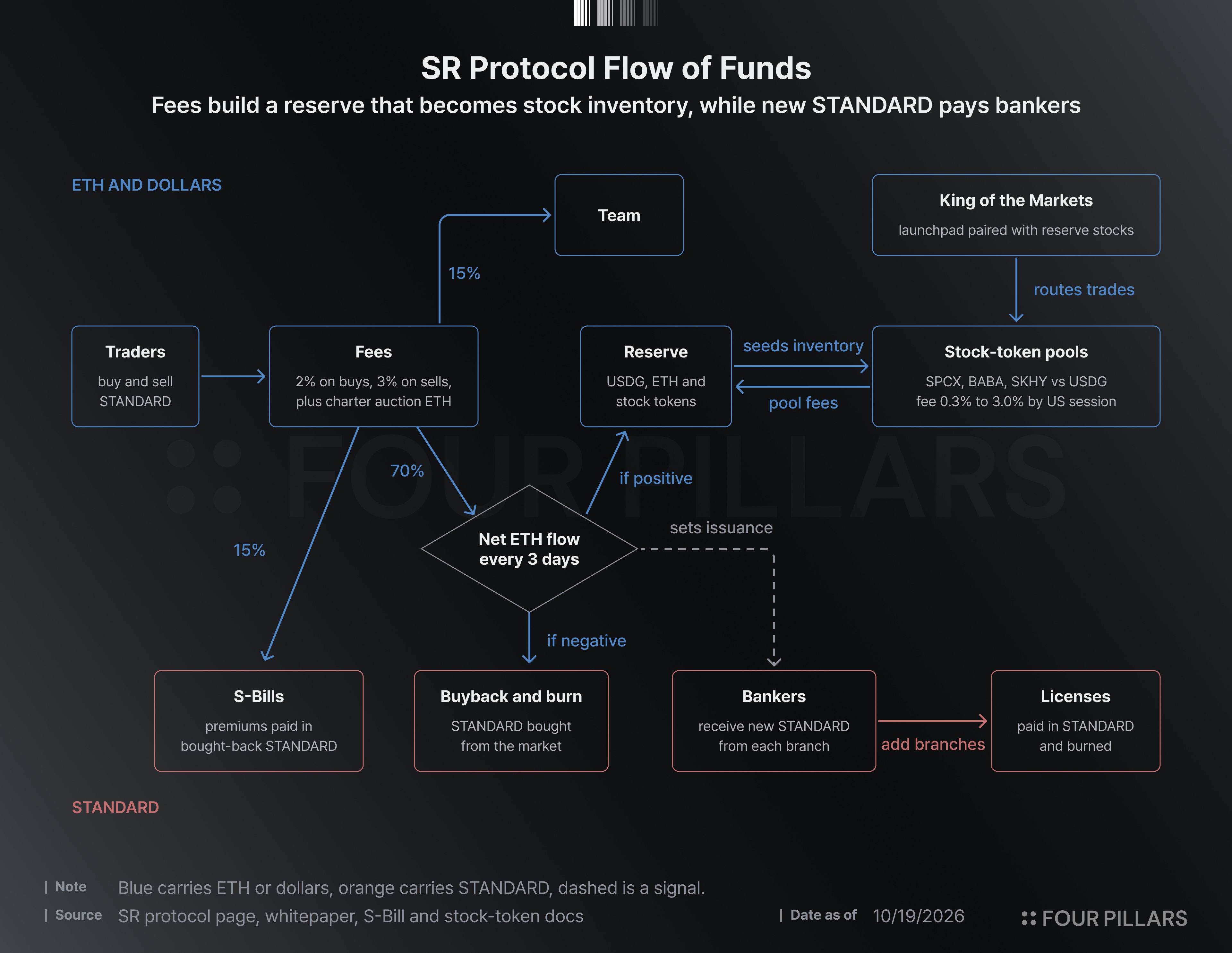
Capital collection begins with the token itself. At genesis, SR placed 100M STANDARD into a Uniswap v4 pool against ETH, with no ETH on the other side. Every purchase added ETH to the pool, building liquidity that the protocol cannot withdraw. Trading also generates income. Buyers pay a 2% fee and sellers pay 3%, both in ETH.
The participants who earn newly issued STANDARD are called bankers. To become one, a user must acquire a charter, an NFT sold through daily ETH auctions that allows its owner to operate up to ten branches. Each branch earns an equal share of a base issuance rate of 700,000 STANDARD per day, adjusted by the protocol's issuance multiplier. A charter starts with one branch, and opening additional branches requires licenses purchased through daily auctions in STANDARD, which is burned.
These rewards accumulate within the charter and are minted into transferable STANDARD only when a banker closes branches to withdraw them. Doing so also forfeits the future rewards those branches would have earned. Withdrawals carry an exit fee that rises from 2% toward 60% as more bankers exit, with half burned and half distributed to those who remain. The design makes leaving increasingly expensive when others are doing the same.
For holders who do not want to operate branches, SR offers S-Bills. These allow users to lock STANDARD for 15 days and earn a premium from a separately funded token budget, with the rate determined by auction. Unlike banker issuance, S-Bill premiums do not require minting new tokens.
The direction of capital flows determines what the protocol does with its income. Every three days, SR closes an epoch and measures the net ETH entering or leaving STANDARD's pool. When inflows exceed outflows, 70% of protocol ETH revenue goes to the reserve. When outflows exceed inflows, that 70% instead funds buybacks that remove STANDARD from circulation. Another 15% funds purchases of STANDARD for the protocol's incentives system, while the remaining 15% goes to the team. Revenue includes trading fees and charter auction proceeds.
The same capital-flow signal also governs issuance. The multiplier increases gradually after consecutive positive epochs but falls immediately after a negative one. As capital leaves, SR reduces new issuance while directing more income toward buybacks. When capital returns, issuance can recover and the reserve begins accumulating assets again.
The reserve puts that capital to work. Revenue collected during expansion periods is deployed as liquidity for tokenized stocks. SR's launchpad extends the model by pairing new tokens with stocks held by the reserve instead of ETH, directing additional trading activity through its stock pools. Each trade routed through those pools creates another opportunity for the reserve to earn fees.
SR describes itself as an onchain central bank, and the analogy captures its ambition. STANDARD trading finances the system, monetary rules govern issuance and capital allocation, and the reserve uses its balance sheet to support markets beyond STANDARD itself.
1.3 Lessons of the Last Generation
The ingredients are familiar. SR's reserve, branches, and exit fees all have ancestors in the reserve tokens, node protocols, and reflexive staking designs of the last cycle. What makes SR interesting is not that these ideas are new. It is that their best-known failure modes have explicit answers in the design.
Our conversation clarified the wager behind that redesign. Beans argues that systems like Olympus and Curve kept participants engaged for longer than is now remembered, despite relying heavily on token incentives created within crypto. He wants to test whether similar incentives can draw stock inventory and outside capital into lasting markets.
However, there is a real tension here. STANDARD still finances the initial system through speculation, and the external business must eventually become large enough to justify that financing.
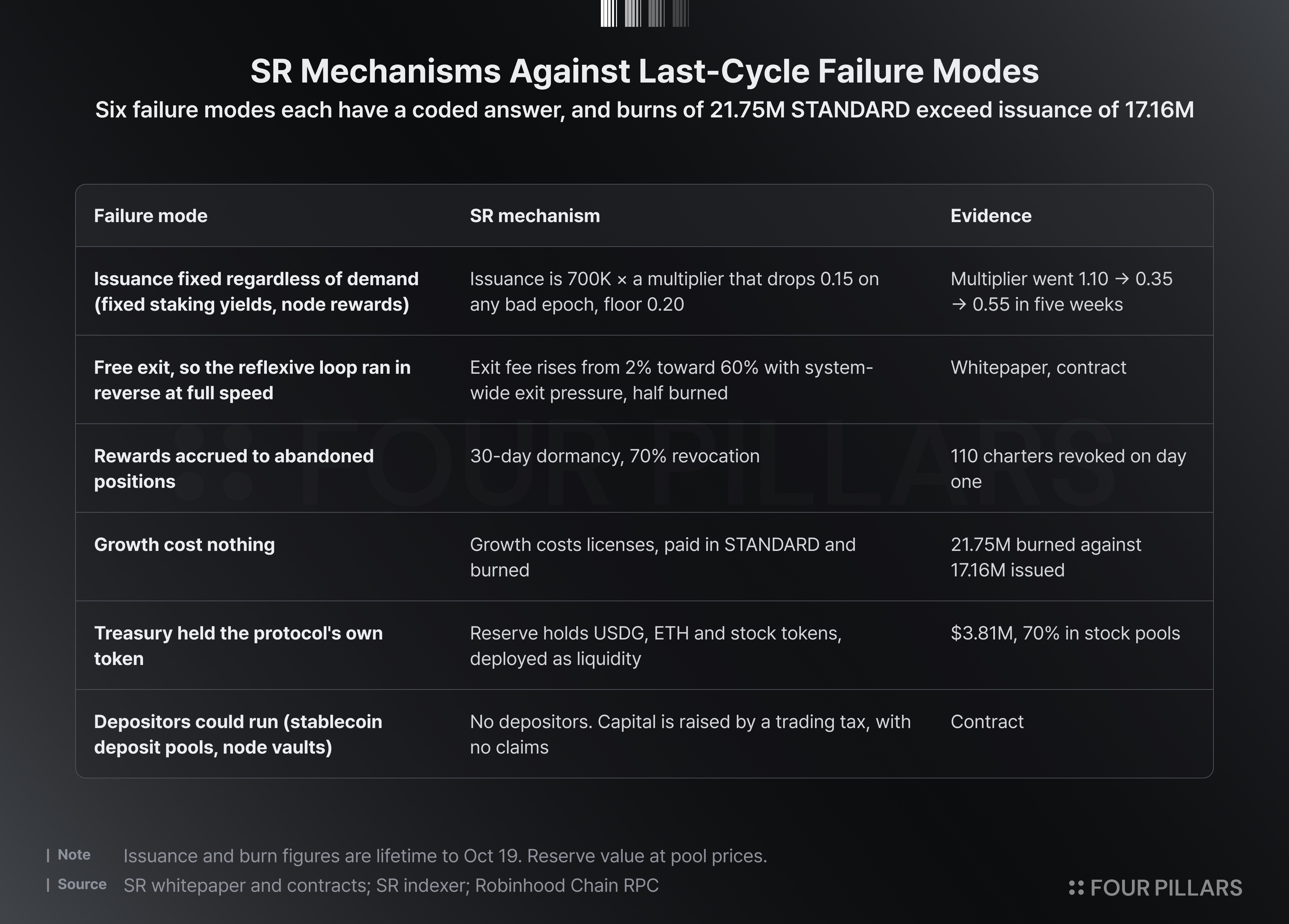
The first five weeks have tested the design in the direction it was built to handle. STANDARD fell 39% between its launch-day close and October 10. Over that period, the issuance multiplier dropped from 1.10 to 0.35 before recovering to 0.55. Seven of the first ten completed epochs sent fees toward buybacks. License burns exceeded issuance, and 110 dormant charters were revoked within 63 minutes of the first eligible block.
That said, this does not yet establish that the resulting economy can survive a prolonged downturn, much less attract enough new demand to grow.
2. A Reserve for Every Stock
2.1 Why Robinhood Chain
Robinhood Chain is only 3.5 months old, yet it is already the 3rd largest venue for onchain spot trading, with $34.6B in DEX volume over the 30 days to October 19 and $1.05B in TVL. Most of that trading is not in stocks. What distinguishes the chain is the 188 stock tokens Robinhood has issued on it, available for continuous trading in more than 120 countries outside the United States.
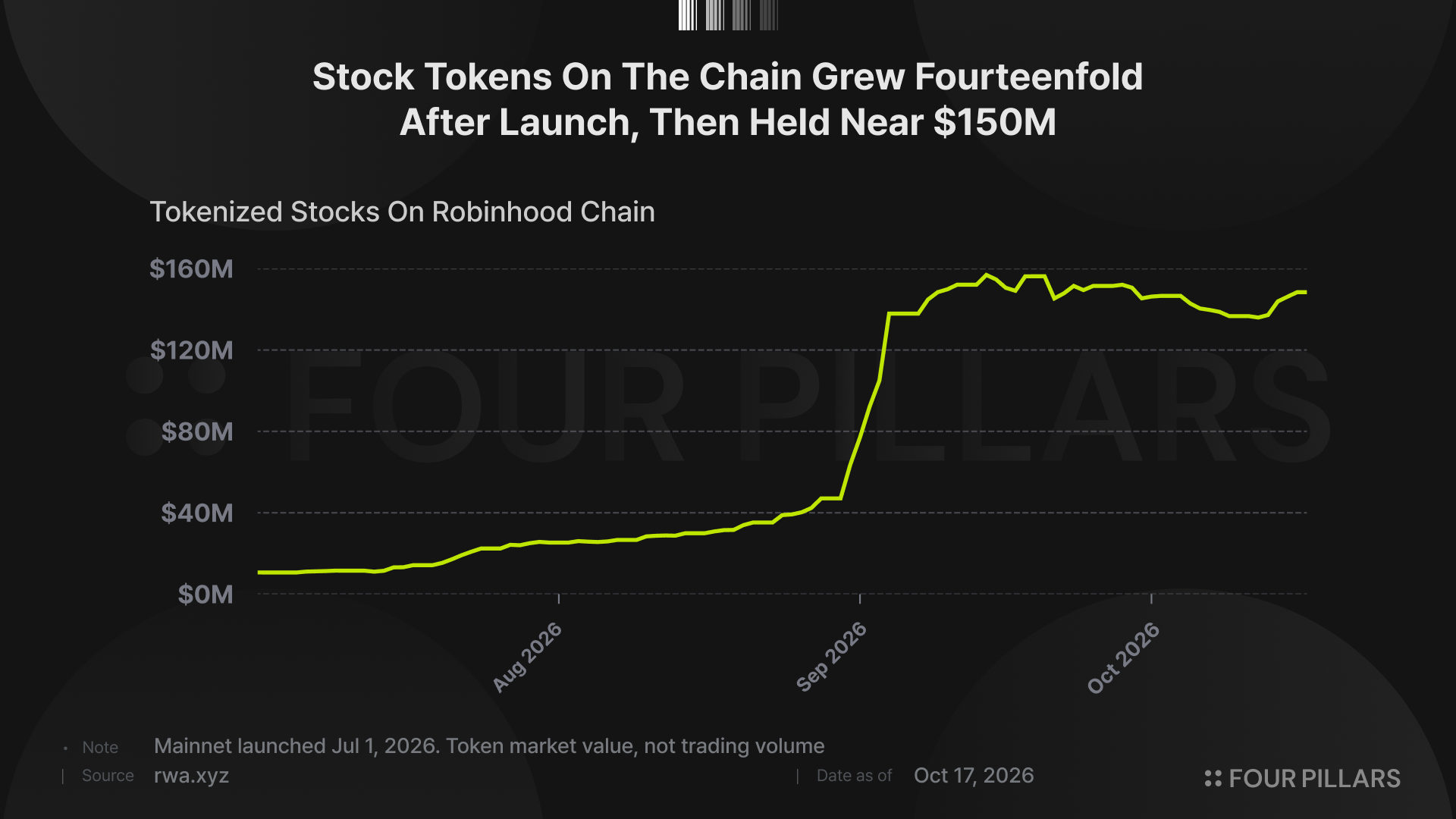
Robinhood has been explicit about the direction it wants to take. On its July 29 earnings call, Vlad Tenev called Robinhood Chain "the first chain purpose built for real world assets" and said the company intended to "make them fully DeFi enabled." The value of stock tokens on the chain grew from $14.2M in mid-July to $148.4M by mid-October. For context, Robinhood customers traded $335B of US equities in August 2026. The SEC's September exemption for tokenized securities, which requires tokens to carry full shareholder rights, offers one potential regulatory route for some of that broader equity activity to reach onchain markets.
Issuing a stock token, however, is not the same as giving it a market. Liquidity must come from somewhere, and someone must be willing to hold inventory when trading becomes difficult. SR is an attempt to fill in that hole.
SR's starting premise is that stock markets should not cost the same to make at every hour of the week. During US market hours, liquidity providers can price and hedge against an active underlying market. Overnight and on weekends, that reference market is closed.
The initial hook schedule reflected that distinction: 0.3% during regular hours, 0.6% in extended hours, 1.5% overnight, and 3.0% over the weekend. These were the original published rates, not an immutable schedule. Beans told us the team now monitors its share of order flow through a keeper and adjusts pool fees when competition warrants it. A pool can be cheaper during the session and charge more for weekend inventory risk.
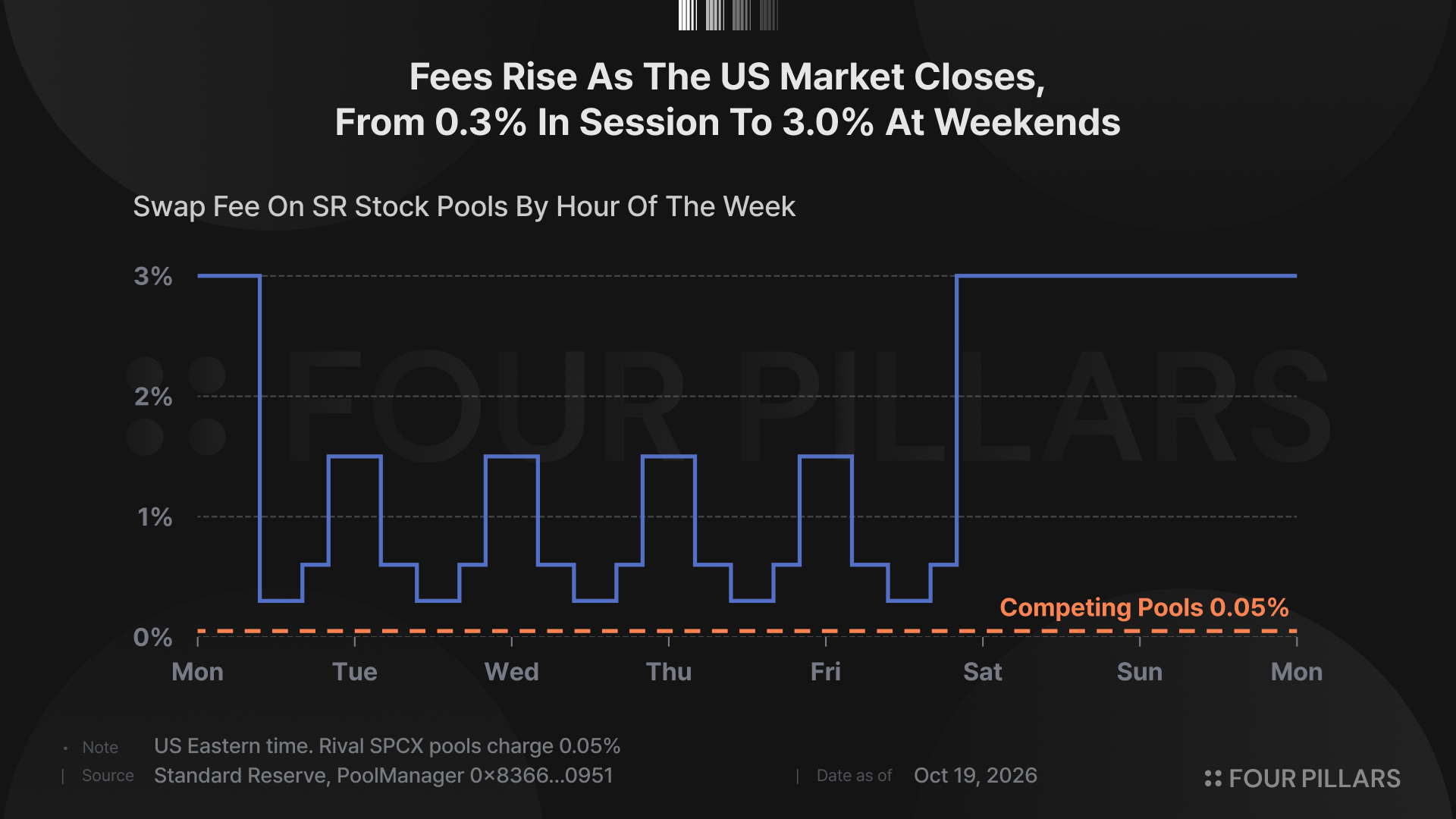
SR reserve’s funding model has no depositors who can demand their capital back, allowing it to hold stock inventory through periods when conventional liquidity providers may be less willing to do so. Session-based fees are the price it charges for taking that risk.
Other chains approached Beans after the whitepaper. His choice of Robinhood Chain came partly from a practical preference for EVM composability, where other developers can build on SR's liquidity and contracts, and partly from the people he expected the chain to attract. He wanted experienced DeFi users as well as short-term traders. He also regarded Robinhood's focus on issuing stock tokens as a better fit than a grant from a larger ecosystem.
There is an actual working relationship, although it should not be confused with a formal endorsement. Beans said the teams share a Slack channel and that Robinhood has helped with introductions, including to potential integration partners, and with access to stock-token APIs. He was equally clear about the limits: Robinhood has not promised to supply liquidity or co-sign SR. The thesis therefore rests on SR building the business itself, even while it benefits from the chain's distribution and asset pipeline.
2.2 Early Returns
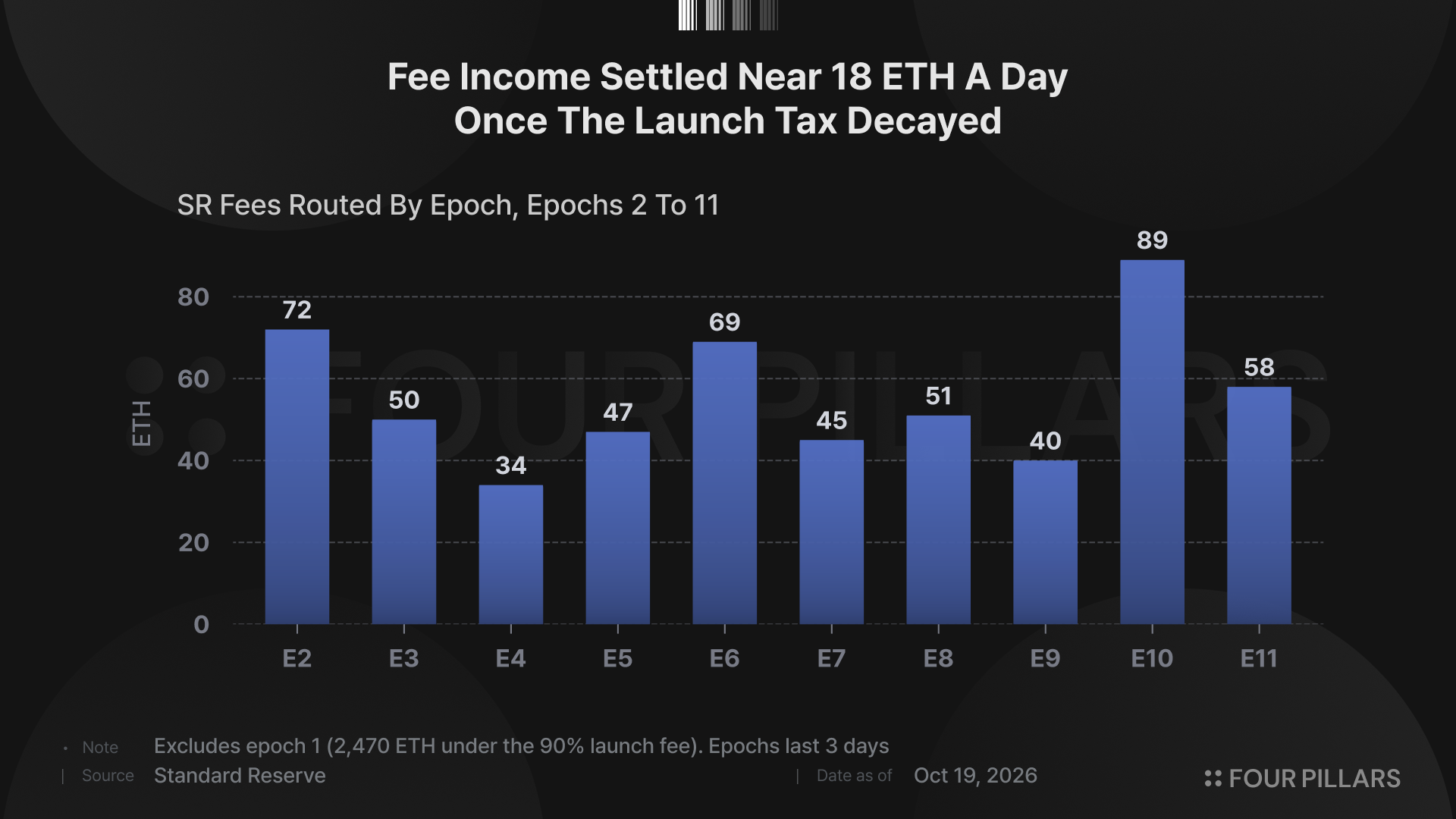
Fees have raised 3,023 ETH in SR's lifetime, 82% of it in the launch epoch under a 90% opening fee that decayed within an hour, and have since settled at about 18.4 ETH a day.
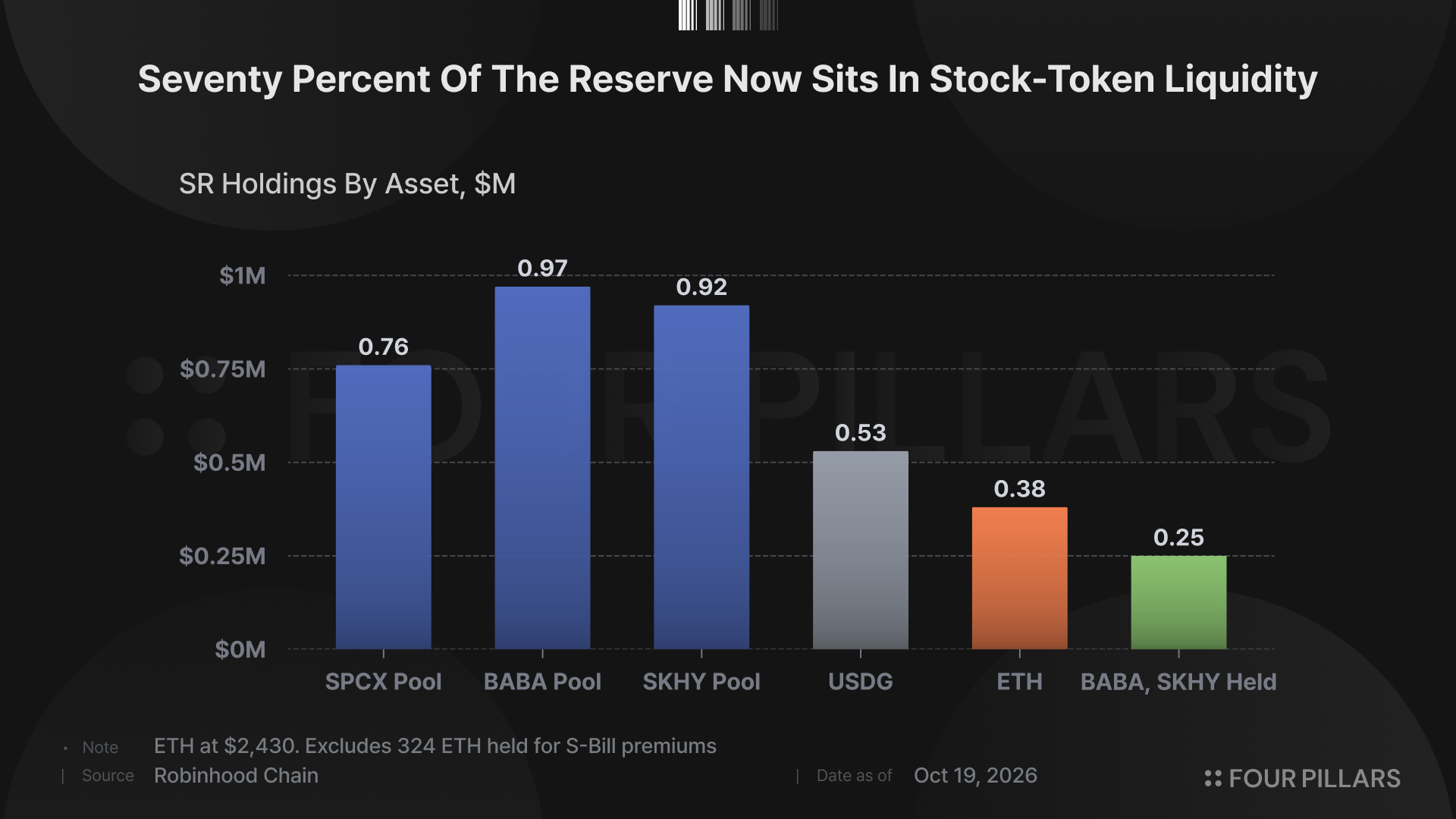
On October 13–14, the reserve put that capital to work. It sold approximately 1,318 ETH for USDG, acquired SpaceX, Alibaba, and SK Hynix tokens, and seeded markets for all three with about $2.73M in a single transaction. The reserve holds closer to $5M across currently dispersed accounts, with another ~$5M in effectively locked protocol-owned liquidity (POL). Those are separate pools of capital: the latter is not an additional $5M available for new stock listings. The team intends to consolidate the dispersed reserve funds.
The liquidity is meaningful relative to the markets available today. For Alibaba and SK Hynix, SR's pools hold more than fifteen times as much liquidity as the next-largest pool on the chain. SpaceX is the exception: a competing Uniswap v3 pool charging 0.05% is larger.
In their first five days the three pools traded $13.6M and earned $32.8K in fees for the reserve. The volume was front-loaded. 58% of the pools' volume in their first fourteen hours came through the launchpad, and launches had faded by the third day, after which the pools settled at $150K to $300K of volume and $1K to $1.5K of fees a day.
Against two competing Uniswap pools charging 0.05%, our earlier snapshot showed SR's SpaceX pool taking 17% of regular-hours volume and 8% on weekends. The team has since changed fees. Beans estimated on our call that its adjusted pools were capturing around 40% of flows during regular hours and about 10% on weekends, when higher fees could make lower volume more profitable. Those figures are founder-reported, cover a later period, and are not directly comparable to our SpaceX-only snapshot.
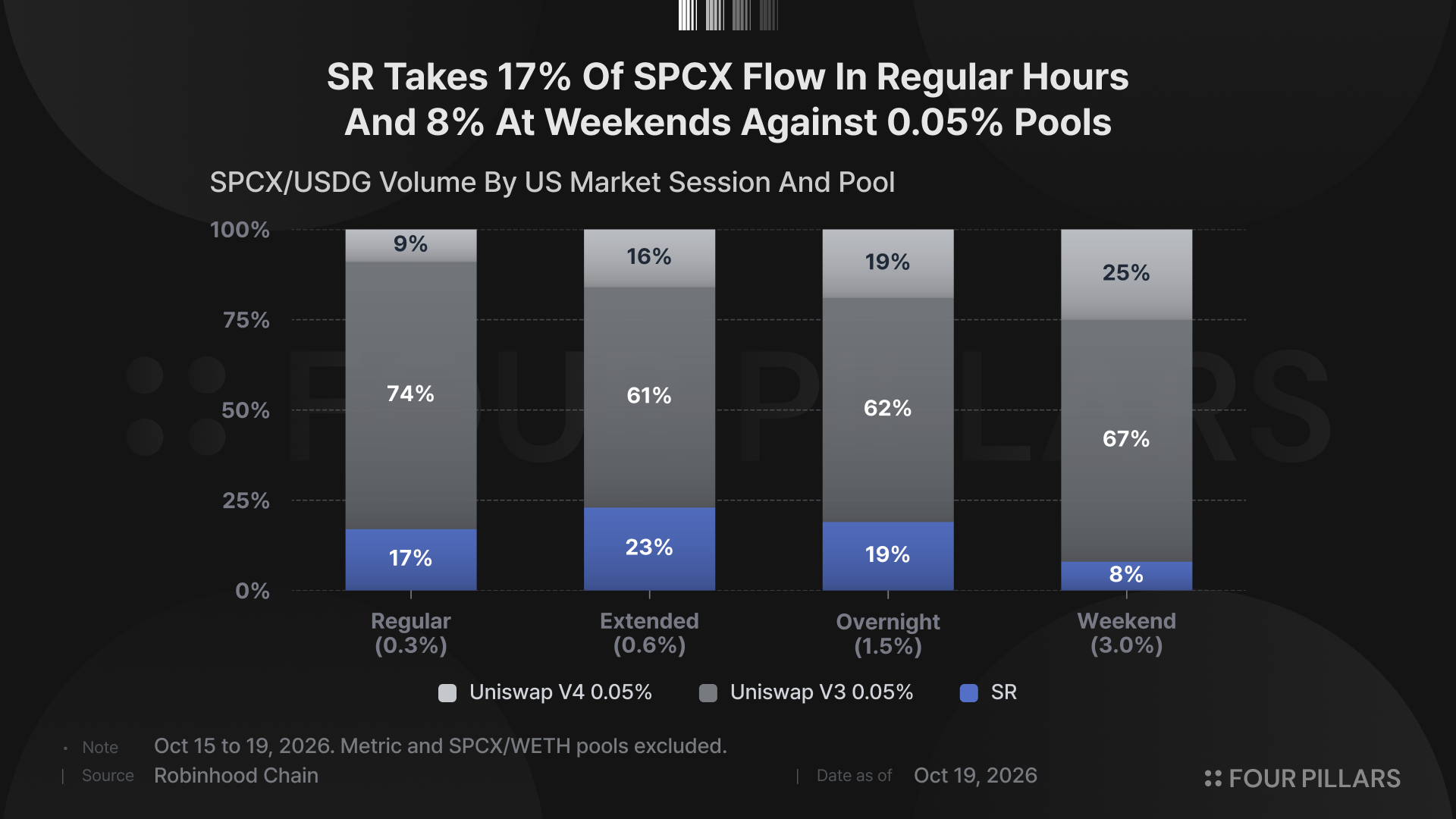
The mechanism is as follows. A $20–$50 trade may find a cheaper route through a low-fee pool. For a larger order in a thinner name such as Alibaba or SK Hynix, SR's depth can offset a higher fee through lower slippage. For SpaceX, which faces stronger competition, Beans said the team cut the regular-hours fee to win more orders while retaining a higher weekend charge. The goal is fee income, not maximum volume at any price.
SR is also testing a less conventional revenue line. Beans said the protocol grants selected delta-neutral firms a fee bypass when they arbitrage its stock pools, in exchange for 80% of their arbitrage profits returning to SR's liquidity and reserve. He cited more than $4M of arbitrage trading volume under this arrangement, not $4M in revenue. If the arrangement scales, SR can earn from the price corrections that its stock inventory requires rather than bearing their full cost. The reported volume and profit split still need independent validation against realized cash flows.
2.3 Scalability
SR has listed three stocks so far. Its documentation says each stock token added by the reserve will receive a USDG market seeded with reserve capital. Once a token is also approved for the launchpad, it can receive additional order flow from tokens paired against it. New listings therefore have a repeatable structure: inventory goes in, trading takes place, and fees accrue to the reserve.
Beans’ strategy is to build deep pools, make them useful to other products, and earn a share of the trades that pass through. "We're betting on the flows," he says. SR intends to seed the initial liquidity, bring outside capital into pools governed by its hooks, and eventually publish how much stock-token volume those pools capture. In his five-year vision, a larger reserve also becomes a lending business: it could lend USDG against productive charters so bankers do not have to close branches for liquidity, and eventually support loans against stock tokens. The latter needs liquid markets where lenders can sell collateral during liquidation. The trading pools come first because lending cannot safely scale without them.
The ambition extends to outside builders. A charter holder might propose a leveraged equity product and use an SR pool as its underlying market, sharing its revenue with the reserve. SR could also contribute one side of a stock/USDG pool alongside a partner and split trading fees. None of these products is an established source of earnings yet. They describe the businesses that existing liquidity could make possible.
Beans gave another example that rarely appears in the tokenization narrative. Highly correlated stock exposures, such as a Korean equity index and its largest constituents, may support liquidity and yield products with a different risk profile from unrelated crypto tokens. Correlation can reduce some forms of relative-price divergence, though it does not remove impermanent loss, concentration risk, or the possibility that those stocks move apart. He does not know which product will drive adoption. His bet is that usable liquidity makes experimentation possible.
There is a potential distribution advantage beyond the reserve itself. SR is releasing hook modules that let token teams build custom trading rules atop already approved Uniswap v4 hooks without repeating the full integration process. Combined with open-source URC-5 routing support, that could lower the cost of building products that use SR's markets. This is a route to more integrations and order flow, although the underlying technology is not exclusive and the supposed network advantage has yet to be demonstrated.
The opportunity is easy to illustrate, though much harder to realize. Robinhood's reported stock-token volume implies roughly $150M in trading per day across the chain. If SR captured one-third of that activity at a 0.3% fee, the pools would generate approximately $150K in gross daily fees, before any rebates, revenue-sharing arrangements or operating costs. That would be roughly three times the token mechanism's current daily fee income. It is a sensitivity, not a revenue forecast.
Robinhood's customers traded $335B in US equities in August. Even a small migration of that activity onchain would create a market far larger than SR's current token economy.
3. The Case for STANDARD
The investment case has two links to establish. First, can SR turn liquidity into a durable business? Second, can that business make STANDARD more valuable to own?
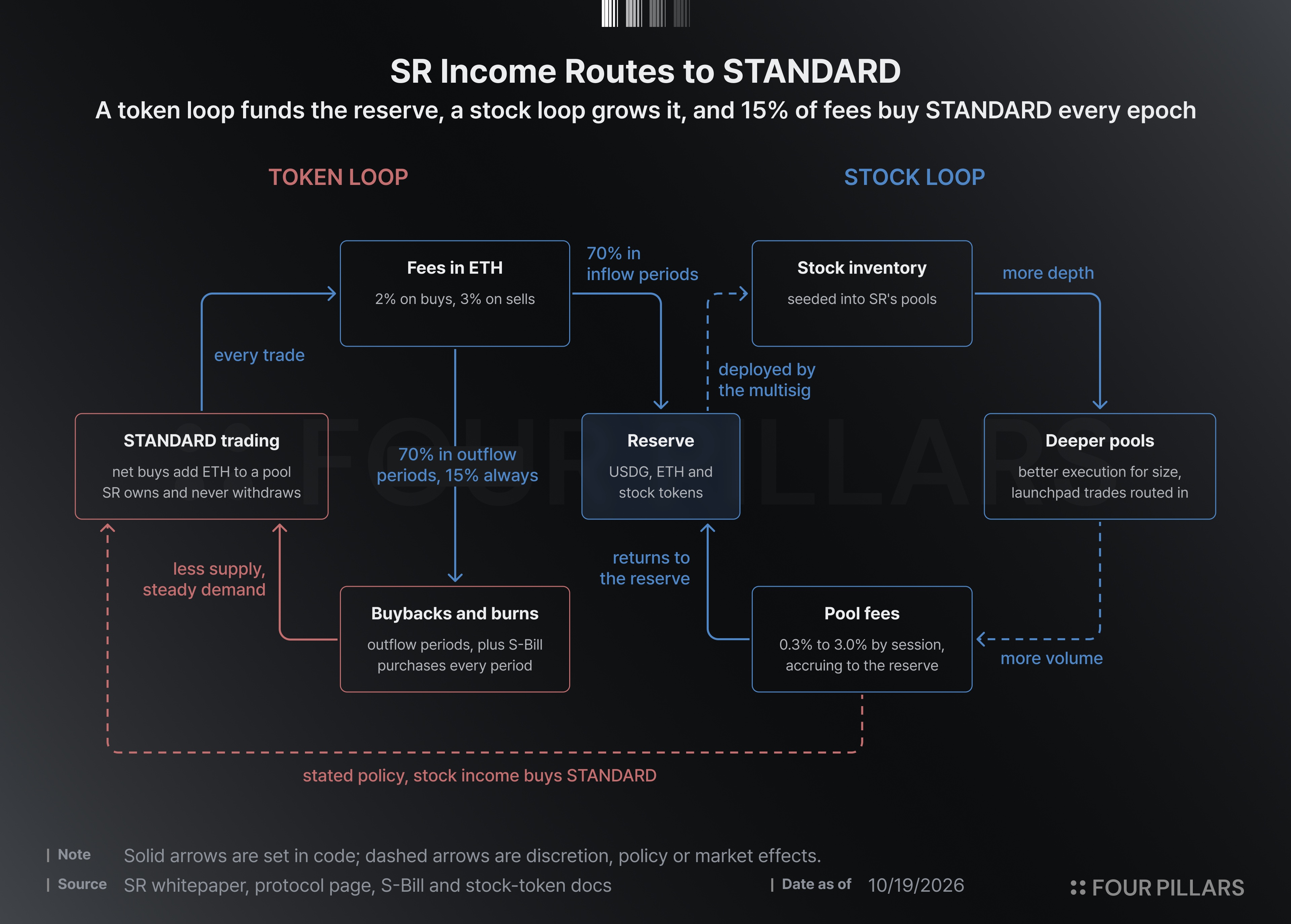
The token loop is already largely enforced by code. Banker rewards create new STANDARD when withdrawn, while license purchases destroy tokens; cumulative burns have exceeded issuance so far. In contraction periods, the rules direct 70% of relevant protocol ETH revenue toward buybacks and burns. Another 15% funds token purchases for incentives, including the separately budgeted S-Bills program. Buying STANDARD also adds ETH to liquidity the protocol cannot withdraw. These rules offset some dilution; they do not guarantee a price floor.
The stock business is less automatic. Expansion-period income equips the reserve to make stock markets, while stock trading fees and the newly described share of arbitrage profits can grow that balance sheet. Beans has said external market revenue is intended to follow the protocol's expansion/contraction logic, with proceeds ultimately supporting reserve growth or token purchases. That is an important commercial intention, but today's stock fees reach a multisig-controlled reserve, not an immutable distribution contract.
Our call clarified why. SR initially explored more restrictive treasury contracts, but Beans said attempts to acquire around $1M in SpaceX or SK Hynix tokens onchain would have incurred 5–10% slippage. The team needed to source inventory over the counter from firms with mint/redeem access, which required a more flexible multisig. SR has applied for its own mint/redeem rights. Beans said that, if granted, those rights could allow more enforceable onchain rules when stock tokens return to the system. Some custody and settlement will remain offchain because the underlying stocks are offchain. Neither the application nor the intended safeguards is a guarantee.
There may eventually be a more direct link. Beans floated a pilot in which arbitrageurs stake STANDARD for preferential access or lower fees. That could create demand tied to the stock market-making business itself, but it is a proposal, not a current token utility. STANDARD holders today have no legal claim on reserve assets or stock-market profits.
So the investment case is specific. SR must win repeat stock-trading volume, earn attractive returns after inventory risk and partner economics, and establish credible value transfer to STANDARD. If those conditions hold, buybacks could eventually be funded by equity trading even when interest in STANDARD cools. That would be a true departure from the circular economics of the last cycle. Until then, it remains the thesis to prove.
4. Looking Forward
Beans was unusually willing to admit what he does not know. He cannot name the tokenized-stock product that will bring the next wave of users, or promise that SR's economic design will survive a full cycle. His argument is that liquid markets make more products possible, and that DeFi's old incentive designs deserve another attempt when the assets being traded have lives outside crypto.
SR could fail. Five weeks is not a full cycle, external revenues remain small, and the path from those revenues back to STANDARD is not yet fully contractual.
But the point is not that SR has already figured everything out. It is that someone is trying again.
We spent much of the last cycle learning what doesn't work. Those lessons were expensive, and they should make us better builders, not less ambitious ones. Yet somehow, as the industry grew larger and more sophisticated, its willingness to experiment seemed to shrink.
Again, we don't know if SR will work. What we do know is that DeFi needs more people willing to find out.
After all, DeFi was supposed to be fun.
The author of this report may have personal holdings or financial interests in assets or tokens discussed herein. However, the author affirms that no transactions have conducted using material non-public information obtained in the course of research or drafting. This report is intended solely for general information purposes and does not constitute legal, business, investment, or tax advice. It should not be used as a basis for making any investment decisions or as guidance for accounting, legal, or tax matters. Any references to specific assets or securities are made for informational purposes only and should not be construed as an offer, solicitation, or recommendation to invest. The opinions expressed herein are those of the author and may not reflect the views of any affiliated institutions, organizations, or individuals. The opinions and analyses expressed herein are subject to change without prior notice. In addition, beyond the individual disclosures included in each report, Four Pillars, may hold existing or prospective investments in some of the assets or protocols discussed herein. Furthermore, FP Validated, a division of Four Pillars, may already be operating as a node in certain networks or protocols discussed herein or may do so in the future. Please see below links in the footer for FP Validated's participating network disclosures and for broader disclosure details.


