Table of Contents
Researcher

Key Takeaways
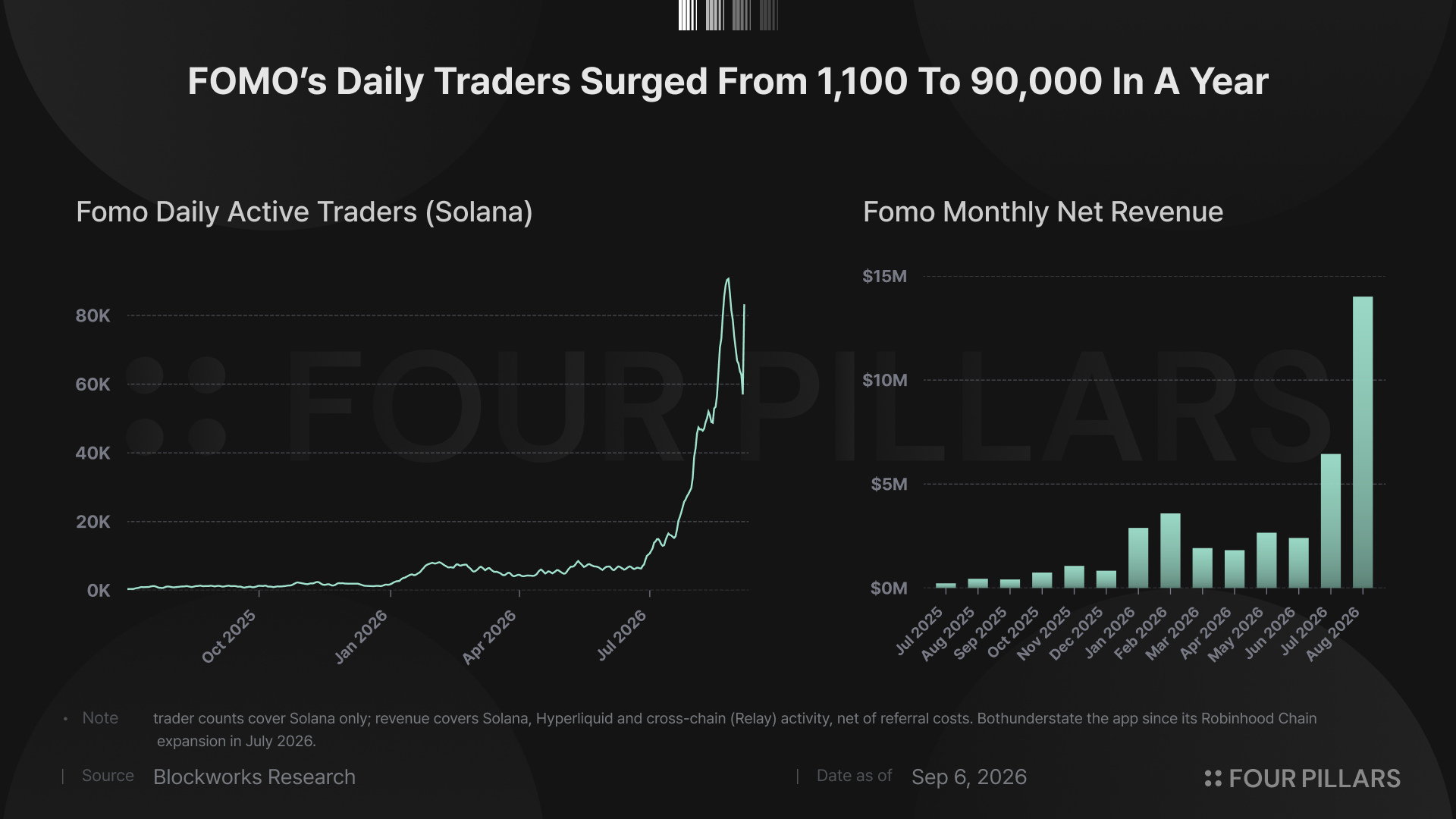
- Trading has turned into a spectator business, with every trade on apps like FOMO posting to a public feed with its profit attached, and FOMO's daily traders growing from 1,100 to +90,000 in a year.
- Platforms now pay traders the way media companies pay talent, with pump.fun handing creators $483 million and offering top traders $30,000 a month to trade nowhere else.
- Clans, a feature both apps added in August that pools members' positions under one scoreboard, are the early sign of followers organizing into trading groups that recruit on trade history rather than follower counts.
- Public PnL shows who is winning but not what following them pays, since only 6% of 292,531 FOMO wallets finished a 90-day stretch ahead, the median lost $120, and the top accounts' gains are mostly unrealized.
On September 6 a trader posted a recruiting notice. He was looking for members for his clan, a feature in the pump.fun app that pools several traders’ positions under one name and one scoreboard. Recruits would be added to the clan and would “trench” together in a Telegram voice chat. He didn’t care how many followers they had. He wanted evidence they could trade, and the best evidence, he said, would be their pump.fun account so he could analyze their trades. The clan had three members and $300,790 in open positions, up 11% on the day. The stated goal was to get it above $1 million.
A colleague sent it to me with the question that prompts this article. Is this still trading, or has it become something else? I should say up front that I trade on fomo and pumpfun mobile myself, and that I enjoy it. That may color what follows.
1. Trading Is the content
A trade, once it’s public, is a piece of content, the content draws an audience, and the audience supplies the next trade. What makes that loop run now (which didn’t exist in the last memecoin mania) is the phone. In January 2025 the trade lived in a Telegram bot or a browser terminal and the boast lived on X. This summer both live in the same app.
FOMO and the pump.fun mobile app put the feed and the buy button on one screen. Every trade on FOMO, the app that has grown fastest this summer, posts to a public feed with its profit or loss attached. Every account carries a leaderboard rank over a day, a week, a month and all time. Followers aren’t a count of people who liked your thoughts. They’re a count of people who watched your trades and want the next one pushed to their phone.
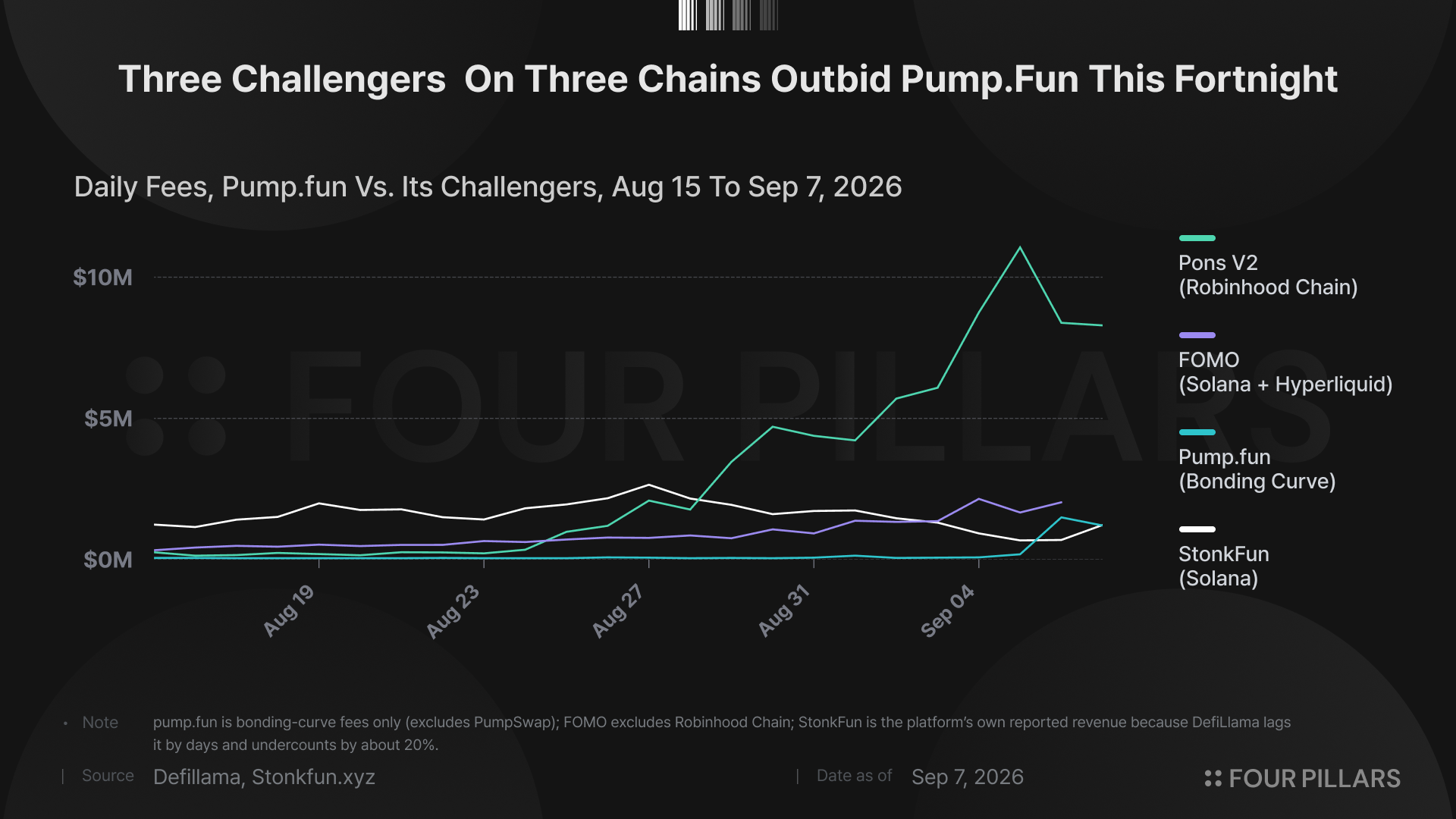
The take-up has been enormous. FOMO’s daily active traders on Solana alone averaged 1,100 a year ago and +90,000 in August, before counting Robinhood Chain, where most of its volume now happens. On August 21 it ranked third among finance apps on the American iPhone, ahead of Cash App. pump.fun, the launchpad it is fighting, has paid its token creators $483 million since it began sharing fees with them in May of last year. Over the same period it kept about $653 million for itself. For every dollar the platform earned, the talent got 74 cents.
2. Traders are the new influencers
If trading is content, the platforms are media companies, and media companies compete for talent. In August a contract pump.fun was offering top traders leaked. A $20,000 signing bonus, $30,000 a month, a minimum volume, four public callouts a month, and the requirement to close your FOMO account and declare one wallet as your only wallet.
The same month pump.fun began paying anyone whose callout drove trading, from a daily pool that started at $15,000, reached $300,000 within two weeks, and hit $1 million a day on September 1. On the days it paid $1 million, buybacks and callout rewards together consumed all of the platform's revenue. FOMO pays referrers a quarter of their referees’ fees. Pons sends 70% of every fee to the creator of the token.
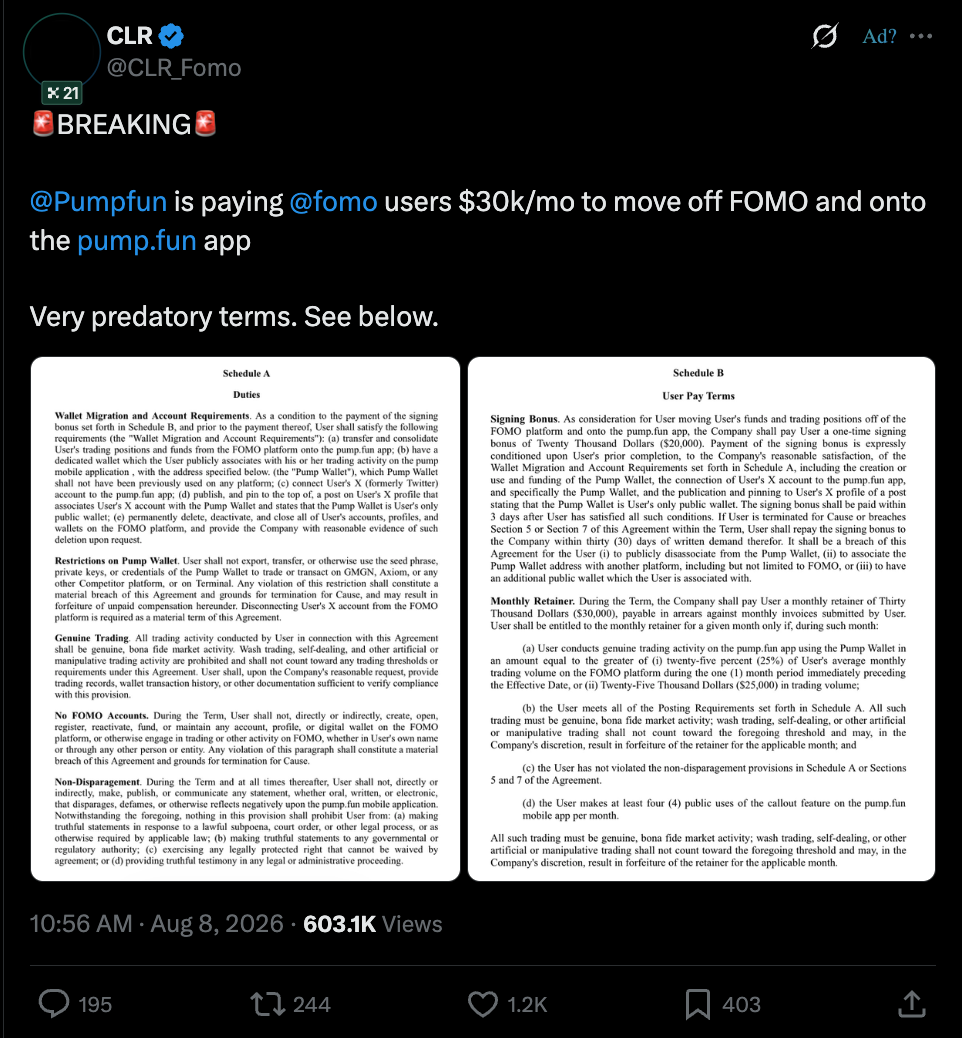
Source: X (@CLR_Fomo)
When a product can’t be differentiated, the only way to gain share is to cut the price, and in markets the subtler price cut is accepting less safety. Attention is a commodity in exactly that sense. The tokens are the same, the chains are the same, the scoreboard is the same, so the apps can only bid. Congratulations to whoever pays the most for flow.
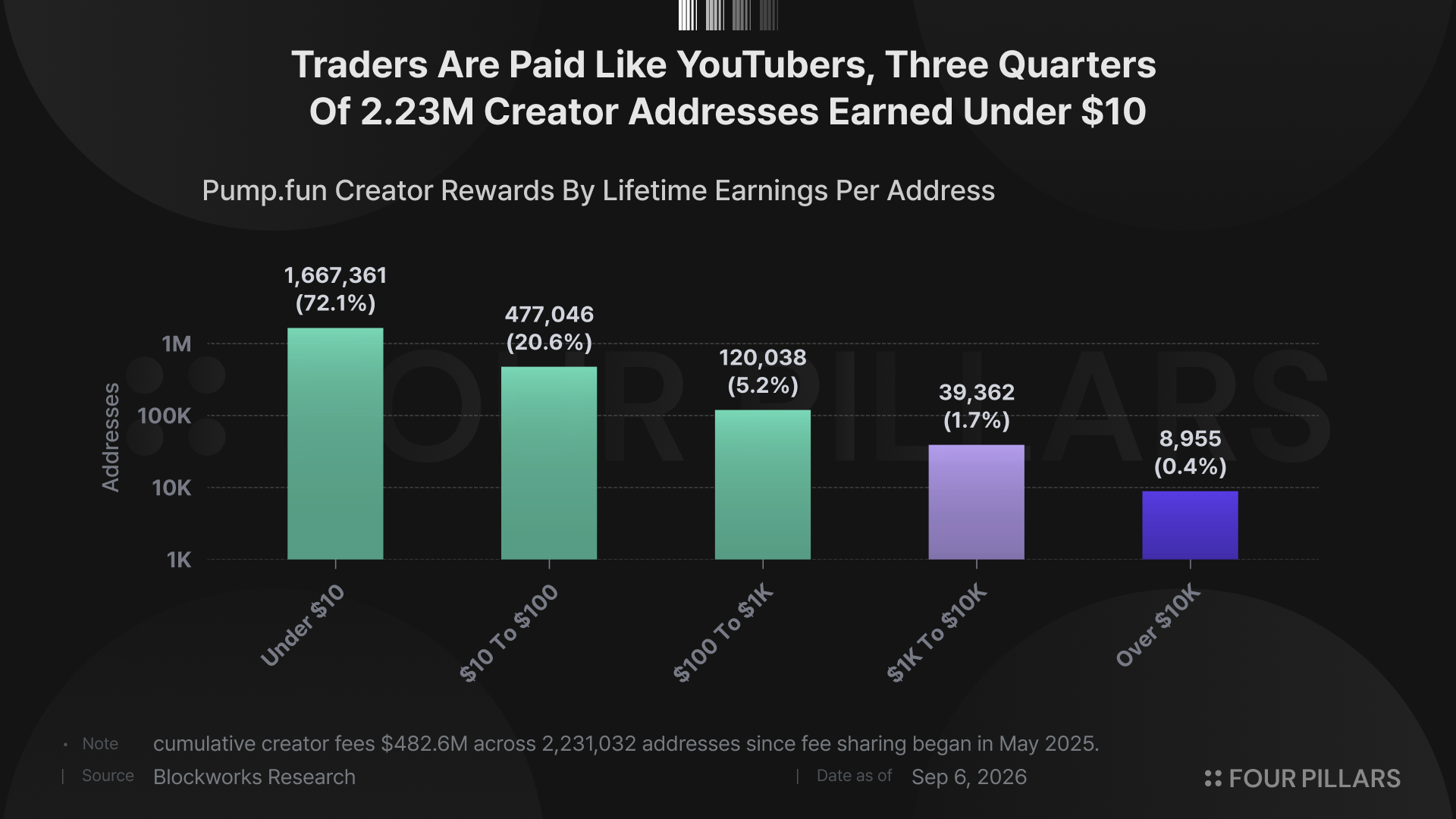
The influencer economy has a well known shape, and this one has it too. Of 2.23 million addresses that have earned creator rewards on pump.fun, 1.67 million have earned less than $10 in their lifetime. About 9,000 have earned more than $10,000. That is the distribution of YouTube. It’s the distribution of every medium where the audience pays the talent through a platform. The difference here is that the audience also trades against the talent.
3. Trading together
The clan is what happens when a feed grows a roster. FOMO launched Clans on August 10, ranked by their members’ combined profit over a week and a month. There were 50 at launch and 150 three weeks later. pump.fun’s version, Squads, was spotted eleven days after FOMO’s. A third party promptly began selling keys to clans’ private chats, so a clan’s conversation became an asset too.
The memecoin game has gone through three stages, and each was a different game.
The first launchpad era was roulette. Anyone could launch, nobody could see much, and luck did most of the work.
The second era, which the traders themselves called the cabal era, was poker. Supply was gathered in bundled wallets before launch and the hidden information was who held it.
The current era looks more like backgammon. Everything on the board is visible. You can see every position the leaders hold, the day they opened it, and when they leave.
A clan doesn’t remove that hidden card. It adds a second one. Now you also can’t see what the three people in the voice chat agreed to before the trade posted.
4. The vamp wars
What an organized group can do with visible chips became clear on Robinhood Chain over the past two weekends. Robinhood issues tokenized versions of about 190 stocks, minted by one authorised participant and only during market hours. On Sunday August 30 a memecoin paired against tokenized HIMS absorbed 81% of the 15,227 HIMS tokens in existence, and the token printed $132.64 on $39,000 of volume against a Friday close of $28.84. When the minter returned on Monday the premium was gone within the hour. The stock fell 6% that week and no short seller was touched. The chief executive of the company whose stock was cornered now follows the coin’s account.
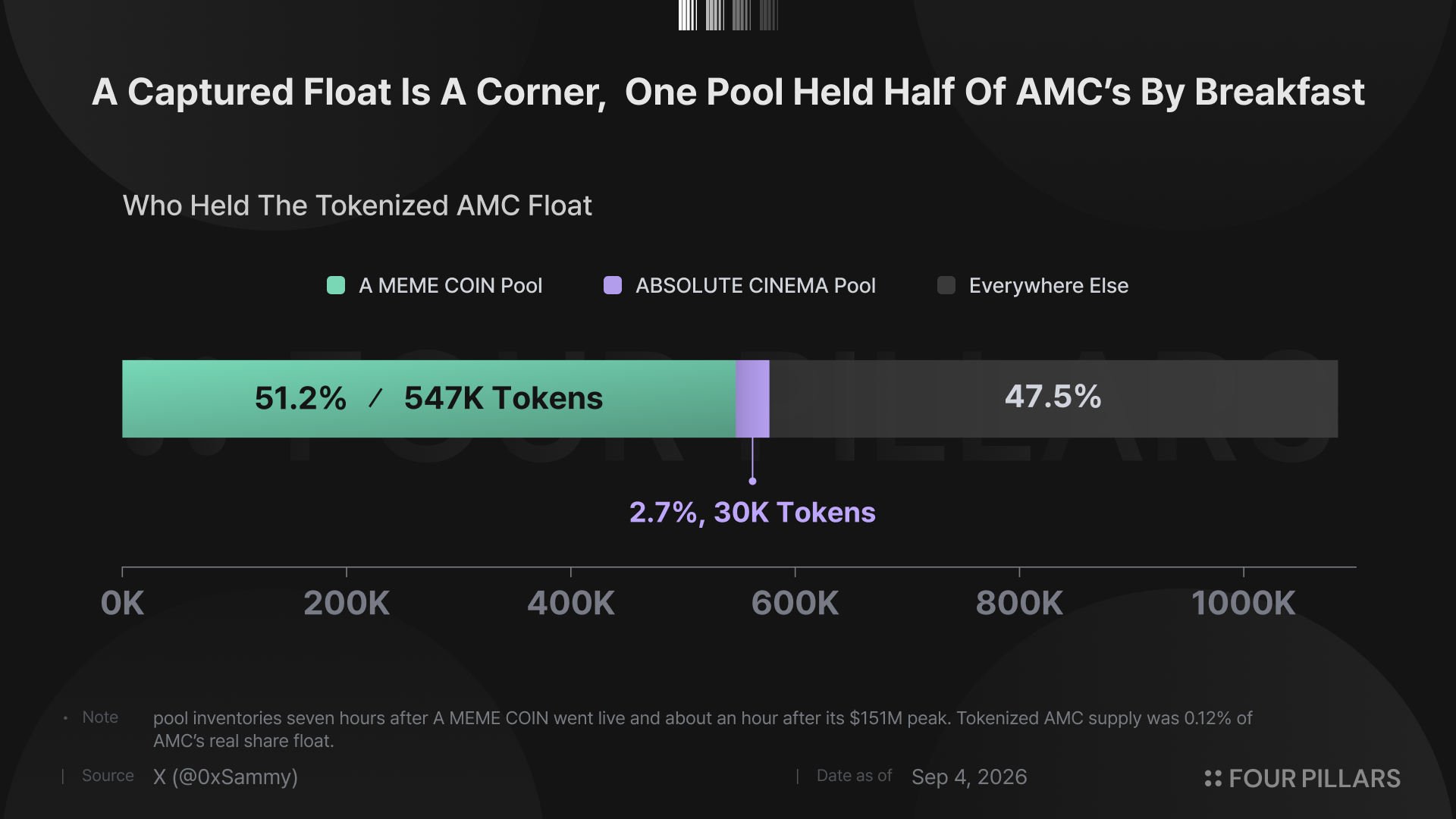
Then AMC. A coin called CINEMA had run the same play on tokenized AMC a week earlier, before anyone noticed. On the night of September 3 AMC’s chief executive posted that Robinhood’s token was a “pseudo-fake market” and demanded that it “CEASE AND DECIST.” A coin named A MEME COIN went live a few minutes after midnight UTC, and forty minutes after his second post it was worth $151 million. By eight in the morning its pool held 547,000 of the 1.1 million tokenized AMC shares that existed. The incumbent’s pool held 30,000. The incumbent is now worth about $1 million. Robinhood’s general counsel replied “Send your lawyers and we’ll educate them,” and its chief executive asked “What’s the concern?” On January 28, 2021 AMC’s shareholders begged Robinhood to let them buy. On September 4, 2026 AMC’s chief executive begged Robinhood to make them stop, and Robinhood declined. Sound familiar?
5. What are the odds?
Anyone who has stood at a betting window knows the favorite isn’t valuable information, since everyone can see it. What’s valuable is whether the odds are fair. Public PnL has made the favorites perfectly visible. The apps, the top twenty accounts with $82 million of combined displayed profit, the clan leaders. What it hasn’t published is the proposition for the person joining next.
Midcurver77’s public Dune query did. Of 292,531 wallets that traded through FOMO’s Solana router in the 90 days to mid-August, 6.16% were profitable, and 88% of those made less than $100. The median wallet lost $120. Together they lost $1.26 billion. His comparison was a casino with a 1% house edge, which leaves roughly 37% of its players ahead over a similar span. Meanwhile the $82 million at the top is mostly open positions in a few tokens on thin pools.
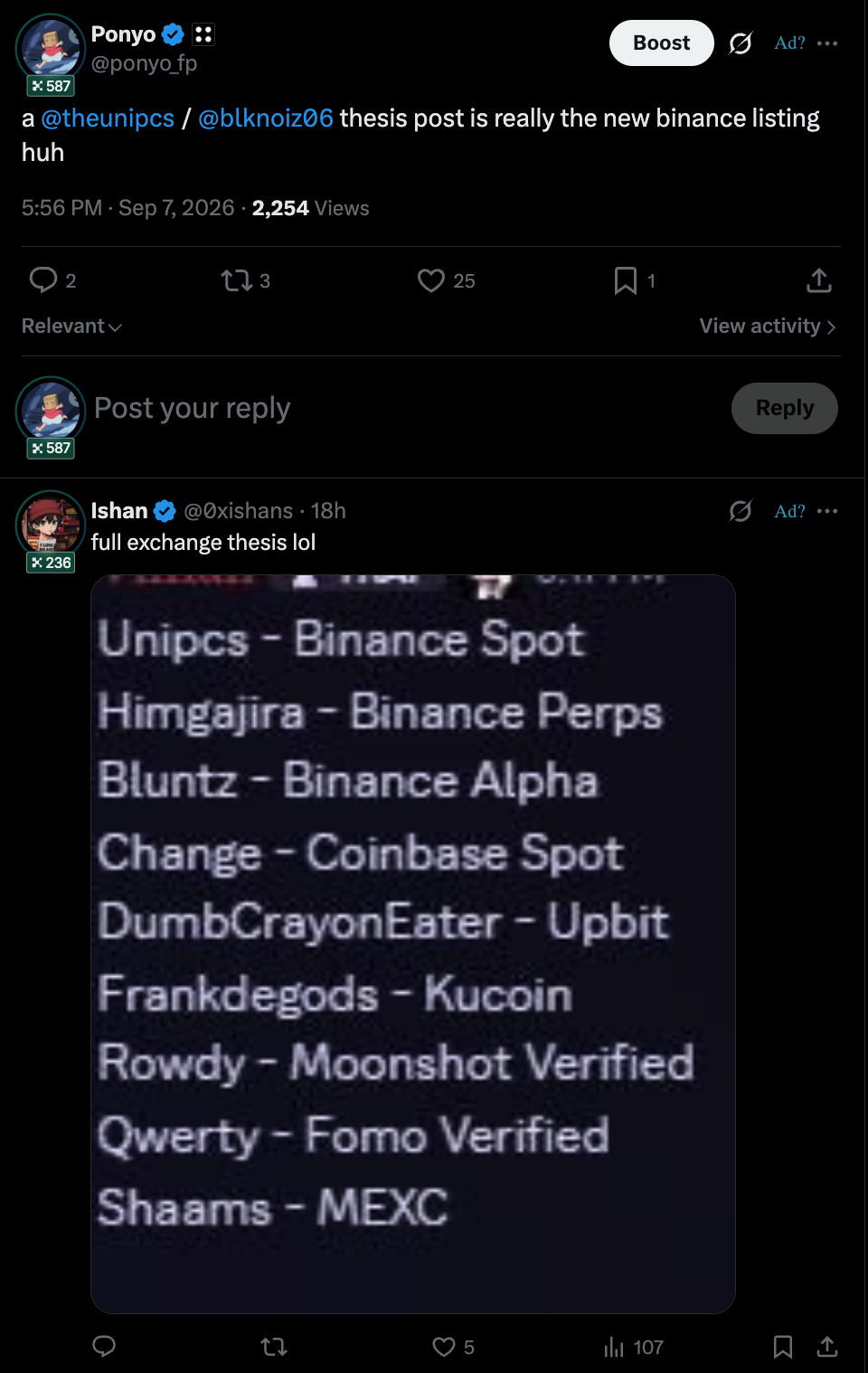
The other day I wondered aloud whether a thesis post from one of the top traders had become the new CEX listing. It was half a joke. Someone replied with a list that was already making the rounds, which ranks traders by the exchange tier their post is worth, Binance spot at the top and a second-tier Asian exchange at the bottom.
The list is absurd, and nobody who made it or passed it along thinks a post is a listing. But that isn’t the point. The point is that the market has started to think of traders the way it used to think of exchanges, as the thing whose attention moves the price.
Source: X (@ponyo_fp)
6. Looking Forward
Here's where I come out:
- Trading has become a form of entertainment and content.
- The platforms are media companies now. They bid for talent with contracts, callout pools and fee splits, and since attention is a commodity the bidding only goes one way.
- The odds for the follower are poor, and a clan doesn't change them. A clan makes the winning side better organized and the losing side larger.
- The vamp that wins is the one that captures the float, and a captured float is a corner. Corners end when the float grows.
- If you join a clan, know which of the three games you’re in, and whether you’re the one holding the cube.
I'll give Charlie Munger the last word, since the betting window is the right place to end. He described the racetrack as the purest market there is. Everyone's money goes into one pool, the track takes about 17% off the top, and the odds on each horse are set by how much of the pool is riding on it. Anyone can see which horse is fastest. But by the time you can see it, so can everyone else, and the money already on it has bet the payout down to almost nothing. So the average bettor loses the track's cut, a shrewd one loses a little less, and the few who beat the game, he said, "bet very seldom." They wait until the crowd has priced a horse wrong, and then they bet heavily.
The author of this report may have personal holdings or financial interests in assets or tokens discussed herein. However, the author affirms that no transactions have conducted using material non-public information obtained in the course of research or drafting. This report is intended solely for general information purposes and does not constitute legal, business, investment, or tax advice. It should not be used as a basis for making any investment decisions or as guidance for accounting, legal, or tax matters. Any references to specific assets or securities are made for informational purposes only and should not be construed as an offer, solicitation, or recommendation to invest. The opinions expressed herein are those of the author and may not reflect the views of any affiliated institutions, organizations, or individuals. The opinions and analyses expressed herein are subject to change without prior notice. In addition, beyond the individual disclosures included in each report, Four Pillars, may hold existing or prospective investments in some of the assets or protocols discussed herein. Furthermore, FP Validated, a division of Four Pillars, may already be operating as a node in certain networks or protocols discussed herein or may do so in the future. Please see below links in the footer for FP Validated's participating network disclosures and for broader disclosure details.