Table of Contents
Researcher

[ASA News] is a weekly newsletter where we share the most important news related to stablecoin in Asia. (2026.11.02~11.08)
Author's Comment
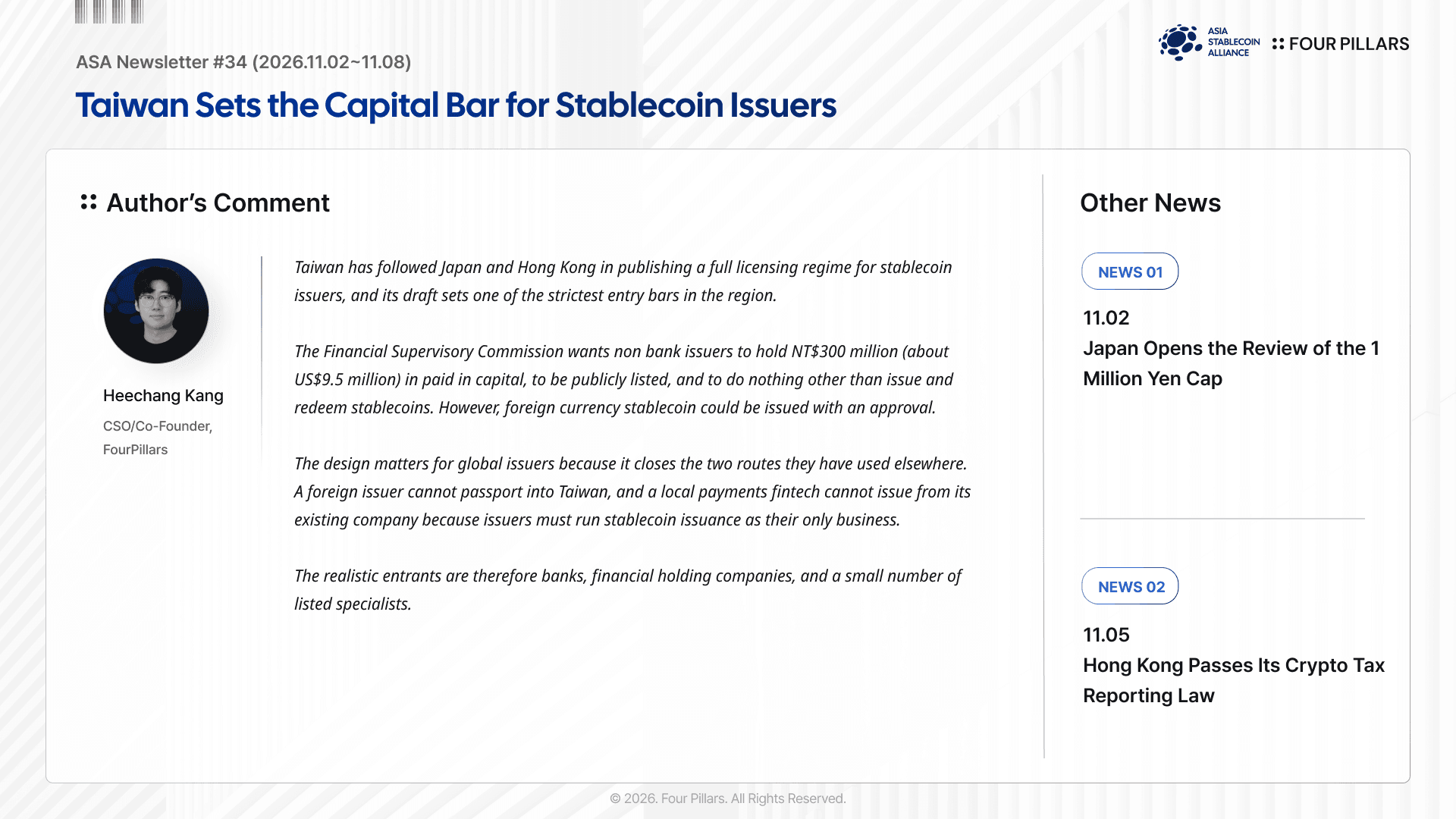
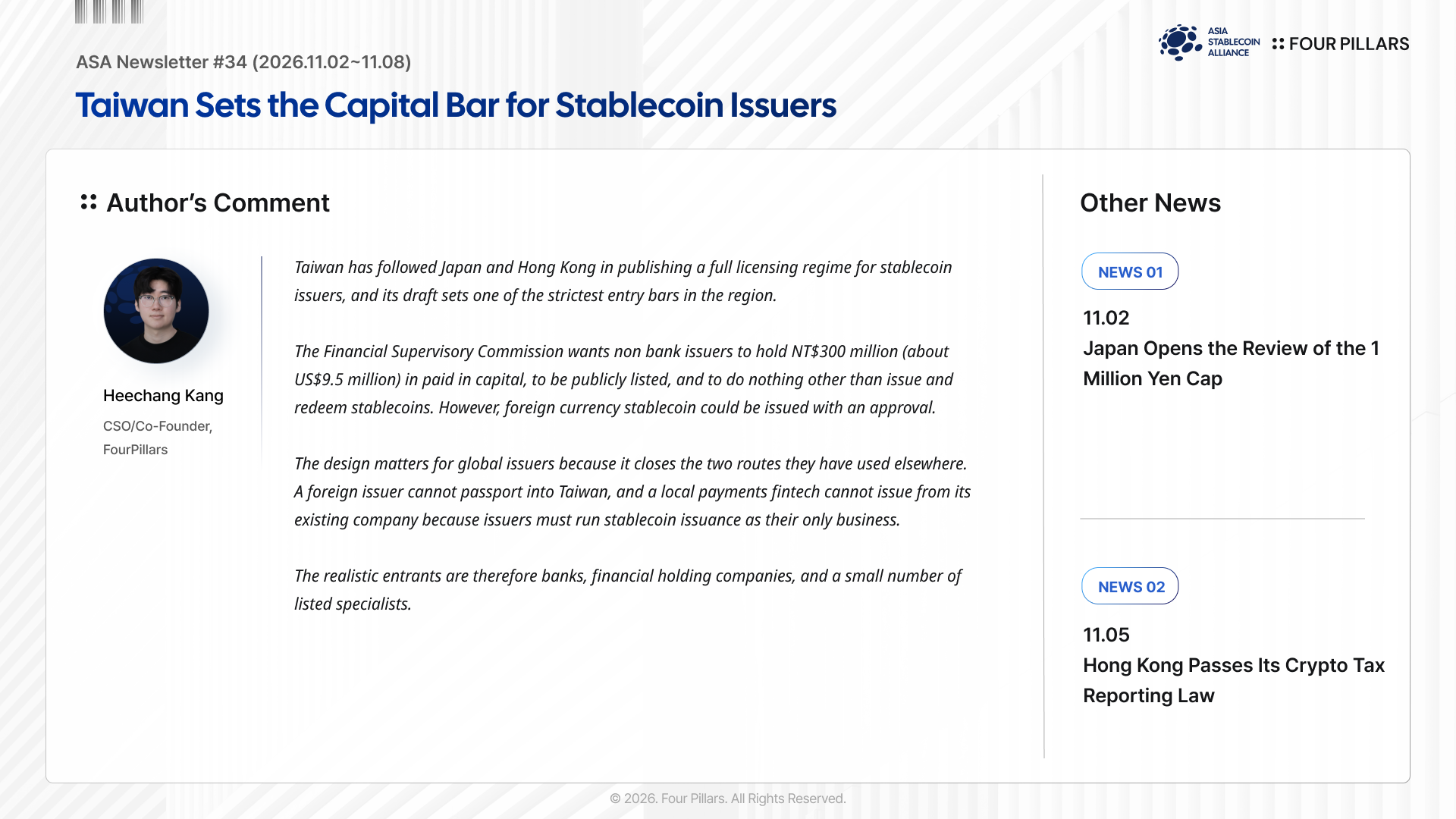
Taiwan has followed Japan and Hong Kong in publishing a full licensing regime for stablecoin issuers, and its draft sets one of the strictest entry bars in the region.
The Financial Supervisory Commission wants non bank issuers to hold NT$300 million (about US$9.5 million) in paid in capital, to be publicly listed, and to do nothing other than issue and redeem stablecoins. Because tokens may be pegged to the New Taiwan dollar or to a single foreign currency, a licensed issuer could launch a US dollar stablecoin in Taiwan, subject to approval from the commission and the central bank.
The design matters for global issuers because it closes the two routes they have used elsewhere. A foreign issuer cannot passport into Taiwan, and a local payments fintech cannot issue from its existing company because issuers must run stablecoin issuance as their only business. The realistic entrants are therefore banks, financial holding companies, and a small number of listed specialists.
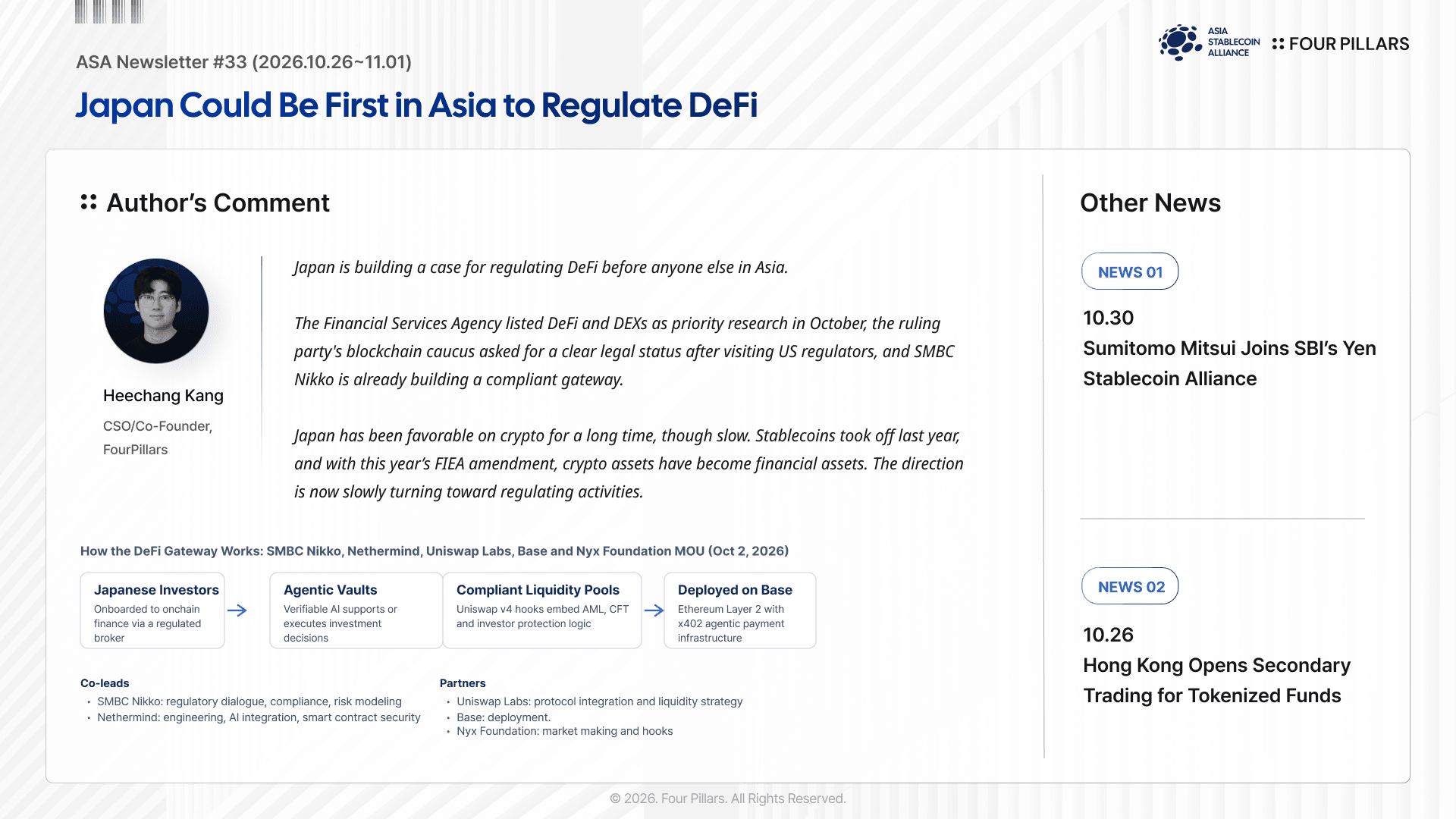
Japan spent the week on the opposite problem. The Financial Services Agency opened a formal review of the 1 million yen (about US$6,700) transfer cap that has held JPYC and JPYSC back, with issuers asking for exemptions and the Japanese Bankers Association asking for caution.
Hong Kong, meanwhile, passed its crypto tax reporting law and set up a dedicated tax task force. From 2027 every licensed platform in the city will report client transactions, and the same reporting pipes are now being built in Indonesia and Korea.
1. Taiwan Sets the Capital Bar for Stablecoin Issuers
The Financial Supervisory Commission released a draft Regulations Governing Permission and Management of Stablecoin Issuance on November 3. Three groups may apply for an issuance license: banks, financial holding companies or bank invested companies, and other institutions the commission designates.
Non bank applicants face the highest bar in the region. They need at least NT$300 million (about US$9.5 million) in paid in capital, must be publicly listed, and may operate only a stablecoin issuance and redemption business, with no other lines allowed.
Eligible tokens must be pegged 1:1 to the New Taiwan dollar or a single foreign currency. Reserve assets are valued at fair value, must never fall below outstanding circulation, and are audited regularly by certified accountants, with issuers also reporting to the commission and the central bank.
The commission paired the stablecoin draft with eight sub regulations under the Virtual Asset Service Act on the same day. Trading platforms and custodians need NT$100 million (about US$3.2 million) in capital, lending providers NT$200 million (about US$6.3 million), and banks may offer exchange, transfer, custody, and underwriting services, with exchange and transfer limited to corporate clients for now.
Both drafts carry a 40 day comment period, and the commission is amending its anti money laundering rules so that stablecoin issuers are treated as financial institutions under the Money Laundering Control Act. Chairperson Peng Jinlung has said the sub regulations could take effect as early as the first quarter of 2027, with the Executive Yuan setting the date for the parent act.
2. Japan Opens the Review of the 1 Million Yen Cap
The Financial Services Agency held the second meeting of its study group on digital and decentralized finance on November 2. The agenda covered the roughly 1 million yen (about US$6,700) cap on issuance and transfers of electronic payment instruments, the absence of comprehensive rules for stablecoin lending, and whether deposit taking banks should issue stablecoins or tokenized deposits.
JPYC told the group that the cap applies at the issuance stage. Paying a 50,000 yen (about US$330) benefit to 100,000 people would require 5,000 separate issuance transactions, so the company asked for batch issuance treatment and exemptions for government, financial institution, and verified corporate counterparties.
SBI VC Trade reported about 10.7 billion yen (about US$71 million) in customer lending balances as of October, split between 7.65 billion yen (about US$51 million) in JPYSC and 3.06 billion yen (about US$20 million) in USDC, and called for removing the cap on Type 4 instruments such as RLUSD. Its JPYSC lending balance passed 10 billion yen (about US$67 million) on November 2, four months after launch, with total JPYSC balances above 30 billion yen (about US$200 million).
The Japanese Bankers Association asked the agency to proceed with caution. SBI Holdings separately reported that its crypto asset revenue fell 30.1 percent to 23.08 billion yen (about US$154 million) in the April to September half, while naming domestic and US circulation of JPYSC under the GENIUS Act framework as a priority for the year.
3. Hong Kong Passes Its Crypto Tax Reporting Law
The Legislative Council passed the third reading of the crypto asset reporting framework bill on November 5. From 2027, exchanges and related service providers must collect customer identity and transaction data for tax reporting, aligning the city with the OECD Crypto Asset Reporting Framework.
Hong Kong authorities also set up a dedicated task force to strengthen tax oversight of assets such as Bitcoin and Ethereum. On the incentive side, the Financial Services and the Treasury Bureau plans to add digital assets and precious metals to the qualifying asset list for fund and family office tax concessions.
The Securities and Futures Commission tightened the perimeter in the same week. It plans to bar unlicensed entities from using terms such as crypto and exchange in their names and marketing, and it is extending its rules to any asset that can be traded or settled on a licensed platform.
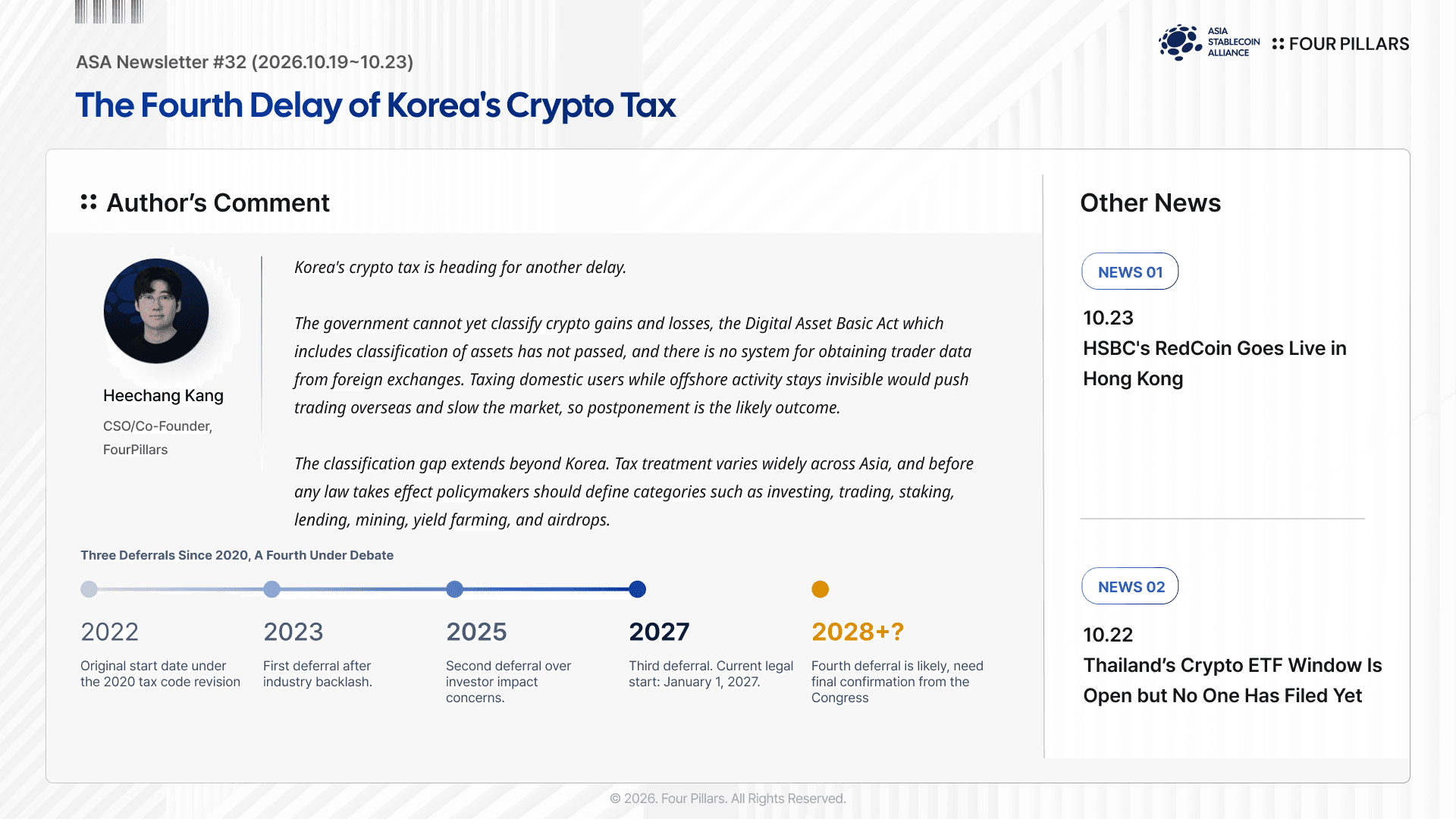
The reporting framework is spreading across the region. Indonesia's Financial Services Authority is drafting CARF based cross border reporting rules, and Korea's tax authorities said they will be able to tax residents using US exchanges after 2029 once information exchange is in place.
4. Other Updates by Market
- Australia: From July 1, 2027, capital gains tax on crypto will use inflation indexation instead of the 50 percent discount.
- Bhutan: The Royal Monetary Authority published its regulatory stance on cryptocurrency.
- China: The State Council will strengthen regulation of RWA tokenization, and authorities halted a Solana event in Shanghai before it opened.
- Hong Kong: The Hong Kong Monetary Authority extended EnsembleTX to 24 hour settlement in tokenized central bank money and launched Project SAGE for agentic finance, while Standard Chartered launched tokenized deposits for corporate clients. JD Coinlink's website went offline after it missed the first stablecoin license list.
- India: The Enforcement Directorate searched premises linked to CoinDCX and Delta Exchange over alleged unauthorized cross border transactions.
- Indonesia: The Financial Services Authority is evaluating six crypto business models, and the Ministry of Finance issued a VAT and income tax regulation for crypto trading.
- Japan: The Financial Services Agency and the European Commission mentioned tokenization for the first time in a joint statement, and MUFG Bank and J.P. Morgan's blockchain unit formed a Singapore nonprofit to set tokenized asset standards.
- Mongolia: The Law on Virtual Asset Service Providers now details management, capital, and customer protection obligations.
- Singapore: The Monetary Authority of Singapore reiterated that Binance holds no license for regulated services, and Visa set up six global capability centers in Singapore covering AI and stablecoins.
- South Korea: The government confirmed a two year deferral of digital asset taxation to 2029, and regulators plan a 15 to 20 percent cap on any single shareholder of an exchange. After the Binance hack, the Financial Services Commission discussed raising the cold wallet floor from 80 to 99 percent and will require immediate incident reporting.
- Thailand: The Securities and Exchange Commission filed a criminal complaint against Bitget's operator for unlicensed operations, and the Bank of Thailand's baht stablecoin consultation runs until November 17.
- Turkey: TÜBİTAK BİLGEM published infrastructure criteria for crypto asset service providers.
- Uzbekistan: Presidential Decree UP-121 was amended on crypto asset licensing fees and conditions.
Key Dates Ahead
- 2026.11, Korea: Digital Asset Basic Act subcommittee review
- 2026.11, Thailand: Bank of Thailand stablecoin and BNPL rules begin rollout
- 2026.11, Japan: Progmat live testing of tokenized JGB repo on Canton begins
- 2026.11, Australia: ASIC consultation on platform rules closes
- 2026.11.17, Thailand: Bank of Thailand baht stablecoin consultation closes
- 2026.12, Taiwan: Comment period on stablecoin and virtual asset rules closes
- 2026.12.03, Korea: Bank of Korea reporting on cross border transfers begins
- 2026 year end, Hong Kong: Licensing amendment bill submission
- 2027, Hong Kong: Crypto asset reporting by exchanges begins
- 2027.01.18, United States: GENIUS Act takes effect
- 2027 early, Japan: FSA interim summary and public private roadmap
- 2027 Q1, Taiwan: Virtual Asset Service Act sub regulations could take effect
- 2027.02.04, Korea: Token securities system takes effect
- 2027.02.27, Thailand: Travel Rule takes effect
- 2027.03, Japan: Megabank yen stablecoin commercial launch target
- 2027.04, Australia: ASIC platform rules take effect
- 2027.07.01, Australia: Indexation replaces the 50 percent CGT discount on crypto
- 2028 H1, Korea: Crypto tax guidelines published
- 2029.01.01, Korea: Digital asset income taxation takes effect under the deferral plan
The author of this report may have personal holdings or financial interests in assets or tokens discussed herein. However, the author affirms that no transactions have conducted using material non-public information obtained in the course of research or drafting. This report is intended solely for general information purposes and does not constitute legal, business, investment, or tax advice. It should not be used as a basis for making any investment decisions or as guidance for accounting, legal, or tax matters. Any references to specific assets or securities are made for informational purposes only and should not be construed as an offer, solicitation, or recommendation to invest. The opinions expressed herein are those of the author and may not reflect the views of any affiliated institutions, organizations, or individuals. The opinions and analyses expressed herein are subject to change without prior notice. In addition, beyond the individual disclosures included in each report, Four Pillars, may hold existing or prospective investments in some of the assets or protocols discussed herein. Furthermore, FP Validated, a division of Four Pillars, may already be operating as a node in certain networks or protocols discussed herein or may do so in the future. Please see below links in the footer for FP Validated's participating network disclosures and for broader disclosure details.