

Table of Contents
Researcher

Author's Comment
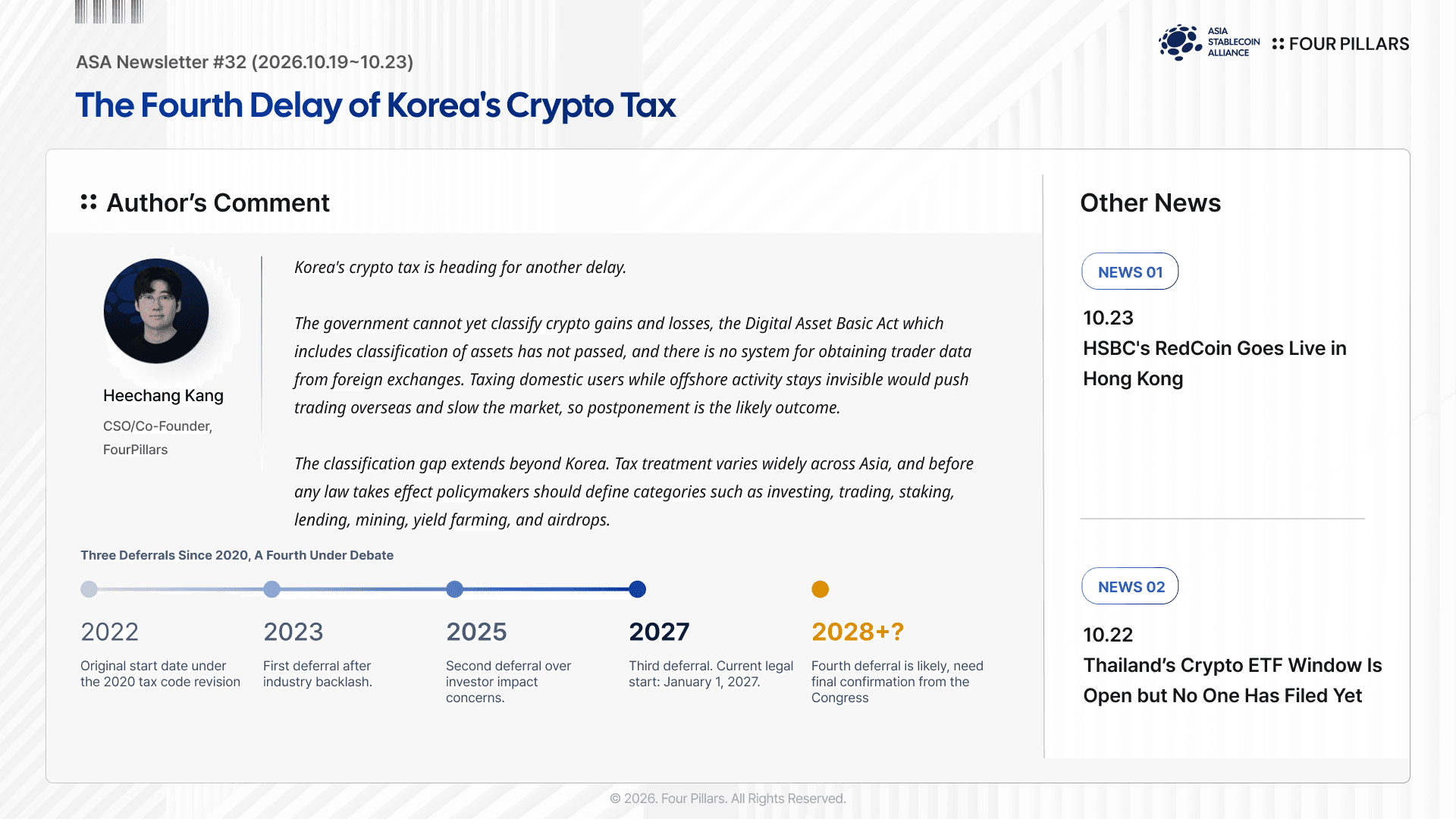
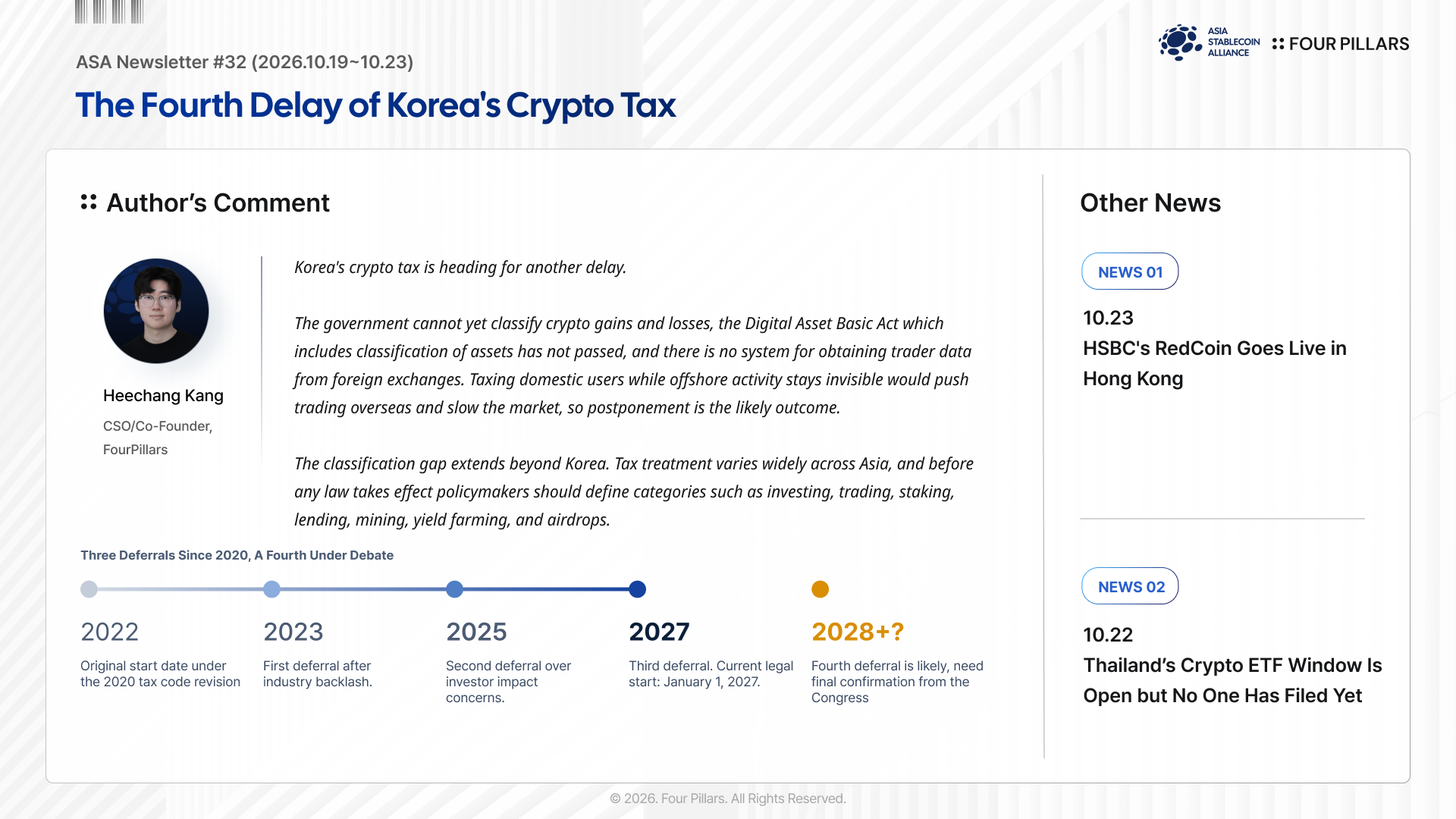
Korea's crypto tax is heading for another delay. The government cannot yet classify crypto gains and losses, the Digital Asset Basic Act which includes classification of assets has not passed, and there is no system for obtaining trader data from foreign exchanges. Taxing domestic users while offshore activity stays invisible would push trading overseas and slow the market, so postponement is the likely outcome.
Last week the question moved from the National Assembly to the presidential office. The Democratic Party leader asked the government for a final review, the finance minister dropped his September position that the tax would start on schedule, and by the weekend the presidential office confirmed it is reviewing a further delay.
The Bank of Korea is also drafting a Foreign Exchange Transactions Act amendment this year that treats stablecoins as a means of payment, along with monthly reporting on users who move assets overseas.
Global issuers and exchanges planning a Korea entry should expect the tax decision, the Basic Act, and this amendment to set the shape of the market before year end.
The classification gap extends beyond Korea. Tax treatment varies widely across Asia, and before any law takes effect policymakers should define categories such as investing, trading, staking, lending, mining, yield farming, and airdrops.
1. Korea's Presidential Office Leans Toward a Fourth Crypto Tax Delay
On October 15, Rep. Park Min-gyu of the Democratic Party of Korea filed a bill that ties the start of crypto taxation to Korea's first OECD CARF data exchange in 2027, which in practice pushes the start date to 2029.
On October 22 strong push was made by the Democratic Party leader Kim Minseok where he said the tax issue must be settled this year and asked Deputy Prime Minister Lee Hyoungil for a final review. Lee had told the Assembly in September that the January 2027 start would proceed, but said the same day that he would now deliberate thoroughly.
Three days later, Seoul Economic Daily reported that the presidential office has shifted toward delay, citing incomplete collection readiness and pushback from younger taxpayers. An official said no decision has been made, leaving the final call to a party government consultation after the audit.
Until that decision arrives, the National Tax Service is preparing for a January start. It plans to finalize the draft notice on October 30, issue the administrative notice on November 30, and verify DEX, private wallet, and DeFi filings with tracing tools, while domestic exchanges collect individual records from January 1, 2027. Open questions remain in the tax rules themselves, as committee chair Cho Seungrae raised the lack of standards for staking and airdrops and the review report confirmed no loss carryforward.
Settling those classification questions depends on the Digital Asset Basic Act, which is in final negotiations with the major shareholder cap and bank led stablecoin issuance as sticking points. The FSC is also reviewing exchange neutrality safeguards as the Fair Trade Commission examines the Naver Financial and Dunamu combination, and will study exchange participation in the STO market.
Oversight of offshore flows is tightening at the same time, as the Bank of Korea and the government will draft a Foreign Exchange Transactions Act amendment this year regulating stablecoins as a means of payment. Exchanges will also report monthly from December 3 on any user who has transferred assets overseas.
2. HSBC's RedCoin Goes Live in Hong Kong
HSBC launched its licensed stablecoin RedCoin through PayMe, which has more than 3.3 million users, and circulation reached HK$80.81 million within two days. Reserves are held entirely in cash, and the coin already works at more than 100,000 merchants and for peer to peer transfers.
In the same week, HSBC used its tokenised deposit service for the first time to invest in a Franklin Templeton tokenised money market fund through Ant International's WhaleRTP settlement platform.
RedCoin is the first bank issued Hong Kong dollar stablecoin in retail use at scale. It would become the benchmark for Korea's bank consortium model and for the yen coin Japan's megabanks are targeting by March 2027.
*HSBC received its issuer license from the Hong Kong Monetary Authority in April under the Stablecoins Ordinance that took effect in August 2025.
3. Thailand’s Crypto ETF Window Is Open but No One Has Filed Yet
The Securities and Exchange Commission said last week that several asset managers have inquired about crypto ETFs but none has submitted a formal application.
The framework took effect on October 16 and allows Bitcoin and Ethereum ETFs to list only on the Stock Exchange of Thailand, with each fund holding its target asset at an average of at least 80 percent of net assets. Retail investors lose access to crypto ETFs listed abroad under the same rules.
The empty pipeline suggests local managers are still working through custody arrangements, the 80 percent floor, and whether a listed product can compete with the direct exchange access Thai retail investors already have. The rules protect domestic managers from offshore competition, but they also leave the market without a product until someone is ready to file.
The first application will show whether the framework works in practice. Hong Kong, which lets foreign issuers list and already trades spot Solana ETFs, offers the comparison Thai regulators will be measured against.
4. Other Updates by Market
- Australia: Treasury's exposure draft implementing CARF is open for comment until October 28.
- China: The People's Bank of China overhauled digital yuan infrastructure on October 21, adding smart contracts and cross border settlement. The Tianjin court accepted a forfeiture application covering 61,896 BTC in the Qian Zhimin case.
- Hong Kong: The SFC listed BTCC as a suspicious platform, and Futu opened BNB deposits and withdrawals to professional investors.
- Indonesia: OJK and the Ministry of Finance are developing sukuk tokenization, and the ministry posted Regulation No. 50 of 2025 on crypto VAT and income tax.
- Japan: SBI VC Trade agreed with Shinhan Card to test yen stablecoin payments between Japan and Korea, and JPYC signed an MOU with SBJ Bank and LINE NEXT on bank linked charging. The Mt. Gox trustee extended the repayment deadline to October 31, 2027.
- Malaysia: Bank Negara Malaysia launched a tokenized bond platform and joined Project BLOOM.
- Philippines: Maya restored onchain crypto deposits, and the DILG secretary alleged a fugitive gaming tycoon converted up to US$3 billion into crypto.
- Singapore: Bank Negara Malaysia and the Bank of Thailand joined Project BLOOM as policymakers, while Visa, Mastercard, and Ripple were among new industry members that brought the total to 24.
- South Korea: The Seoul Administrative Court held the first hearing in Bithumb's suit against the FIU over 45,772 transfers to unregistered providers. Shinhan Bank piloted stablecoin payments for foreign patients, and Chainlink partnered with LG CNS on won stablecoin infrastructure.
- Taiwan: The Canton Foundation signed an MOU with the Institute for Information Industry on RWA talent, and BitoPro launched USD to USDT conversion with Far Eastern International Bank's Bankee.
- Thailand: The SEC said no asset manager has filed a crypto ETF application yet despite several inquiries, and Bitget agreed to acquire GMO Z.com Cryptonomics pending regulatory approval.
- Turkey: The Capital Markets Board added two Bitbns entities to its provisional liquidation list.
Key Dates Ahead
- 2026.10.28, Australia: CARF draft legislation comments close
- 2026.10.30, Korea: NTS finalizes draft taxation notice
- 2026.11.01, Korea: Supreme Court Rule No. 3280 on crypto seizure takes effect
- 2026.11.06, Korea: NTS requests preliminary review of the notice
- 2026.11, Korea: Party government consultation on tax deferral after the audit
- 2026.11, Japan: Progmat live testing of tokenized JGB repo on Canton begins
- 2026.11, Australia: ASIC consultation on platform rules closes
- 2026.11, Indonesia: DSN MUI target for sharia Bitcoin fatwa
- 2026.11.30, Korea: NTS administrative notice on taxation
- 2026.12.03, Korea: Bank of Korea monthly reporting on overseas transfers begins
- 2027 early, Japan: FSA interim summary and public private roadmap
- 2027.02, Japan: FSA and Ministry of Finance host Asia Day 2027
- 2027.02.27, Thailand: Travel Rule takes effect
- 2027.03, Japan: Megabank yen stablecoin commercial launch target
- 2027.04, Australia: ASIC platform rules take effect
The author of this report may have personal holdings or financial interests in assets or tokens discussed herein. However, the author affirms that no transactions have conducted using material non-public information obtained in the course of research or drafting. This report is intended solely for general information purposes and does not constitute legal, business, investment, or tax advice. It should not be used as a basis for making any investment decisions or as guidance for accounting, legal, or tax matters. Any references to specific assets or securities are made for informational purposes only and should not be construed as an offer, solicitation, or recommendation to invest. The opinions expressed herein are those of the author and may not reflect the views of any affiliated institutions, organizations, or individuals. The opinions and analyses expressed herein are subject to change without prior notice. In addition, beyond the individual disclosures included in each report, Four Pillars, may hold existing or prospective investments in some of the assets or protocols discussed herein. Furthermore, FP Validated, a division of Four Pillars, may already be operating as a node in certain networks or protocols discussed herein or may do so in the future. Please see below links in the footer for FP Validated's participating network disclosures and for broader disclosure details.


