Table of Contents
Researcher

Author's Comment
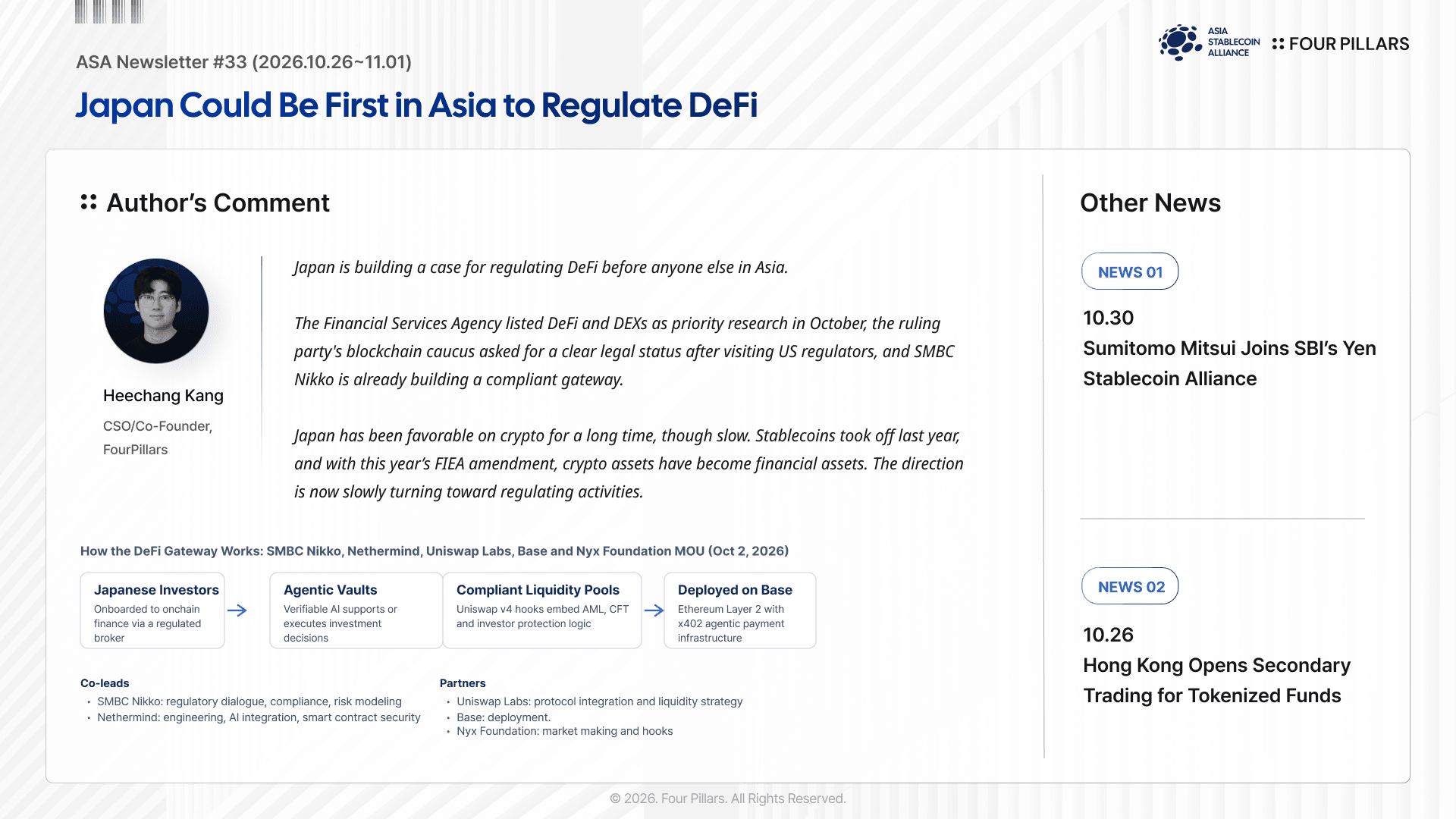
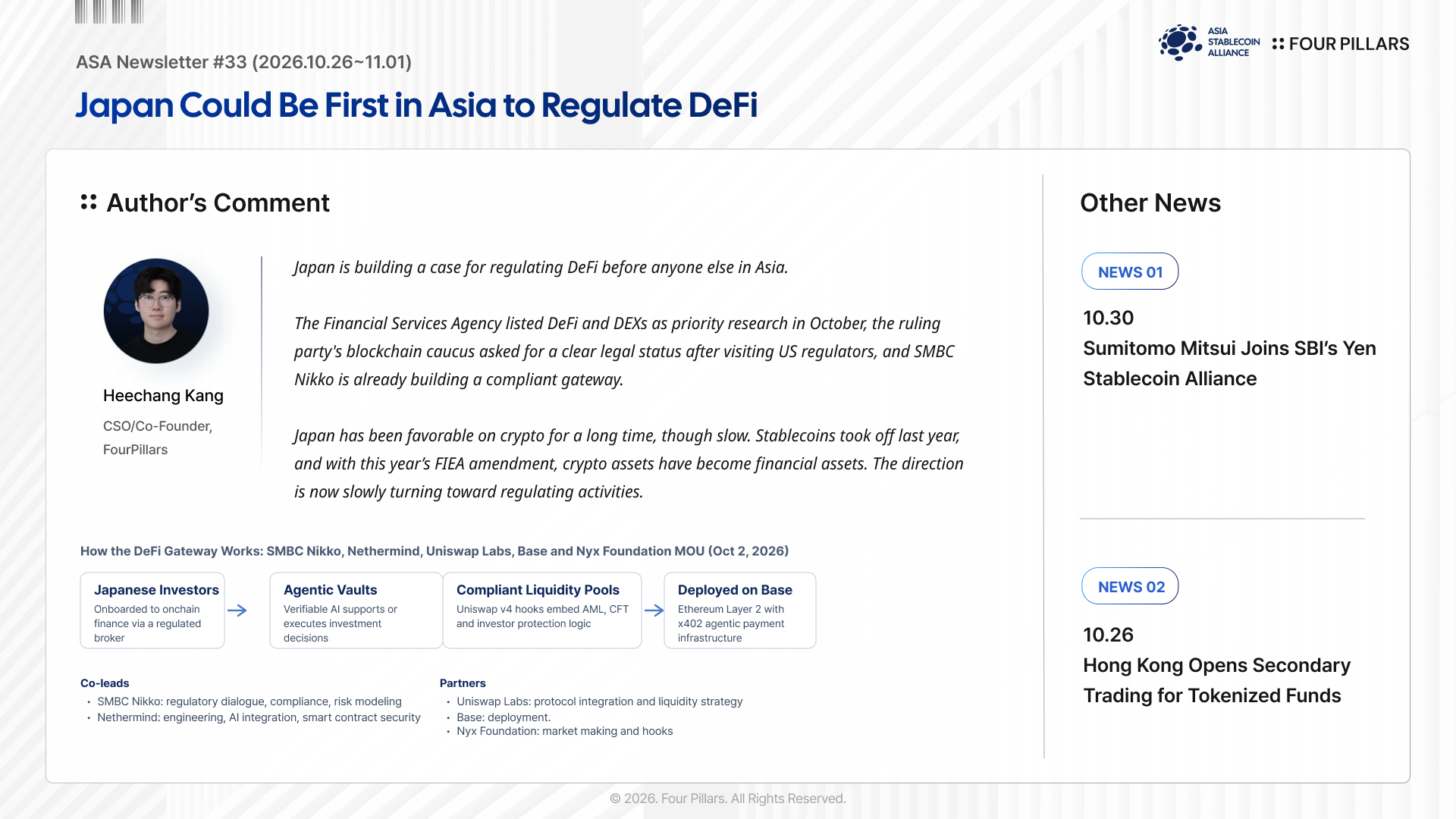
Japan is building a case for regulating DeFi before anyone else in Asia. The Financial Services Agency listed DeFi and DEXs as priority research in October, the ruling party's blockchain caucus asked for a clear legal status after visiting US regulators, and SMBC Nikko is already building a compliant gateway.
The direction matters because every other Asian regulator has so far either ignored DeFi or banned it. If Japan writes rules for wallet providers and DEX front ends by early 2027, it sets the template that Korea's Basic Act and Hong Kong's licensing bill will be measured against.
Japan has been favorable on crypto for a long time, though slow. Stablecoins took off last year, and with this year’s FIEA amendment, crypto assets have become financial assets. The direction is now slowly turning toward regulating activities.
The rest of the week was about consolidation. SBI pulled Sumitomo Mitsui Financial Group, BlackRock, and Cross River Bank into its yen stablecoin while JPYC admitted it has not grown, and Hong Kong moved tokenized funds into secondary trading.
1. Japan Could Be First in Asia to Regulate DeFi
The Liberal Democratic Party's Blockchain Promotion Caucus reported on October 27 on its August trip to the US Treasury, SEC, CFTC, JPMorgan, Kalshi, and Polymarket. Members described the US as prioritizing access over restriction and noted the CFTC treats prediction markets as event contracts.
The caucus and the Japan Blockchain Association proposed clarifying the legal status of DeFi and DEX activity and defining digital assets such as Bitcoin as property, citing UK legislation as the model. This follows the Financial Services Agency study group that named DeFi and DEX regulation a priority research candidate on October 20, with smart contract risk, anti money laundering, and whether DEX front end providers must verify users on the agenda.
Industry is moving ahead of the rules. SMBC Nikko Securities discussed its DeFi Gateway on October 29, a regulation compliant route to DeFi for Japanese investors who today can reach overseas protocols with only a wallet and no accountable operator. Nomura told the FSA that rules should be no stricter than overseas standards.
The FSA also published a 609 page survey of eight overseas regimes on October 30 as reference material, noting the US GENIUS Act takes effect January 18, 2027. An interim summary and a public private roadmap are due in early 2027, which is the point to watch for whether DeFi rules make it into the draft.
2. SBI Builds a Yen Stablecoin Alliance as JPYC Admits It Has Not Grown
SBI signed three JPYSC agreements in one week. SBI, Startale, and BlackRock agreed to study linking a tokenized money market fund with JPYSC on October 27, and SBI agreed to form a Japan joint venture with CRB Group, parent of Cross River Bank, on October 28.
On October 30, Nikkei reported that Sumitomo Mitsui Financial Group will take a 5 percent stake in SBI Startale Marketing so its 24 million retail customers can use JPYSC. SBI Shinsei Trust Bank, the issuer, will absorb SBI Clearing Trust on December 31 to combine issuance and custody.
The first mover is struggling. JPYC's president said frankly that it has not grown in its first year, with the 1 million yen per transaction cap cited as the constraint, although Japan Tax Free now pays visitor tax refunds in JPYC from November 1.
Distribution seems to have decided the outcomes. JPYC had the license first, and SBI is winning on bank channels and asset managers.
3. Hong Kong Moves From Launches to Secondary Markets
The Fintech Business Facilitation Task Force met on October 26 to discuss frameworks for trading, custody, advisory, and management ahead of the licensing bill due before year end. The SFC authorized secondary trading of tokenized public funds on a licensed platform, starting with two ChinaAMC money market funds on PantherTrade.
Regulators also approved a digital public fund with 24 hour, seven day trading, and the Investor and Financial Education Council warned that secondary prices can diverge from net asset value. AnchorPoint's HKDAP entered beta and partnered with the Solana Foundation to issue and redeem directly on Solana.
Also, capital is following. PhotonPay raised US$40 million, RedotPay is weighing a US IPO at up to US$5 billion, and the London Metal Exchange is exploring tokenized metal inventory in Hong Kong warehouses.
4. Other Updates by Market
- Australia: Westpac will cap payments to crypto exchanges at A$10,000 per month, and the Reserve Bank of Australia closed its wholesale tokenized settlement consultation on October 30.
- China: The CPC Central Committee named virtual currencies and blockchain as corruption channels to be targeted. Two Jiangsu universities will pay salaries in digital yuan from November, and Beijing penalized its first blockchain backed pyramid scheme.
- India: The Enforcement Directorate is investigating cross border crypto transactions above 5,000 crore rupees under FEMA.
- Indonesia: OJK put the tokenization opportunity at Rp260 trillion over five years, and Bawaslu is studying blockchain for 2029 election data.
- Japan: Shoko Chukin Bank will pilot DCJPY tokenized deposits for trade settlement by year end, Toyota Finance issued a self arranged security token bond oversubscribed ten times, and NEC partnered with DFNS on institutional custody.
- Malaysia: Binance is in talks for an operating license to return to the market.
- Philippines: DICT launched a free blockchain certification course under SPARK.
- Singapore: The Digital Token Service Providers Regulations were updated again on October 26.
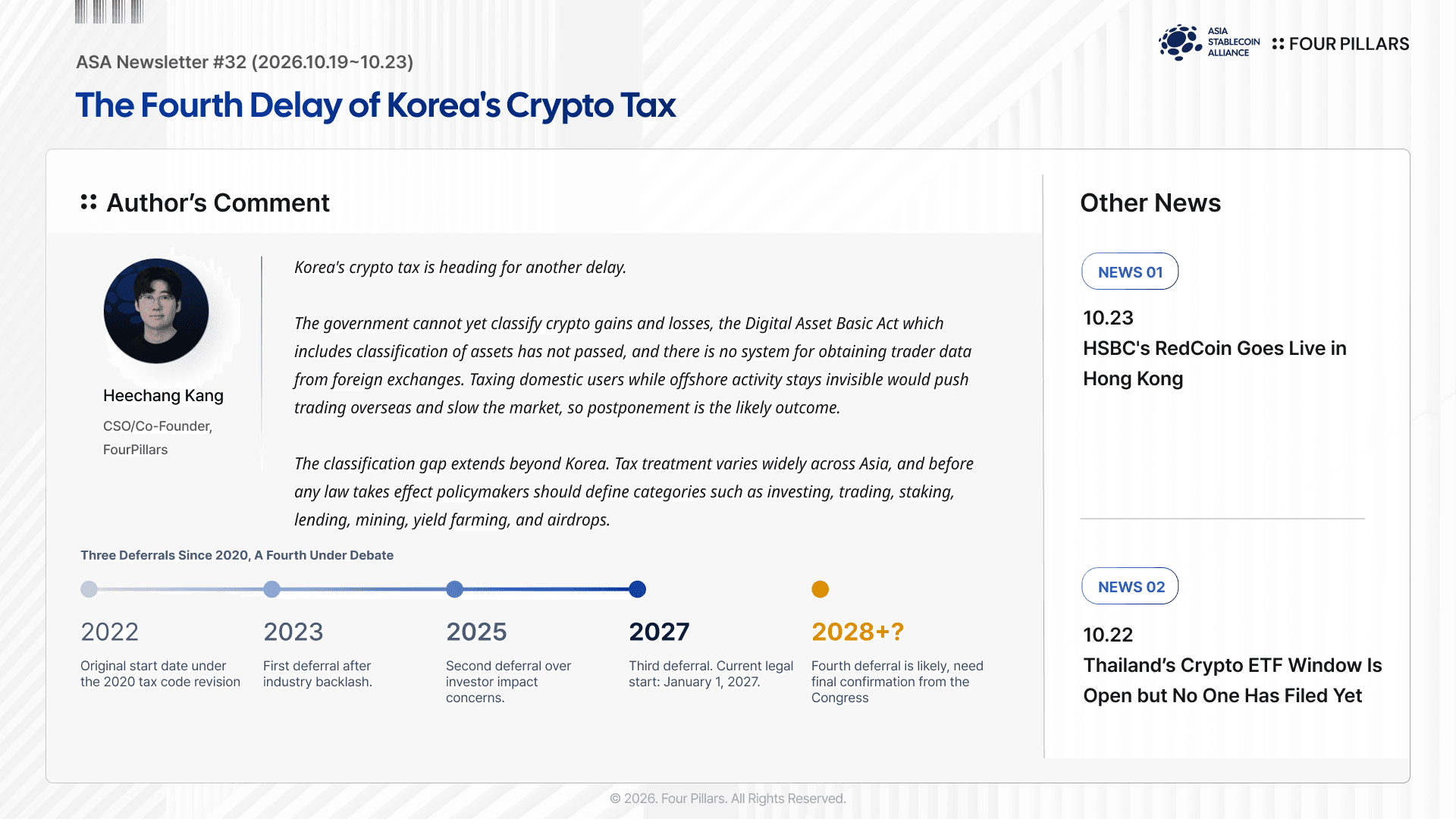
- South Korea: The Democratic Party asked the government to hold the tax notice due October 30 and will decide on deferral by late November, with the party government consultation agreeing to speed up the Digital Asset Basic Act. Rep. Jung Taeho filed a fourth Basic Act bill requiring re-review of all listed tokens. Bithumb reported an employee data breach, the presidential National Security Office held an emergency meeting, and the FIU requested blocks on Tether Max and SuperTrust.
- Thailand: The Bank of Thailand will roll out stablecoin, BNPL, and gold trading rules from around November, the Supreme Court ruled Bitcoin is property, and WORPT launched stablecoin QR payments for tourists under the SEC sandbox.
- Vietnam: OnePay opened stablecoin deposits with automatic conversion to US dollars.
Key Dates Ahead
- 2026.11, Korea: Democratic Party decision on tax deferral by late November
- 2026.11, Thailand: Bank of Thailand stablecoin and BNPL rules begin rollout
- 2026.11, Japan: Progmat live testing of tokenized JGB repo on Canton begins
- 2026.11, Australia: ASIC consultation on platform rules closes
- 2026.12.03, Korea: Bank of Korea reporting on cross border transfers begins
- 2026.12.31, Japan: SBI Shinsei Trust Bank absorbs SBI Clearing Trust
- 2026 year end, Hong Kong: Licensing amendment bill submission
- 2027.01.18, United States: GENIUS Act takes effect
- 2027 early, Japan: FSA interim summary and public private roadmap
- 2027.02, Japan: FSA and Ministry of Finance host Asia Day 2027
- 2027.02.27, Thailand: Travel Rule takes effect
- 2027.03, Japan: Megabank yen stablecoin commercial launch target
- 2027.04, Australia: ASIC platform rules take effect
The author of this report may have personal holdings or financial interests in assets or tokens discussed herein. However, the author affirms that no transactions have conducted using material non-public information obtained in the course of research or drafting. This report is intended solely for general information purposes and does not constitute legal, business, investment, or tax advice. It should not be used as a basis for making any investment decisions or as guidance for accounting, legal, or tax matters. Any references to specific assets or securities are made for informational purposes only and should not be construed as an offer, solicitation, or recommendation to invest. The opinions expressed herein are those of the author and may not reflect the views of any affiliated institutions, organizations, or individuals. The opinions and analyses expressed herein are subject to change without prior notice. In addition, beyond the individual disclosures included in each report, Four Pillars, may hold existing or prospective investments in some of the assets or protocols discussed herein. Furthermore, FP Validated, a division of Four Pillars, may already be operating as a node in certain networks or protocols discussed herein or may do so in the future. Please see below links in the footer for FP Validated's participating network disclosures and for broader disclosure details.