Table of Contents
Researcher

[ASA News] is a weekly newsletter where we share the most important news related to stablecoin in Asia. (2026.11.09~11.15)
Author's Comment
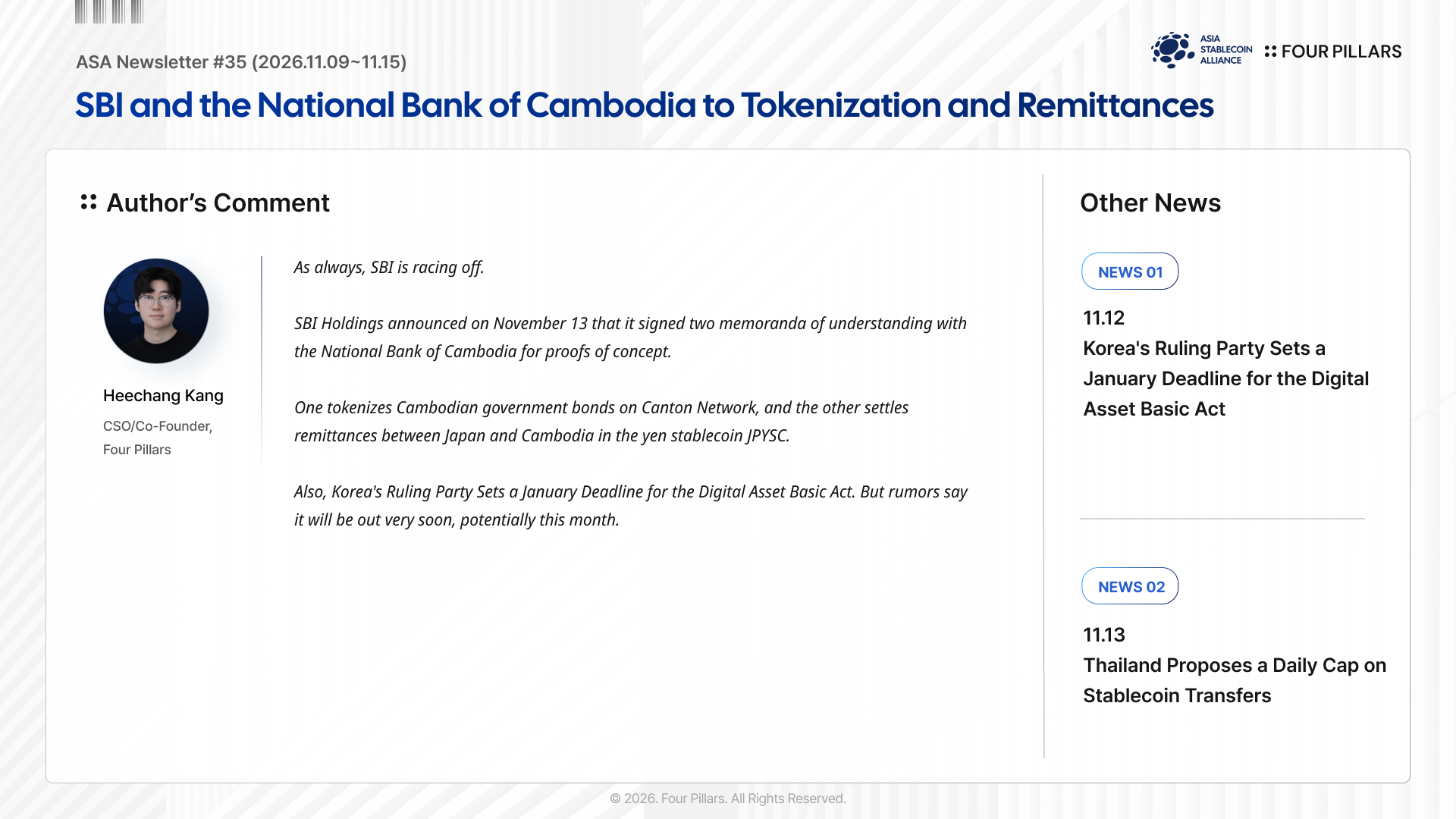
As always, SBI is racing off.
SBI Holdings announced on November 13 that it signed two memoranda of understanding with the National Bank of Cambodia for proofs of concept. One tokenizes Cambodian government bonds on Canton Network, and the other settles remittances between Japan and Cambodia in the yen stablecoin JPYSC.
The central bank takes part directly in both tests. It will keep the register of bond holders and review the remittance test under Cambodia's licensing framework, so global issuers, exchanges, and banks can see how a regulated stablecoin settles between institutions while customers continue to use the national payment system.
In other country, Thailand moved in a tighter direction on usage. Its Securities and Exchange Commission proposed daily caps of 5 million baht (about US$148,000) each on stablecoin deposits and withdrawals, and it would restrict transfers to wallets held in the customer's own name.
Also, Korea's Ruling Party Sets a January Deadline for the Digital Asset Basic Act. But rumors say it will be out very soon, potentially this month.
*Check out 100y's (Four Pillars) Research on "SBI's Strategy."
1. SBI and the National Bank of Cambodia to Test Tokenized Bonds and Yen Stablecoin Remittances
SBI Holdings announced on November 13 that it signed two memoranda of understanding with the National Bank of Cambodia, one on tokenizing Cambodian government bonds and one on remittances between Japan and Cambodia that use a stablecoin. The bond test will run on Canton Network, and the remittance test will use the yen stablecoin JPYSC.
In the bond test, the National Bank of Cambodia will register and manage holder information when a tokenized bond is transferred, while SBI Bank (Cambodia) verifies the transfers and SBI Digital Practice builds and operates the Canton environment. The test aims to let individuals buy government bonds in small amounts through local financial institutions, and it will check technical feasibility, process efficiency, security, and transparency.
In the remittance test, JPYSC serves as the settlement layer between financial institutions, and SBI states that the experience of remittance customers will not change. SBI Remit accepts the remittance in Japan, SBI VC Trade handles JPYSC, SBI Digitrust builds the test environment, and SBI Bank (Cambodia), a member bank of the Bakong payment system, acts as the settlement bank in Cambodia.
The National Bank of Cambodia will provide guidance on Cambodia's legal and licensing framework and will attend and review the remittance test. Its December 2024 rules on cryptoassets place fully backed stablecoins in the group that banks may handle with central bank approval.
SBI says the remittance scheme is intended to complement Bakong and to support use of the riel, and it has announced no service design or launch date for either test. Interim results were scheduled for the Black Swan Summit in Phnom Penh on November 15 and 16, with a demonstration of each test.
2. Korea's Ruling Party Sets a January Deadline for the Digital Asset Basic Act
Min Byungdok of the Democratic Party called for the Digital Asset Basic Act to pass by January 9, 2027 at a November 13 debate in Yeouido, and he proposed a Digital Asset Committee under the President. The Office of the Comptroller of the Currency has said its final GENIUS Act rules take effect on January 18, 2027, nine days after that target.
The Financial Services Commission is in final interagency consultation on the government draft, which is expected this month and will reach the National Assembly as a lawmaker sponsored bill. The draft is expected to cover business licensing, token issuance and disclosure, listing review, and standards for stablecoin reserves and redemption.
Issuer eligibility is the central question. The November 13 debate treated as a key dispute a plan to limit won stablecoin issuance to consortia in which banks hold 50 percent plus one share, which Min opposed, and the government draft is expected to propose issuance by bank led consortia while exchanges and payment platforms compete for funding and settlement channels.
Supervisors set out their conditions in the same week. Financial Services Commission official Yu Wongyu said reserves should guarantee full redemption even if the issuer or custodian becomes insolvent, and Shim Eunseop, who heads electronic finance inspection at the Financial Supervisory Service, said in a personal capacity that the Electronic Financial Transactions Act will inevitably apply to stablecoin payments.
3. Thailand Proposes a Daily Cap on Stablecoin Transfers
The Securities and Exchange Commission of Thailand published a draft notification on stablecoin transactions on November 12, covering transfers through digital asset operators such as exchanges and brokers. The draft follows a public hearing in September, and comments are open until November 26.
The draft caps each customer's daily stablecoin deposits and daily withdrawals at 5 million baht (about US$148,000) each per operator. Transfers would also need to match each customer's income and financial position.
Transfers would be allowed only between accounts and wallets held in the customer's own name, and transfers to third parties would be banned. Operators must apply the Travel Rule, profile customers, and screen wallets with blockchain analytics, and over the counter trades would need a minimum size of 3 million baht (about US$89,000) with disclosed prices.
The cap exempts operators' own business transfers, market makers in stablecoin and baht pairs, subscriptions and refunds for approved token offerings, and operators approved under Bank of Thailand supervision. The same draft requires licensed exchanges to disclose their market makers and monitor market maker activity.
4. Other Updates by Market
- Australia: The capital gains tax reform enacted on June 26 applies a 30 percent minimum rate on real gains from July 1, 2027, and the widely cited 47 percent figure is the top marginal rate including the Medicare levy.
- China: A State Council report delivered to the National People's Congress Standing Committee on November 3 calls for stronger regulation of RWA tokenization in its section on illegal financial activity. A new filing system for blockchain services came into use, and the Cyberspace Administration of China clarified the filing requirements.
- Hong Kong: HKEX will accept the wholesale digital Hong Kong dollar for advance margin deposits on overnight derivatives trading from December 14, and the Securities and Futures Commission and the Hong Kong Monetary Authority held a November 11 seminar on tokenized products, including secondary trading. Standard Chartered piloted a liquidity facility against tokenized money market fund redemptions for Ant International, and police arrested 22 people over more than HK$150 million (about US$19 million) in crypto money laundering.
- India: The Enforcement Directorate's November 4 and 5 searches of CoinDCX and Delta Exchange India concern alleged use of USDT to move customer funds abroad for offshore trading outside foreign exchange rules. Gate said an asset freeze requested by Indian police remains under judicial review and that it has transferred no assets.
- Indonesia: The Financial Services Authority, acting through its task force Satgas PASTI, ordered a halt to OneTwoMarkets, a platform suspected of illegal financial activity that offered crypto among other products and claimed a link to a South African license.
- Japan: The Financial Services Agency published the minutes of the first meeting of its study group on digital and decentralized finance, held on October 20, and the Securities and Exchange Surveillance Commission sought a court injunction against three unregistered firms that raised about 4.9 billion yen (about US$33 million), in part on a claim of exposure to a spot Bitcoin ETF.
- Malaysia: Police in Selangor destroyed 186 seized Bitcoin mining rigs on November 11.
- Philippines: RCBC and Meridian expanded the RCBC Pulz dollar account to accept USDC and USDT transfers with automatic conversion to US dollars.
- Singapore: The Accounting and Corporate Regulatory Authority issued Digital Asset Audit Guidance No. 3 on November 11, naming private key ownership and smart contracts as audit risk factors. The Payment Services Act 2019 was updated to a version current as of November 9.
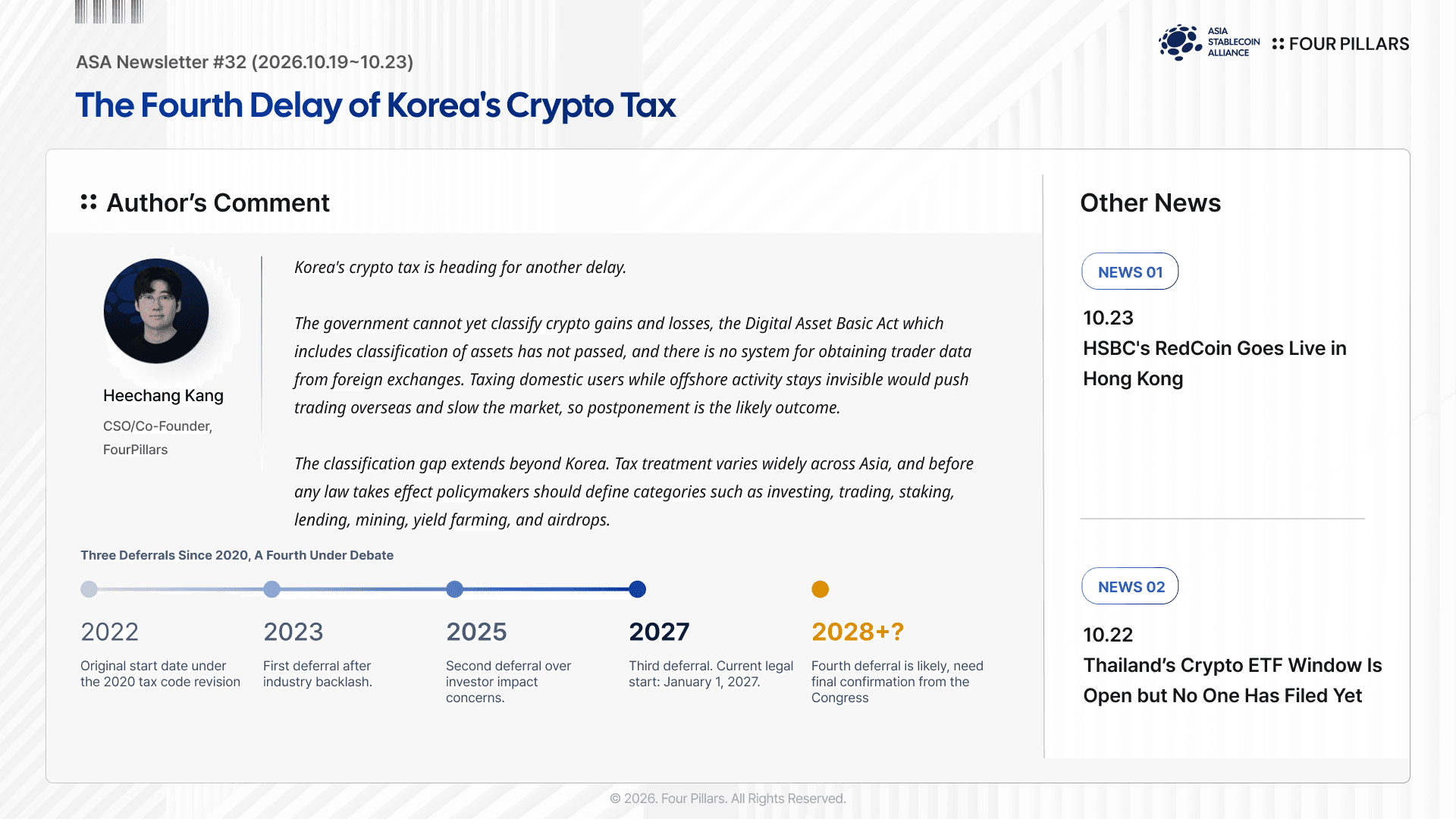
- South Korea: The National Assembly tax subcommittee reached a tentative agreement on November 11 to defer crypto taxation to 2029, but the amendment stalled over the basic deduction and exchange data submission duties. The Korea Fair Trade Commission cited competition concerns in its examiner's report on the Naver Financial and Dunamu share swap, including in the future won stablecoin issuance market. The Financial Services Commission will issue a no action letter allowing exchanges to suspend deposits and withdrawals on a suspected hack.
- Taiwan: The Financial Supervisory Commission expects the Virtual Asset Service Act to take effect in the first quarter of 2027, with existing exchanges given up to 21 months to obtain a license. Under the draft sub regulations, same day conversions of NT$500,000 (about US$15,800) or more into foreign stablecoins count toward the annual foreign exchange quota, and exchanges may not list a token without a whitepaper.
- Thailand: A payment app named WORPT launched for foreign tourists, who convert crypto into baht and pay local merchants by QR code during a pilot lasting 18 months. The Securities and Exchange Commission proposed minimum content for the knowledge test ICO portals give investors, and it moved to block the unlicensed platform VCEX and ordered Coins TH to fix compliance shortcomings.
Key Dates Ahead
- 2026.11, Korea: Government draft of the Digital Asset Basic Act expected
- 2026.11, Thailand: Bank of Thailand begins introducing five measures, including stablecoin and BNPL rules, through March 2027
- 2026.11, Japan: Progmat sandbox verification of tokenized JGB and onchain repo begins
- 2026.11.17, Thailand: Bank of Thailand baht stablecoin consultation closes
- 2026.11.26, Thailand: Comment period on the stablecoin transfer cap closes
- 2026.11.27, Australia: ASIC consultation on platform rules closes
- 2026.12, Taiwan: Comment period on stablecoin issuance rules closes
- 2026.12.03, Korea: Amended Foreign Exchange Transactions Act takes effect, with cross border digital asset transfers reported to the Bank of Korea
- 2026.12.09, Korea: National Assembly regular session ends
- 2026.12.14, Hong Kong: HKEX begins digital Hong Kong dollar settlement for overnight margin
- 2026.12.16, Taiwan: Comment period on Virtual Asset Service Act sub regulations closes
- 2026 year end, Hong Kong: Licensing amendment bill submission
- 2026 year end, Korea: Revised exchange security inspection standards
- 2027, Hong Kong: Exchanges begin collecting customer data under the crypto asset reporting framework
- 2027.01.09, Korea: Ruling party target for passing the Digital Asset Basic Act
- 2027.01.18, United States: GENIUS Act takes effect
- 2027 early, Japan: FSA interim summary and public private roadmap
- 2027 Q1, Taiwan: Virtual Asset Service Act and sub regulations could take effect
- 2027.02.04, Korea: Token securities system takes effect
- 2027.02.27, Thailand: Travel Rule takes effect
- 2027.03, Japan: Megabank yen stablecoin commercial launch target
- 2027.04.08, Australia: Digital Assets Framework Act takes effect
- 2027.07.01, Australia: Indexation replaces the 50 percent CGT discount on crypto
- 2028 H1, Korea: Crypto tax guidelines published
- 2029, Korea: Digital asset income taxation begins under the deferral plan