


Table of Contents
- 1. Bank of Korea Releases Unified Ledger Paper...Government Bond Tokenization and the Public Monetary System Come to the Fore
- 1.1 [News] Project Hangang Expands from a Stablecoin Alternative to a Discussion on Government Bond Tokenization
- 1.2 Commentary
- 2. Taiwan Passes First Virtual Asset Special Act...Stablecoins Enter a Consent and Licensing Regime Under the Central Bank
- 2.1 [News] A Single Law Covers Full VASP Licensing, Stablecoin Reserve Assets, and Penalties for Unauthorized Activity
- 2.2 Commentary
- 3. Hong Kong Prepares Tokenized Bond Rules...Moving the Fixed Income Market onto DLT
- 3.1 [News] HKMA and Financial Services and the Treasury Bureau Complete Phase 1 Review and Prepare New Rules for Tokenized Bonds
- 3.2 Commentary
- 4. Other News
- 4.1 Theme 1. Institutionalizing Stablecoin and RWA Roadmaps
- 4.2 Theme 2. Pressure to Incorporate Digital Assets into Korea’s Financial Sector
- 4.3 Theme 3. Alignment of CBDC, Self-Regulation, and Market Surveillance


[ASA News] is a biweekly newsletter that summarizes key stablecoin-related news across Asia and shares perspectives from industry participants. (2026.06.29~07.05)
1. Bank of Korea Releases Unified Ledger Paper...Government Bond Tokenization and the Public Monetary System Come to the Fore
1.1 [News] Project Hangang Expands from a Stablecoin Alternative to a Discussion on Government Bond Tokenization
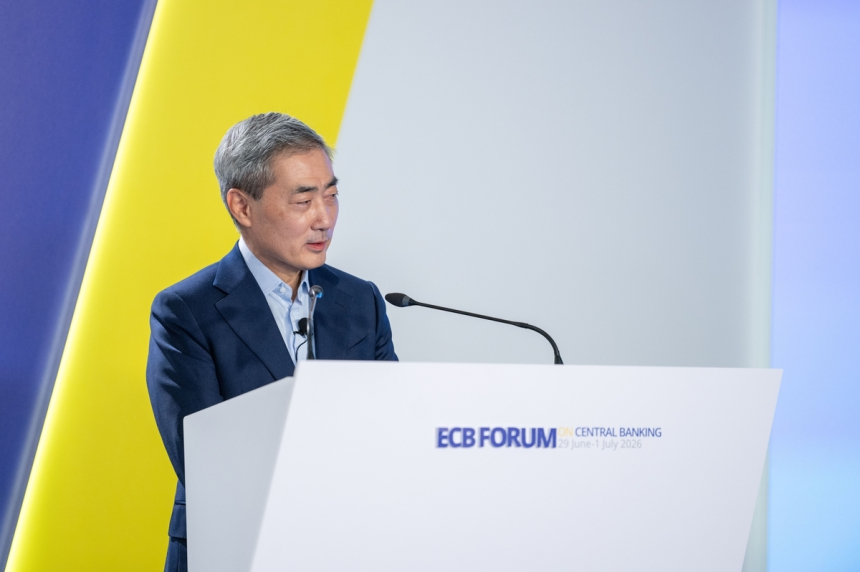
Bank of Korea Governor Hyun Song Shin presented a paper titled Practical Implementation of a Unified Ledger: Lessons from Project Hangang at the European Central Bank Forum in Sintra, Portugal, on July 1. The paper proposed a structure in which institutional digital money and private bank deposits are settled on a single ledger based on central bank trust. The Bank of Korea described this as a direction that strengthens the public monetary system rather than private stablecoins.
On the same day, Governor Shin also mentioned the need to tokenize assets such as government bonds. He explained tokenization not simply as moving money into numbers on a screen, but as embedding transaction conditions and execution rules together. This suggests that payment and settlement experiments could expand from deposit tokenization to asset tokenization involving government bonds and equities.
Ledger Insights noted that the Bank of Korea’s Project Hangang paper barely addressed privacy issues. Seven banks participated in Phase 1 of Project Hangang, and participation expanded to nine banks in Phase 2. The fact that the Bank of Korea directly released the paper on the international stage suggests that this experiment has moved beyond research and onto the agenda for future financial infrastructure reform.
1.2 Commentary
1.2.1 Not a Stablecoin Alternative, but a Redesign of Bank Ledgers
The Bank of Korea’s latest announcement should be read not as simple CBDC research, but as an attempt to redesign the ledger structure of the banking system. The core idea is to connect central bank money and bank deposits on a single unified ledger. This is not merely a defensive logic aimed at blocking private stablecoins. Rather, it is closer to a public infrastructure strategy that seeks to place deposits, government bonds, and settlement conditions within the same execution environment.
Structurally, Project Hangang is moving from issuance to use. If Phase 1 confirmed the feasibility of interbank settlement and tokenized deposits, this announcement opened the path to bringing assets such as government bonds and equities onto the ledger as well. However, the criticism that privacy has not been sufficiently addressed is important. A unified ledger increases efficiency, but where transaction information and authority are allocated becomes central to trust.
From a comparative perspective, Korea has brought central bank-led ledger design to the international stage before legalizing private stablecoins. Japan is bringing stablecoin use into the institutional framework through its amended Payment Services Act and private payment service providers, while Hong Kong is handling licensing and the tokenized bond market in parallel. Among the three, Korea is taking the most public-ledger-centered approach. This appears to be a choice to digitize a bank-centered financial system while keeping issuance authority and settlement unity anchored to the central bank.
The question going forward is whether Project Hangang can move beyond experimentation and become actual market infrastructure. If government bond tokenization is included, the scope expands beyond payments and settlement to government cash management and securities settlement. At that point, the allocation of authority among banks, the Korea Securities Depository, and financial regulators will also need to be clarified. If privacy and governance conditions are properly aligned, Korea’s unified ledger could become not a stablecoin alternative, but the starting point for public digital financial infrastructure.
2. Taiwan Passes First Virtual Asset Special Act...Stablecoins Enter a Consent and Licensing Regime Under the Central Bank
2.1 [News] A Single Law Covers Full VASP Licensing, Stablecoin Reserve Assets, and Penalties for Unauthorized Activity

Source: Taiwan Enacts Comprehensive Crypto Regulation...Introduces Authorization Regime for Stablecoins
Taiwan’s Legislative Yuan passed the Virtual Asset Services Act on June 30. The law is Taiwan’s first comprehensive special act for virtual assets and legally defines seven types of VASP businesses, including exchanges and custodians. Each business must establish systems for management eligibility, internal controls, audits, and cybersecurity management.
Separate requirements were imposed for stablecoin issuance. To issue a stablecoin in Taiwan, both central bank consent and approval from the financial supervisory authority are required. Full backing by reserve assets, segregated trust management, regular audits, and information disclosure are also required.
Penalties for unauthorized operations are also severe. Violations can result in imprisonment of three to ten years and fines of up to NT$200 million. Existing businesses must apply within 12 months after implementation and obtain approval within 21 months.
2.2 Commentary
2.2.1 The Core of Licensing Is Control Over Issuance Rights, Not Market Opening
Taiwan’s Virtual Asset Services Act should be read not simply as exchange regulation, but as a structure that places stablecoin issuance rights under the consent of monetary authorities. Classifying VASPs into seven business types is an exercise in mapping the industry. But the more important point is that stablecoin issuance requires both central bank consent and approval from the supervisory authority. This appears to be a design that allows private issuance while leaving the final judgment on monetary unity in the public domain.
Structurally, Taiwan has combined licensing with criminal penalties. Full reserve backing, segregated trust management, and regular audits are mechanisms that institutionally lock in an issuer’s ability to redeem. With heavy prison sentences and fines added for unauthorized operations, the path of growing a business first in a gray area and registering afterward becomes much narrower. As it moves from exploration to execution, Taiwan has chosen to draw boundaries before prioritizing speed.
Compared with Korea, Japan, and Hong Kong, Taiwan’s choice is closer to a middle path. Korea is still at the stage of restarting discussions on a Basic Digital Assets Act, while the Bank of Korea is separately pushing a unified ledger model. Japan is moving stablecoin businesses and payment pilots within the framework of the Payment Services Act. Hong Kong is restricting issuers through licensing while seeking to connect stablecoins with the payment infrastructure of an international financial hub. Taiwan made its law later than these jurisdictions, but its institutional scope is broad in that it regulated VASPs and stablecoins together in one step.
Still, a strong licensing regime does not itself guarantee market growth. If the number of issuers is limited and reserve requirements become strict, early players are likely to narrow toward banks or large financial groups. In return, user protection and international connectivity may be secured more quickly. For companies, this distinction will directly affect whether they see Taiwan as a test market or as a compliance-oriented issuance base.
3. Hong Kong Prepares Tokenized Bond Rules...Moving the Fixed Income Market onto DLT
3.1 [News] HKMA and Financial Services and the Treasury Bureau Complete Phase 1 Review and Prepare New Rules for Tokenized Bonds

Source: Hong Kong Moves to Prepare New Rules for DLT-Based Tokenised Bonds
The Hong Kong Monetary Authority (HKMA) and the Financial Services and the Treasury Bureau (FSTB) have completed a Phase 1 review on introducing DLT into the local fixed income market. According to the joint announcement, Hong Kong’s current legal framework was found to be sufficiently flexible to handle tokenized bond issuance. Following the review, the two agencies plan to prepare new rules applicable to DLT-based tokenized bonds.
The announcement is significant because it addresses the digital asset market and the fixed income market together. Hong Kong has already pursued tokenized bond issuance and digital asset institutionalization in parallel. This review appears to be a step beyond individual experiments, assessing whether DLT can be applied to fixed income market infrastructure itself.
Hong Kong authorities also stated that they would expand the use of DLT to improve market infrastructure and operational efficiency. This aligns with the broader shift toward making issuance, distribution, settlement, and post-trade management shorter and more automated. Once tokenized bond rules are established, Hong Kong will be able to connect stablecoin licensing and tokenized securities infrastructure within a single market.
3.2 Commentary
3.2.1 Where Bond Market Digitalization Meets Payment Infrastructure
Hong Kong’s preparation of tokenized bond rules should be read not as a simple securities issuance experiment, but as a signal that it intends to move the operating model of the fixed income market onto DLT. Bonds are a core asset in institutional finance, and the processes for issuance, settlement, custody, and interest payments are complex. The finding that the legal framework is sufficiently flexible in this area is important. The issue has now shifted from technical feasibility to what rules will define market standards.
Structurally, Hong Kong appears to be moving in a direction that does not treat stablecoins and tokenized bonds separately. Licensed stablecoins represent the institutionalization of payment instruments, while tokenized bonds represent the institutionalization of the asset layer. If the two layers are designed within the same regulatory perimeter, a vertically integrated model connecting issued assets and payment instruments becomes possible. For international investors, this makes Hong Kong look less like a simple exchange hub and more like on-chain fixed income infrastructure.
The differences among Korea, Japan, and Hong Kong become clear here. In Korea, the Bank of Korea’s unified ledger and the Korea Securities Depository’s preparations for tokenized securities are moving in parallel, but it is still difficult to say that the two axes have been tied into one market operating model. In Japan, private financial groups and payment service providers are first pushing stablecoin use, with self-regulation and legal amendments aligning around that. Hong Kong is closer to a model in which authorities lead licensing and bond rules together while first designing hub-style infrastructure.
However, the success of the Hong Kong model depends less on issuance volume than on connectivity with actual payment instruments. If tokenized bonds merely repackage existing bonds, efficiency gains will be limited. Conversely, if licensed stablecoins, bank payment networks, and tokenized bonds connect into one flow, they could reduce operating costs in the international fixed income market. The key point to watch is whether Hong Kong’s new rules remain at issuance requirements or expand into market infrastructure rules that include settlement and distribution.
4. Other News
4.1 Theme 1. Institutionalizing Stablecoin and RWA Roadmaps
4.1.1 OJK Prepares Crypto Roadmap...Focused on Stablecoins and RWA
- Indonesia’s OJK is preparing a digital asset roadmap for 2026 to 2031
- It is pursuing regulatory framework development with stablecoins, asset tokenization, and RWA as core pillars
- A signal that digital asset policy in Southeast Asia is also shifting from exchange oversight to financial infrastructure design
4.1.2 RWA Could Be the Philippines’ New Funding Engine
- Raises the possibility of regulated real-world asset tokenization under the Philippines’ existing SEC regulatory framework
- Could expand funding access across infrastructure, SMEs, real estate, renewable energy, and agriculture
- Reflects a trend in which RWA is discussed as a way to broaden capital access for the real economy rather than as a speculative product
4.1.3 Osaka Opens Stablecoin Business Subsidy Program Following Tokyo
- Osaka Prefecture has opened applications for pilot subsidies for blockchain and AI financial services, including stablecoin businesses
- The program targets fintech operators, collaborating corporations, and individuals, and requires demonstrability within Osaka Prefecture
- An example of Japanese local governments bringing stablecoin pilots into regional financial market development policy
4.1.4 Circle and Nomura Holdings Pursue Digital Finance Collaboration
- Nomura Holdings and Circle have entered into a basic agreement on collaboration in digital finance
- Highlights the potential expansion of stablecoin payments alongside the implementation of Japan’s amended Payment Services Act
- A signal that the interface between global dollar stablecoin infrastructure and major financial groups is widening in the Japanese market
4.2 Theme 2. Pressure to Incorporate Digital Assets into Korea’s Financial Sector
4.2.1 National Assembly Political Affairs Committee: “Stablecoin Legislation Is Urgent”
- The National Assembly’s Political Affairs Committee explicitly stated the urgency of stablecoin legislation in a policy report
- It cited an average daily trading volume of KRW 5.4 trillion and market capitalization of KRW 87.2 trillion for the digital asset market at the end of last year
- Legislative pressure is growing as the institutional vacuum persists despite the expanding market size
4.2.2 FSS Governor: “Virtual Assets Are Rapidly Converging with the Financial Industry”
- Financial Supervisory Service Governor Lee Chan-jin said virtual assets are converging with the financial industry based on stablecoin use and blockchain technology
- He explained that institutional improvements for asset tokenization are broadening the base of the digital asset industry
- He also pointed to inadequate internal controls and mistaken payment incidents, emphasizing the prerequisites for inclusion in the regulated system
4.2.3 Kiwoom Securities Contacts Bithumb...Will Equity Investment Discussions Continue?
- Kiwoom Securities is reportedly discussing an equity investment in Bithumb through a third-party rights offering
- Highlights securities firms’ moves to expand digital asset businesses ahead of the institutionalization of tokenized securities and stablecoins
- Can be interpreted as a trend in which traditional financial firms seek future infrastructure access through exchange equity stakes
- The Korea Exchange will include tech-special listed companies in delisting review if they change their main business purpose within five years after listing
- Blocks an indirect route of maintaining listing status and attracting market attention by switching to a digital asset treasury model
- An example of clearer boundaries around how far digital asset inclusion will be allowed within capital market discipline
4.3 Theme 3. Alignment of CBDC, Self-Regulation, and Market Surveillance
4.3.1 BSP Reviews Wholesale CBDC for Securities Settlement and Cross-Border Payments
- The Philippine central bank BSP’s Project Agila report presented wholesale CBDC as a potential settlement instrument
- It reviewed securities settlement and cross-border payments as key use cases and summarized technical results
- The Philippines also appears to be moving toward CBDC discussions centered on institutional settlement and securities infrastructure rather than retail payments
4.3.2 Japan’s JVCEA Announces New Leadership...Appoints Directors from FSA Working Group
- Japan’s digital asset industry self-regulatory organization JVCEA announced its new leadership structure
- Academic experts who served on a working group under the Financial Services Agency’s Financial System Council joined as new directors
- Japan’s self-regulation is moving beyond internal industry rules and closer to policy design
- The Financial Services Commission resolved to refer two digital asset market manipulation cases to investigative authorities
- Market manipulation using large amounts of capital and API-based ultra-short-term unfair trading were both detected
- A signal that digital asset market surveillance is becoming closer to capital market-style enforcement against unfair trading
- A paper was published in a Supreme Prosecutors’ Office academic journal on the need to improve procedures for recovering proceeds from digital asset crimes
- It argued for creating a new obstruction of justice offense to punish suspects who refuse to cooperate, such as by providing mnemonic codes
- The discussion is expanding toward redesigning investigation and recovery systems to fit the self-custody structure of digital assets
The author of this report may have personal holdings or financial interests in assets or tokens discussed herein. However, the author affirms that no transactions have conducted using material non-public information obtained in the course of research or drafting. This report is intended solely for general information purposes and does not constitute legal, business, investment, or tax advice. It should not be used as a basis for making any investment decisions or as guidance for accounting, legal, or tax matters. Any references to specific assets or securities are made for informational purposes only and should not be construed as an offer, solicitation, or recommendation to invest. The opinions expressed herein are those of the author and may not reflect the views of any affiliated institutions, organizations, or individuals. The opinions and analyses expressed herein are subject to change without prior notice. In addition, beyond the individual disclosures included in each report, Four Pillars, may hold existing or prospective investments in some of the assets or protocols discussed herein. Furthermore, FP Validated, a division of Four Pillars, may already be operating as a node in certain networks or protocols discussed herein or may do so in the future. Please see below links in the footer for FP Validated's participating network disclosures and for broader disclosure details.


