

Table of Contents
Researcher

Key Takeaways
- DTCC has officially launched its Tokenization Service (DTS), marking a major milestone in bringing securities on-chain. However, the service operates under strict regulatory constraints set by the SEC's No-Action Letter.
- DTS's biggest immediate benefit is more efficient collateral mobility. Financial institutions can transfer tokenized securities 24/7, nearly in real time, while potentially automating workflows through smart contracts.
- Despite the move on-chain, much of the traditional financial infrastructure remains unchanged. Ownership rights, custody arrangements, and market structures stay the same, while DTS does not natively support DvP settlement and requires separate cash solutions.
- DTS may be less transformative today than the hype suggests, but its long-term significance should not be underestimated. DTCC's adoption of blockchain is a major institutional milestone, and its roadmap could pave the way for tokenized securities to become mainstream.
1. DTCC Launches Its Tokenization Service
Source: DTCC
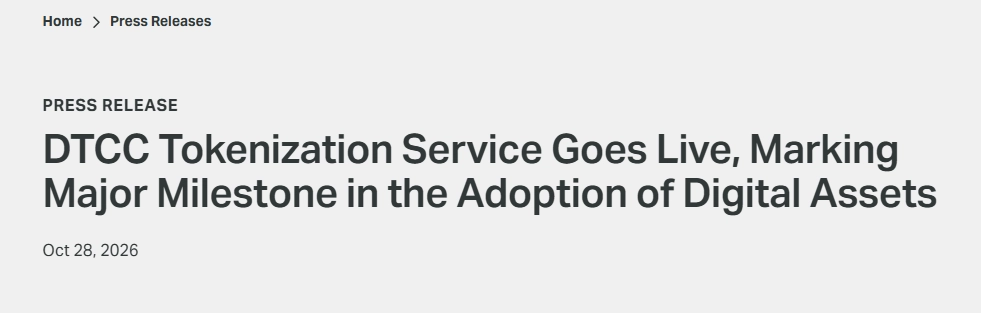
Yesterday, October 28, DTCC finally launched its Tokenization Service (DTS). Until now, we had mostly been hearing about DTCC's plans to bring securities onchain.
Now, those plans have actually become a reality.
The launch of DTS was made possible in large part by the No-Action Letter that the SEC issued to DTC last December. Essentially, the SEC staff agreed not to recommend enforcement action against DTC for operating a limited securities tokenization service, provided it followed certain conditions.
These conditions included:
- Eligible securities: Tokenization is limited to Russell 1000 constituents, U.S. Treasuries, and ETFs tracking major indices.
- No collateral or settlement value within DTC: Tokenized securities can be used as collateral in external transactions, but DTC does not recognize their collateral or settlement value within its existing risk management framework.
- Holding and transfer restrictions: Tokenized securities can only be transferred between DTC-registered wallets.
- DTCC's administrative authority: DTC retains the ability to forcibly recover or transfer tokens in cases involving lost or stolen tokens, erroneous transfers, and other specified circumstances.
- Authorization period: The No-Action Letter applies for three years from the date the initial service begins operating.
The fact that DTCC, a critical piece of U.S. securities market infrastructure, has actually launched a securities tokenization service is incredibly encouraging news for the blockchain industry.
But when you dig into the details of the SEC's No-Action Letter, it's also fair to question just how much additional value this form of tokenization can deliver compared to the existing financial system.
2. What Actually Changes?
Here's how DTCC's Tokenization Service, DTS, works:
- A participating financial institution registers its digital wallet with DTS.
- The institution submits a request to tokenize securities held in its existing DTC account.
- DTC performs the necessary verification and compliance checks.
- The securities entitlements are transferred from the participant's account to DTC's Digital Omnibus Account.
- Corresponding tokens representing those securities entitlements are minted and delivered to the participant's registered digital wallet.
Put simply, financial institutions can now turn their existing securities entitlements into tokens that can be held and transferred onchain.
Rather than focusing primarily on actively trading tokenized stocks in the equity market, DTS is designed with institutional use cases such as collateral mobility in mind.
This brings a few potential improvements:
- Operating hours: Tokenization and conversion requests are only available on business days from 2 AM to 6 PM ET. However, once securities have been tokenized, those tokens can be transferred 24/7 and potentially traded through supported venues. This is a meaningful improvement over traditional DTC processes, where securities transfers and collateral operations are generally subject to business hours and processing cutoffs.
- Transfer speed: Collateral transfers involving tokenized securities can be completed onchain in near real time, without waiting for traditional DTC settlement windows.
- Smart contracts: Tokenized securities can leverage smart contracts to automate certain functions, including compliance controls and distribution-related processes.
3. What Doesn't Change?
Quite a lot, actually.
- Security rights: Securities tokenized through DTS retain the same ownership rights, economic entitlements, and investor protections as their traditional counterparts.
- Custody of underlying securities: DTC continues to hold and safeguard the underlying securities, just as it does today.
- Registered ownership: The underlying securities remain registered under Cede & Co., DTC's nominee.
- Official recordkeeping: DTC remains responsible for maintaining the official records, using its existing books and LedgerScan to track tokenized entitlements.
- Security identifiers: Tokenized securities retain the same CUSIP as their traditional counterparts.
- Market structure: The existing relationships between DTC, broker-dealers, issuers, custodians, and beneficial owners remain unchanged.
- Dividend and interest payments: Payments continue to be made in fiat through traditional financial infrastructure, rather than through onchain stablecoins.
- Regulatory compliance: Existing KYC, AML, and other compliance requirements still apply.
Maintaining the same CUSIP and legal rights as traditional securities is clearly a positive. It helps preserve fungibility between traditional and tokenized positions, reducing the risk of liquidity fragmentation.
On the other hand, the fact that DTC remains responsible for official recordkeeping and the broader market structure stays largely intact suggests that the immediate improvements in efficiency and scalability may be more limited than some expect.
Another interesting point is that using blockchain doesn't automatically mean DTS supports DvP.
One of blockchain's biggest advantages is the ability to use consensus mechanisms and smart contracts to settle both sides of a transaction atomically. In other words, securities and cash can change hands simultaneously, reducing the risk that one party delivers its assets without receiving payment.
Naturally, you might expect DTS to support Delivery versus Payment (DvP) out of the box.
But that's not actually the case.
As outlined in the SEC's No-Action Letter, DTS is designed as a Free of Value (FOV) service. This means that the transfer of securities is not directly tied to a corresponding cash payment.
DTS handles the tokenization and transfer of securities entitlements, but it does not manage the associated cash obligations or provide final cash settlement.
As a result, institutions looking to execute DvP transactions using DTS-tokenized securities need to integrate separate payment infrastructure, such as stablecoins or other forms of digital cash, along with a mechanism that coordinates both legs of the transaction.
4. What Does This Mean Going Forward?
The fact that DTCC, one of the most important players in traditional securities markets, has entered the tokenization industry carries enormous significance.
For decades, financial markets have relied on legacy infrastructure that was built long before blockchain existed. The fact that an institution like DTCC is now adopting blockchain as part of the next generation of financial infrastructure is, by itself, a strong signal for the industry's long-term future.
However, when you look closely at what DTS actually offers today, surprisingly little has changed.
Tokenization is still happening within the constraints of the existing securities infrastructure, and the service operates under a fairly restrictive framework. For now, its practical utility is largely concentrated in enabling more efficient collateral mobility without the usual limitations of traditional market hours.
Compared to some of the other securities tokenization projects that have recently attracted significant attention in the onchain ecosystem, DTS may not seem particularly compelling from a pure utility perspective.
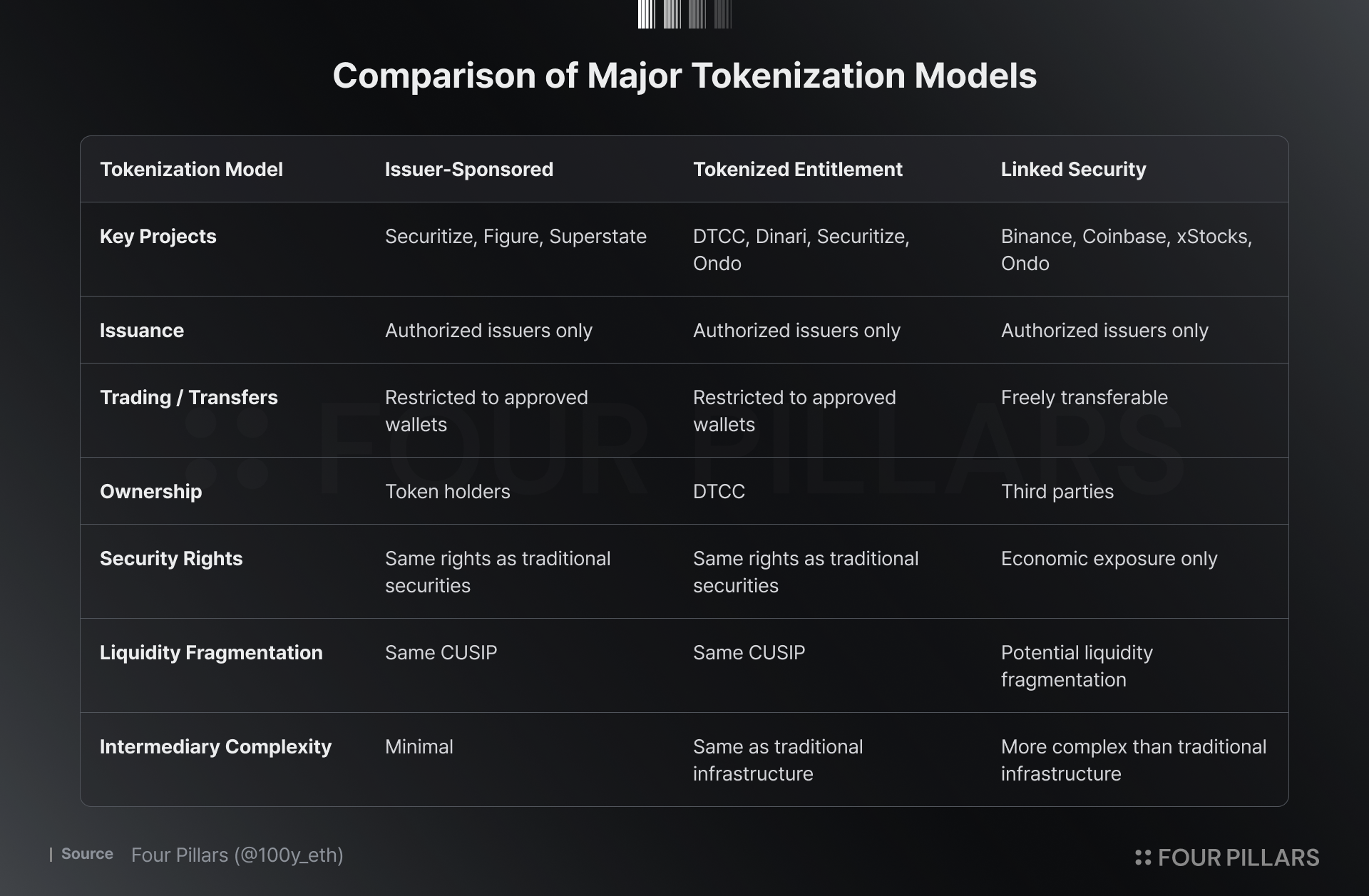
Issuer-sponsored models, for example, can bypass the traditional DTCC intermediated holding structure entirely, allowing issuers and transfer agents to bring securities directly onchain in a potentially much more efficient way.
Linked Security models, meanwhile, may not be able to offer the same level of access to U.S. investors under existing securities regulations, but they can provide investors in other permitted jurisdictions with significantly greater accessibility and flexibility.
The encouraging part is that DTS isn't stopping here. According to DTCC's roadmap, several major improvements are still ahead:
- Support for additional blockchain networks: Expanding beyond Besu and Canton to networks such as Stellar and Arc.
- More eligible securities: Broadening the range of assets available for tokenization.
- Stronger institutional security controls: Introducing additional security, authorization, and operational safeguards.
- Expanded corporate action processing: Supporting more events such as dividends, stock splits, and other corporate actions.
- Unified recordkeeping: Further integrating traditional DTC book-entry records with onchain securities positions.
- Expanded settlement capabilities: Developing additional functionality for settlement and collateral management, including onchain netting and digital cash.
DTCC's launch of DTS is only the beginning. A giant of the financial world has just cautiously taken its first step onto a new continent.
The immediate impact may be limited, but if these small steps continue to build on one another, we may eventually reach a point where tokenized securities become the mainstream foundation of financial markets.
The author of this report may have personal holdings or financial interests in assets or tokens discussed herein. However, the author affirms that no transactions have conducted using material non-public information obtained in the course of research or drafting. This report is intended solely for general information purposes and does not constitute legal, business, investment, or tax advice. It should not be used as a basis for making any investment decisions or as guidance for accounting, legal, or tax matters. Any references to specific assets or securities are made for informational purposes only and should not be construed as an offer, solicitation, or recommendation to invest. The opinions expressed herein are those of the author and may not reflect the views of any affiliated institutions, organizations, or individuals. The opinions and analyses expressed herein are subject to change without prior notice. In addition, beyond the individual disclosures included in each report, Four Pillars, may hold existing or prospective investments in some of the assets or protocols discussed herein. Furthermore, FP Validated, a division of Four Pillars, may already be operating as a node in certain networks or protocols discussed herein or may do so in the future. Please see below links in the footer for FP Validated's participating network disclosures and for broader disclosure details.


