


Table of Contents

Upbit, which accounts for about 70% of Korea's won-denominated crypto trading, saw monthly volume reach roughly ₩406T in December 2024, when trading spiked around the martial law episode. That exceeded the combined turnover of KOSPI and KOSDAQ. Dividing Upbit's volume by the two exchanges' combined turnover puts the ratio near 130%, meaning crypto trading ran about 30% above the entire equity market.
By May 2026 that ratio had fallen to 4%, and Upbit's monthly volume had shrunk to ₩47T, one-eighth of its peak. Since Korean exchanges draw most of their revenue from trading fees, a drop of this scale can read as a crisis signal for the exchanges.
The 4% Is a Number Stock Growth Created
The fall from 130% to 4% depends as much on the denominator, equities, as on the numerator, crypto. Take the numerator first. The benchmark is set at the nearest peak, December 2024, but trading was abnormally concentrated at that point. On December 3 alone, the day martial law was declared, Upbit traded ₩38.7T, 2.5 times the two exchanges' combined turnover. Starting from a peak inflated by a one-off surge makes the subsequent decline look larger than it is. Upbit averaged ₩61T a month over January to May 2026, essentially the same as the ₩59T average over June to October 2024, before the frenzy began. In absolute terms, crypto trading did not collapse. It returned to its earlier level.
The denominator, by contrast, more than tripled over the same period. Combined monthly turnover for KOSPI and KOSDAQ grew from about ₩306T in December 2024 to about ₩1,184T in May 2026. The rally that took KOSPI past 5,000 in late January and to the 9,200 level by June drove turnover higher. With the numerator back at its baseline while the denominator tripled, the fall from 130% to 4% is better read as the result of an equity boom.
Not Only a Negative Signal
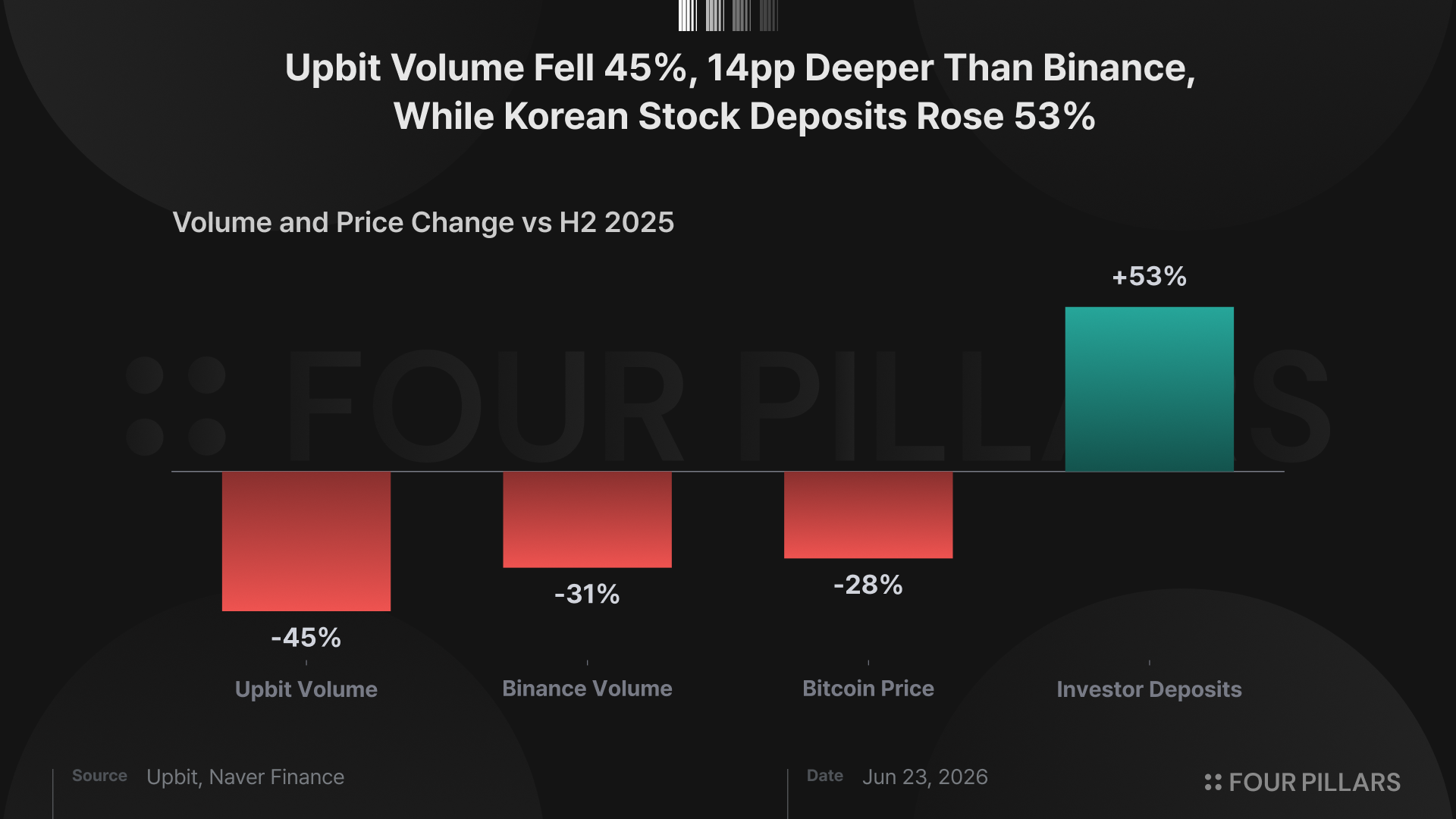
The decline in trading also showed up globally. Comparing the second half of 2025 with January to May 2026, the bitcoin price fell 28% and Binance volume fell 31% alongside it.
Over the same window, however, Upbit volume fell 45%, 14pp more than Binance. This extra decline above the Binance pace reads as domestic capital moving into equities. Investor deposits at brokerages, the idle cash parked to await equity purchases, rose from ₩54T at the end of 2024 to ₩132T in May 2026. On a trailing 24-month basis, Upbit volume shows a correlation of about −0.4 with domestic equity turnover.
Source: https://www.blockmedia.co.kr/2026년-5월-한국-디지털자산-리테일-투자자-리포트
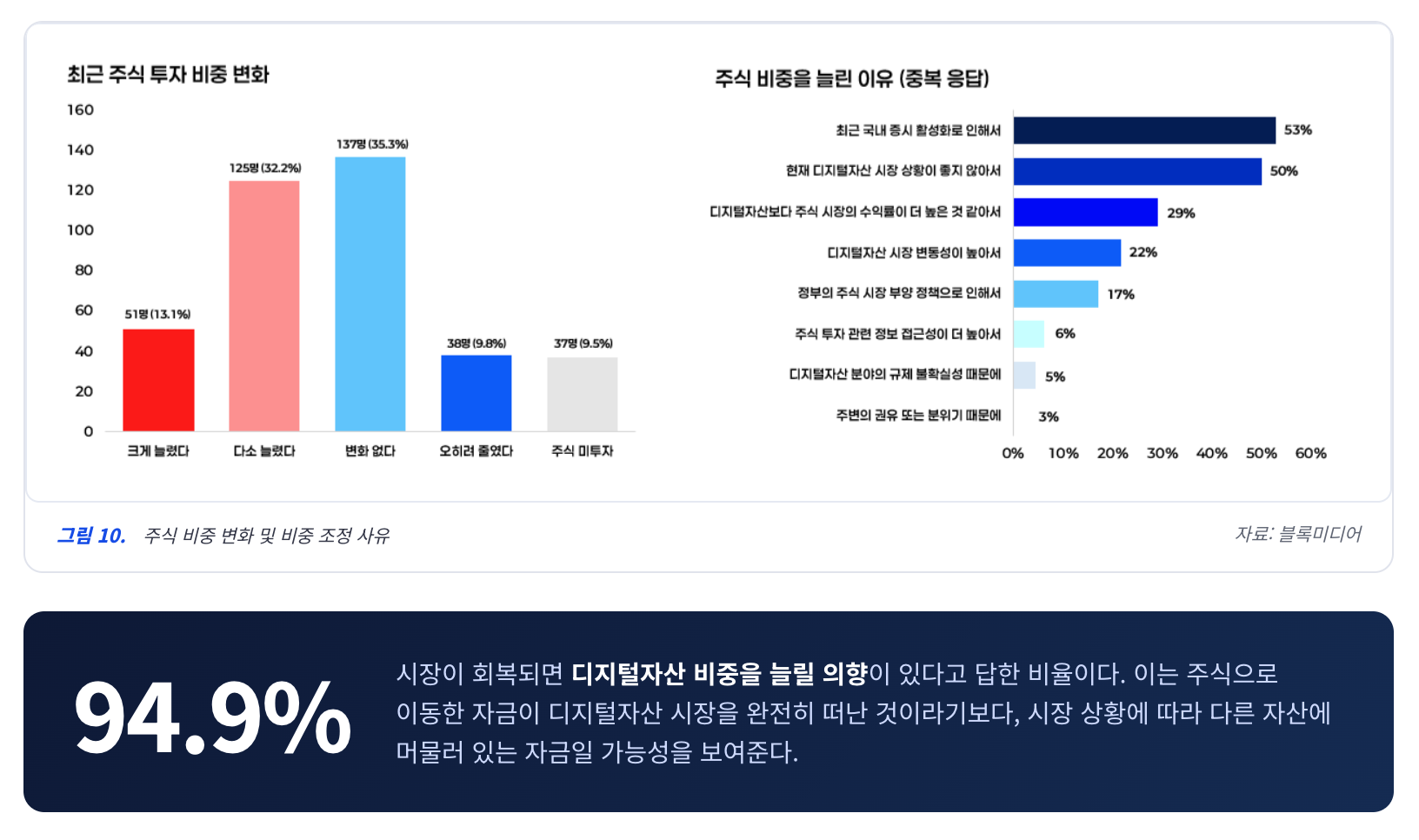
For volume to recover, liquidity has to flow back into crypto, but for now that capital is pointed at the equity market. As long as the domestic rally holds, the incentive to rotate back into crypto stays weak. Capital leaving, however, is not the same as investors leaving the market. In a Blockmedia survey of 388 active investors in May 2026, about 95% of those who had shifted weight into equities said they would return to crypto once the market recovers. They moved their assets, but did not exit the market. If so, Korean exchange volume hinges on when that displaced capital comes back, and the signal for it may surface not only in a crypto price rebound but also when the equity market's heat begins to cool.
The author of this report may have personal holdings or financial interests in assets or tokens discussed herein. However, the author affirms that no transactions have conducted using material non-public information obtained in the course of research or drafting. This report is intended solely for general information purposes and does not constitute legal, business, investment, or tax advice. It should not be used as a basis for making any investment decisions or as guidance for accounting, legal, or tax matters. Any references to specific assets or securities are made for informational purposes only and should not be construed as an offer, solicitation, or recommendation to invest. The opinions expressed herein are those of the author and may not reflect the views of any affiliated institutions, organizations, or individuals. The opinions and analyses expressed herein are subject to change without prior notice. In addition, beyond the individual disclosures included in each report, Four Pillars, may hold existing or prospective investments in some of the assets or protocols discussed herein. Furthermore, FP Validated, a division of Four Pillars, may already be operating as a node in certain networks or protocols discussed herein or may do so in the future. Please see below links in the footer for FP Validated's participating network disclosures and for broader disclosure details.


