



The evolution of EIPs, and more specifically “the number of new authors” participating in the proposal process each year, offers one useful lens through which to assess how decentralized Ethereum’s development process has been over time. Decentralization, at its core, implies an environment where anyone can voluntarily and relatively easily participate, and the share of new-author participation is one of the most direct signals of whether that environment is actually functioning as intended.
One important distinction to keep in mind is that ERCs and non-ERC EIPs(i.e., Core, Networking, Interface, Meta, Informational, and RIP) are quite different in nature. Non-ERC EIPs tend to require a deep understanding of Ethereum’s lower-level network architecture, as well as the accumulated history and context of prior standards, making them relatively difficult to propose. ERCs, by contrast, are standards implemented at the application layer, which means that builders can more easily put forward proposals based on their own needs.
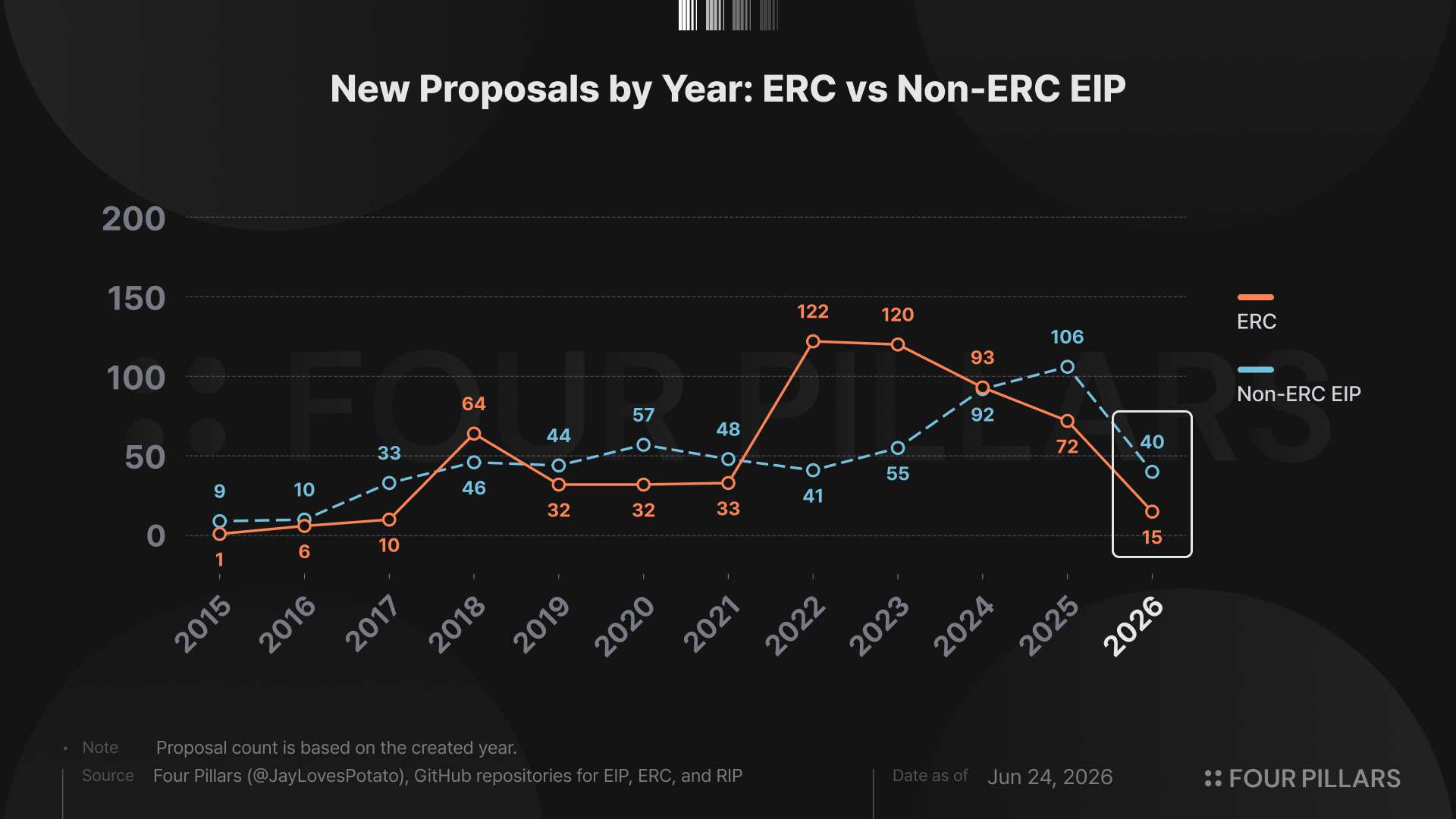
In practice, ERC proposals surged during stronger market periods, peaking in 2018 with 64 ERCs and again in 2022 with 122 ERCs. Excluding 2015 and 2016, the share of new EIP authors during these periods also reached its highest levels compared with adjacent years. While non-ERC EIPs did not see the same degree of newcomer participation as ERCs, they nevertheless consistently maintained a new-author share above the 40% range. The fact that a meaningful number of new faces continued to enter core-layer discussions each year, regardless of market cycles, suggests that Ethereum’s pipeline for external contributors had been functioning steadily over time.
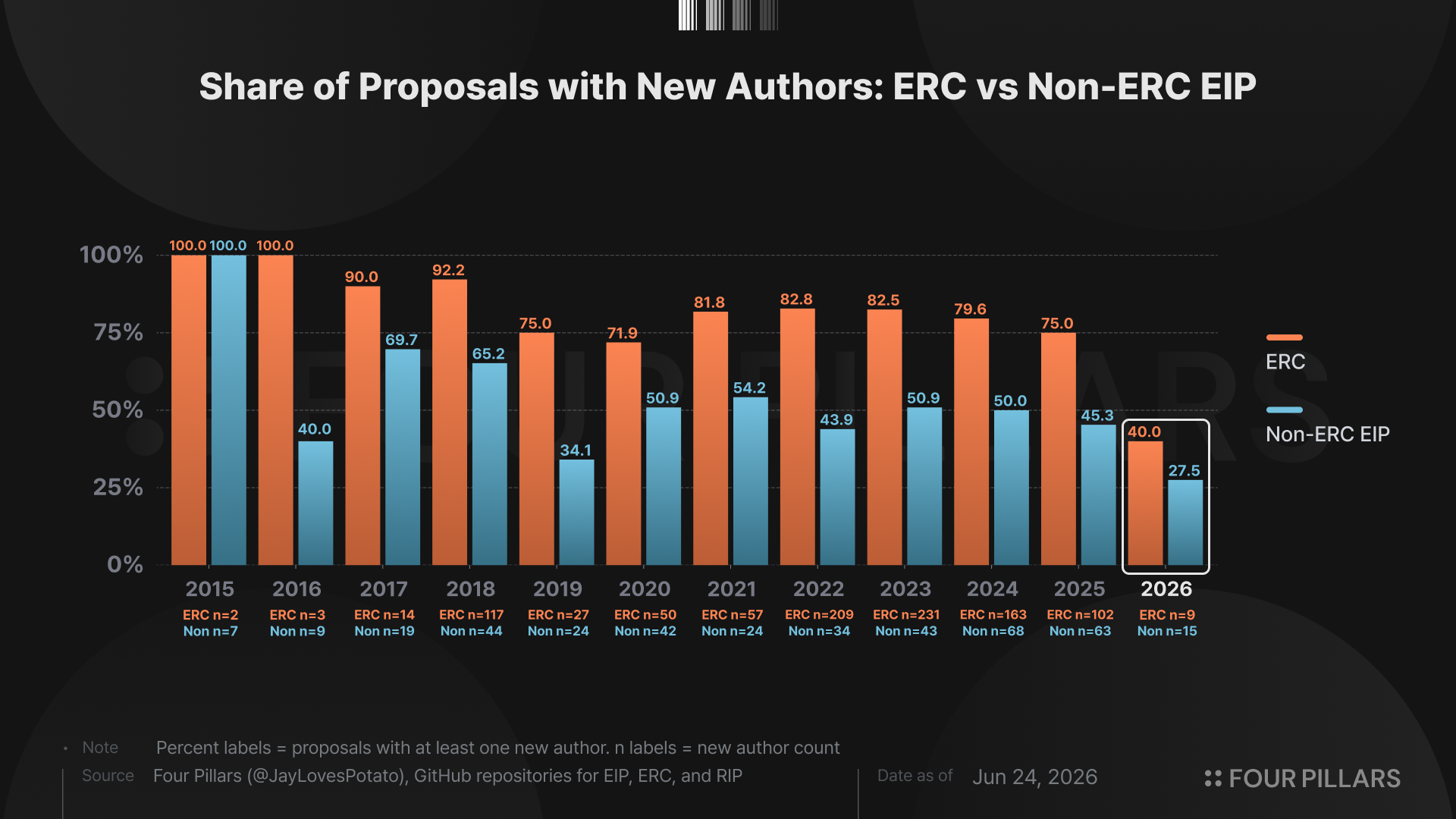
The numbers for 2026, however, tell a clearly different story. Although only half the year has passed as of the writing, 55 EIPs have already been submitted(15 ERCs and 40 non-ERC EIPs), meaning the sample size is by no means insignificant. Yet the share of new authors has fallen sharply, to 40.0% for ERCs and 27.5% for non-ERC EIPs, both markedly lower than in any previous year. For ERCs, the share had never fallen below 70% since 2015, while non-ERC EIPs have now dropped below their previous low of 34.1%, recorded in 2019. In other words, this is not simply a decline in the number of proposals; it points to a different kind of shift, where the composition of those making proposals is itself becoming narrower.
What makes this shift concerning is that 2026 is also the year in which Ethereum saw a significant departure of researchers who had played central roles in the network’s development. When we consider not only that the absolute number of non-ERC EIPs remains below historical norms, but also that many core network-related proposals have continued to be driven primarily by EF(Ethereum Foundation) members or a small group of core contributors close to the EF, the decline in new-author inflow becomes difficult to interpret as a mere cyclical slowdown.
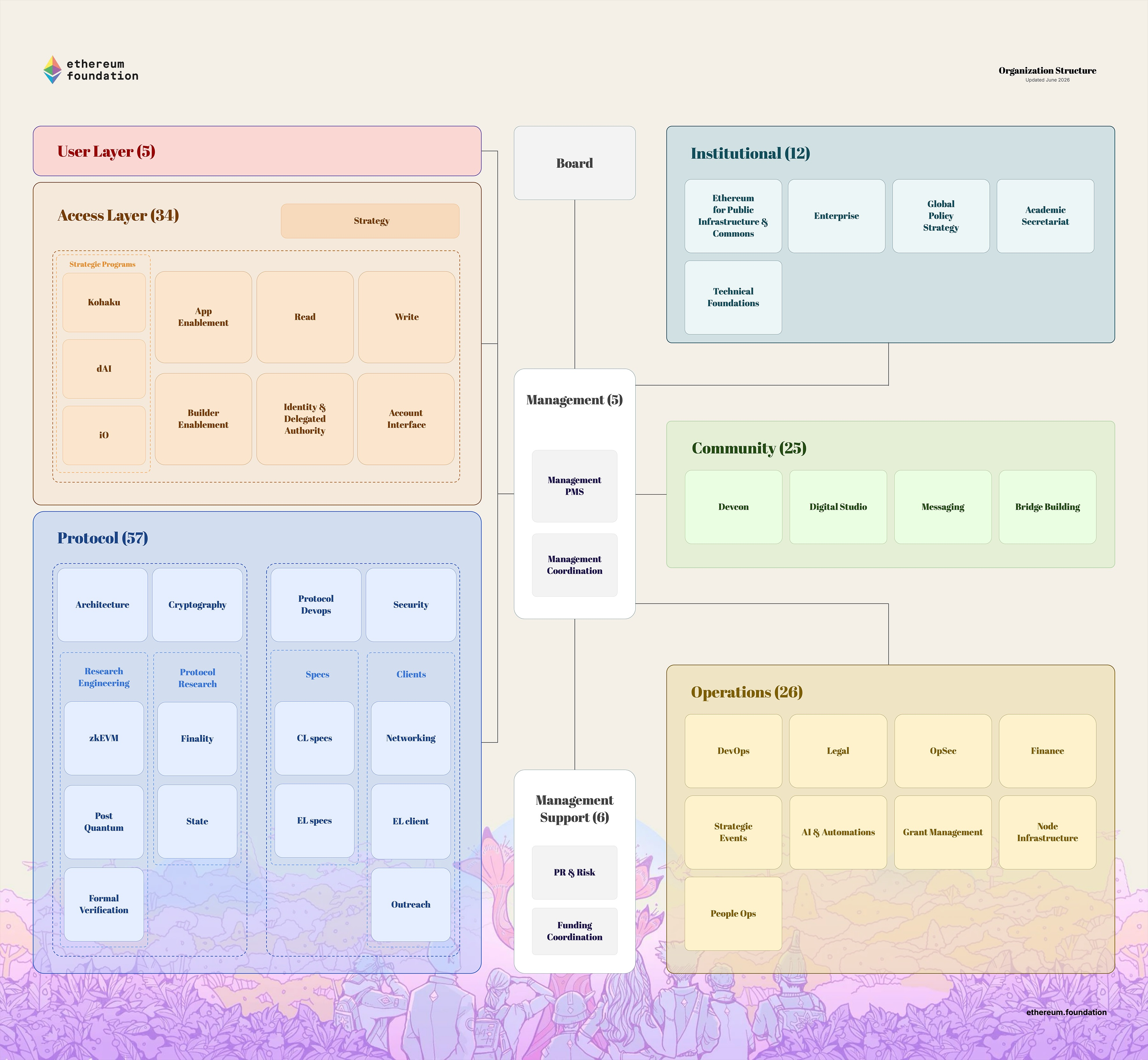
Source: Ethereum Blog
That said, the broader context behind this change also needs to be considered. In 2026, EF has been working to define a clearer scope for its role and direction, and has reorganized itself accordingly. Under the new structure announced on June 23, the EF redefined its work around five clusters(i.e., Protocol, Access, User, Community, and Institutional) while also parting ways with 54 people, or roughly 20% of its workforce. The logic is that, as the Foundation narrows its own scope, some of its responsibilities should naturally move outward to the broader ecosystem. If Ethereum is truly aiming to become “neutral public infrastructure”, the direction itself appears reasonable.
The problem is that this transition is coinciding with a decline in the share of new-author participation. The narrowing of the Foundation’s scope may be an intentional change, but if the inflow of external contributors expected to fill that gap is weakening at the same time, the implications become more complicated. More fundamentally, the concern that naturally follows from the EF’s restructuring is not simply the transfer of power, but the transfer of undocumented tacit knowledge.
Why a particular design was rejected in the past, what constraints a specific client team faces, which researchers have been thinking about which problems for years, why a change that looks elegant in theory may become risky in an actual fork coordination process, what forms of consensus-building are shared implicitly even if they are not explicitly stated during ACD, and whether a given EIP is merely stagnant, effectively abandoned, or still has a path to revival - all of these belong to the accumulated “context” that does not always appear in formal documentation. A decline in the inflow of new authors therefore also means that fewer people are newly gaining access to this context.
Ultimately, there are two things to watch going forward. The first is how researchers who have left the EF continue to contribute to Ethereum’s core updates from new environments. The second is how the Foundation, along with spin-off groups outside the Foundation, attracts new researchers who are aligned with their respective philosophies. Whether the share of new authors recovers in the second half of 2026, or whether the current numbers harden into a longer-term trend, will likely become one of the most direct indicators of whether Ethereum’s decentralization can be maintained through this period of structural transition.
The author of this report may have personal holdings or financial interests in assets or tokens discussed herein. However, the author affirms that no transactions have conducted using material non-public information obtained in the course of research or drafting. This report is intended solely for general information purposes and does not constitute legal, business, investment, or tax advice. It should not be used as a basis for making any investment decisions or as guidance for accounting, legal, or tax matters. Any references to specific assets or securities are made for informational purposes only and should not be construed as an offer, solicitation, or recommendation to invest. The opinions expressed herein are those of the author and may not reflect the views of any affiliated institutions, organizations, or individuals. The opinions and analyses expressed herein are subject to change without prior notice. In addition, beyond the individual disclosures included in each report, Four Pillars, may hold existing or prospective investments in some of the assets or protocols discussed herein. Furthermore, FP Validated, a division of Four Pillars, may already be operating as a node in certain networks or protocols discussed herein or may do so in the future. Please see below links in the footer for FP Validated's participating network disclosures and for broader disclosure details.


