Table of Contents
Researcher

Key Takeaways
- According to DefiLlama, 66 of 83 major tokens have mechanisms that return a portion of revenue to holders, and 76% of these mechanisms were introduced in 2025 or later. The mechanisms fall into three types: burn, hold, and distribution.
- Of the $2.12B returned over the past 12 months, 66% came from burn, and 76% of that was concentrated in Hyperliquid, Tron, and Pump.fun. This reflects the three protocols with the highest revenue adopting burn, rather than burn having a higher accrual rate.
- Only 16 of the 66 tokens with a market cap of at least $50M have a positive net accrual yield, calculated by subtracting supply growth over the same period from returns. Net accrual yield was determined by the scale of supply growth and whether revenue was large enough to offset it, rather than by the type of accrual mechanism.
- Across 39 burn and hold tokens, the Spearman correlation between net accrual yield and 1 year price change vs BTC is +0.29, indicating only a weak positive correlation. For now, value accrual is just one of the factors that determine price.
- Value accrual still sits between narrative and fundamentals. Burn suits holders, hold suits protocols that need capital for growth, and distribution conditional on lock-up suits protocols where long-term holder participation matters, while design suited to each stage and clear communication of its intent are the conditions for turning value accrual into a fundamental.
Crypto markets have recently tended to focus on protocols with mechanisms that return revenue to token holders, such as buybacks, burns, and fee distributions. Hyperliquid became a leading example by buying its native token with most of its revenue, and the number of protocols returning revenue to holders has since grown rapidly.
Of 83 major tokens selected based on DefiLlama data, 66 have introduced mechanisms that return a portion of revenue to holders, and 76% of those mechanisms were introduced in 2025 or later.
This article classifies 83 tokens by their value accrual mechanisms and examines, in order, where the value returned is concentrated, how much of it actually accrues to holders, and how it has been reflected in prices.
1. Three Ways to Return Value
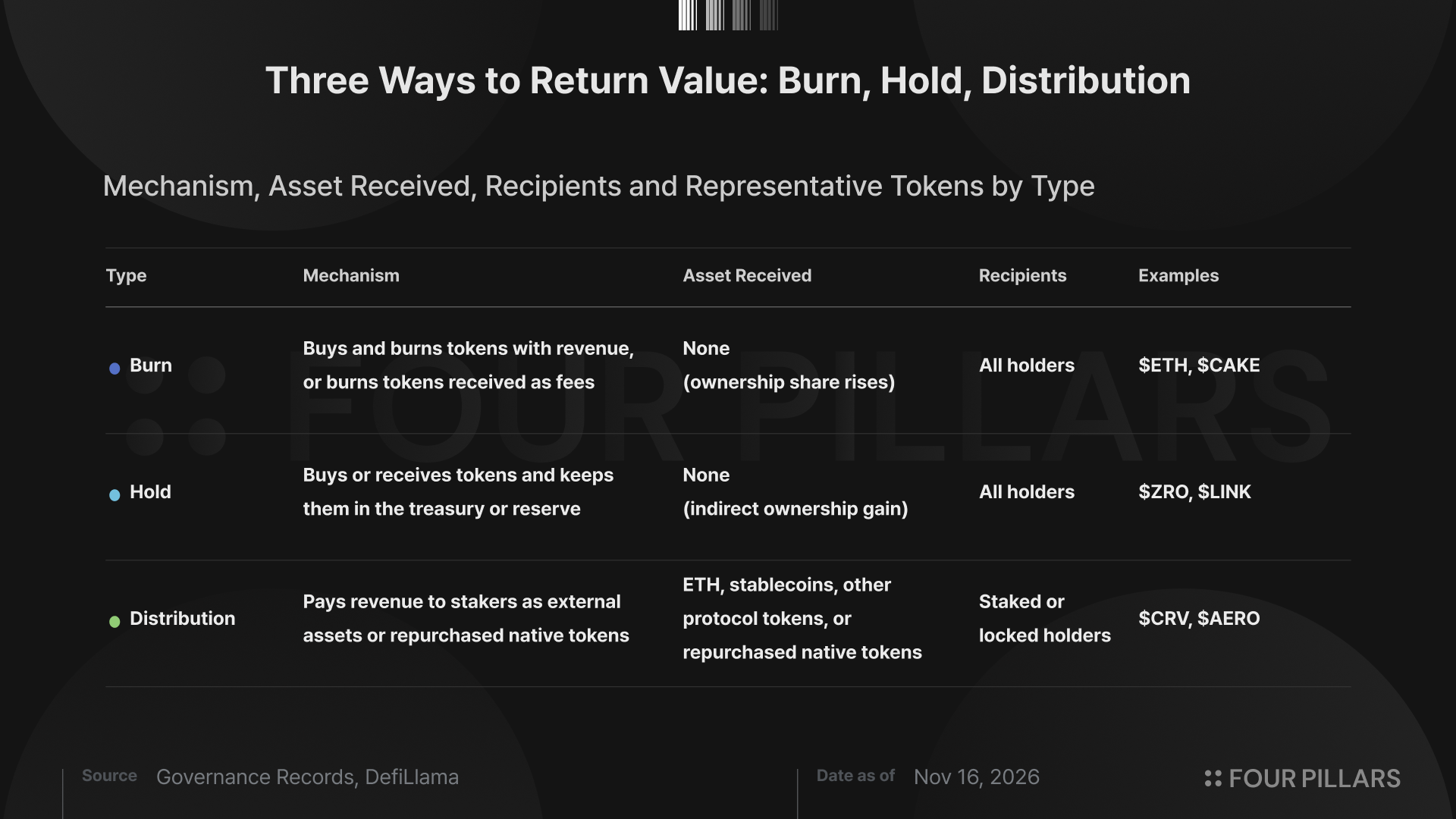
The table above distinguishes the three types by mechanism, asset received, and recipients. Even though all return value, the assets holders receive and the recipients differ by type.
As of November 2026, 83 tokens were selected, focusing on protocols with annual revenue of at least $10M or holder accrual of at least $1M on DefiLlama. Of these, 66 were found to have accrual rules. However, a token does not necessarily have just one value accrual mechanism. For example, Sky uses its net surplus to buy its native token and distribute it to stakers, and buys and burns some as well.
2. Value Returned Is Concentrated in Three Burn Protocols
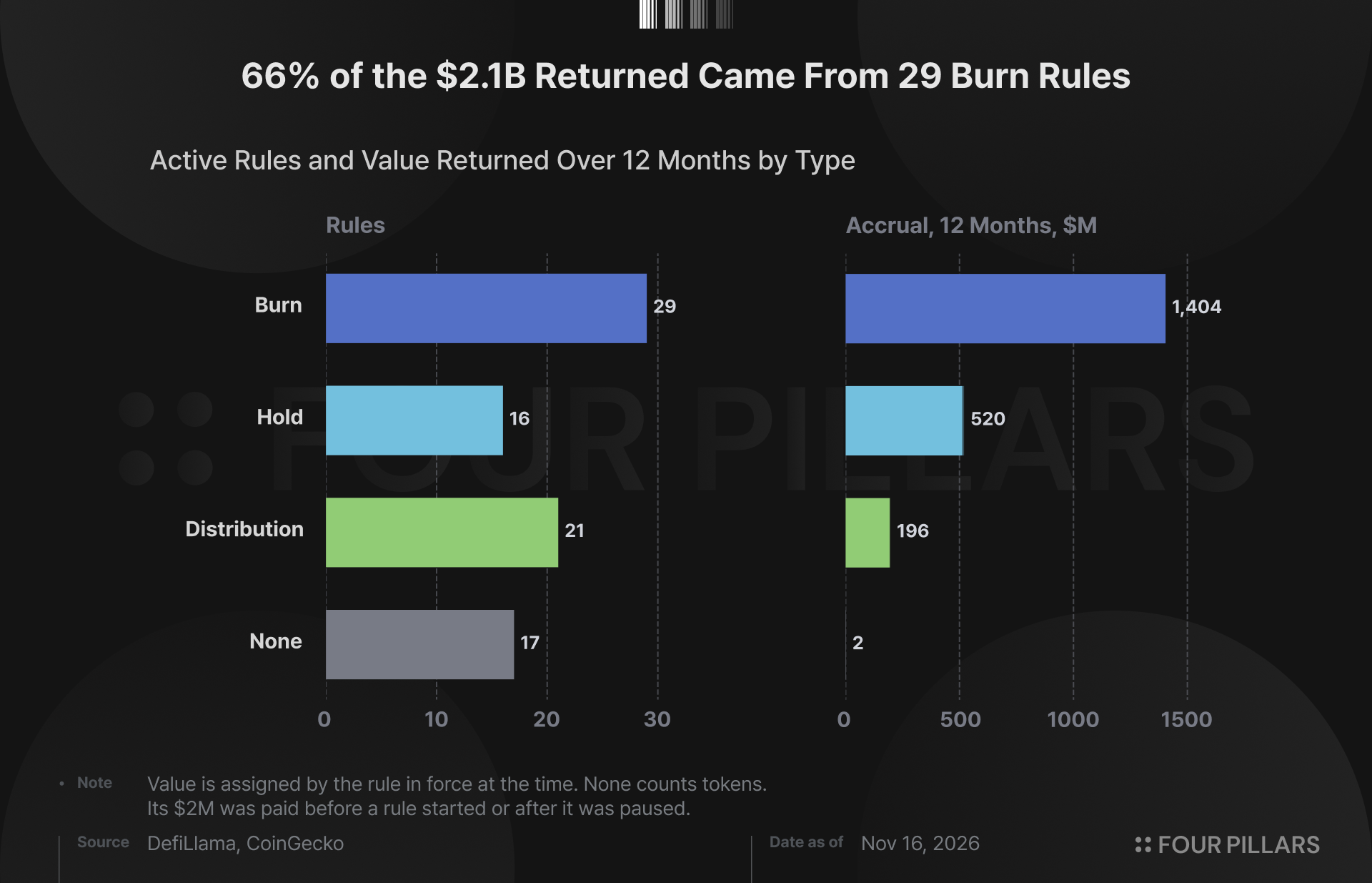
The rule counts are 29 for burn, 16 for hold, and 21 for distribution, but the value returned is concentrated in burn. Of the $2.12B returned over the past 12 months, burn accounted for $1.40B, or 66%, and 76% of that came from three protocols: Hyperliquid at $602M, Tron at $333M, and Pump.fun at $133M. In other words, burn accounts for a large amount not because it has a higher accrual rate, but because the three protocols with the highest revenue chose burn.
Distribution returned $196M, far less than burn and hold. This is because distribution was mainly adopted by the 2020 to 2021 generation, including Curve, Yearn Finance, and Convex, while most high-revenue protocols launched in 2024 or later chose burn or hold. However, its accrual rate relative to market cap is the highest, as the group consists of high-payout tokens with small market caps, such as Curve, Convex, and Aerodrome.
Distribution mechanisms, meanwhile, pay only holders who have staked or locked up their tokens. Lock-up rates differ across protocols, ranging from 8% for Yearn Finance to 74% for Sky across the 10 surveyed, with a median of 50%. In effect, the value returned by distribution tokens generally accrues to only about half of circulating supply.
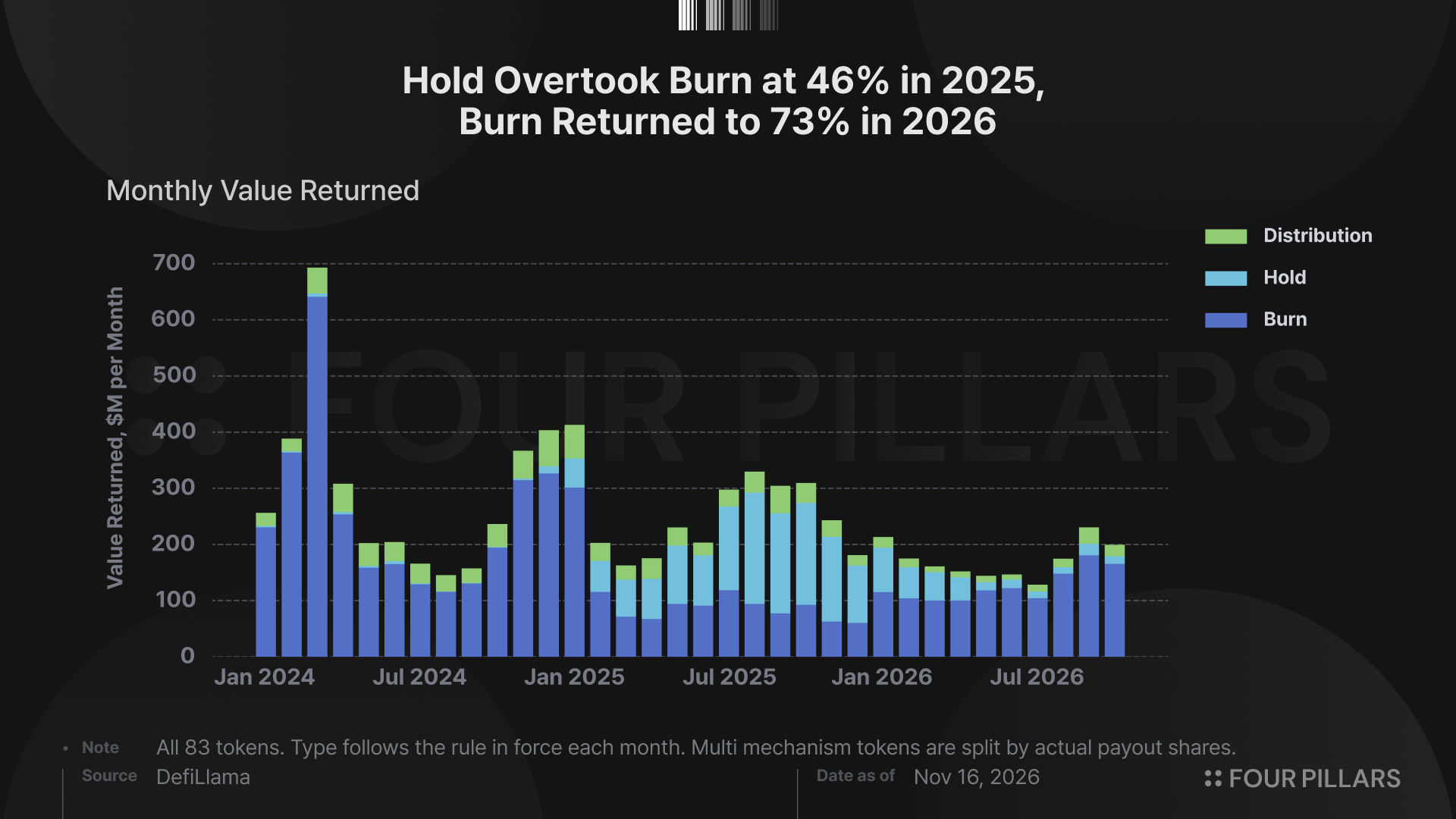
The share of each type changed substantially from year to year. Burn accounted for 85% in 2024, led by $1.99B in Ethereum gas burns. In 2025, hold overtook burn at 46% versus 41%, thanks to $0.81B in purchases by Hyperliquid's Assistance Fund. Burn returned to 73% in 2026, as Hyperliquid classified the Assistance Fund's holdings as burned through a validator vote in December 2025, while Pump.fun burned all of its repurchased tokens in April 2026 and then switched to a rule that automatically burns 50% of net revenue. The composition of value returned by type shifted with rule changes at just one or two protocols.
3. Supply Growth Matters More Than Returns
In fact, looking only at the value returned shows just half the picture of how much value accumulates in a token. For most tokens, circulating supply continues to grow through vesting unlocks of team and investor allocations, staking rewards, and incentive issuance, diluting the effect of value returned. To estimate the amount that actually accrues to holders, returns must therefore be considered alongside supply growth over the same period.
I calculated net accrual yield by subtracting the increase in circulating supply over the same period from the number of tokens returned, then dividing the result by current circulating supply. The sample consists of the 66 of 83 tokens with a market cap of at least $50M, and supply growth is the sum of all team and investor vesting, ecosystem allocations, staking rewards, and incentive issuance.
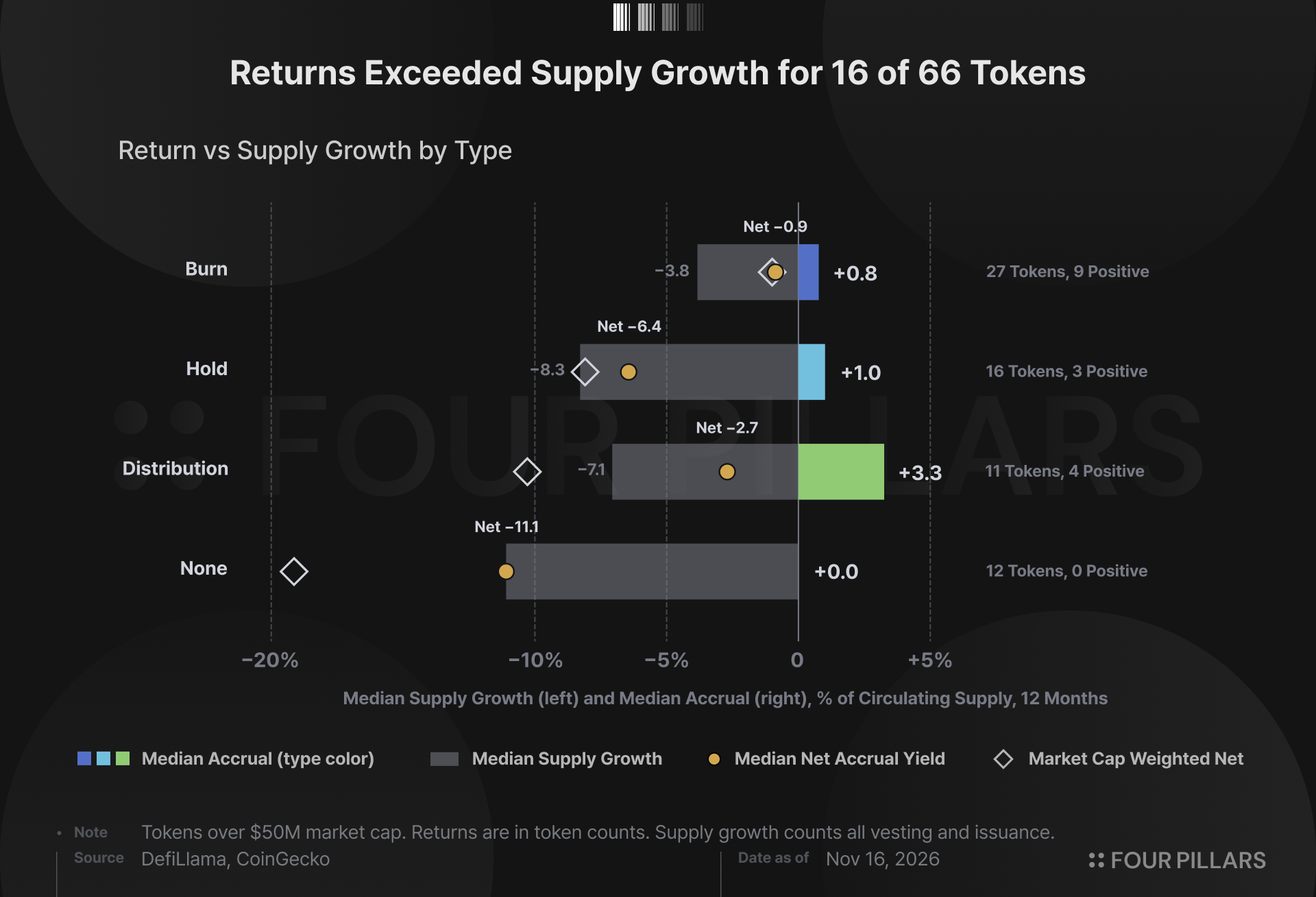
Only 16 of these 66 tokens have a positive net accrual yield. This means that even among the 54 tokens with accrual rules, 38 saw circulating supply grow by more than the number of tokens returned over the same period. Differences by type are also small, with the medians for all three types falling between −0.9%p and −6.4%p. The gap widens on a market cap weighted average basis, at −1.0%p for burn, −8.1%p for hold, and −10.3%p for distribution.
Among them, burn performs best, with a median of −0.9%p, a market cap weighted average of −1.0%p, and positive net accrual yield for 9 of 27 tokens, and can be considered the most effective value accrual mechanism to date.
However, the scale of supply growth, rather than the type of mechanism, determined which tokens had high net accrual yields. Of the 16 tokens with a positive net accrual yield, 11 had supply growth of less than 2% over the past 12 months, either because they had just launched and vesting had not yet begun, as with Pons, or because vesting had ended, as with Uniswap. Hyperliquid, Pump.fun, PancakeSwap, Convex, and Polygon are the only five tokens with a positive net accrual yield despite greater supply growth, and in each case revenue exceeded the increase in supply.
This does not mean that returns are meaningless. Vesting is concentrated in the early stages after launch and eventually ends, while returns can continue as long as there is revenue. Returns are therefore closer to a metric that determines long-term value after vesting ends than to one that determines short-term supply and demand.
4. Net Accrual Yield Has Been Only Partly Reflected in Prices
How much, then, did net accrual yield affect token prices? Over the past 12 months, the median price change relative to $BTC was −7% for burn, −15% for hold, and −17% for distribution.
However, even among the 23 burn tokens, outcomes range from +158% for Hyperliquid to −85% for Helium, making it difficult to attribute them definitively to the mechanism type. Distribution is also disadvantaged in a comparison based solely on price. With burn and hold, returns accumulate in the token price, while distribution pays holders directly, so the value returned is not reflected in the token price. For a more detailed correlation comparison, I therefore limit the sample to 39 burn and hold tokens with a market cap of at least $50M and 1 year of price history.
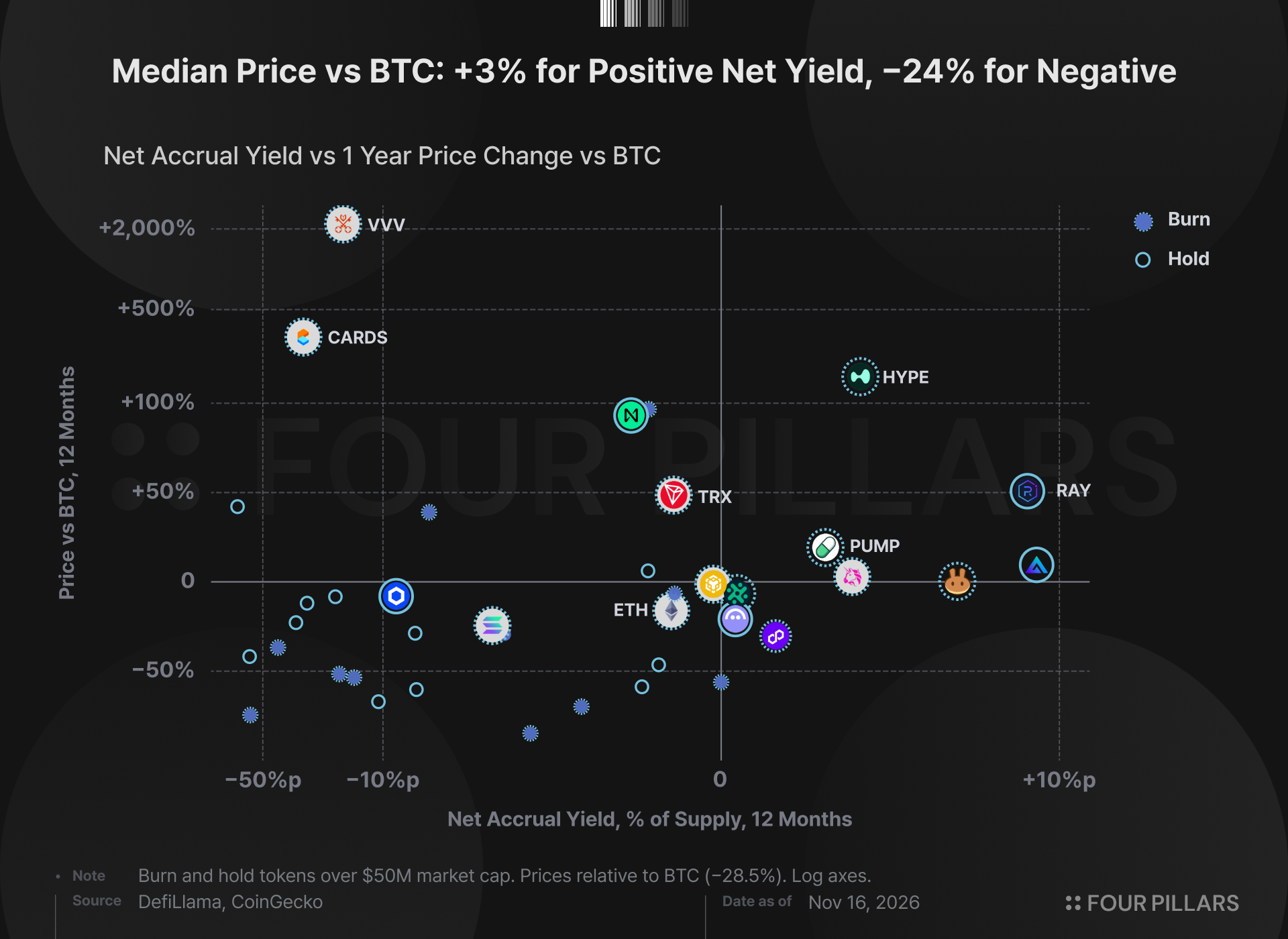
The chart above plots 39 burn and hold tokens with net accrual yield on the horizontal axis and 1 year price change vs BTC on the vertical axis. Of the 9 tokens on the right with a positive net accrual yield, 6 outperformed Bitcoin, and the median for all 9 is +3%. Tokens whose returns exceeded supply growth cluster in the upper right, including Hyperliquid at +158%, Raydium at +51%, and Pump.fun at +19%.
By contrast, the median for the 30 tokens on the left is −24%, and 22 of them underperformed Bitcoin. However, Venice at +2,177% and Collector Crypt at +308% saw their circulating supplies grow by 18% and 29%, respectively, leaving net accrual yields deeply negative, yet they posted the largest gains among the 39 tokens. These are cases where business performance or narratives unrelated to value accrual drove prices.
As these results show, returns do support prices, but their impact is limited. Although the medians for the 9 tokens with positive yields and the 30 with negative yields differ by 27%p, the tokens are widely dispersed, and the Spearman correlation between net accrual yield and price change vs $BTC is only +0.29, indicating a weak positive correlation. The median for the 12 tokens without accrual rules is lower, at −35%, than the −10% for the 39 tokens, but this also reflects differences in revenue scale and launch timing alongside whether an accrual rule exists. For now, value accrual is just one of the factors that move prices.
5. Conditions for Moving from Narrative to Fundamentals
Value accrual still sits somewhere between narrative and fundamentals and is more effective for projects that have moved beyond the effects of vesting and short-term events and reached a stable trajectory. Among these mechanisms, burn can appear the most intuitive and attractive to investors because returns accrue directly to the token price. Hyperliquid's performance has also helped burn become a leading value accrual mechanism recently and a reference for other protocols.
However, the point of examining different value accrual mechanisms lies beyond price. Even among mechanisms that return value, what is good for holders and what is good for protocols are clearly different.
Holders benefit from burn. Burn accrues to all holders unconditionally and reduces circulating supply by the corresponding amount. With hold, repurchased tokens accumulate in the treasury, so the increase in holders' ownership shares is similar, but whether those tokens are sold again or used for other purposes depends on the treasury's decision. Distribution pays cash or tokens directly, but only to holders who have locked up their tokens, and those receiving native tokens also bear the price risk of those tokens.
From the protocol's perspective, however, the ranking is reversed. Protocols such as Hyperliquid that burn most of their fees or use them for users already have an established market position and team token holdings, allowing them to operate without retaining revenue. However, if a protocol with low revenue that still needs to fund development, marketing, and incentives adopts the same approach, its capital for growth quickly disappears. In this context, hold is likely to be the mechanism protocols prefer, since the accumulated tokens can be used flexibly for future expenses, incentives, or crisis response.
That distribution mechanisms require users to lock up their tokens is also an advantage for protocols. Holders who have locked up their tokens are long-term holders who cannot sell immediately, and in the case of ve tokenomics, receiving fees requires involvement in governance and incentive allocation, so their interests align with the protocol's long-term growth. For holders, this limits access to payouts, but for protocols, it is also a mechanism for encouraging recipients to contribute directly or indirectly to the protocol, even when more incentives are paid out.
That is why I do not think there is a single best type of value accrual mechanism. Burn is a rational choice for protocols with high revenue that have completed the investment needed for growth, hold for protocols with low revenue that need capital for growth, and distribution conditional on lock-up for protocols where long-term holder participation matters.
What matters is not simply following the type currently in fashion, but designing a value accrual mechanism that fits each protocol's stage and the values it pursues, then clearly communicating the intent behind that design to users. I believe that when revenue continues after vesting ends and that design intent is communicated to users, the value accrual mechanism a protocol has developed can become a substantive fundamental rather than remain a vague narrative.
The author of this report may have personal holdings or financial interests in assets or tokens discussed herein. However, the author affirms that no transactions have conducted using material non-public information obtained in the course of research or drafting. This report is intended solely for general information purposes and does not constitute legal, business, investment, or tax advice. It should not be used as a basis for making any investment decisions or as guidance for accounting, legal, or tax matters. Any references to specific assets or securities are made for informational purposes only and should not be construed as an offer, solicitation, or recommendation to invest. The opinions expressed herein are those of the author and may not reflect the views of any affiliated institutions, organizations, or individuals. The opinions and analyses expressed herein are subject to change without prior notice. In addition, beyond the individual disclosures included in each report, Four Pillars, may hold existing or prospective investments in some of the assets or protocols discussed herein. Furthermore, FP Validated, a division of Four Pillars, may already be operating as a node in certain networks or protocols discussed herein or may do so in the future. Please see below links in the footer for FP Validated's participating network disclosures and for broader disclosure details.