


Table of Contents
Researcher

Key Takeaways
- Tokenized treasuries are the most active segment of the RWA market, largely because government bonds offer deep liquidity, stability, global demand, and a relatively simple tokenization structure.
- Most tokenized treasury products do not directly tokenize individual government bonds; instead, they tokenize fund interests in MMFs composed of treasuries, repos, cash, and similar assets.
- The key value of tokenized treasuries today is less about fixing back-office inefficiencies and more about expanding investor access through fractional ownership, 24/7 availability, emerging market access, and DeFi integrations.
- Different regulatory structures create different product characteristics: BENJI prioritizes regulated retail access, BUIDL prioritizes institutional flexibility and DeFi use, USYC targets non-US global investors, and USDY uses a debt-instrument structure for broader on-chain utility.
- In Korea, near-term opportunities for tokenized government bonds are limited because Korean bonds already function efficiently through electronic securities infrastructure, and the market’s potential will depend heavily on whether STO regulations allow public blockchain-based issuance and distribution.
This article is adapted from "Korean Blockchain Guidebook for Institutions 2026," jointly published by Four Pillars and Pantera Capital. The full report covers 14 more themes for companies and institutional investors.
1. Overview: Accessibility Is the Key
Government bonds are by far the most actively tokenized asset class. Tokenized U.S. Treasuries stand at $13.4B. Spiko's EU T-Bills MMF, backed by French government bonds, has roughly $1B tokenized, and RMB and HKD MMFs from ChinaAMC and Libeara account for over $200M combined.
Four things make U.S. Treasuries the default: deep liquidity, strong global demand, relatively high yields, and a straightforward tokenization process. One point is worth getting right up front. Most tokenized government bond products are not direct tokenizations of the bonds. They are tokenizations of MMFs (money market funds) made up of government bonds, repos, cash, and similar assets.
Tokenizing an MMF sounds like it should require a new regulatory framework. It doesn't. The transfer agent that keeps the fund's investor registry issues tokens for each investor's share and records the registry on a blockchain instead of an internal database. The SEC has stated the approach doesn't violate existing securities laws.
Cleaning up back-office inefficiency is one benefit of tokenized government bonds. The bigger benefit today is wider investor access: fractional investment, round-the-clock trading, entry points for emerging-market investors, and DeFi integration.
2. Global Trends: How Major Issuers Structure Their Products
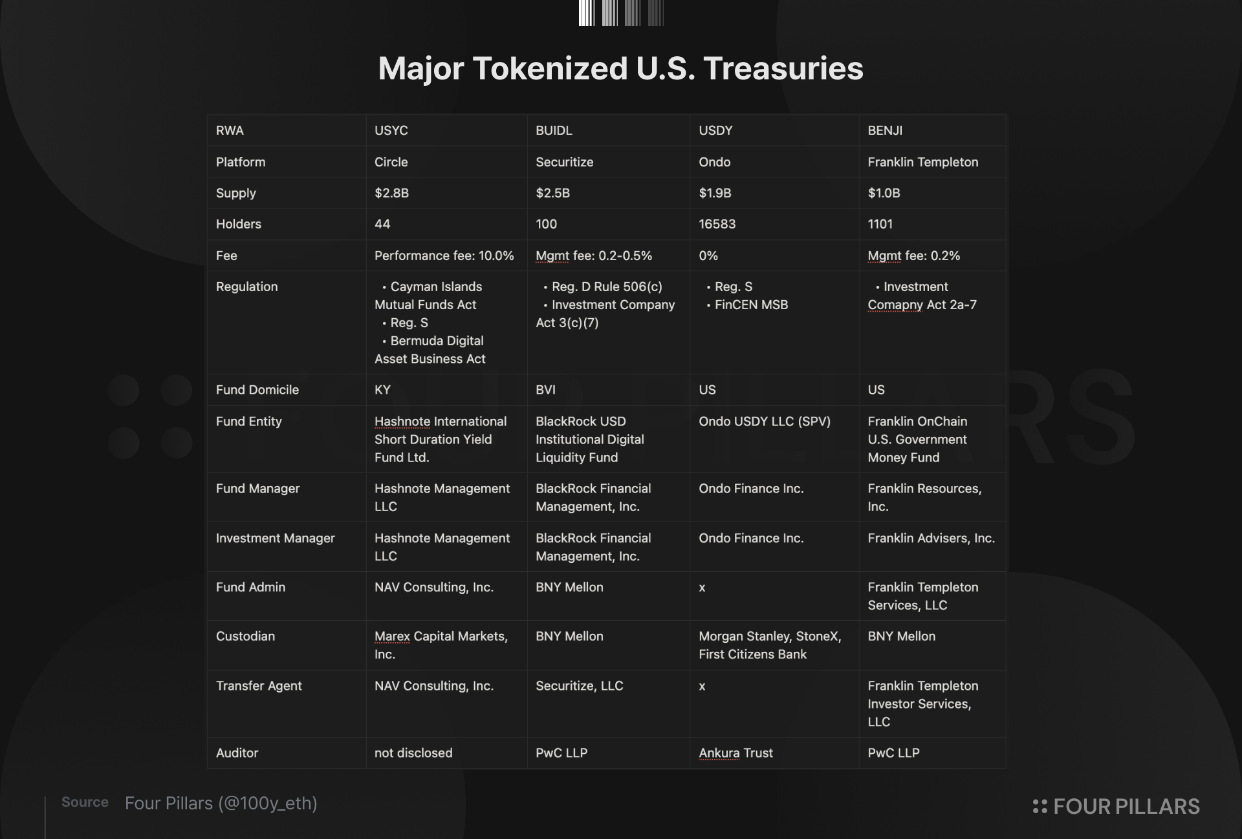
Asset managers, protocols, and financial firms have tokenized MMFs in different ways. Fund structure and regulatory regime shape each approach, which in turn decides who can invest and how far the tokens travel on-chain.
- BENJI is a publicly offered mutual fund registered with the SEC. U.S. retail investors can buy it through an app in small amounts. The blockchain is just a record-keeping tool, and the fund itself remains the core. Subscriptions and redemptions aren't available 24/7, and BENJI can't be used in DeFi protocols.
- BUIDL runs into the same Rule 2a-7 limits when set up as a U.S. fund, as BENJI shows. BlackRock worked around this with Securitize by combining a BVI offshore fund structure with Reg. D 506(c) and 3(c)(7). The fund sells only to accredited U.S. investors, skips SEC registration, picks up tax advantages, and operates with more flexibility. Unlike BENJI, BUIDL works on-chain and is accepted as collateral on DeFi platforms like Ethena and Ondo Finance.
- USYC is Hashnote's tokenized government bond; Circle acquired Hashnote in January 2025. Its design points in a different direction from BUIDL. Because Hashnote aimed at global enterprises and non-U.S. retail investors, it used Reg. S to exclude the U.S. market and stay exempt from SEC registration. The fund complies with Cayman regulations for fund-level credibility and with Bermuda regulations for token-issuance trust. USYC is accepted as collateral on Binance, OKX, and Bybit, and on lending platforms like Maple Finance.
- USDY from Ondo takes a different shape. Where the previous three products tokenize fund shares, USDY is a debt instrument. Investors lend to Ondo USDY LLC and receive USDY as a note. Ondo buys government bonds and bank deposits with the proceeds, and the yield flows back to investors. This structure gives USDY the highest on-chain usability of the four, including in permissionless DeFi.
The advantage of tokenized government bonds is what investors can do with them after issuance. BUIDL and USYC, for example, can be posted (with limits) as collateral or reserves on exchanges, lending protocols, and prime brokerage platforms.
That opens up looping strategies. An investor borrows stablecoins against tokenized government bonds, buys more tokenized bonds with those stablecoins, posts them as collateral, and repeats. Companies like 3F Labs have launched specifically to provide liquidity and tooling for RWA loops.
3. Opportunities in the Korean Market: Korea's STO Law and the Public-blockchain Question
Short-term opportunities in Korea look limited. The STO law passed in January 2026 allows government bonds to be tokenized in principle, but incentives are weak. Korean government bonds are already handled efficiently through electronic securities systems, and they carry lower global demand than U.S. Treasuries.
That said, a few projects are still moving.
- Shinhan Securities and Etherfuse tokenized Korean government bonds on a public blockchain (Solana) for the first time. Shinhan handles brokerage and custody; Etherfuse issues the bonds as a token called KTB. KRWQ, an overseas KRW stablecoin issuer, holds KTB as part of its reserves.
- Kyobo Life and Ripple announced a partnership to test tokenized government bonds. The goal is cutting T+2 settlement on Korean government bonds down to near real-time. Details are still undisclosed.
The bigger open question is whether Korea will allow public blockchains at all. Globally, tokenized government bonds mostly live on public chains. That setup may not be permitted in Korea. Subordinate regulations have yet to be finalized, but the Financial Services Commission has previously suggested that eligible blockchains may need to be composed of more than 51% financial institutions.
If that threshold holds, Korean tokenized government bonds will stay on private blockchains. In practice, Korean securities firms will likely offer products that only trade and transfer inside their own apps, similar to how Franklin Templeton and WisdomTree operate today.
The author of this report may have personal holdings or financial interests in assets or tokens discussed herein. However, the author affirms that no transactions have conducted using material non-public information obtained in the course of research or drafting. This report is intended solely for general information purposes and does not constitute legal, business, investment, or tax advice. It should not be used as a basis for making any investment decisions or as guidance for accounting, legal, or tax matters. Any references to specific assets or securities are made for informational purposes only and should not be construed as an offer, solicitation, or recommendation to invest. The opinions expressed herein are those of the author and may not reflect the views of any affiliated institutions, organizations, or individuals. The opinions and analyses expressed herein are subject to change without prior notice. In addition, beyond the individual disclosures included in each report, Four Pillars, may hold existing or prospective investments in some of the assets or protocols discussed herein. Furthermore, FP Validated, a division of Four Pillars, may already be operating as a node in certain networks or protocols discussed herein or may do so in the future. Please see below links in the footer for FP Validated's participating network disclosures and for broader disclosure details.
![CLARITY Act Fails, the SEC Steps In [FP Weekly 39]](/_next/image?url=https%3A%2F%2Fkrotgrfjzckvumudxopj.supabase.co%2Fstorage%2Fv1%2Fobject%2Fpublic%2Fassets%2Fimg%2Fcontent%2Farticle%2Fnotion-import%2Fmqlpp6muat2oq6.png&w=3840&q=75)

![CLARITY Act Faces the Senate, $LAPTOP Faces Reality [FP Weekly 38]](/_next/image?url=https%3A%2F%2Fkrotgrfjzckvumudxopj.supabase.co%2Fstorage%2Fv1%2Fobject%2Fpublic%2Fassets%2Fimg%2Fcontent%2Farticle%2Fnotion-import%2Fc3ygeemu0lqxb5.png&w=3840&q=75)

![Robinhood Takes Over Onchain
[FP Weekly 37]](/_next/image?url=https%3A%2F%2Fkrotgrfjzckvumudxopj.supabase.co%2Fstorage%2Fv1%2Fobject%2Fpublic%2Fassets%2Fimg%2Fissues%2Frobinhood-takes-over-onchain-fp-weekly-37.png%3Ft%3D1788765790150&w=3840&q=75)