


Table of Contents
- Key Takeaways
- 1. The SEC Is Preparing an Innovation Exemption for Tokenized Stock Trading
- 2. The Possibility That the SEC Will Allow Third-Party Tokenization
- 3. Coinbase’s Moves
- 3.1 Third-Party Tokenization: Coinbase’s Only Hope
- 3.2 Why Brian Armstrong Opposed the Draft CLARITY Act
- 3.3 Coinbase’s Letter to the SEC
- 4. Two Implications Hidden Behind the News
- 4.1 Coinbase Is Afraid of Securitize
- 4.2 Third-Party Tokenization Causes Liquidity Fragmentation in Stocks
- 5. Either Stick to Native Tokenization or Solve the Liquidity Fragmentation Problem
Researcher

Related Projects

Key Takeaways
- Tokenized stocks were originally meant to let anyone trade a wide range of assets seamlessly, anytime and anywhere. But today’s tokenized stock market may actually deepen liquidity fragmentation, as the same stock gets split into multiple product forms.
- According to Bloomberg, the “innovation exemption” reportedly being prepared by the SEC could become an important turning point, as it may allow the trading of third-party tokenized stocks. That said, rather than viewing this simply as bullish news, we need to look at why third-party tokenization is being pushed forward and what structural problems it could create.
- Tokenized stocks can be structured in several ways, including Issuer-Sponsored, Custodial, Linked Securities, and Security-Based Swaps. Each model differs in how closely it is connected to the original stock. In particular, third-party tokenization, where the issuer or transfer agent is not directly involved, can create a rights structure that differs from the actual stock, which raises issues around investor protection and regulation.
- Behind this debate are the interests of players like Coinbase, which want to offer tokenized stock services outside the existing transfer agent-centered structure. At the same time, if third-party tokenization spreads, multiple incompatible products based on the same stock could emerge, fragmenting not only trading venues but the very form of the stock itself.
- Ultimately, for tokenized stocks to deliver on their original promise, the market either needs to move toward native tokenization that is compatible with the rights structure of existing stocks, or it needs mechanisms that can address the liquidity fragmentation caused by third-party tokenization. The key questions to watch are how the SEC will allow third-party tokenization, and how it will organize investor rights and market structure in the process.
The future that tokenization promises for financial markets is clear: anyone should be able to trade many different types of assets seamlessly, anytime and anywhere.
But when we look at the tokenized stocks sector, tokenization seems far from that rosy future. If anything, tokenization today is accelerating the fragmentation of stocks.
1. The SEC Is Preparing an Innovation Exemption for Tokenized Stock Trading
On May 19, Bloomberg reported that the U.S. SEC is preparing a new exemption, or pilot regulatory framework, that would allow tokenized stocks to be traded. The SEC could reportedly announce this “innovation exemption” as early as this week.
The SEC, the most important regulator when it comes to stocks, is preparing to announce a pilot regulatory framework to allow tokenized stocks? Does this mean we are finally entering a world where every stock is tokenized and traded onchain? At first glance, this sounds like extremely important news for the crypto market.
But contrary to what one might expect, there has also been quite a bit of pushback from the industry. This news looks obviously bullish, so who is pushing back, and why? To understand that, we need to look at the central issue behind the announcement: “third-party tokenization.”
2. The Possibility That the SEC Will Allow Third-Party Tokenization
This section only covers the basics. For a more detailed classification of tokenized stocks and related examples, please refer to “2026: The Year of Tokenized Stocks.”
The most important point in this announcement is that it could open the door to “Third Party-Sponsored Tokenization.” So what is third-party tokenization?
In January 2026, the SEC published its “Statement on Tokenized Securities,” where it presented its views on the classification of tokenized securities. The SEC classified tokenized securities as follows.
- Issuer-Sponsored Tokenized Securities: A structure where the issuer directly, or through an agent such as a transfer agent, issues an existing security in tokenized form. The onchain records are connected to the existing shareholder ledger records, and the security remains fully subject to U.S. securities laws. Representative example: Securitize
- Custodial Tokenized Securities: A structure where a third party such as DTCC holds the securities in custody and issues tokens that represent rights to those custodied securities. Token holders indirectly hold rights to the securities, rather than directly holding the securities themselves. Representative example: DTCC
- Linked Securities: A structure where a third party issues a separate security in tokenized form, with returns linked to the value of a specific underlying security. Token holders are not granted rights such as voting rights or information rights in relation to the underlying security. Representative example: Ondo Finance
- Security-Based Swaps: A structure where a third party issues a derivative contract in tokenized form, with returns linked to the value of a specific underlying security. In general, token holders are not granted ownership rights or voting rights in relation to the underlying security. Representative example: Robinhood
Among these, the three models other than Issuer-Sponsored Tokenized Securities, namely Custodial Tokenized Securities, Linked Securities, and Security-Based Swaps, are classified as Third Party-Sponsored Tokenized Securities because they involve tokenization by a third party rather than direct tokenization by the issuer.
Under the SEC’s existing position, only two of the four tokenization models above were clearly permitted under existing securities laws.
- Issuer-Sponsored Tokenized Securities are securities issued in full compliance with existing securities laws, with only the form changed into a token. In its tokenization statement this January, the SEC explicitly stated that this model does not present an issue.
- In the case of Custodial Tokenized Securities, the SEC issued a no-action letter to DTC in December 2025, allowing DTC to carry out this tokenization model under limited conditions.
According to the SEC statement, the SEC is taking a fairly cautious approach toward Synthetic Tokenized Securities such as Linked Securities and Security-Based Swaps. The SEC does not ban these forms of tokenization, but it makes clear that because they do not provide the same rights as actual stocks, they may remain subject to separate regulations depending on their structure. In practice, Ondo Finance and xStocks, which use the Linked Securities model, cannot provide services to U.S. persons.
Then came reports suggesting that the SEC may suddenly be changing its stance. The SEC is reportedly preparing to announce an innovation exemption, signaling the possibility that it may allow third-party tokenization.
3. Coinbase’s Moves
3.1 Third-Party Tokenization: Coinbase’s Only Hope
From the SEC’s point of view, it would be easier to continue allowing only Issuer-Sponsored Tokenized Securities and Custodial Tokenized Securities. These two models are not very different from the way existing securities regulation and securities markets already work. So why would the SEC suddenly consider allowing other forms of tokenization that it had previously approached with caution?
The surface-level justification is to innovate capital markets by creating a new regulatory pathway for stocks to be traded on crypto platforms outside traditional exchanges. But in my personal view, Coinbase’s lobbying efforts likely played a significant role behind the scenes.
Coinbase has long been highly interested in tokenized stocks. Its competitor Robinhood has already started trading across stocks, crypto, tokenized stocks, and other assets. Similarly, since the second half of last year, Coinbase has been talking about launching tokenized stock services under its vision of becoming an “everything exchange.”
The problem is that, under current rules, the only way to provide tokenized stocks to U.S. investors while complying with existing securities laws is through a transfer agent. And Coinbase is not a transfer agent registered with the SEC.
In the end, the only immediate way for Coinbase to tokenize stocks would be to set up a separate entity, like Robinhood, have that entity buy and custody the stocks, issue tokens linked to the returns of those stocks, and offer those tokens to investors. But that structure cannot be offered to U.S. investors.
So Coinbase likely moved in the direction of persuading the SEC to allow Synthetic Tokenized Securities issued by third parties. We can infer this from a few examples.
3.2 Why Brian Armstrong Opposed the Draft CLARITY Act
Source: X(@brian-armstrong)
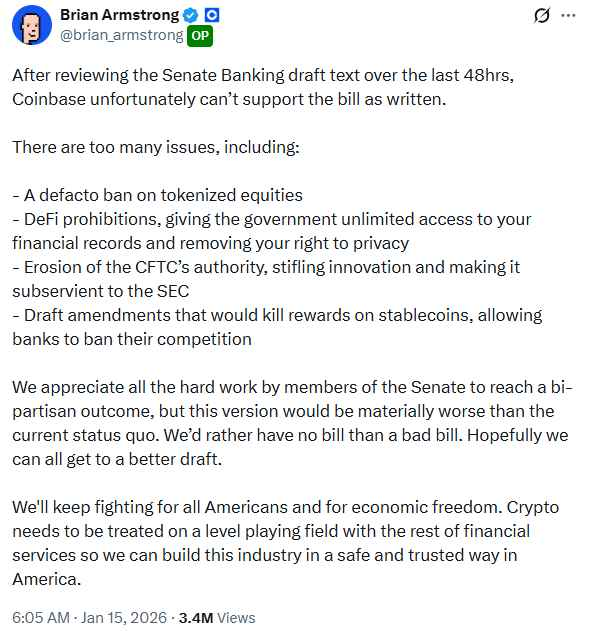
The first example is Coinbase CEO Brian Armstrong’s opposition to the draft CLARITY Act in January 2026. Among the various reasons Brian Armstrong opposed the bill, one was his claim that the bill effectively banned tokenized stocks.
The basis for this claim was Section 505(e)(2) of an earlier draft. That section stated that even if a financial product is tokenized through a blockchain, the existing financial regulations applicable to that product do not change. In other words, even if a stock is tokenized, it must still follow existing securities laws.
Does this provision really ban tokenized stocks? Not at all. Tokenization platforms such as Securitize and Superstate can already tokenize stocks in full compliance with regulation as transfer agents. More precisely, this provision does not ban all types of tokenized stocks. It bans the type of tokenization that Coinbase wants to carry out.
3.3 Coinbase’s Letter to the SEC
Source: SEC
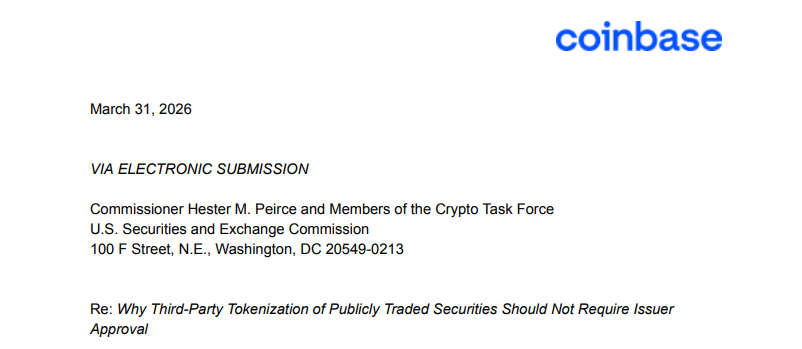
The second example is the document Coinbase submitted to the SEC in March 2026, titled Re: Why Third-Party Tokenization of Publicly Traded Securities Should Not Require Issuer Approval. Its core argument is that when a third party tokenizes and distributes stocks or securities that already trade freely in public markets on a blockchain, separate approval from the issuer of those securities should not be required.
The Issuer-Sponsored Tokenized Securities model explicitly permitted in the SEC statement requires the consent of the company itself, or its transfer agent, in order to tokenize that company’s stock. Coinbase submitted this document to the SEC because it wants to tokenize stocks through methods beyond that route as well.
The key arguments of the document are as follows:
- Requiring issuer consent is inconsistent with existing legal principles: Once a listed stock enters the public market, the issuer cannot freely control the distribution infrastructure for that stock. If existing stock ownership rights or beneficial interests are merely being represented through a new recordkeeping method called a token, then separate securities registration or issuer consent should not be required.
- Requiring issuer consent is anti-competitive: If the market sticks to existing methods, only existing exchanges and infrastructure providers benefit, and the industry cannot innovate. Also, if issuer consent is required for every security, it becomes difficult to achieve sufficient liquidity and meaningful network effects at scale.
- Third-party tokenization does not create excessive risk: DeFi risk and liquidity crises are not problems that can be solved through issuer consent. Even today, stocks are traded across many venues, including exchanges, ATSs, OTC venues, dark pools, and foreign markets.
Reading the full document, some arguments seem valid, while others make you tilt your head a bit. But either way, the main point is clear: Coinbase wants to offer tokenized stock services, and it is asking the SEC to open a lawful regulatory pathway for third-party tokenization that does not require issuer consent.
4. Two Implications Hidden Behind the News
On the surface, the SEC’s potential allowance of third-party tokenization sounds like huge news for the industry. But it is worth looking at two implications hiding behind it.
4.1 Coinbase Is Afraid of Securitize
Source: X(@CitronResearch)
First, we need to understand the competitive dynamics and tension spreading across the tokenized stocks sector. Tokenized stocks are an attractive service that everyone wants to offer, but the way each player can offer them varies greatly depending on its existing business and licensing status.
As explained above, Coinbase currently has no clear path to tokenize and offer stocks while fully complying with existing securities regulation. So while Coinbase’s tokenization-related moves are framed around industry growth, there is also another meaning behind them.
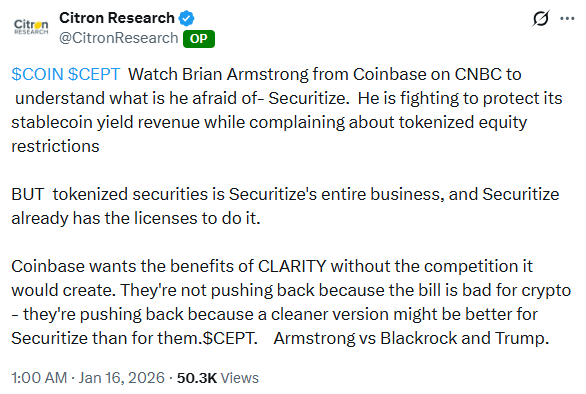
In fact, the well-known independent research firm Citron Research commented that Coinbase is afraid of Securitize and is trying to keep it in check.
4.2 Third-Party Tokenization Causes Liquidity Fragmentation in Stocks
Second is the issue of liquidity fragmentation. If all types of third-party tokenized stocks are allowed, the same company’s stock could be offered in many different forms across many different services. These products may not be interoperable with one another, which could fragment liquidity.
Take Tesla stock as an example. Tesla’s current transfer agent is Computershare. Computershare handles Tesla’s shareholder ledger management, stock transfers, dividends, and shareholder meeting-related operations. TSLA is officially listed on the Nasdaq Global Select Market, but it is also traded across various venues, including ATSs, dark pools, and overseas securities markets.
Third-party tokenization adds another axis of fragmentation: the form of the stock itself.
The Issuer-Sponsored Tokenized Securities model simply changes the shareholder ledger management that a transfer agent already performs into tokenized form. As a result, the stock is tokenized as the same stock, without liquidity fragmentation. The same is true for Custodial Tokenized Securities. In this model, DTCC simply manages indirect ownership rights to the stock through blockchain, so it remains fully compatible with the existing stock.
Third-party tokenization models such as Linked Securities and Security-Based Swaps are different. These models are basically tokenized securities or derivative contracts that represent rights to the returns of stocks acquired by a specific company. As a result, these tokenized stocks are completely different from the existing stock and are not interoperable at all from a regulatory or trading perspective.
For example, TSLA is already being tokenized and distributed through various platforms, including Ondo Finance’s TSLAon, xStocks’ xTSLA, and Robinhood’s Tesla stock token. Even though all of these are based on the same underlying Tesla stock, their regulatory frameworks and rights structures are completely different. They are not interoperable with one another, and they inevitably cause liquidity fragmentation.
If fragmentation goes beyond trading venues and extends to the very form of the stock itself, investors may become confused. This could end up contradicting the core value that tokenization was originally supposed to provide.
5. Either Stick to Native Tokenization or Solve the Liquidity Fragmentation Problem
Ultimately, to achieve the core value of tokenization discussed at the beginning, where anyone can trade many different types of assets seamlessly, anytime and anywhere, there are only two options.
- Allow only tokenization models that preserve the rights structure of existing stocks, such as Issuer-Sponsored Tokenized Securities and Custodial Tokenized Securities, or
- Allow the remaining third-party tokenization models, but add legal or system-level mechanisms that can solve the liquidity fragmentation problem.
Let’s see whether the SEC really allows third-party tokenization this week, as Bloomberg reported, and if it does, what new provisions it introduces.
The author of this report may have personal holdings or financial interests in assets or tokens discussed herein. However, the author affirms that no transactions have conducted using material non-public information obtained in the course of research or drafting. This report is intended solely for general information purposes and does not constitute legal, business, investment, or tax advice. It should not be used as a basis for making any investment decisions or as guidance for accounting, legal, or tax matters. Any references to specific assets or securities are made for informational purposes only and should not be construed as an offer, solicitation, or recommendation to invest. The opinions expressed herein are those of the author and may not reflect the views of any affiliated institutions, organizations, or individuals. The opinions and analyses expressed herein are subject to change without prior notice. In addition, beyond the individual disclosures included in each report, Four Pillars, may hold existing or prospective investments in some of the assets or protocols discussed herein. Furthermore, FP Validated, a division of Four Pillars, may already be operating as a node in certain networks or protocols discussed herein or may do so in the future. Please see below links in the footer for FP Validated's participating network disclosures and for broader disclosure details.
![CLARITY Act Fails, the SEC Steps In [FP Weekly 39]](/_next/image?url=https%3A%2F%2Fkrotgrfjzckvumudxopj.supabase.co%2Fstorage%2Fv1%2Fobject%2Fpublic%2Fassets%2Fimg%2Fcontent%2Farticle%2Fnotion-import%2Fmqlpp6muat2oq6.png&w=3840&q=75)

![CLARITY Act Faces the Senate, $LAPTOP Faces Reality [FP Weekly 38]](/_next/image?url=https%3A%2F%2Fkrotgrfjzckvumudxopj.supabase.co%2Fstorage%2Fv1%2Fobject%2Fpublic%2Fassets%2Fimg%2Fcontent%2Farticle%2Fnotion-import%2Fc3ygeemu0lqxb5.png&w=3840&q=75)

![Robinhood Takes Over Onchain
[FP Weekly 37]](/_next/image?url=https%3A%2F%2Fkrotgrfjzckvumudxopj.supabase.co%2Fstorage%2Fv1%2Fobject%2Fpublic%2Fassets%2Fimg%2Fissues%2Frobinhood-takes-over-onchain-fp-weekly-37.png%3Ft%3D1788765790150&w=3840&q=75)