


Table of Contents
Researcher


Strategy’s 32 BTC Sale Wipes $42B Off Bitcoin’s Market Cap
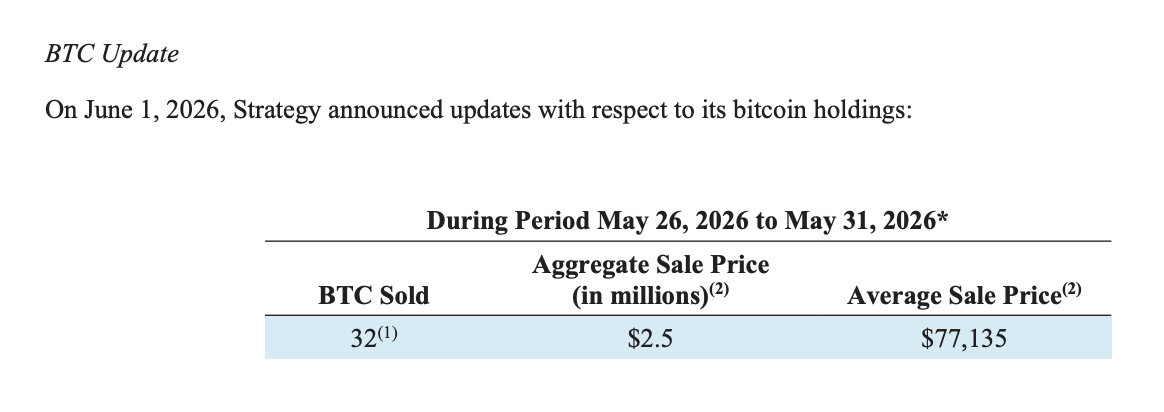
Source: SEC
According to the 8-K filing Strategy submitted to the SEC on June 1, 2026, Strategy sold 32 BTC on May 26 and received $2.5M. This was Strategy’s first BTC sale since it sold 704 BTC in 2022 for tax benefits. For reference, back then, Strategy bought 810 BTC again two days after selling 704 BTC.
The market is taking this as a major shock. At the time of writing, BTC has fallen below $70K, and Strategy’s $2.5M sale has wiped out more than $42B in Bitcoin market cap.
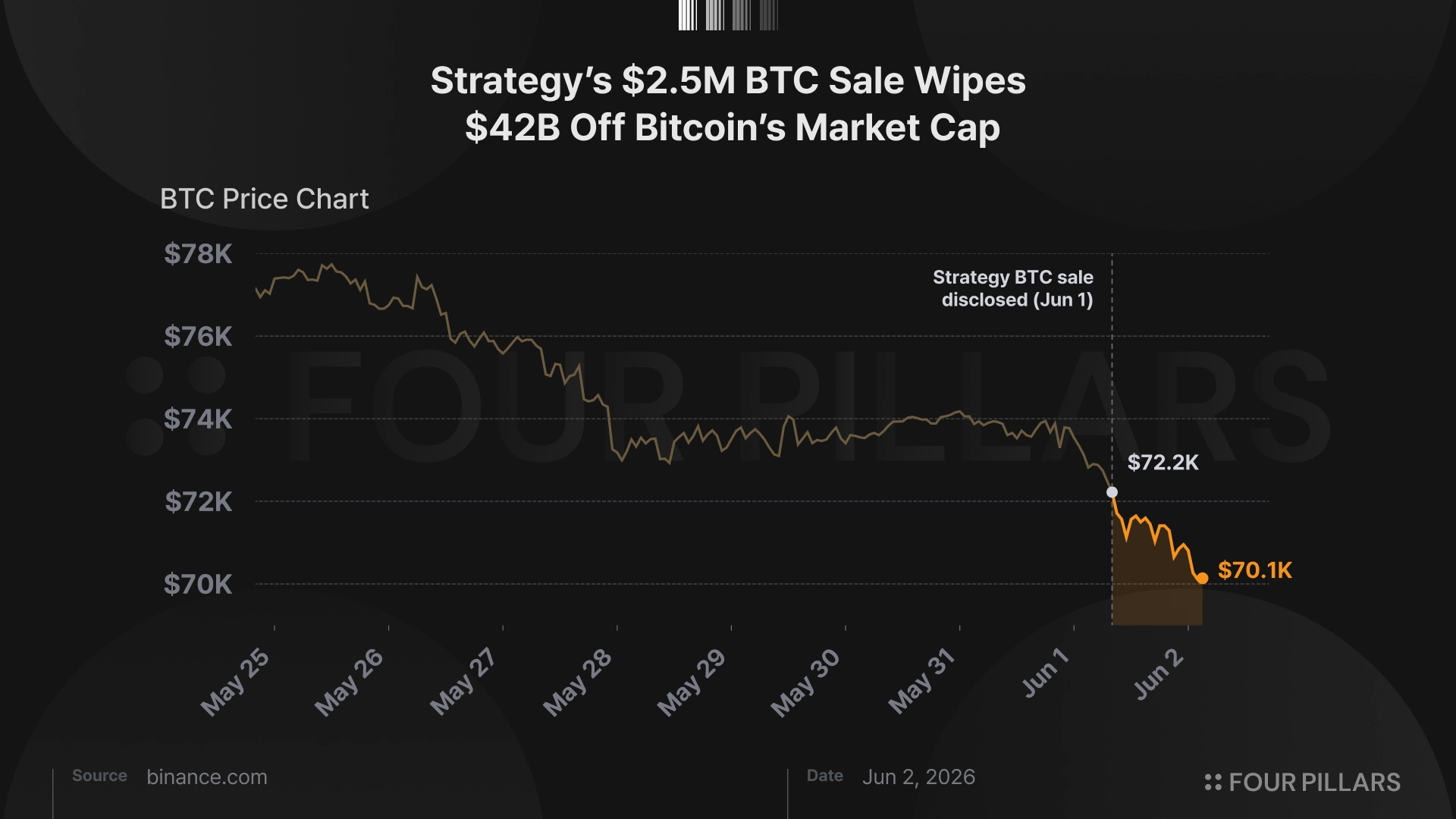
During its Q1 2026 earnings call, Strategy said it could sell BTC to reduce the loss in BPS. However, investors have long seen Strategy as a company that never sells BTC, and that seems to have been a major catalyst for the price decline.
Is Strategy really in trouble the way investors think it is?
Selling BTC Can Actually Support a Healthier Financial Structure
Selling BTC does not mean Strategy is in trouble. In fact, depending on the situation, selling BTC can be the better move from the perspective of BPS, or BTC per share, which is what Strategy cares about.
Strategy is no longer just a company that never sells BTC. It has become a capital engine that uses bonds and preferred stock to maximize BPS. Strategy’s primary goal is to maximize BPS, which represents BTC exposure per share, and BTC Yield, which shows how much BPS has increased, is its core KPI.
To increase BPS, mNAV, which represents the ratio of enterprise value to the amount of BTC the company holds, needs to be above 1.22.
If we think about the simplest type of company with no debt or preferred stock, then if mNAV is above 1, that company can increase BPS by issuing common stock through an ATM program and using the proceeds to buy BTC. But Strategy is not a simple company. Unlike in the past, debt and preferred stock have now been added to Strategy’s funding structure, so it can no longer increase BPS simply by issuing MSTR through an ATM whenever mNAV is above 1.
Once debt and preferred stock exist, part of the BTC Strategy holds effectively belongs to preferred shareholders and creditors, who have claims ahead of common shareholders. As a result, the pure BTC share represented by one share of MSTR decreases. This means Strategy needs to issue MSTR through an ATM at an mNAV higher than 1 in order to increase BPS.
That number is 1.22.
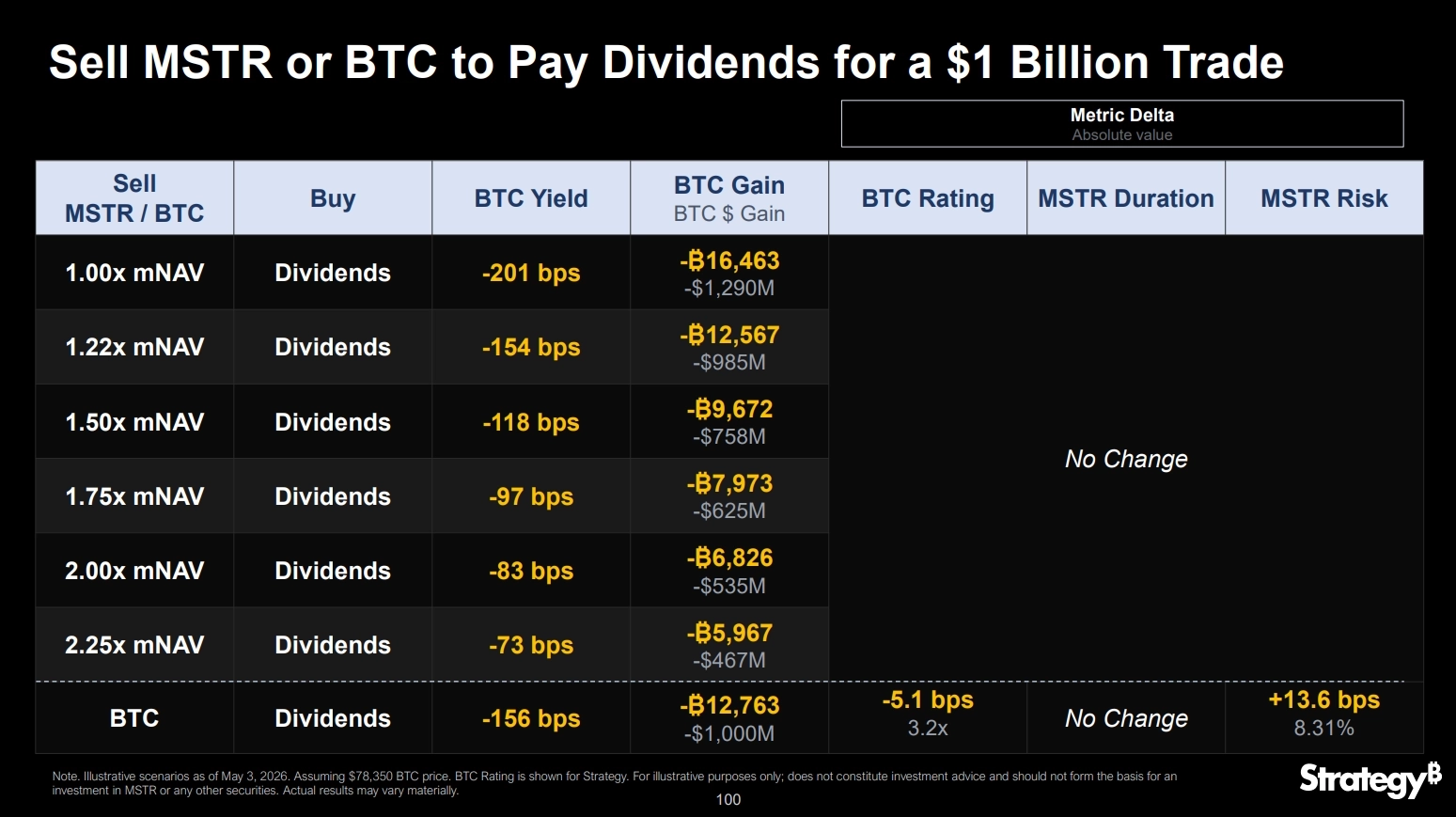
Strategy needs to pay dividends on its bonds and preferred stock. What matters here is that when mNAV is below 1.22, raising capital by selling BTC can be less damaging to BPS than raising capital through a common stock ATM.
If Strategy sells common stock when mNAV is low, the dilution can be larger, and from a BPS perspective, it can have a worse impact than selling BTC.
According to Strategy, its current mNAV is around 1.25, meaning BTC sales are clearly an option it can consider for dividend payments. In that sense, the 32 BTC sale may actually have been a transaction that helped support Strategy’s healthier financial structure.
Investors Are Overreacting
Strategy’s net leverage is only 10%. Strategy still has $871M left in its USD reserve. Strategy’s breakeven ARR is 2.90%, meaning that if BTC grows by more than 2.90% per year on average, it can cover dividends permanently. Strategy’s latest 32 BTC sale is simply an event showing that BTC sales can be used as a tool to optimize its financial structure. It is not a transaction that damages the company’s long-term financial structure.
That said, there are still some things to watch. Strategy’s current USD reserve can cover only around 6.3 months of dividend payments. For Strategy’s capital engine to keep running, there needs to be continued demand for preferred stock, led by STRC, mNAV needs to stay around the 1.22 level, and ultimately, the market must not lose trust in this structure.
Strategy is no longer the Strategy of the past. It is no longer a company that never sells BTC. It is now a company that uses BTC sales as a capital structure optimization tool when the situation calls for it. The market tends to view Strategy with a hot heart rather than analyze it financially with a cool head. Strategy will need to strike the right balance between its financial structure and market trust.
The author of this report may have personal holdings or financial interests in assets or tokens discussed herein. However, the author affirms that no transactions have conducted using material non-public information obtained in the course of research or drafting. This report is intended solely for general information purposes and does not constitute legal, business, investment, or tax advice. It should not be used as a basis for making any investment decisions or as guidance for accounting, legal, or tax matters. Any references to specific assets or securities are made for informational purposes only and should not be construed as an offer, solicitation, or recommendation to invest. The opinions expressed herein are those of the author and may not reflect the views of any affiliated institutions, organizations, or individuals. The opinions and analyses expressed herein are subject to change without prior notice. In addition, beyond the individual disclosures included in each report, Four Pillars, may hold existing or prospective investments in some of the assets or protocols discussed herein. Furthermore, FP Validated, a division of Four Pillars, may already be operating as a node in certain networks or protocols discussed herein or may do so in the future. Please see below links in the footer for FP Validated's participating network disclosures and for broader disclosure details.


