Table of Contents
- Key Takeaways
- 1. What Happened
- 1.1 October 2025
- 1.2 November 2026
- 2. Opposing Views on Each Issue
- 2.1 The PSM and Illicit Funds
- 2.2 Are Depositors Safe?
- 2.3 A Liquidation Pause for the Founder
- 2.4 Was Sky's Explanation Enough?
- 2.5 Where the Borrowed Money Went
- 3. Implications
- 3.1 A Lending Market Without Liquidations Did Not Function Properly
- 3.2 How This Differs from the Curve Case
- 3.3 On Korean Exchanges' Suspension of USDS Deposits
Researcher

Related Projects

Key Takeaways
- Sky's stUSDS recently saw withdrawals freeze after virtually all of its deposits were lent out. The cause was that nearly half of all loans (~77M USDS) were concentrated in one person, founder Rune, a risk that had been pointed out a year earlier. USDS handled more than $2B in redemptions in a single day without trouble, but the team's early statements addressed only USDS. stUSDS depositors did not hear Rune's apology and repayment plan until after exchanges had issued trading caution designations.
- stUSDS was designed to raise its rate when the vault runs short of funds, encouraging repayments and new deposits. With automatic liquidations turned off, however, this mechanism did not work as intended. During the four days in which the rate rose from 24.74% to 49.74%, the natural repayments the protocol was counting on did not happen. What finally moved Rune was action by exchanges and public criticism.
- As the situation spread, Korean exchanges including Upbit designated SKY and USDS as trading caution assets and suspended deposits. This closed off arbitrage, and USDS, which can be redeemed for one dollar at any time, climbed as high as 7,835 KRW (~5.83 USD) on Upbit. Korean exchanges have been actively adding stablecoin pairs, so they also need a separate framework for handling unexpected events involving stablecoins.
1. What Happened
Over the past week, Sky has been at the center of several controversies. Reports of illicit fund flows, large USDS redemptions, the founder's loans, and exchange deposit suspensions all became tangled together, making it hard to tell what the actual problem was. In this piece, I first lay out the events in chronological order. I then look at what questions were raised on each issue and how far they have been answered, and close with my own view.
Before going through the events, it is worth briefly explaining what stUSDS is.
Sky operates the stUSDS vault. The vault takes USDS from depositors and lends it out, giving depositors stUSDS tokens as a receipt. Anyone who wants to borrow from the vault must post SKY, Sky's governance token, as collateral, and the interest they pay becomes the depositors' yield. Sky also offers sUSDS, a product that pays a savings rate on deposited USDS. The names are similar, but the structures are entirely different.
Depositors can withdraw immediately only up to the amount of USDS remaining in the vault. USDS that has already been lent out comes back only when borrowers repay, and because the loans have no maturity, there is no way to know when that will be. Sky manages this problem through interest rates. When the USDS left in the vault runs low, the rate rises in steps to a maximum of 50%, encouraging borrowers to repay and new depositors to add funds. If the loans incur losses, the design has depositors absorb them first.
1.1 October 2025
Source: Aave Governance
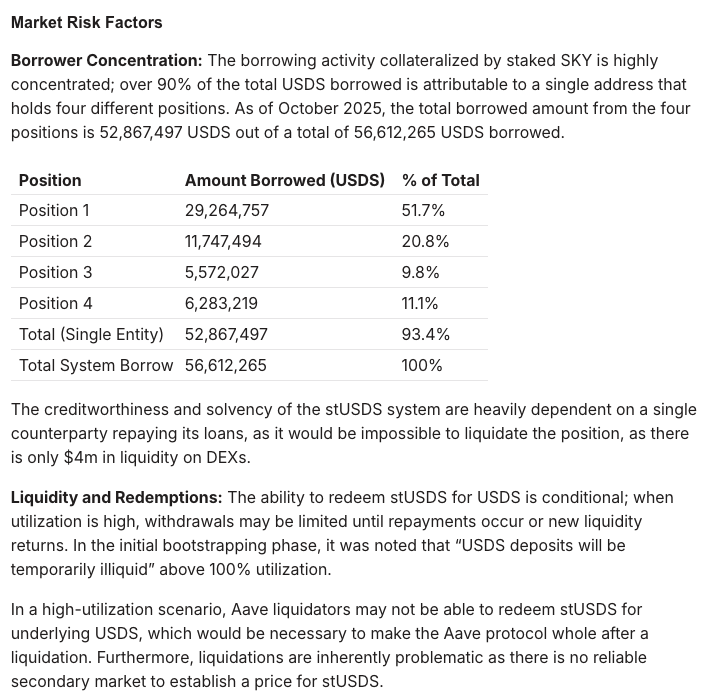
Under the stUSDS structure described above, depositors' withdrawals can be blocked for a long time if loans are concentrated in a few borrowers or if borrowers do not repay. This risk was first raised publicly a year ago. In October 2025, when Aave was considering adding stUSDS as a collateral asset, the risk analysis firm LlamaRisk reported that about 52.87 million USDS of the roughly 56.61 million USDS in total stUSDS loans sat in four positions held by a single address. Beyond this concentration, the report also stated that withdrawals could be restricted, that liquidations required manual intervention by governance, and that depositors would bear any losses.
One month later, in November 2025, withdrawals did in fact freeze. Sky co-founder Rune Christensen (hereafter Rune) proposed speeding up rate adjustments. He also proposed supplying liquidity on Curve so that depositors who needed to exit quickly could sell stUSDS, even at a discount, and expanding the stUSDS collateral market on Morpho. The same proposal lowered the collateral ratio requirement from 145% to 120% and placed a $0.025 cap on the SKY price used to value loans. In the end, that freeze was resolved after the rate rose to about 38% and roughly 19.9 million USDS in new deposits came in.
1.2 November 2026
The recent series of events is an extension of the problems raised last year. In chronological order, it unfolded as follows.
1) November 13
Source: Sky Ecosystem Forum
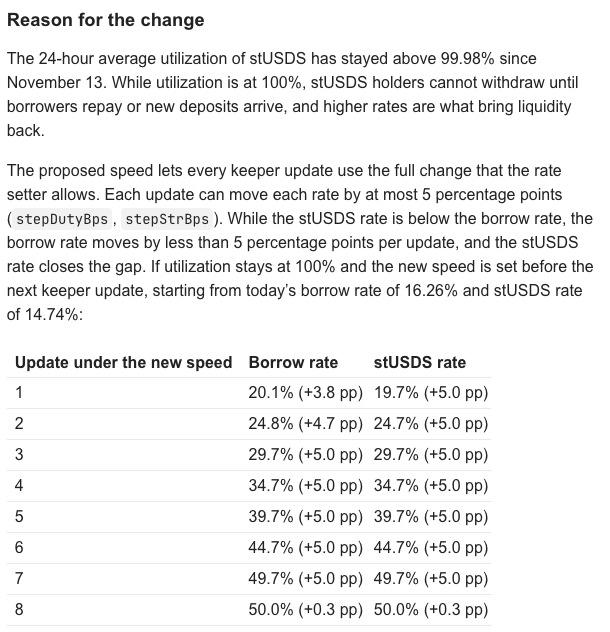
According to BA Labs, Sky's risk advisor, the 24-hour average utilization of stUSDS loans stayed above 99.98% from November 13 onward. Virtually all deposits had been lent out, and immediate withdrawals became impossible.
2) November 19
On the 19th, two separate events came to light and affected the Sky ecosystem.
Source: CoinDesk
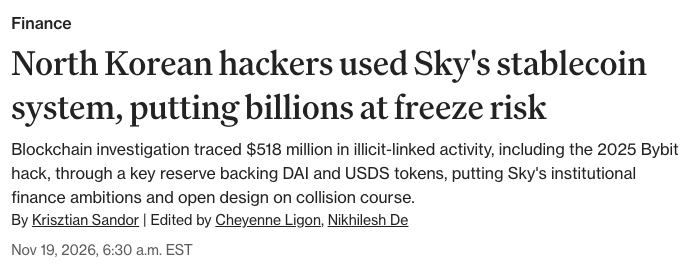
The first was a report on Sky's Peg Stability Module (hereafter PSM). The analytics firm Inca Digital said that 422 wallets linked to illicit activity had moved about $518M through the PSM, of which about $101.9M was directly tied to North Korean hackers. In the 10 days following the 2025 Bybit hack alone, the related wallets reportedly converted about $91.5M through the PSM. The report also noted that the roughly $2.7B in USDC held by the PSM is kept at a single address, so the entire reserve could be locked if Circle froze that address. After the report, more than $2B of USDS was redeemed for USDC through the PSM in a single day.
The second concerned stUSDS. On the same day, the on-chain analytics firm Bitquery published an analysis showing that a multisig wallet linked to rune.eth owed about 77.1 million USDS, roughly 48% of all loans. It also emerged that the user risk disclosure of the company operating the Sky frontend had been revised that day, which fueled suspicion in the community that the team was trying to avoid responsibility.
3) November 20
Source: @RuneKek
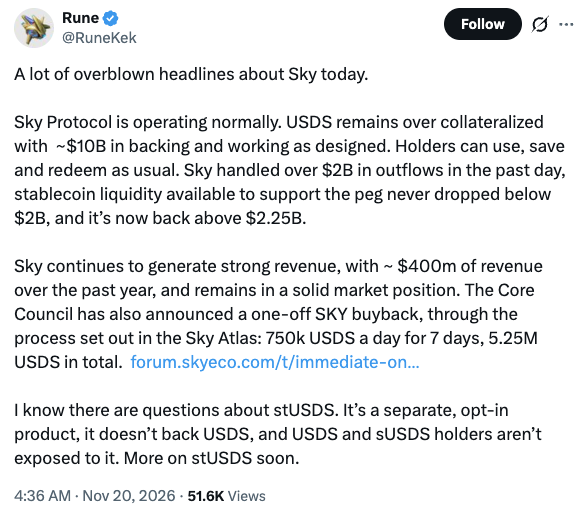
Rune issued a statement on the PSM. He said that USDS was overcollateralized, that PSM liquidity never fell below $2B while it processed more than $2B in outflows, and that stUSDS is a separate, opt-in product and not collateral for USDS.
On stUSDS itself, he said only that details would follow later. As the SKY price fell on the series of reports, Sky also announced a one-time SKY buyback of 750,000 USDS per day for seven days, 5.25 million USDS in total.
4) November 20 to 23
The deposit rate, which stood at 24.74% on the 19th, moved through 29.74%, 34.74%, 39.74%, and 44.74% before reaching 49.74% on the 23rd, close to the cap. On the 21st, stUSDS worth 1.09 USDS at the vault traded at about 0.91 USDS on Curve, a discount of roughly 16.5%.
5) November 23
Sky announced that the PSM's USDC liquidity had recovered to $1.77B and that USDS was backed by $9.2B in collateral. Once again, there was no explanation regarding stUSDS.
6) November 23, 20:00 KST
Source: Upbit
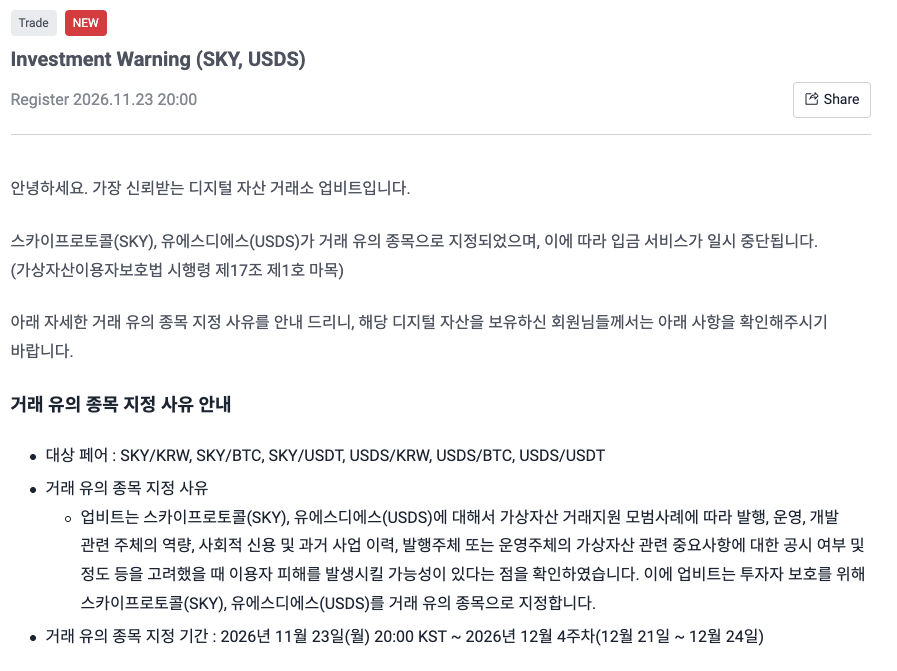
The Korean exchanges Upbit, Bithumb, and Coinone designated SKY and USDS as trading caution assets and suspended deposits.
7) November 23, 21:10 KST
A wallet believed to be linked to Rune repaid 3 million USDS. However, these funds were fully withdrawn within just three blocks, including the block in which the repayment was made, or about 24 seconds. Of this amount, about $910,000 went to an arbitrage bot that had bought discounted stUSDS on Curve, within the same block as the repayment.
8) November 23, 22:39 KST
Source: @RuneKek
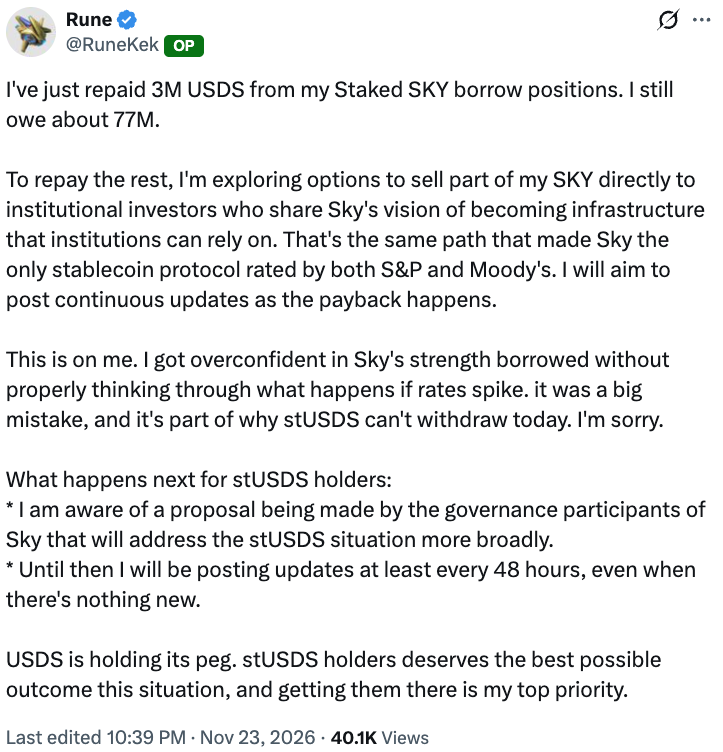
Rune issued a second statement. He said he had repaid 3 million USDS from his position, that about 77 million USDS of debt remained, and that he was looking into selling part of his SKY holdings directly to institutional investors to repay it. He apologized, saying that borrowing without properly considering what would happen if rates spiked had been a serious mistake, and that he bore responsibility for the current freeze on stUSDS withdrawals. He added that a governance proposal covering the stUSDS issue as a whole was being prepared, and that he would share progress at least every 48 hours even if there was no news.
2. Opposing Views on Each Issue
Judged by the outcome, the debate over who was responsible was settled when Rune admitted fault. During the week before that, however, opinions on the question were sharply divided. Below, I go through what each side argued on each issue and add my own thoughts.
2.1 The PSM and Illicit Funds
The concern raised was twofold. The PSM had been used as a route for converting funds linked to illicit activity into USDC. And because its reserves were held at a single address, redemptions of USDS and DAI themselves could be put at risk if Circle froze that address.
Sky responded that the transactions in question amounted to less than 0.06% of the PSM's cumulative volume, and that most of them went through third-party routes and not Sky's official frontend. It added that frontends in the Sky ecosystem already apply screening procedures to filter out sanctioned wallets.
Few would dispute that the share of problematic transactions is small. A small share, however, does not remove the risk that reserves held at a single address could be frozen. The frontend screening also has a clear limit. As long as screening happens only at the frontend, there is no way to filter funds that come in by calling the contract directly. Sky's explanation does not answer either of these two points, and I think the call to improve this structure is reasonable.
2.2 Are Depositors Safe?
When the controversy was spreading, the SKY posted as collateral in Rune's position was worth about $185M at market prices, against debt of about $77M. Sky's defenders pointed to these numbers to argue that depositors' principal was not at risk. The collateral was more than twice the debt. The lack of loan maturity and the rise in rates under heavy withdrawals had also been disclosed in the documentation. In their view, it was too early to talk about losses simply because withdrawals were delayed.
Critics questioned whether the collateral could actually be sold at that price. The SKY posted as collateral amounts to about 15% of total supply, and the current price would be unlikely to hold if that much came onto the market.
In fact, this position can look very different depending on which price is applied. At $0.025, the oracle price cap Sky uses to value loans, the collateral ratio sits only around the 120% threshold. At about $0.04, the reported market price as of the 23rd, it rises to about 190%. A collateral ratio below the threshold does not immediately mean a loss, so the defenders have a point. Still, Sky set a price cap in the first place because prices in a thinly traded market were hard to trust at face value. Given that, it is difficult to accept a calculation based on the market price as it stands.
Rune's second statement went some way toward answering this debate. He said he would repay the remaining debt by selling SKY over the counter to institutional investors and not on the open market. This allows a large amount to be sold without shocking the market price, which makes it a reasonable approach for depositors as well.
At the same time, it effectively concedes the point Sky's critics had raised. If collateral worth twice the debt could have been sold on the market at full price, there would have been no need to go looking for a buyer.
2.3 A Liquidation Pause for the Founder
This issue drew the strongest reaction. Some of Rune's positions were not liquidated even though their collateral ratios had fallen below the threshold, raising suspicion that he was receiving special treatment. When it became known that the risk disclosure had been revised on the 19th, in the middle of the controversy, a further suspicion followed that the terms had been changed only after the problem surfaced.
The record shows, however, that automatic liquidations for stUSDS were not turned off because of this episode. According to LlamaRisk's report from last year, automatic liquidations in the stUSDS market had been off for all loans since 2025. As for the risk disclosure, it is true that it was revised to version 2.0 on November 19. The current document states that governance can turn off liquidations, that withdrawals can be blocked for extended periods, and that stUSDS holders bear losses resulting from liquidations not being carried out. These risks, however, had existed from the start as part of the contract structure.
That does not mean there is no problem. In my view, the larger issue is not whether automatic liquidations are on or off. It is that the person who borrowed the most has been closely involved in deciding the matter. It was Rune who proposed in 2025 to lower the collateral ratio requirement from 145% to 120%. The person proposing the policy was also its largest beneficiary.
It is also worth noting that SKY posted as collateral keeps its voting power. According to one on-chain analysis, about 53% of the SKY that voted for the November 19 executive vote was delegated from SKY Rune had posted as collateral. The items that day concerned the monthly settlement and limit adjustments for some vaults, and had nothing to do with stUSDS liquidations. There is also no evidence that delegates acted on Rune's instructions. But if a decision ever has to be made on whether to liquidate this collateral, the collateral subject to liquidation would take part directly in that vote. The governance proposal Rune has announced will be put to a vote under the same structure. A question asking who will resume liquidations, and on what criteria, has already been posted on the forum, but no answer has come yet.
2.4 Was Sky's Explanation Enough?
Until the evening of the 23rd, every explanation from Sky and Rune was about USDS. More than $2B in redemptions in a single day had been processed one to one without issue. And because stUSDS loans are not collateral for USDS, holders of USDS and sUSDS would not suffer losses from these loans. Even Sky's critics largely agreed that the risks of USDS and sUSDS should be viewed separately from those of stUSDS.
The problem was that the people actually waiting for answers were stUSDS depositors. What they wanted to know was when, and in what order, they could get their money back, and Sky's announcements said nothing on this question. The stUSDS explanation Rune had promised on the 20th had still not arrived three days later. The announcement on the evening of the 23rd described the past week only as a period of extreme market pressure and distorted reporting, without a single word on stUSDS. The SKY buyback during the same period was announced with a set amount and schedule. It was natural for depositors to ask why no schedule at all was offered for recovering their deposits.
The first answer directed at depositors came in Rune's second statement. He acknowledged his responsibility, explained how he would fund the repayment, and promised regular updates going forward. It was a markedly different attitude from the official announcement made just hours earlier. The fact that this statement happened to come right after the Korean exchanges' trading caution designations left the community, myself included, with mixed feelings.
2.5 Where the Borrowed Money Went
Source: Bitquery
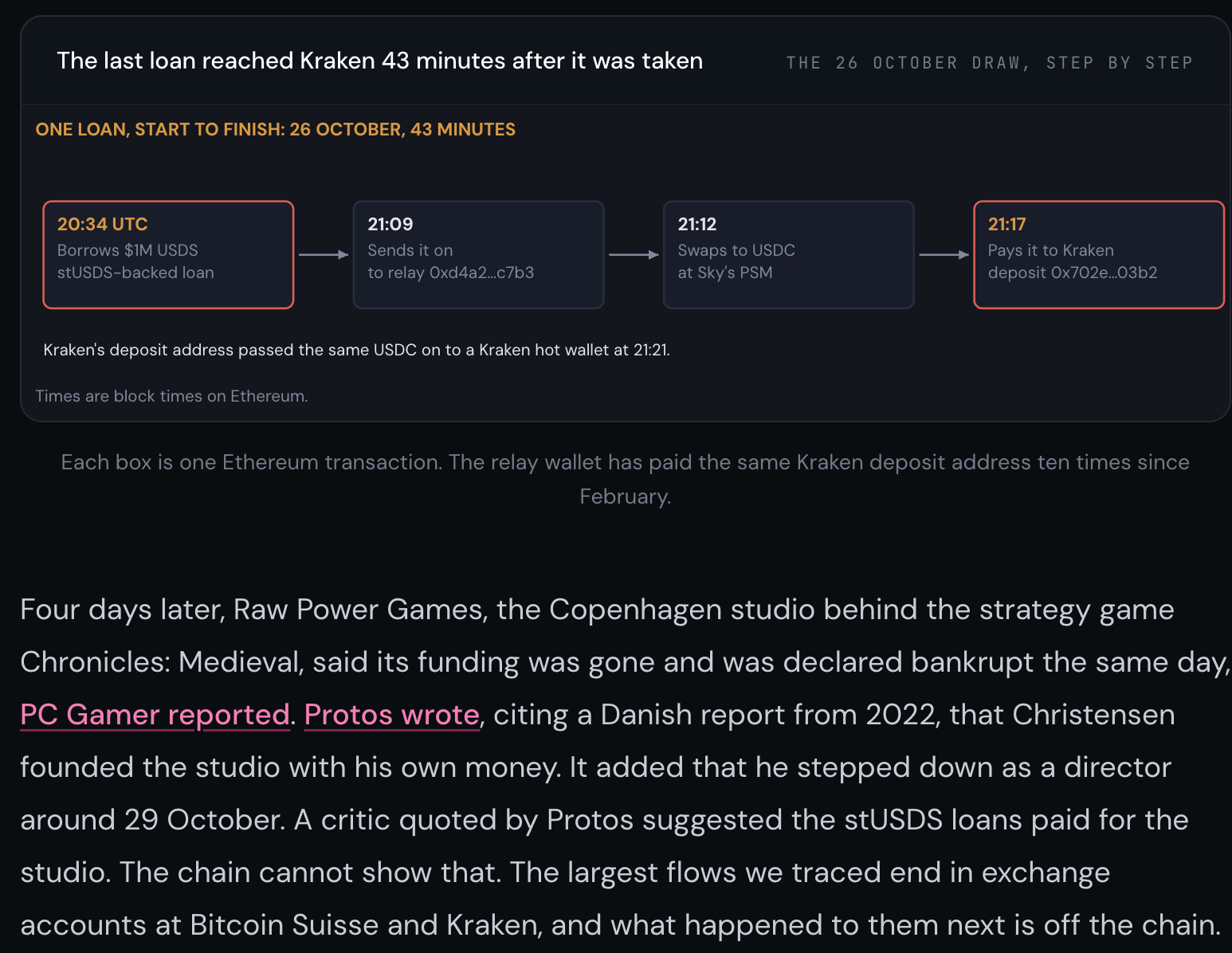
Separately from Sky, Rune founded and funded a game company, Raw Power Games. On October 30, the company announced that the funding behind the studio had been cut off, and it then entered bankruptcy proceedings. It later became known that the last loan from Rune's position, 1 million USDS, was drawn on October 26, just before that announcement. This raised suspicion that the borrowed money had flowed into the company. Speculation followed that if the company was struggling, repaying the principal would not be easy either. Some went further and claimed that Rune had deliberately built this structure to quietly dispose of his SKY holdings.
The facts confirmed so far, however, are not enough to support these suspicions. Bitquery traced part of the loan proceeds to deposit addresses at exchanges and brokerage firms, but could not determine who received the funds after that or what they were used for.
That does not make the demand to disclose the use of funds unreasonable. The question of who owned the position was settled when Rune confirmed it was his. In his statement, however, he did not say why he borrowed the money or where it was spent. Moreover, looking only at the result, Rune will have secured cash first by posting SKY as collateral without selling it on the market, and will then repay the debt by selling that SKY over the counter. Whatever the original intent, other SKY holders and stUSDS depositors are unlikely to view this favorably.
For this reason, I believe transparent disclosure of how the loan was used and the terms of the sale is the minimum condition for restoring trust. For the person who has been most deeply involved in the protocol and has taken the largest loan, the purpose of that loan and the plan to repay it can hardly remain a purely personal matter.
3. Implications
3.1 A Lending Market Without Liquidations Did Not Function Properly
stUSDS is designed to restore liquidity through interest rates. The assumption is that when the vault runs short of funds, the rate rises, and when the rate rises, borrowers will want to repay and new depositors will want to add funds. In a typical lending protocol, this works because liquidations exist. If accrued interest pushes the collateral ratio below the threshold, the borrower loses the collateral. When rates rise, borrowers have little choice but to repay quickly or add more collateral.
In stUSDS, this link is broken. Interest is not paid in cash but simply added to the debt, and even when the growing debt pushes the collateral ratio below the threshold, no automatic liquidation takes place. In this situation, however high the rate goes, the borrower feels little pressure. Only the debt on the books grows.
The part of Rune's statement I found most interesting was his admission that he borrowed without properly considering what would happen if rates spiked. The rate model assumes that borrowers treat the rate as a cost and act accordingly. Yet the person who took half of all loans has said himself that he did not properly think through what a rate increase would mean.
It is also a problem that roughly half of the loans that pushed stUSDS utilization to 100% belonged to Rune. From his standpoint, the rate spike was less an outside shock that arrived suddenly than a result his own borrowing produced. When a few borrowers hold most of the loans in this way, the rate can hardly work as a tool for changing borrower behavior.
What, then, actually moved Rune? During the four days in which the rate rose from 24.74% to 49.74%, not a single repayment was made. The repayment and the apology came only after exchanges placed SKY under a trading caution designation and public criticism poured in. I think this case shows that a lending market without the enforcement tool of liquidation ends up depending on pressure from outside the protocol.
3.2 How This Differs from the Curve Case
This is not the first time a founder has taken out large loans against his own token and then turned to an over-the-counter sale once problems surfaced. In August 2023, Curve founder Michael Egorov had borrowed about $100M against CRV. When the Curve hack sent the CRV price down sharply and raised his liquidation risk, he sold 72 million CRV over the counter to 15 buyers at $0.40 each, raising $28.8M. That price was roughly 30% below the market price of $0.58 at the time, and the sale came with lockups of three to six months.
This precedent tells us two things.
The first is the cost of an over-the-counter sale. Suppose Rune has to accept a similar discount from the $0.04 market price on the 23rd. He would then need about 2.7 billion SKY to repay all of the remaining debt, which is more than three quarters of the collateral and about 11% of total supply. It also means that this much voting power would pass to institutional investors.
The second is that an over-the-counter sale does not end the problem. Egorov kept his position open after repaying part of the debt. In June 2024, a position of about $140M was eventually liquidated, leaving about $10M in bad debt. Rune has likewise said he will sell only part of his holdings. How the remaining position is managed after the sale therefore matters as much as the sale itself.
There is, however, a decisive difference between the two cases. The liquidation mechanisms in the markets where Egorov borrowed were not something he could switch off at will. In 2023, he had borrowed from outside protocols such as Aave. By June 2024, his borrowing also included LlamaLend, Curve's own lending market, yet liquidations there were carried out without exception. The roughly $10M in bad debt also arose in Curve's CRV lending pool, and he repaid it himself within days. Rune, by contrast, borrowed from a product of the protocol he built, under collateral terms he proposed, with liquidations turned off. In Curve's case, the checks on the founder sat outside the protocol. stUSDS has no such checks, and the burden falls entirely on depositors. I think this is why some consider this episode worse than what happened at Curve.
3.3 On Korean Exchanges' Suspension of USDS Deposits
Source: Upbit
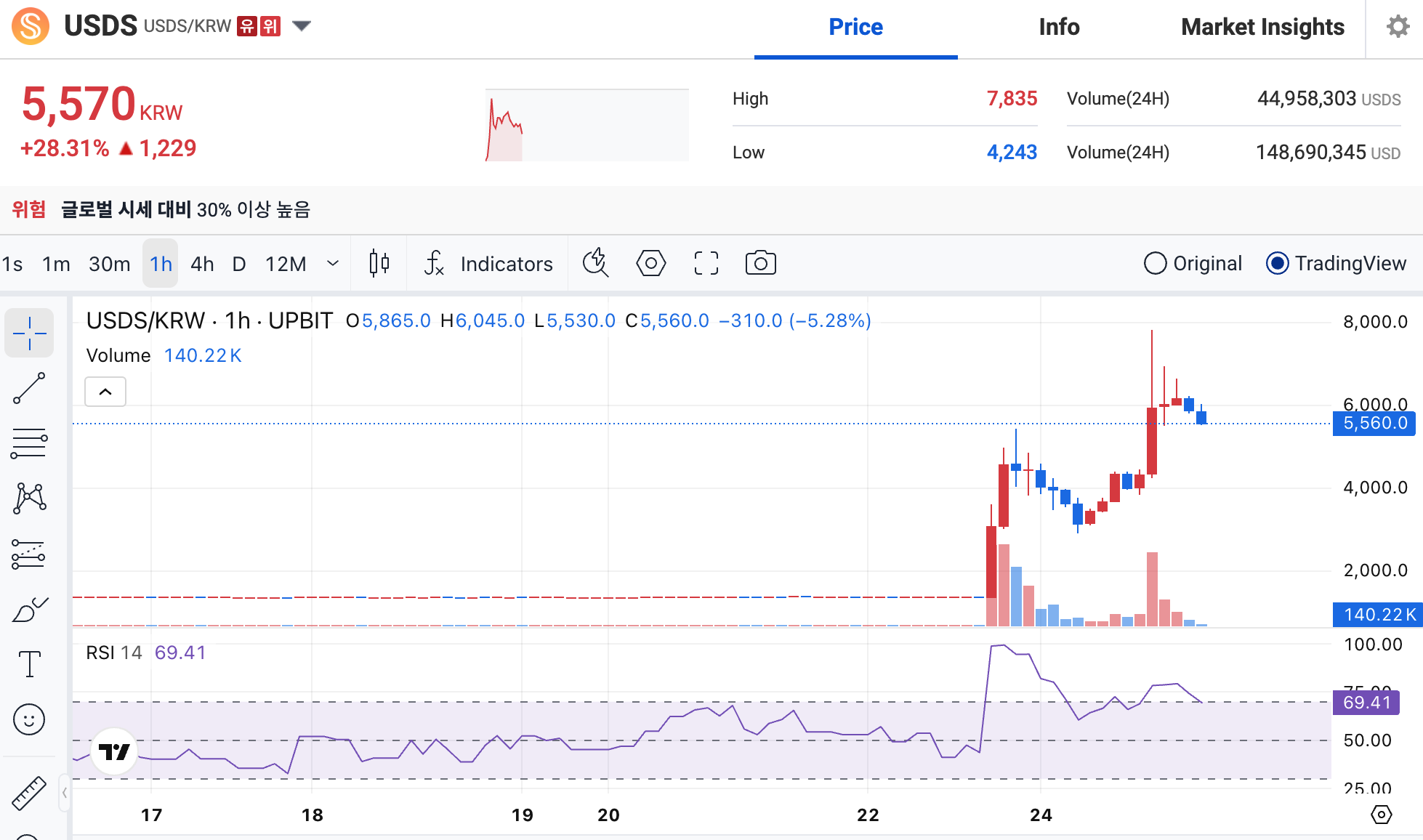
After the trading caution designation, another problem appeared on Korean exchanges. The price of USDS, which should be fixed at one dollar, surged on Upbit's KRW market. USDS normally trades in the KRW 1,400 range. It began rising on the night of the 23rd, when deposits were suspended, and climbed as high as KRW 7,835 during trading on the 24th. At the time of writing, it is still trading at KRW 5,570, nearly four times the value of a dollar.
The cause lies in the deposit suspension that came with Upbit's caution measure. Unless a dedicated liquidity provider exists, a stablecoin's price is kept in line mostly through arbitrage. Once deposits are blocked, arbitrage becomes impossible, and a kind of PvP market forms over the supply already inside the exchange.
The problem is that exchanges do not hold much stablecoin supply. Upbit has listed a series of stablecoins this year, including RLUSD and USDG, and has greatly expanded the related pairs. As I showed in an earlier piece, however, about 98% of trading is still concentrated in USDT. USDS is also a thinly traded pair on Upbit, with average daily volume of only tens of thousands of dollars. It is not hard to predict what happens when deposits are blocked in a market like this.
This situation is likely to repeat. Stablecoins are assets where issues that can lead to a caution designation, such as reserves, issuers, and regulation, come up fairly often. The more stablecoins are listed, the more often this will happen.
The approach I consider most reasonable is to take the necessary measures after an accurate assessment of the situation. In this case, USDS could be redeemed immediately through the PSM, so there was no reason for it to trade above the global price. A cap on the premium over the global price would therefore be a workable measure. The case is different when a stablecoin has been stolen in a hack or is depegging sharply for some reason. Stolen tokens or tokens that are losing their value could then flood into the exchange and be passed on to Korean investors. In such cases, the current approach of blocking deposits can serve as a measure that protects investors.
Of course, it is not easy for an exchange to judge this accurately in the early stage of an incident. It is also hard to fault the conservative choice of blocking deposits first until a judgment can be made. If so, exchanges could at least consider applying a cap on the premium over the global price by default for stablecoins whenever they suspend deposits. If the asset's value has in fact been damaged, the price will fall regardless of the cap. If it has not, the cap can prevent some of the harm caused by a surge followed by a crash.
A caution designation meant to warn of risk is now being read as a signal for a price surge, which is clearly the opposite of what the system intends. As Korean exchanges continue to add stablecoin pairs, they will need to prepare a matching way of responding.
The author of this report may have personal holdings or financial interests in assets or tokens discussed herein. However, the author affirms that no transactions have conducted using material non-public information obtained in the course of research or drafting. This report is intended solely for general information purposes and does not constitute legal, business, investment, or tax advice. It should not be used as a basis for making any investment decisions or as guidance for accounting, legal, or tax matters. Any references to specific assets or securities are made for informational purposes only and should not be construed as an offer, solicitation, or recommendation to invest. The opinions expressed herein are those of the author and may not reflect the views of any affiliated institutions, organizations, or individuals. The opinions and analyses expressed herein are subject to change without prior notice. In addition, beyond the individual disclosures included in each report, Four Pillars, may hold existing or prospective investments in some of the assets or protocols discussed herein. Furthermore, FP Validated, a division of Four Pillars, may already be operating as a node in certain networks or protocols discussed herein or may do so in the future. Please see below links in the footer for FP Validated's participating network disclosures and for broader disclosure details.