Table of Contents
- Key Takeaways
- 1. A Liquidity Aggregator That Makes Its Own Market
- 2. Zero Trading Fees, Paid For by the Spread
- 3. Swaps Plug Into Liquidity That Orderbooks Have to Build
- 4. Built for Size and Breadth
- 5. OLP Is Run by the Team That Built Genesis's Market Maker
- 6. What You're Really Underwriting Is OLP
- 7. Citadel First, Robinhood Next
Researcher

Related Projects

Key Takeaways
- Variational runs a broker-like model, so you trade with a single counterparty instead of an orderbook. Its in-house desk, OLP, takes the other side of every trade ($904.3 million a side on 1 November 2026) and nets or hedges it, often within milliseconds.
- There are no trading fees since the spread is the revenue. Variational kept between 1.64 and 3.09 bps per dollar traded in its 2026 biweekly reports and made a net profit in all 18 periods, and so far the benefits of scale have gone to traders as tighter spreads.
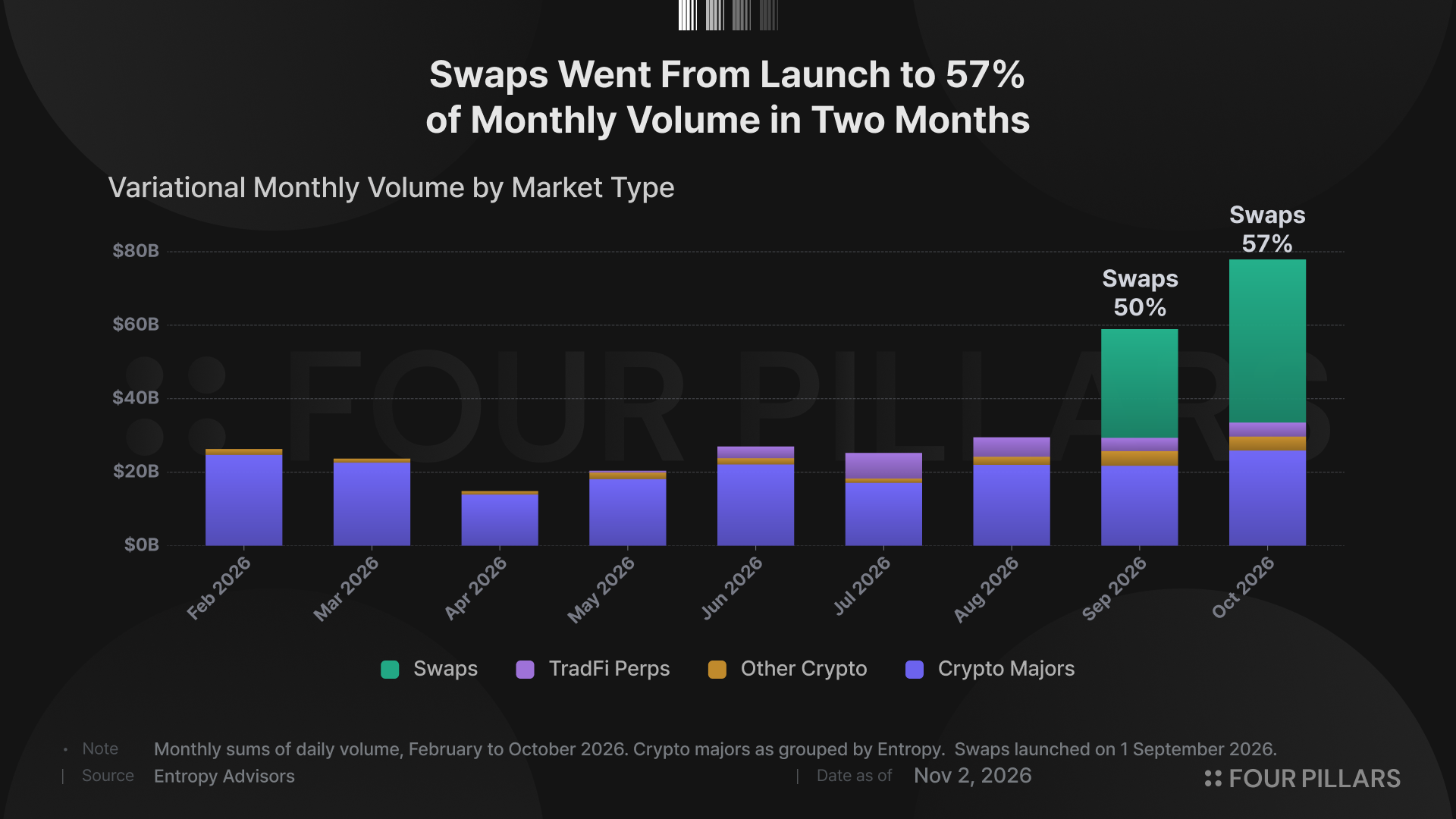
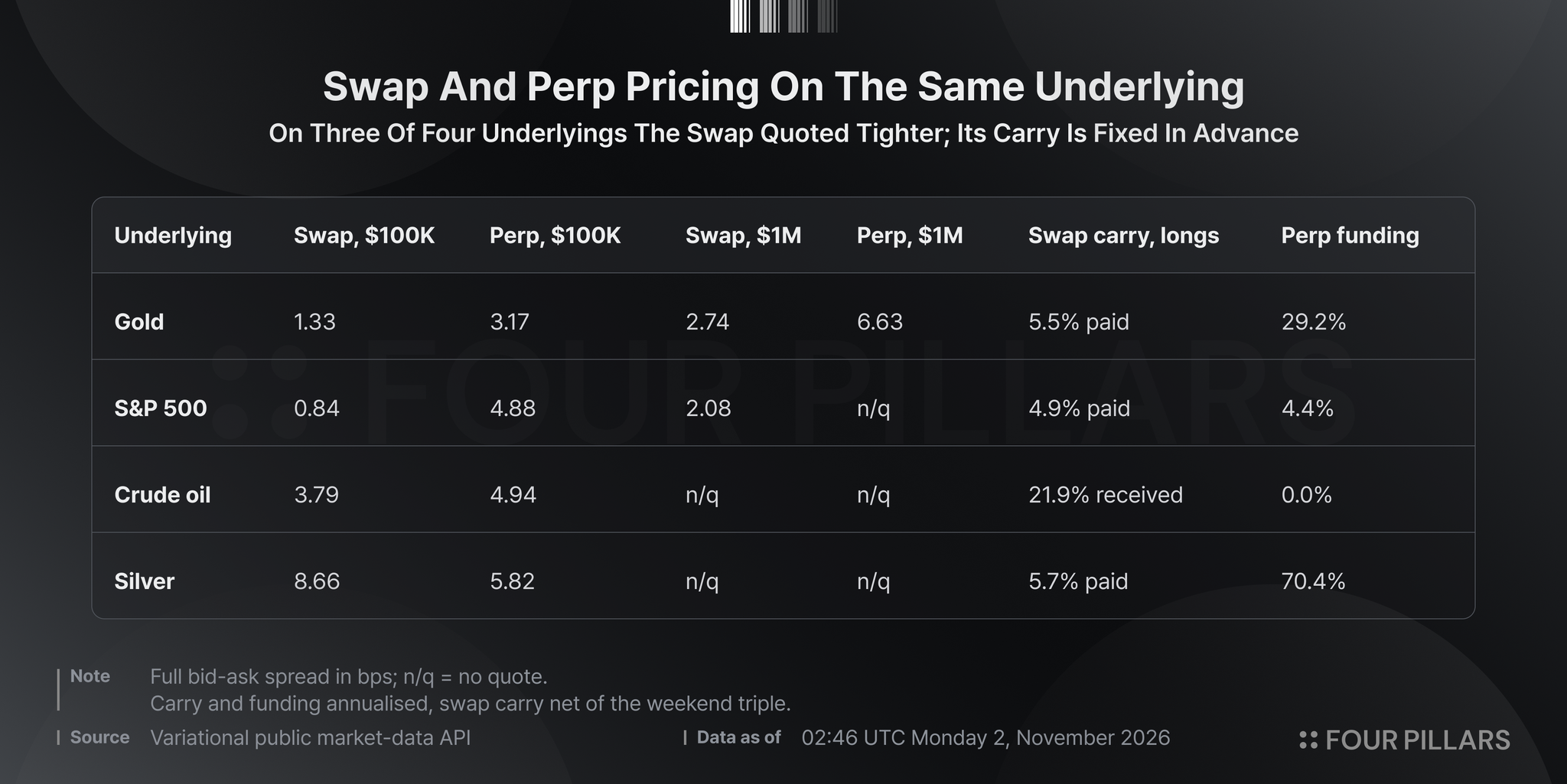
- Swaps are how Variational brings TradFi liquidity on-chain. OLP hedges them directly with TradFi dealers and charges financing tied to rates like SOFR instead of perp funding. Against the perp on the same underlying, the swap quoted tighter on three of four pairs, and swaps went from launch to 57% of October volume in two months.
- The edge is size and TradFi breadth. On a $1 million trade, most of Variational's swaps were cheaper than the same markets on Hyperliquid even before fees. On crypto, Hyperliquid's book is tighter, but since Variational charges no trading fees, it ends up cheaper on every major except HYPE.
- What you’re underwriting is OLP, run by the pair who built Genesis Trading’s electronic market-making system. Its worst two weeks on record lost $36,821, it made $1.06 million in the fortnight of the Binance hack, and user collateral stayed withdrawable throughout.
Most traders never ask who took the other side of their fill. On an orderbook there isn’t much point. It was whoever happened to have an order resting at that price, and you’ll never find out who.
On Variational, the answer is always the same. Every trade on Omni, its retail venue, is filled by the Omni Liquidity Provider (OLP), a market-making system the team built and runs. OLP takes the position and then either nets it against another user’s flow or hedges it somewhere else.
When we spoke, Variational co-founder and CEO Lucas Schuermann described Omni as a broker-like business. On Bankless in September, he called it “Robinhood and Citadel built on top of each other.”
Anyone who has looked at how Robinhood makes money gets the analogy. Those are normally two separate firms with a payment-for-order-flow deal between them. Variational decided to be both, and it has gotten big doing it. It cleared $451.7 billion of cumulative volume through 1 November 2026, $78.1 billion of it in October, across 581 listed markets, with a team of about 25.
Being both is what lets Variational charge no trading fees and sell a product an exchange can’t list. It also puts every position on the platform on a single desk.
1. A Liquidity Aggregator That Makes Its Own Market
Schuermann’s framing is that trading involves three jobs. Exchanges match orders, market makers quote prices and sit on the resulting positions, and brokers give retail users access. Robinhood outsources the middle job to wholesalers like Citadel Securities, which pay for the flow. Variational kept it in-house.
The CEO also ranks the businesses in finance by hierarchy. Banks come first, then market makers, then brokers, then exchanges, with CFD houses that bet against their own clients at the bottom. Variational is built as a market maker that also owns the customer relationship.
As Schuermann said, “we’re not trying to be the venue for price discovery. We’re trying to be the venue for best execution.” Price discovery is what exchanges sell, and they charge fees for it. Best execution is won on price, and the money is in the spread. Variational is telling you which P&L it wants.
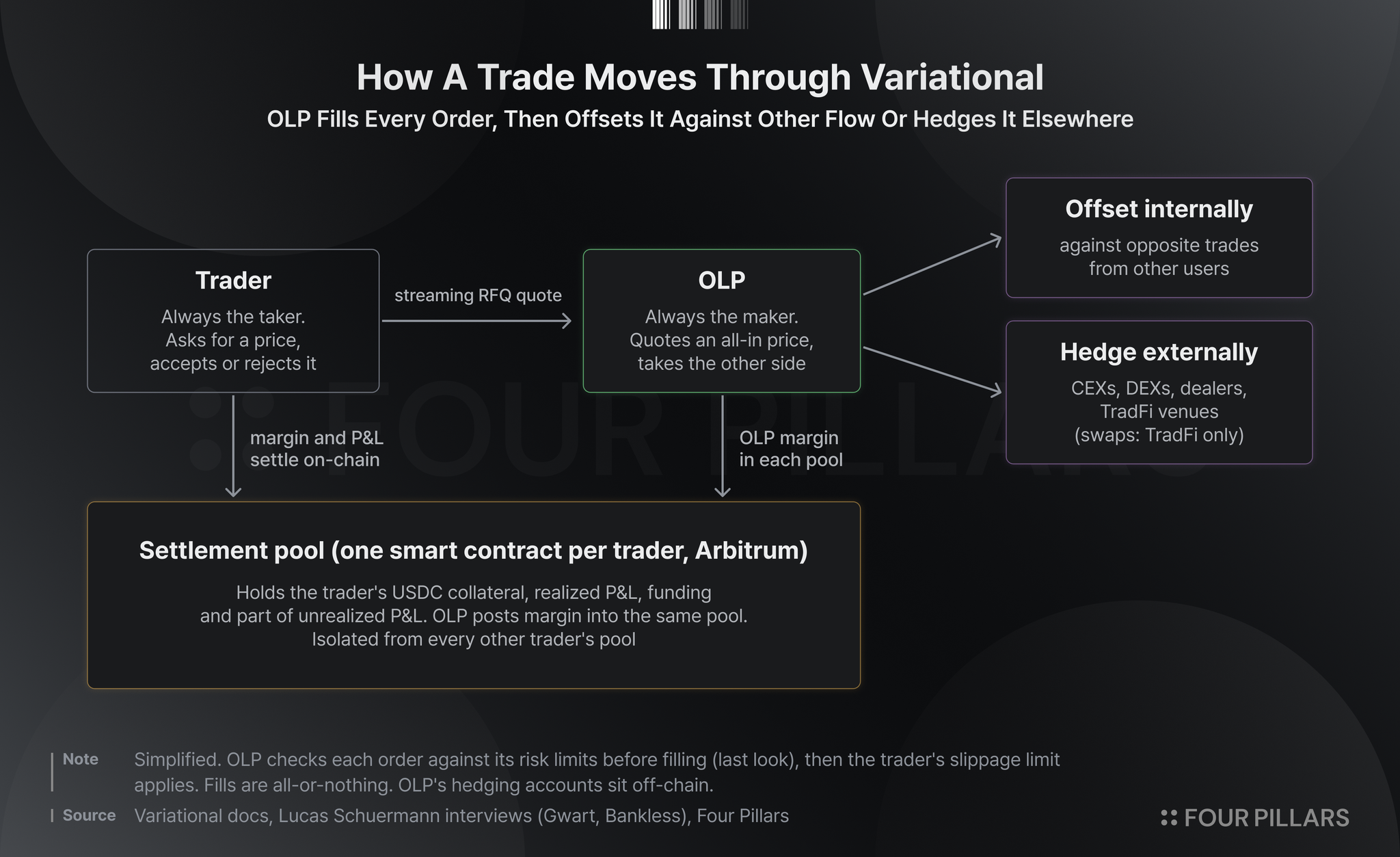
The mechanics go roughly like this. You ask for a price and get a real-time all-in quote, which Variational calls streaming RFQ. OLP checks the order against its risk limits, your slippage limit is applied, and the order fills in full or not at all. OLP now holds the other side and wants the risk gone. Unless offsetting flow from another user turns up first, it hedges as efficiently as possible on CEXes, DEXes or with dealers. Margin and P&L settle on Arbitrum, into a smart contract deployed for each user.
 Why use a single counterparty instead of a smart router that shops your order around?
Co-founder Edward Yu made the case on X, and it comes down to the instrument. A derivatives position isn’t spot. You can’t carry it to another venue, so a router that splits your order across five exchanges would leave you holding five positions, each with its own margin and funding. Somebody has to carry the position and pool the liquidity behind it, and on Variational that somebody is OLP.
At first glance, Variational's model resembles that of a traditional CFD broker, but Schuermann argues the two are fundamentally different.
A CFD house that keeps client trades on its own book (i.e. B-booking) earns when its clients lose. “OLP is best understood as a flow trading market-making strategy,” the CEO says, closer to the desks at Jane Street or Wintermute, which charge a spread and hedge the risk away. Custody is where OLP differs from all of them. Each client’s collateral sits in its own on-chain contract that the client can see.
The difference becomes even clearer when comparing Variational’s model with traditional orderbook-based exchanges.
On Hyperliquid or Lighter, your counterparty is whichever third party posted the resting order. Both run vaults alongside their books (HLP and LLP), but as the CEO’ sees it those vaults support an exchange, whereas OLP is the counterparty.
Schuermann talks about exchanges less as rivals than as infrastructure, filing Hyperliquid in the same layer as the CME and AWS, with Variational wanting to be “like Apple.”
In practice, the two are more connected than that. Hyperliquid has been one of OLP’s hedging venues, so some of what happens on Variational shows up as flow on Hyperliquid.
2. Zero Trading Fees, Paid For by the Spread
There’s no trading fee on Variational. Schuermann’s argument is that a trader pays two costs, the fee and the spread, and only the spread is unavoidable. At Robinhood, the wholesaler (i.e. Citadel) captures the spread and passes a slice back to the broker as payment for order flow. Variational keeps all of it, which avoids “leaking it out to the market makers” and leaves room to price tighter.
What an analyst wants to know next is how much spread sticks per dollar traded, and what happens to it as volume grows. Gross spread revenue divided by volume, from the biweekly updates, was 1.64 bps in the period ending 20 March. It peaked at 3.09 bps in early September and was back at 1.64 bps in the period ending 30 October, by which point two-week volume had tripled from $10.75 billion to $32.0 billion.
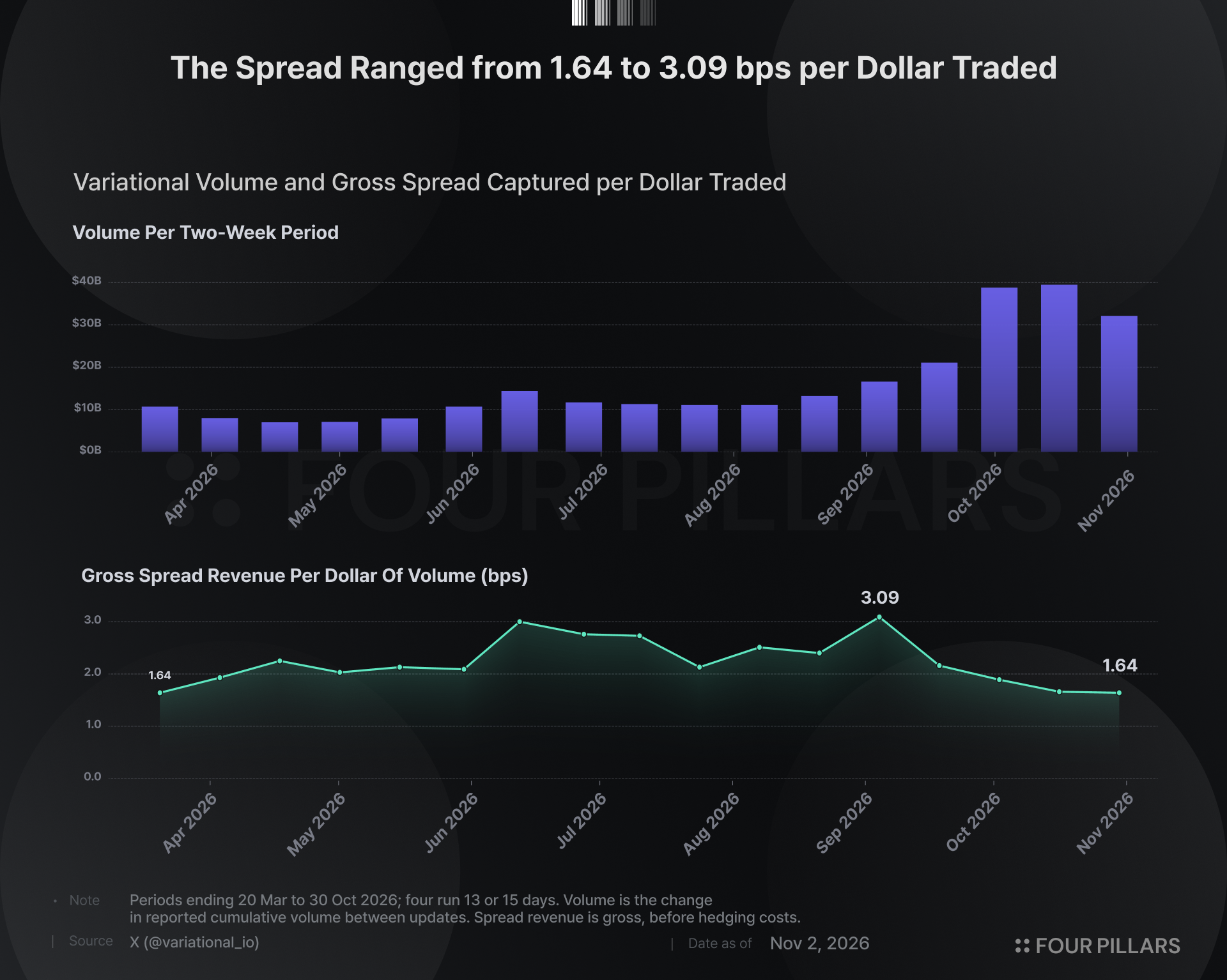
Part of that is mix, since swaps carried most of October’s growth and quote tighter than perps on most underlyings. The rest is scale. In Schuermann’s telling, a market maker gets cheaper to run as it grows, for three reasons.
Volume buys better terms on hedging venues, from fee tiers and rebates to cheaper financing.
More flow means more trades OLP can cross against each other, earning the spread on both sides without paying a hedging venue anything.
The third reason is the least obvious. A desk that has just bought $100 million of BTC from one seller now has an axe, a position it wants to offload, so it can offer the next buyer a better price than the market and still make money. The second reason waits for offsetting flow to show up, while this one goes and gets it with price. Better prices pull in more flow, and the loop repeats. In the CEO’s reading, that’s why a handful of firms handle most of TradFi’s market-making volume.
So far the benefits of scale have gone to traders. Across the 18 biweekly updates from March to October, Variational reported $59.7 million of gross spread revenue and $24.7 million of net profit after market-making costs and user rewards, with every period in profit. Costs took between 43% and 78% of gross revenue per period with no clear trend, so OLP hasn’t widened its margin as it grew. That’s what Schuermann means in calling OLP “not built to be extractive.”
The biggest reduction in trading costs so far came from a product only a dealer can offer.
3. Swaps Plug Into Liquidity That Orderbooks Have to Build
From the user’s perspective, a swap on Variational looks a lot like a perp. Leverage, long or short, USDC collateral. Underneath, it’s a bilateral contract between you and OLP, and a swap by definition can’t be listed on an orderbook or cleared by an exchange. It only exists if a dealer takes the other side.
Funding works differently too. A perp’s rate moves with the gap between the contract’s price and the index. A swap uses a published financing rate passed through from Variational’s TradFi counterparties, priced off SOFR plus a spread for US equity indices, metal lease rates for precious metals and futures-curve carry for other commodities. Dividends are paid through to holders, and swaps hedge only into TradFi markets.
The bigger thesis is that orderbooks have to rebuild liquidity one market at a time. An on-chain book needs market makers to commit capital to every new listing. That’s manageable for a handful of deep markets. Across hundreds, it turns into a Herculean effort.
Variational skipped the rebuild and wired OLP into the venues and dealers where the liquidity already lives. The TradFi onboarding “took us two quarters to solve, if not longer,” by Schuermann’s account, from colocated servers in Equinix’s NY4 data centre to FIX connections and commercial agreements.
Slow, dull work, and the partner network it produced is a big part of Variational’s moat. Capacity is well above a billion dollars and is being released in tranches.
As a result, TradFi markets went from 4.3% of Variational’s volume in May, when the first RWA perps went live, to 62.0% in October. Swaps launched on 1 September and did $44.6 billion in October, 57% of total volume and 92% of October’s TradFi volume.
Swaps account for an even larger share of weekday trading, representing 66% of the $2.65 billion in volume recorded over the 24 hours ending at 05:20 UTC on 4 November. The number of listed markets increased from 466 at the end of March to 581, including 18 swaps.
The cleanest test is like-for-like. Variational lists both a swap and a perp on gold, silver, crude oil and the S&P 500, so you can line them up. At 02:46 UTC on Monday 2 November, Variational’s public market data had the swap quoting a tighter full bid-ask spread than the perp on three of the four pairs at $100,000. On a $1 million gold trade, the swap was 2.74 bps against the perp’s 6.63.
Coming out of the weekend, the gold perp’s funding was running at 29.2% annualised and silver’s at 70.4%, against long carry of 5.5% and 5.7% on the swaps. The S&P 500 perp, at 4.4%, was a touch below the swap’s 4.9%.
So the swap doesn’t always carry cheaper. What it sells is a rate tied to TradFi benchmarks, so it doesn’t spike when traders on Variational pile onto one side.
That case now has a regulated rival in the US. ICE, the parent of the New York Stock Exchange, said on 29 October it would build a US-regulated perp market with trade.xyz on Hyperliquid’s infrastructure, and on 3 November the first single-stock perpetual futures cleared CFTC review.
Schuermann reads the news as good for the industry and neutral for the swap case. Perps are the right construct where an asset lacks deep spot and derivatives markets, which describes crypto and pre-IPO names.
For stocks, indices and commodities, the deep liquidity and the leverage already live in TradFi, and a swap plugs straight into them. “If a retail user has the ability to buy a dated future versus a perp versus a swap versus a spot product, I still think that the swap is the best,” the CEO says. What the CFTC changes is how many retail traders can reach leveraged derivatives at all, which grows the market for everyone building them.
4. Built for Size and Breadth
Schuermann is unusually candid about where the model offers less of an advantage. In a September interview, he conceded that for a retail order of “$1,000 or $10,000,” an orderbook and Variational “might be comparable on two or five or 10 markets.” Go past that, to bigger orders, the hundreds of less-traded Nasdaq names or global markets, and orderbooks struggle to scale. For Variational it’s “a turnkey connectivity problem.”
The quotes back this up. To compare like with like, I pulled Variational's quotes and Hyperliquid's orderbooks at the same moment three times during US market hours on 11 November, at 10am, noon and 2pm New York time, and averaged the round-trip cost of buying and selling $1 million at once. Each Variational swap was lined up against the trade.xyz perp on the same underlying.
Variational was cheaper on the S&P 500, Nasdaq 100, gold and crude even before counting Hyperliquid's fee. A Nasdaq 100 round trip cost 0.9 bps on Variational against 4.0 on Hyperliquid once its taker fee was added. Gold looks the most lopsided because trade.xyz charges its full fee on gold, while its other four markets here run at a 90% fee discount. Silver was the one TradFi market where Hyperliquid came out ahead.
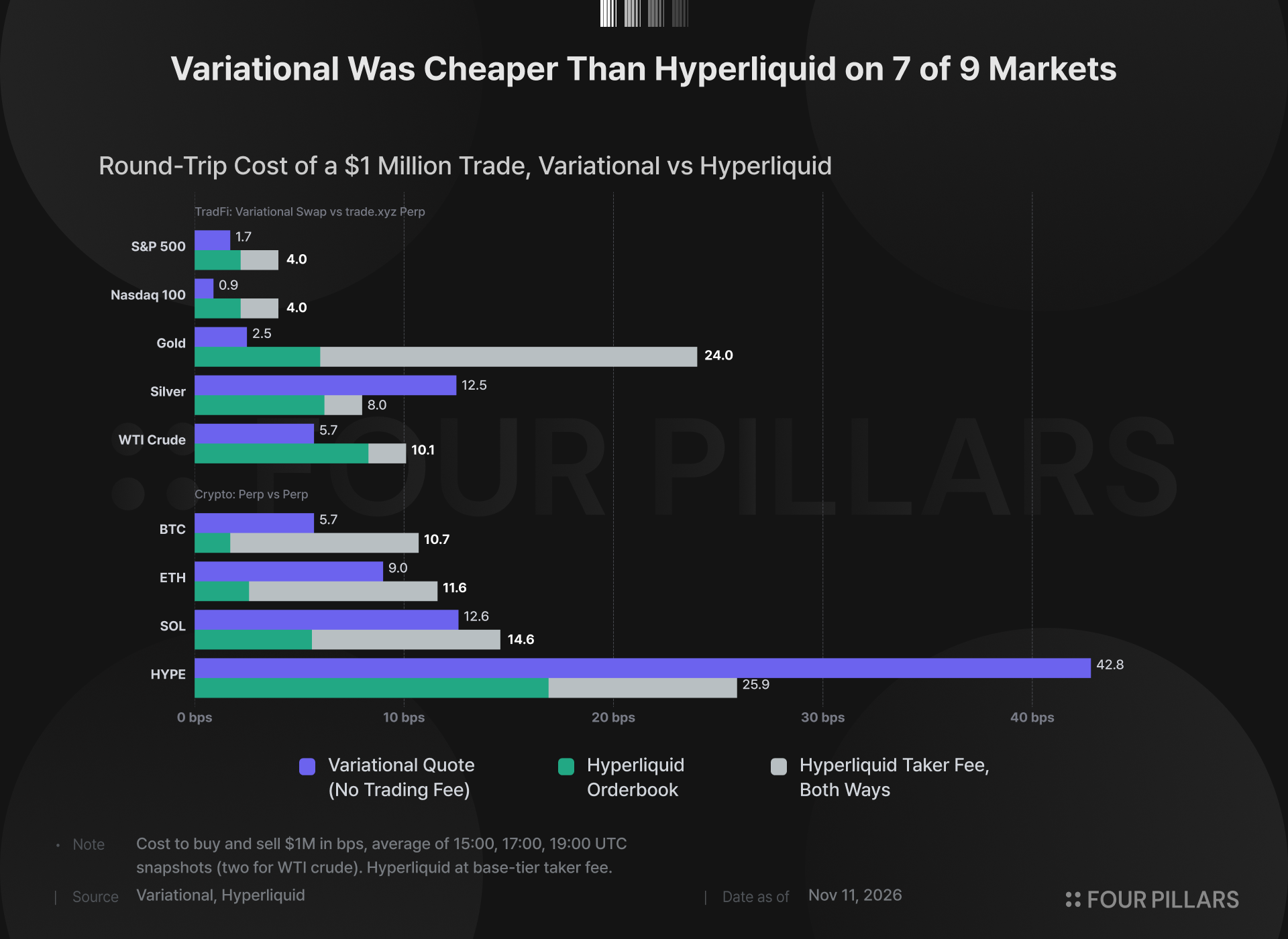
On crypto, Hyperliquid's orderbook was tighter than Variational's quote on all four majors, at 1.7 bps against 5.7 on a $1 million BTC round trip. Adding Hyperliquid's base-tier taker fee of 4.5 bps each way flips that, leaving Variational the cheaper round trip on BTC, ETH and SOL at $1 million and on all four majors at $100,000.
HYPE at $1 million was the exception, at 42.8 bps on Variational against 25.9 on Hyperliquid even after the fee. A quote-and-hedge model adds the least where the deepest liquidity already sits on a venue it hedges into, and for HYPE that venue is Hyperliquid. Hyperliquid also cuts its fee for its biggest traders, which narrows the gap for them.
Few traders send $1 million of SOL or HYPE in one clip, and most who trade that size run an execution algorithm or a TWAP, slicing the order up over time. The bigger point is focus. With swaps now most of the volume, Variational’s next stretch of work goes into TradFi, where it can be far cheaper than other on-chain venues and list hundreds of markets they don’t have. Crypto execution has plenty of room to improve, and for now the goal is to keep it competitive.
Perps dominate weekend trading. Swaps close at the end of Friday’s session and reopen Sunday evening UTC, because keeping thin markets shut avoids the snap moves or liquidations you get on round-the-clock RWA perps. Perps on the same underlyings keep trading through the weekend against a smoothed index. Between 7 September and 1 November, Saturdays and Sundays carried 3.3% of Variational’s TradFi volume, against 18.5% from June to August, when TradFi traded only as perps.
Hence index and commodity swaps at size are the strongest case for Variational, and crypto majors at everyday sizes come out cheaper once fees are factored in. HYPE in seven-figure clips and silver still belong on Hyperliquid, and for weekend TradFi exposure, perps are the only option.
5. OLP Is Run by the Team That Built Genesis's Market Maker
Between 2019 and 2021, Schuermann and Yu built the electronic market-making system and single-dealer platform at Genesis Trading, with Schuermann running engineering and Yu quantitative research. Omni is, in effect, the second single-dealer platform they've built, and this time the dealer is their own. Genesis wasn't the start either. The two met at Columbia and ran a systematic FX and crypto fund, Qu Capital, from around 2017 before selling it to Digital Currency Group, Genesis's parent.
They left in late 2021, more than a year before Genesis's lending arm filed for bankruptcy, and ran Variational as a prop and OTC trading firm through 2024, across most of that era's DeFi derivatives venues from dYdX and Drift to Zeta and Lyra. They were early on Hyperliquid too, at one point among the largest depositors in its vaults.
FTX changed what they built. Schuermann watched OTC counterparties get wiped out across the market in 2022, and the weak point was plumbing. An OTC trade was negotiated over Telegram or a voice call, confirmed by email and DocuSign and paid by wire days later, and if the other side failed before the wire, the trade was gone.
The fix was on-chain RFQ and settlement, with stablecoin collateral held in a contract and liquidated automatically if a counterparty failed. That idea became Pro, and it's why every Omni user trades out of a settlement pool of their own.
Going public meant giving up a stealth prop firm with no marketing team and no public profiles. The pair debated it for a long time and decided a category-defining business was worth it. The protocol launched on mainnet in January 2025. Bain Capital Crypto and Peak XV co-led a $10.3 million seed round, and Dragonfly led a $50 million Series A in May 2026.
The experience shows in the rules around OLP, which sit in the protocol itself. Every order passes risk checks that cap OLP's value at risk, its gross and net notional, its position in each market and its exposure relative to the size of each listed asset. Per-user limits add another layer of protection, and an administrator can halt trading if necessary. These safeguards allow OLP to reject orders that breach its risk limits. For now, orders must fill in full or not at all, though partial fills for limit orders are planned.
6. What You're Really Underwriting Is OLP
The settlement pools are the first half of the answer to a single-counterparty model. Each user's collateral sits in a smart contract on Arbitrum deployed for that user alone, and OLP posts its own margin into the same pool. Realised P&L, funding and part of unrealised P&L move between your pool and OLP in near real time. On 2 November there were 40,747 pools that Entropy classifies as live.
If there's ever an issue with OLP and it blows up, that original margin in these smart contracts stays completely isolated. If OLP's margin in your pool runs out, OLP is the one that gets liquidated, and your position closes at the settlement price plus a 0.5% reward. Variational reported 167 of these auto-deleveraging trades, $273,000 in total, between launch and 10 October, against roughly $400 billion of volume.
The second half is how OLP trades. Schuermann describes the book as run "very, very, very flat," with risk held "for milliseconds in many cases" before it's hedged or offset, and the biweekly reports back that up. OLP's own P&L line was positive in 17 of 18 periods. The one loss, in the two weeks to 1 May, was $36,821 on $7.0 billion of volume. Extreme markets are hard on any market maker and that period shows OLP can lose money, but a loss that size on a book that size is what flat looks like.
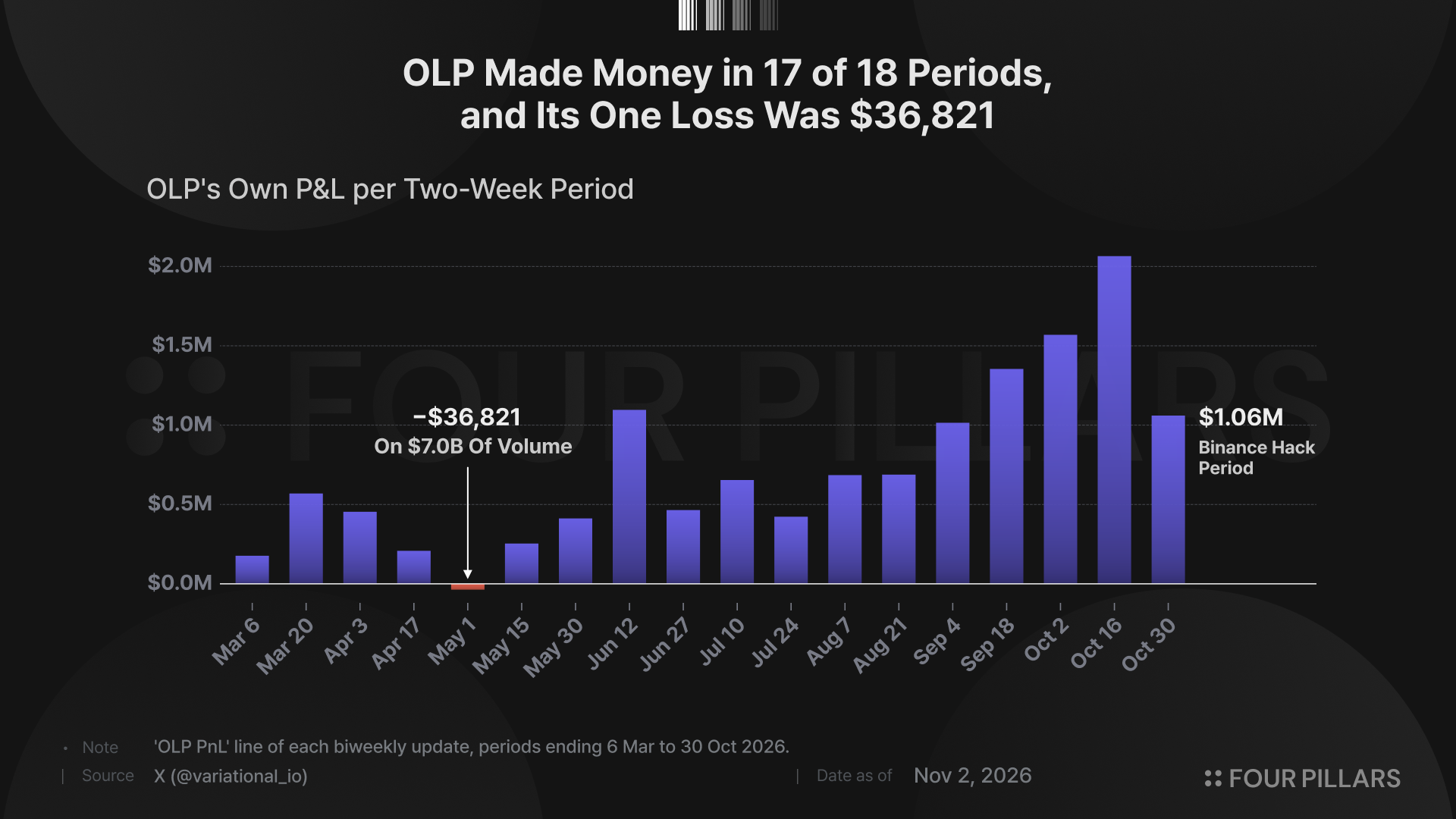
Then Binance got hacked. On 29 October about $6.3 billion was stolen from Binance, which paused withdrawals and said it would cover the losses. Variational users pulled a net $16.5 million from their pools that day, the largest daily outflow on record, and the withdrawals settled because the collateral had never left the on-chain contracts. OLP made $1.06 million over the two weeks that included the hack, and Schuermann says it also made money through the 10 October 2025 crash.
Yu said afterwards that less than 25% of OLP's funds were on Binance at the time, and that OLP's capital providers, not users, would have taken any loss.
Pressed on the worst case, OLP losing all of its funds, Yu answered that users could still withdraw their existing funds from the pools, but "any future upnl/rpnl past the point of OLP insolvency may not be able to get paid out." Collateral and settled profit are protected. Gains still owed at the moment OLP fails are not.
That puts the weight on OLP's capital, and most of it can't be seen. OLP hedges on CEXs, DEXs and with TradFi dealers, so its hedging capital sits off-chain and outside reported TVL, and the on-chain OLP vault, which ranged between $16.2 million and $54.8 million in October, is a working balance.
The total hasn't been published. OLP's largest capital provider is Variational itself, funded by its venture rounds, retained profit and the founders' prop-trading years, and outside parties add more through LP agreements. The CEO describes the company as well capitalised.
A community OLP vault is on the public roadmap, though not imminent.
7. Citadel First, Robinhood Next
Robinhood started with the customer and rented the dealer. Variational built the Citadel half first and tested its desk on live orders during Omni's private beta. In September, Omni had no trading API. Justin Bram, Variational's head of product, said all the volume then came from users trading by hand in the app.
Yu calls the moat "owning the end user," and the retail customers Variational wants already trade with the brokers Schuermann names as competitors. The list runs from Robinhood and Interactive Brokers to Pluang in Indonesia, Groww in India and, regulation permitting, Toss in Korea, where Variational already has one of its biggest user bases. The pitch is execution on swaps good enough that you stop looking at the orderbook, the way you don't when you buy a stock through a brokerage app.
Under invite-only sign-up, new accounts fell from 42,700 in the first quarter of 2026 to 17,500 in the third. Monthly actives went from 35,088 in February to 39,123 in October, and monthly volume per active account went from $0.76 million to $2.0 million over the same period. On 2 November the 100 largest settlement pools held 43.6% of the $227.0 million in user pools.
Schuermann puts the slowdown down to the market and tracks the count of larger accounts trading actively in swaps and RWA perps, which has been rising. Many run strategies, such as basis trades between perps and swaps, that don't depend on incentives. "Traders like things where they make money," the CEO says.
On 12 November, Omni opened its mainnet and dropped the referral code requirement. A trading API would bring in systematic traders, whose flow is harder to price than manual clicks. This is where the scale loop from section 2 becomes important. More flow gives OLP more orders to cross internally and better information to price incoming trades.
Pro, due in 2027, is multi-dealer, and Yu has said it can support markets OLP plays no part in, because Variational isn't providing the liquidity on Pro. Omni can only list what OLP will quote and carry, and Pro is built to take that limit away.
The prize for Pro is the OTC flow that runs through dealers like Goldman Sachs and JP Morgan. In Schuermann's telling, if you want an OTC derivative from a bank today, you still phone the desk and settle by wire two days later. By his reckoning, that market is bigger than all of retail trading combined.
He calls Pro "a stablecoin moment for OTC trading." In 2017, everyone could see the dollar rails were bad, and it still took years to get institutions and regulators on board. The case for something like Pro is easy to make. It comes down to who has the dealer connections to build it, and Variational already has them from getting swaps to work.
The market took a long time to see Hyperliquid as more than a crypto exchange.
I doubt it needs as long this time.
The report is based on the independent research of the author sponsored/funded by Applied Variational Research SECZ.
The author of this report may have personal holdings or financial interests in assets or tokens discussed herein. However, the author affirms that no transactions have conducted using material non-public information obtained in the course of research or drafting. This report is intended solely for general information purposes and does not constitute legal, business, investment, or tax advice. It should not be used as a basis for making any investment decisions or as guidance for accounting, legal, or tax matters. Any references to specific assets or securities are made for informational purposes only and should not be construed as an offer, solicitation, or recommendation to invest. The opinions expressed herein are those of the author and may not reflect the views of any affiliated institutions, organizations, or individuals. The opinions and analyses expressed herein are subject to change without prior notice. In addition, beyond the individual disclosures included in each report, Four Pillars, may hold existing or prospective investments in some of the assets or protocols discussed herein. Furthermore, FP Validated, a division of Four Pillars, may already be operating as a node in certain networks or protocols discussed herein or may do so in the future. Please see below links in the footer for FP Validated's participating network disclosures and for broader disclosure details.