Table of Contents
Researcher

Related Projects

Anthropic ($ANT) has gone public, new AI models keep arriving, and the age of AI agents is beginning in earnest. Interest in how those agents will pay is spreading well beyond the blockchain industry.
Source: X(@brian_armstrong)
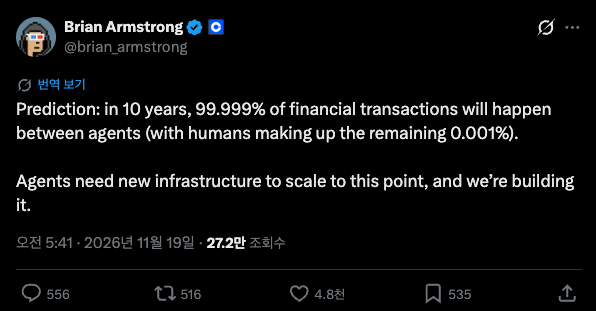
Brian Armstrong(@brian_armstrong) predicts that within ten years, 99.999% of financial transactions will take place between agents. He argues that reaching that scale will require new infrastructure, and he has set out to build it. Across the blockchain industry, companies are competing to provide the payment rails for that market.
Card networks including Visa, Mastercard, and American Express are preparing their infrastructure for agent payments, as are fintech companies. Stripe-backed Tempo(@tempo) has taken two paths at once. It participates in x402 and has developed its own Machine Payments Protocol (MPP).
Source: X(@brendan_j_ryan)
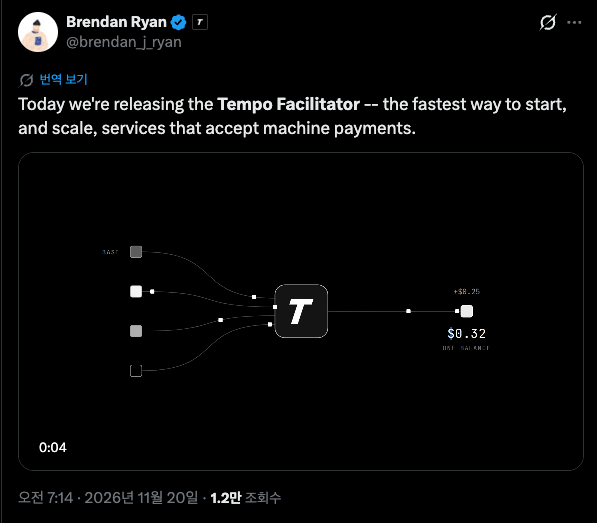
tbh I expected Tempo to go all in on MPP, since their own protocol already uses the same HTTP 402 status code. Then, on November 20, 2026, Tempo announced the Tempo Facilitator for settling x402 payments.
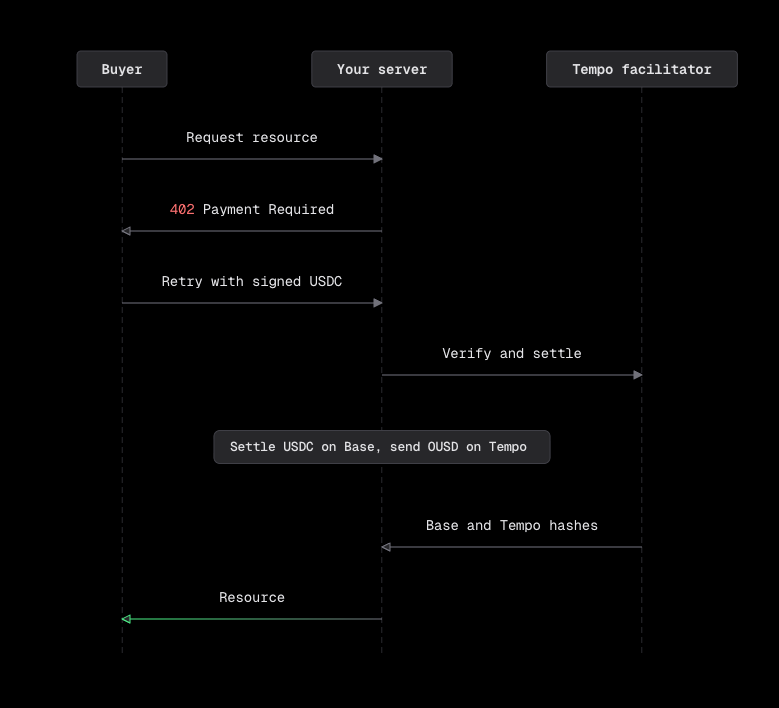
The buyer pays in USDC on Base mainnet, and the merchant receives OUSD on Tempo mainnet. For developers, it takes two clicks to get an API key and one line of code to integrate the facilitator into a service.
Source: Tempo
From the buyer’s perspective, little changes beyond a slight difference in settlement time. Even Tempo’s own diagram looks much like the payment flow for an existing x402 facilitator.
The differences emerge in Tempo’s API reference, its OpenAPI specification, and its public endpoints. Follow the money after the buyer signs, and the term I would use for what Tempo has built is a payment gateway (PG). I use the term in the sense familiar to Korean merchants, where a PG can collect payments and settle the proceeds with each merchant.
Stripe built much of its influence by making payments easy for developers to integrate. Tempo takes a similar approach. Developers see the familiar x402 endpoints, /supported, /verify, and /settle. Behind them, Tempo handles collection and merchant payouts in much the same way a payment gateway does. Three design choices show how.
Principle 1. Payments to different merchants go to one deposit address
Start with a buyer requesting a paid service. The merchant’s server replies with an HTTP 402 response that sets out its payment requirements.
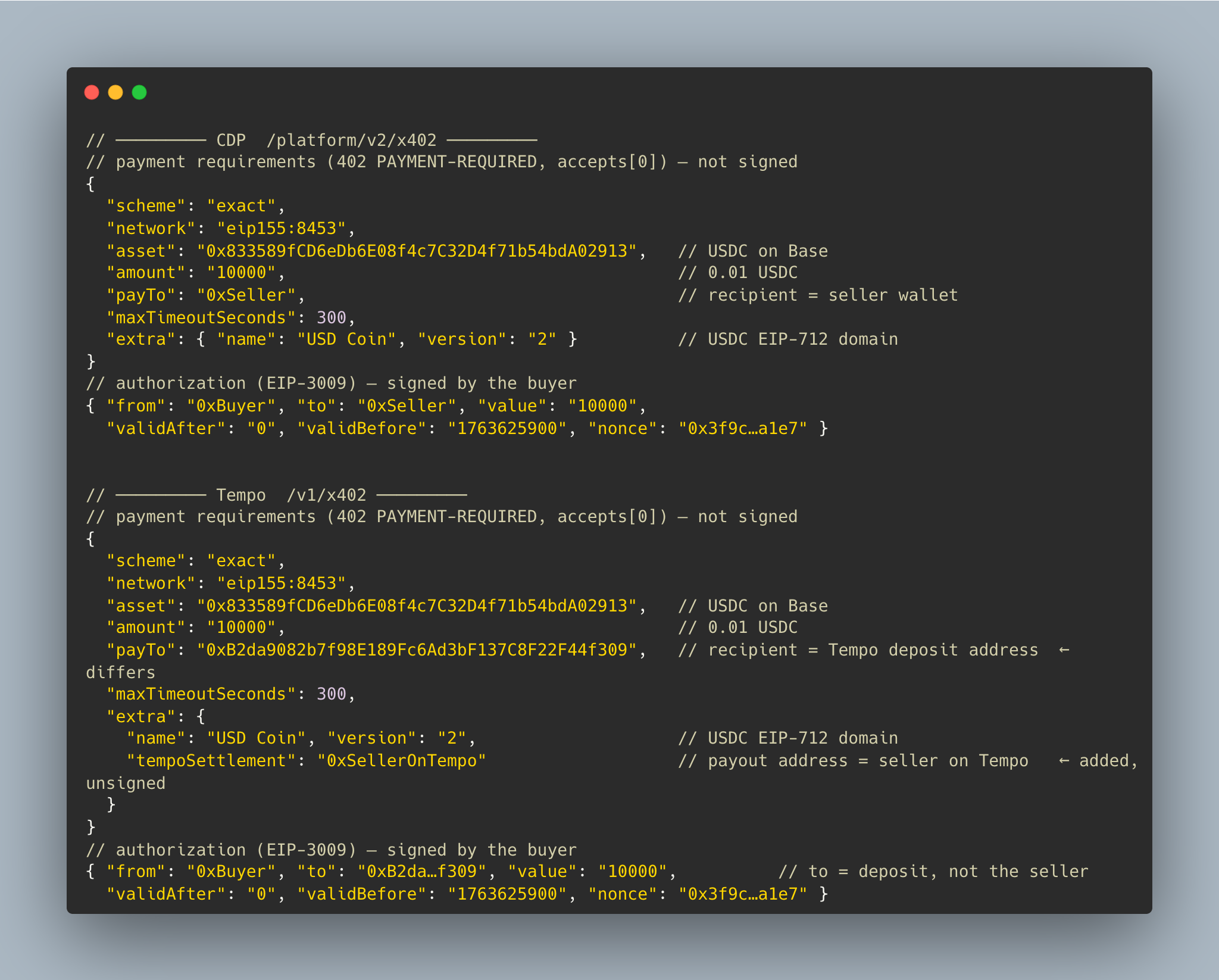
With Coinbase’s CDP facilitator, the merchant puts its own wallet address, an externally owned account (EOA), in the payTo field of the 402 response. The buyer uses those requirements to create and sign an EIP-3009 transfer authorization. Its to field takes the value of payTo, so when the buyer signs, they are authorizing a specific transfer of USDC to that merchant.
The facilitator submits the signed authorization on the buyer’s behalf and pays the gas fee. The funds move directly from the buyer’s wallet to the merchant’s.
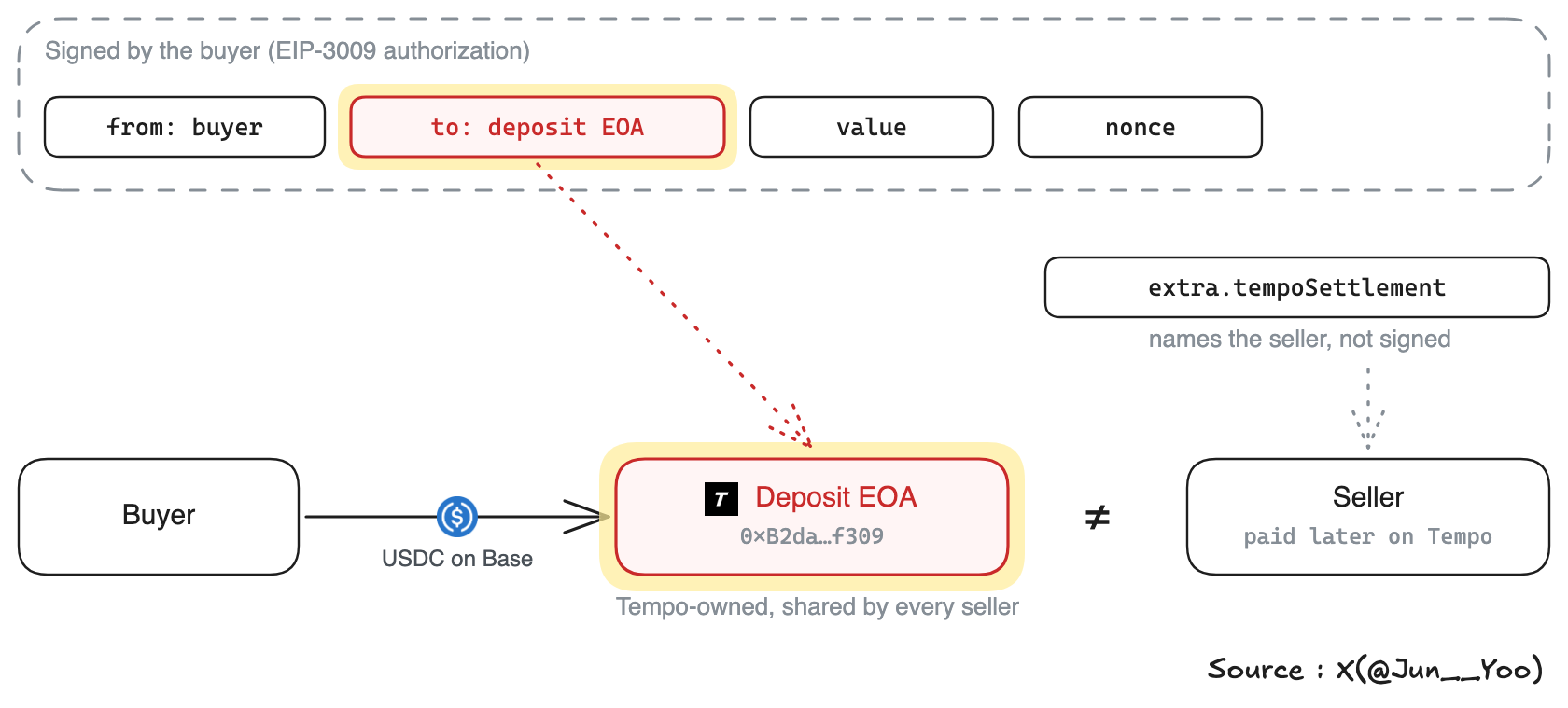
With the Tempo Facilitator, payTo is set to Tempo’s deposit EOA.
As of November 20, 2026, Tempo’s deposit EOA is 0xB2da9082b7f98E189Fc6Ad3bF137C8F22F44f309. The address may change. View on BaseScanThe merchant must use the address returned by GET /v1/x402/supported as payTo. If it supplies another address, Tempo rejects the payment with payto_not_deposit_address. The merchant puts its own Tempo wallet address in a separate field, extra.tempoSettlement, which falls outside the buyer’s signature. Whichever merchant makes the sale, the to address the buyer signs is the same Tempo deposit address.
That changes who holds the funds. CDP’s flow is non-custodial. The facilitator never holds the buyer’s USDC. Tempo’s flow is custodial in the sense that Tempo receives the USDC into its own account before paying the merchant separately in OUSD on Tempo.
It also changes where the merchant is identified. With CDP, anyone reading the signed to field can identify the merchant’s wallet. With Tempo, the signed authorization alone does not tell you who will receive the OUSD. That information comes from an offchain request. How does Tempo use it to pay the right merchant?
Principle 2. The organization handling the payment and the merchant receiving it can be different
The buyer retries the request with the signed payment in the PAYMENT-SIGNATURE header. The merchant’s server checks that the PaymentPayload matches the terms it sent in its 402 response. It then forwards the PaymentPayload unchanged, adds its own PaymentRequirements, and calls the facilitator’s /verify and /settle endpoints. At this point, the two facilitators handle the request differently.
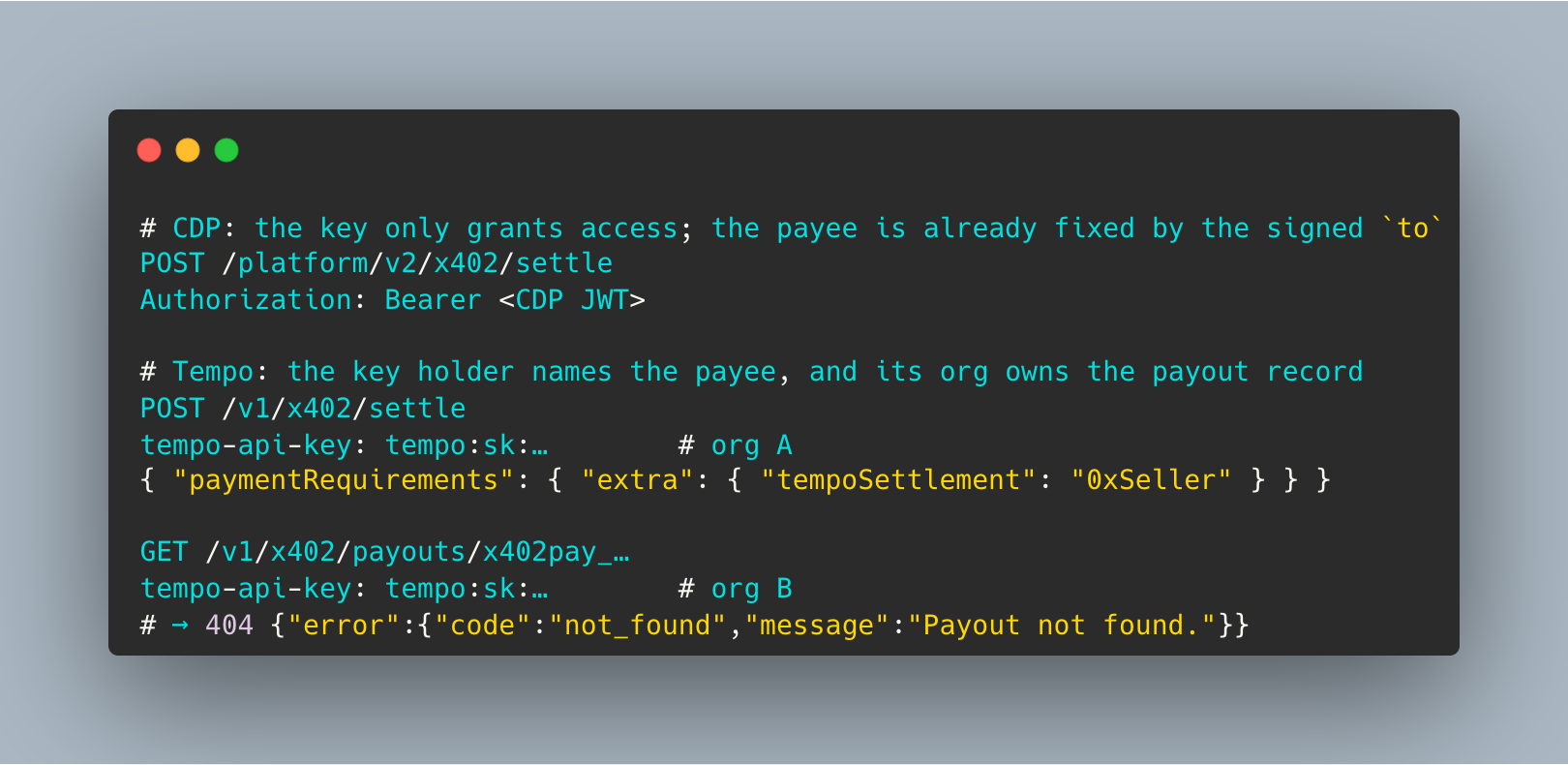
With CDP, the merchant’s server signs a JSON Web Token (JWT) with its CDP API key and sends it to the facilitator in the Authorization header. The key authenticates the server as a registered CDP client. The buyer’s signature has already established the recipient’s address.
Tempo uses two pieces of information to determine whose transaction it is and where the money goes.
tempo-api-keyidentifies the organization (org) calling/settle. It determines which account the transaction belongs to.paymentRequirements.extra.tempoSettlementspecifies the payout address that will receive the OUSD.
The merchant’s server sends both values in its request. Tempo uses them to create a payout record for each payment. The record includes the buyer’s address (payer), the payout address (to), the amount, the Base settlement transaction (settlement.transaction), and the current payout status (status).
The distinction matters because the organization handling the sale can be a marketplace, while the merchant entitled to the proceeds is a seller on that marketplace. Tempo’s guide allows a different payout address for each API route.
A route can send its payout to its own address, such as a platform's seller: tempo.route({ price: '$0.10', payoutAddress: seller.tempoAddress })A marketplace could offer APIs from several merchants under one organization account. For each route, it would put the corresponding merchant’s wallet in extra.tempoSettlement.
Tempo can therefore keep the transaction on the marketplace’s account and send the money to the individual merchant. That distinction has a counterpart in card payments, where a PG maintains the merchant’s contractual account separately from the bank account that receives its payouts.
Once the USDC reaches Tempo’s deposit address, when does the merchant actually get paid?
Principle 3. Tempo confirms the deposit on Base and completes the payout on Tempo
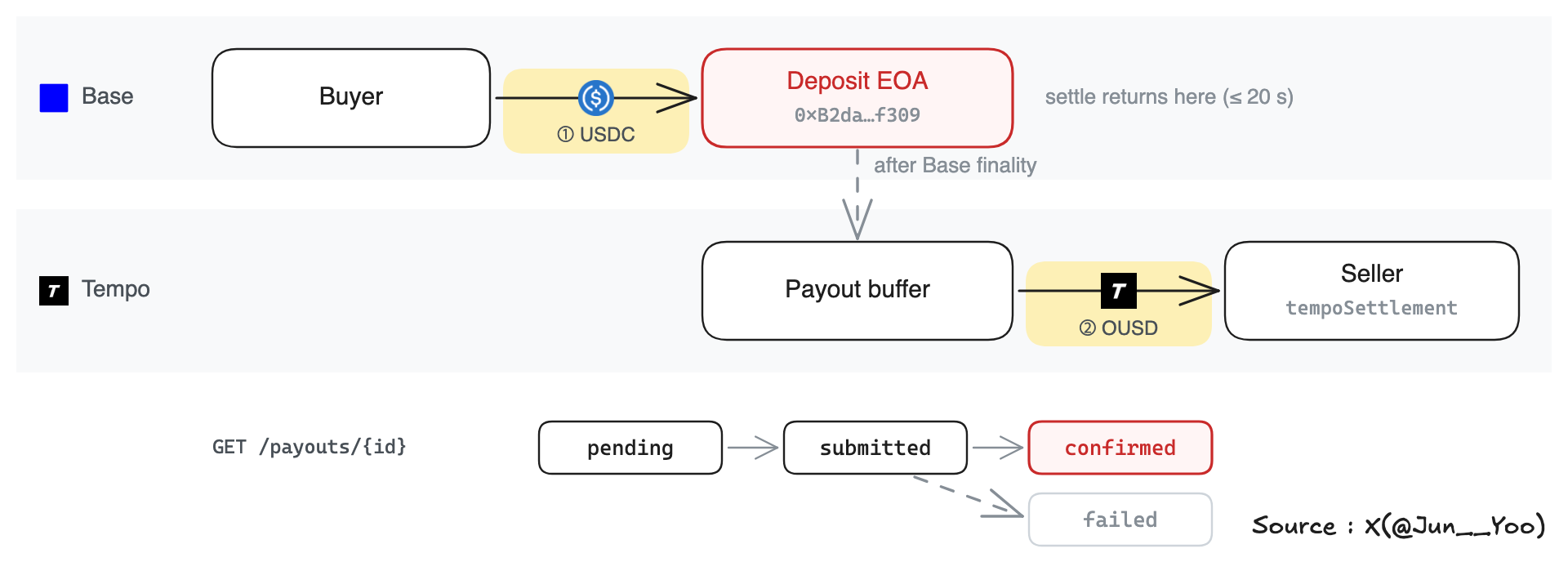
With CDP, the transaction in a successful /settle response is the transaction that credits the merchant’s wallet. By the time the response arrives, the merchant has been paid. Tempo processes and records settlement in two stages.
First, the buyer’s USDC goes to Tempo’s deposit EOA on Base. The facilitator waits up to 20 seconds for confirmation and returns settlement_pending if it is still waiting. Once it confirms the deposit, Tempo signs a transaction to send OUSD to the merchant’s designated address. The response reports the payout details under extensions.tempoSettlement. Given Base’s L2 finality, the OUSD payout is expected to complete within a few minutes of the Base transaction becoming final.
A successful/settleresponse confirms that the buyer’s USDC reached Tempo’s deposit address. To check whether the merchant has received OUSD, the merchant’s server makes a separate call toGET /v1/x402/payouts/{id}and checks that the payout is confirmed.
Why did Tempo design its facilitator this way?
Consider Tempo’s position in the stablecoin market. It is building an ecosystem around OUSD while USDC accounts for 99.5% of agent payments. As a new entrant, Tempo has to compete with USDC while serving buyers who already use it. That may explain its initial design. Buyers pay in USDC on Base, where the infrastructure is well established, and merchants receive OUSD on Tempo. Splitting settlement into two stages appears to give Tempo a way to connect the two chains and assets while making sure merchants receive the proceeds on its network.
Tempo’s TIP-20 tokens support ERC-2612-style signed approvals (permit) through TIP-1004. In the future, accepting payments directly on Tempo is another possibility.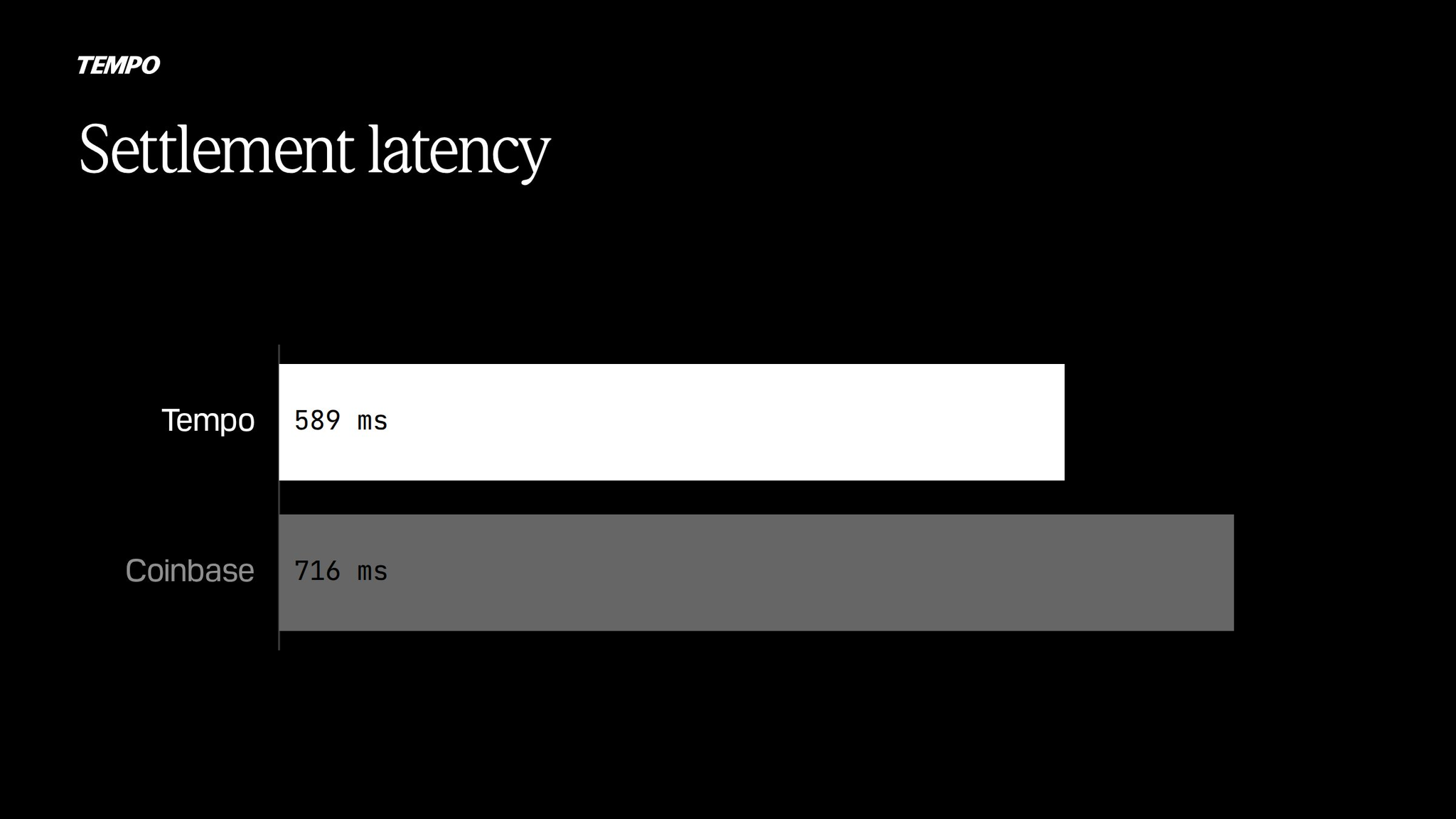
Source: X(@brendan_j_ryan)
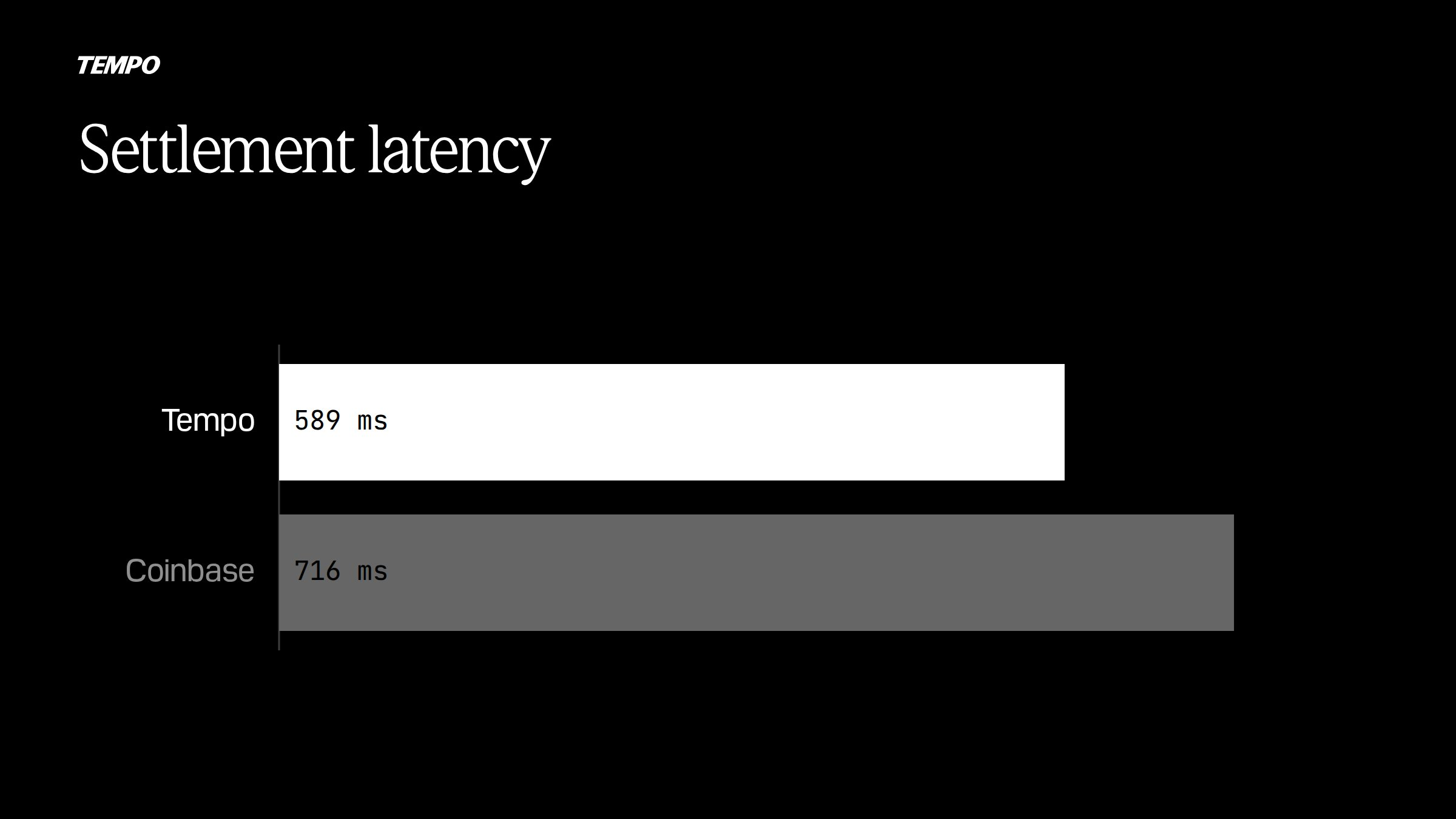
Two stages raise an obvious question about latency. Tempo says its early benchmarks consistently showed faster settlement than competing facilitators, including Coinbase’s. It also says it intends to keep improving performance and reliability.
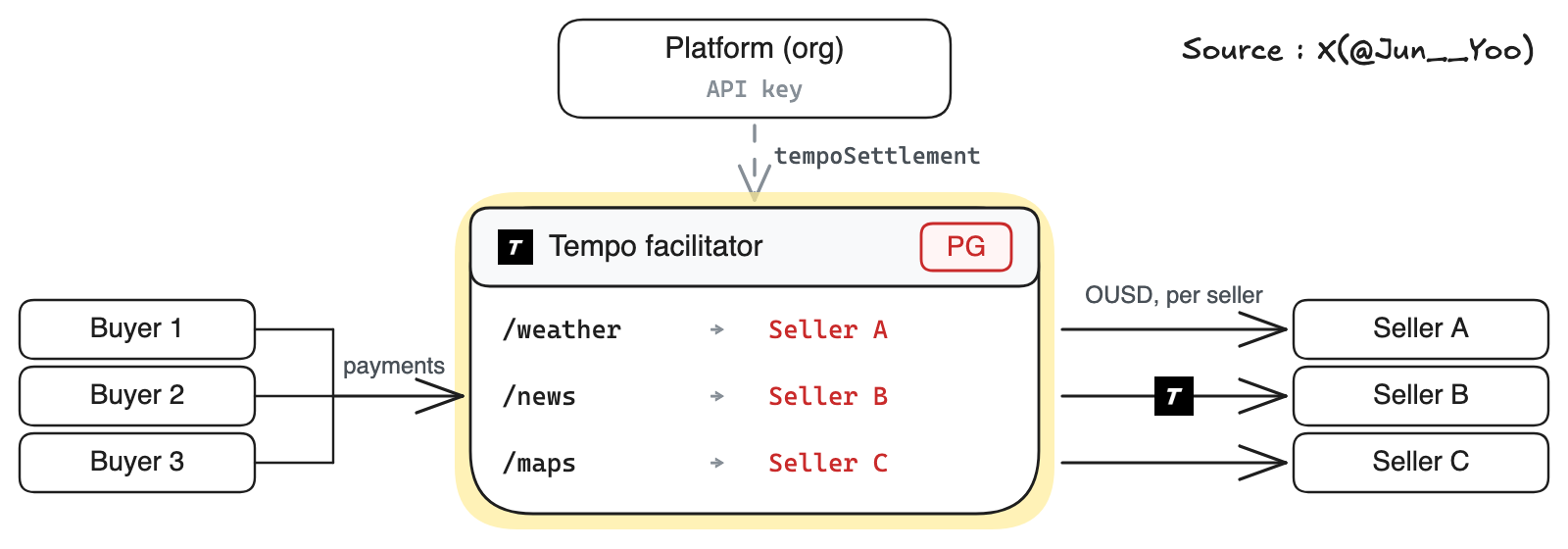
From a business perspective, the more consequential choice is to give collection and payout separate addresses. Issuing a Base deposit address to every merchant would make it easy to tell whose sale each deposit represents. It would also leave Tempo with a growing number of addresses and balances to manage. Instead, Tempo collects USDC at one shared address, uses the API key to identify the organization requesting settlement, and sends OUSD to the address in tempoSettlement. The buyer still authorizes payment to payTo. When a new merchant joins a platform, the platform only needs to specify that merchant’s payout address. It can do so without registering each merchant separately with Tempo.
This is where the Tempo Facilitator most closely resembles a payment gateway that settles sales for a marketplace. With Stripe Connect, a platform creating a payment can designate a seller’s connected account, and Stripe transfers the proceeds to that account. With Tempo, the platform identifies whose sale it is, and the facilitator distributes the proceeds according to those instructions.
The design becomes more valuable if machine-to-machine (M2M) micropayments grow exponentially, as Armstrong expects. Suppose Tempo and OUSD gain meaningful market share and the facilitator starts accepting OUSD deposits on Tempo as well as paying out OUSD there. Tempo could then use its merchant records to tally sales in an offchain ledger and pay each merchant in batches. In a market where machines constantly make tiny payments, issuing a separate onchain payout for every purchase adds cost and load. Collecting funds at one address and tracking each merchant’s share in a ledger could lay the groundwork for reducing both.
Blockchain-based agent payments are still at an early stage, and Tempo already has a session-based protocol in MPP. An x402 facilitator might therefore look like a modest feature addition. But x402 is an open payment standard that multiple companies are building together through the x402 Foundation under the Linux Foundation. By supporting it, Tempo is helping extend the ecosystem beyond its own protocol. As AI agents move between payment networks, the ability to accept payments across a wide range of rails will become a competitive advantage for merchants.
Tempo’s facilitator shows how the company thinks about collecting payments and paying merchants across networks. What I’ll be watching is how far it takes that design.
The author of this report may have personal holdings or financial interests in assets or tokens discussed herein. However, the author affirms that no transactions have conducted using material non-public information obtained in the course of research or drafting. This report is intended solely for general information purposes and does not constitute legal, business, investment, or tax advice. It should not be used as a basis for making any investment decisions or as guidance for accounting, legal, or tax matters. Any references to specific assets or securities are made for informational purposes only and should not be construed as an offer, solicitation, or recommendation to invest. The opinions expressed herein are those of the author and may not reflect the views of any affiliated institutions, organizations, or individuals. The opinions and analyses expressed herein are subject to change without prior notice. In addition, beyond the individual disclosures included in each report, Four Pillars, may hold existing or prospective investments in some of the assets or protocols discussed herein. Furthermore, FP Validated, a division of Four Pillars, may already be operating as a node in certain networks or protocols discussed herein or may do so in the future. Please see below links in the footer for FP Validated's participating network disclosures and for broader disclosure details.