Table of Contents
Researcher


Key Takeaways
- To use BTC as onchain collateral, holders must first choose how to bridge it to another chain. The four models are custodial, signer-set, chain-native, and trust-minimized. Custodial tokens, each backed by BTC held by a single company, still account for about 85% of all BTC wrapped on other chains.
- Only about 360,000 BTC (1.8% of total supply) is wrapped on other chains. Half of that, about 180,000 BTC (0.9% of supply), is deposited as collateral in DeFi lending markets. Bitcoin ETFs and publicly traded companies hold about 2.67 million BTC (13.3% of supply), more than seven times the total wrapped on other chains.
- As ETFs and publicly traded companies hold a growing share of BTC, demand for BTC-backed loans will rise. Traditional lenders are likely to meet most of that demand. For now, the onchain market will continue to serve mainly borrowers who want to use the proceeds to buy more crypto.
Everything I own keeps falling in value. I want to buy more at these prices, but I’m short on cash. Then I remembered the bitcoin I’d tucked away in my hardware wallet and all but forgotten about. That bitcoin would make good collateral. Here’s how I could borrow against it onchain.
1. Who holds my “real” BTC?
Bitcoin does not support general-purpose smart contracts. Strictly speaking, a DeFi protocol cannot take BTC on the Bitcoin network directly as collateral. The protocols differ in how they handle custody, but the basic mechanism is the same. They lock BTC on the Bitcoin network and mint a token to represent it on a chain that supports smart contracts. Before I can borrow against my BTC, I have to decide who will hold it and how the wrapped token will be issued.
Fixed-rate lending has yet to work well onchain, and rates can change quickly as market conditions shift. Before comparing rates, I need to decide which custody arrangements I’m willing to trust.
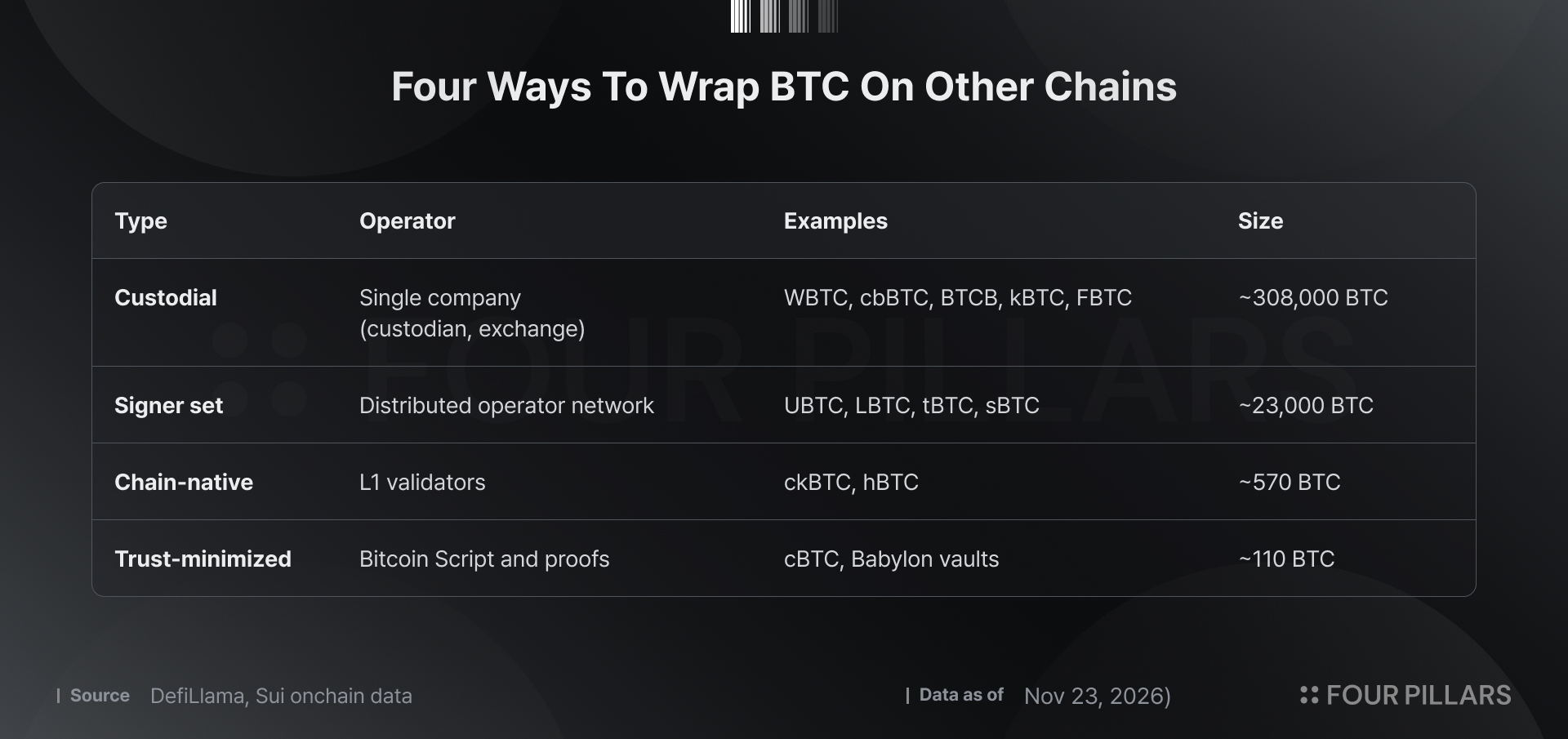
There are four models.
1.1 Custodial tokens
The custodial model is the easiest to use and understand. A company, such as a custodian or an exchange, holds the BTC and issues the same number of tokens on a smart contract platform. WBTC, launched in 2019, is one example. Coinbase launched cbBTC in September 2024, and Circle launched cirBTC on Ethereum on June 8, 2026.
Custodial tokens account for about 85% of the BTC used on other chains. Morpho’s cbBTC market on Base alone holds about $2.5 billion in collateral. Borrowers have drawn about $1.4 billion in USDC against it.
The drawback is that holders must trust a single company with their bitcoin. Many of the people who keep accumulating bitcoin are staunch advocates of self-custody. Their refrain is “Not your keys, not your coins.” A custodial token is unlikely to appeal to them.
1.2 Signer sets
Several signers share control of the keys to the BTC held on the Bitcoin network. With tBTC, moving the BTC requires signatures from 51 of 100 randomly selected operators. With sBTC, Stacks signers share control of the key. This is an improvement over relying on a single custodian. An unauthorized transfer would require several independent signers to collude or be compromised at the same time. Signer sets secure about 23,000 BTC, roughly 6% of the BTC represented on other chains.
The size of the signer set varies by project. For UBTC on Hyperliquid, two of three guardians can authorize a transfer. A consortium of around 15 institutions assembled by Lombard controls LBTC. Moving the BTC behind sBTC requires approval from 70% of a group of roughly ten selected signers.
1.3 Chain-native custody
If I borrow through a DeFi protocol on a particular chain, I already trust that chain’s validators. Entrusting my BTC to those same validators adds no new party to the arrangement. This is a form of signer-set custody in which the signers also validate the layer 1 blockchain where the token is used. The Internet Computer (ICP) first tried this approach with ckBTC in 2023. Hashi, which launched on Sui on November 19, 2026, uses it too.
1.4 Trust-minimized bridges and vaults
In this model, Bitcoin Script locks the BTC. A proof of what happened on another chain allows it to be released. These BitVM-style designs assume that one honest participant is enough to keep the BTC safe. Citrea’s Clementine bridge, which went live with Citrea’s mainnet on January 27, is one example. Another is Babylon’s vaults. On November 9, Aave DAO backed a proposal to accept BTC held in those vaults as collateral in Aave V4.
The drawbacks are slow withdrawals and limited liquidity. Under Babylon’s design, getting BTC back from a vault takes several days, including the challenge period. On November 23, a team led by Babylon co-founder David Tse presented a witness encryption technique for releasing BTC with a withdrawal proof alone. Eliminating the challenge game this way could shorten the wait.
Protocols often market these arrangements as “native BTC.” Here, “native” usually means that no single company issues the wrapped token. In every model, the BTC stays on Bitcoin and the DeFi protocol takes a token representing it as collateral.
2. Which DeFi lending protocol should I use?
Once I have a wrapped token, the choice narrows. Each token is issued on specific chains, and the protocols with deep liquidity differ by token. About $11 billion worth of BTC tokens are currently deposited in DeFi lending markets. Aave accounts for about $4.7 billion and Morpho for about $3.8 billion. Together they account for 77% of the total.
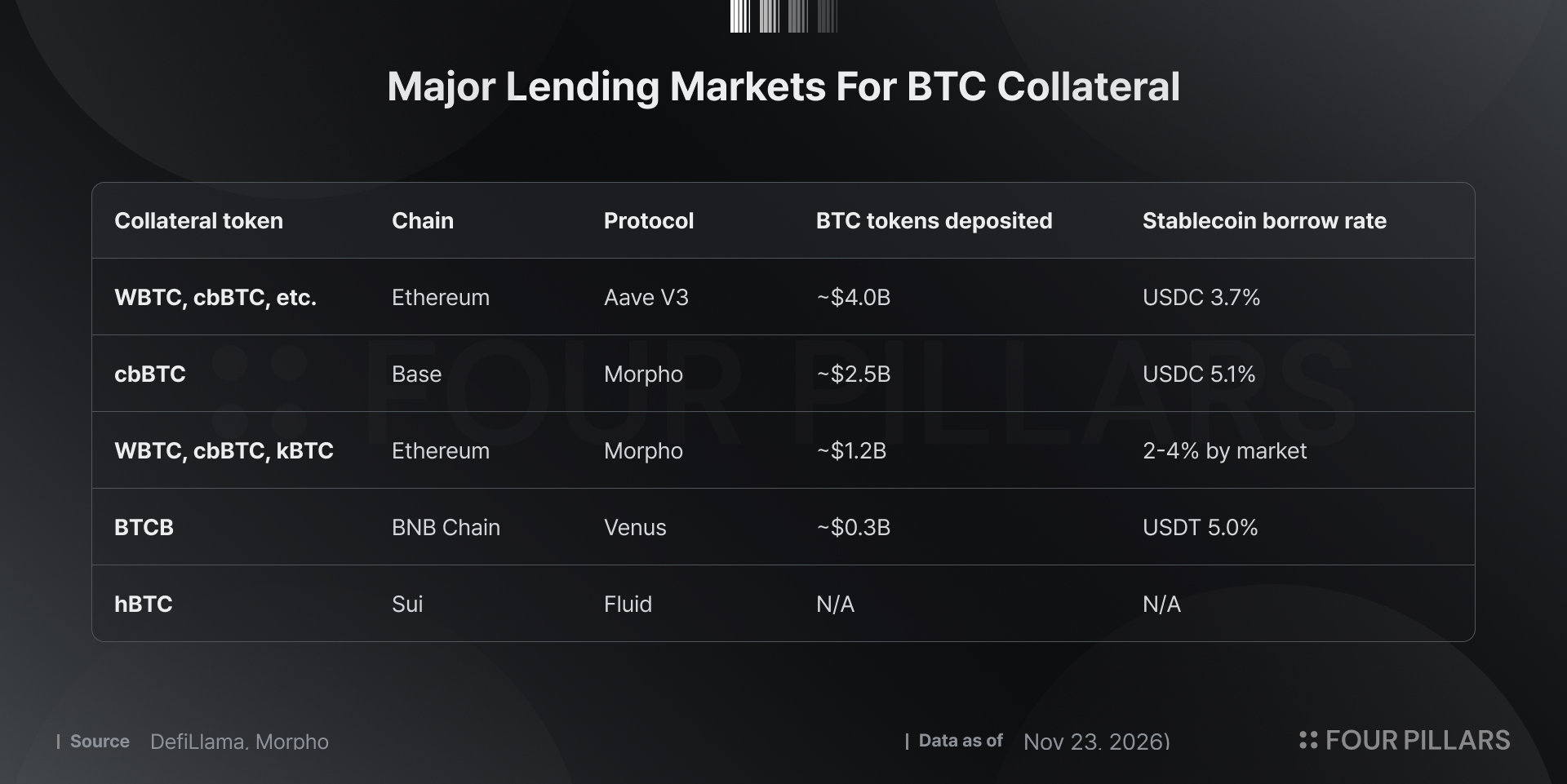
For WBTC or cbBTC holders on Ethereum, Aave is a natural choice. All depositors share a pool, so liquidity is deepest there. Its annual USDC borrowing rate is relatively low at 3.7%. Borrowers can take out up to 81% of the value of their collateral. A position is liquidated if its loan-to-value ratio exceeds 85%.
If my BTC is on Coinbase, I’m likely to borrow through Morpho. The bitcoin-backed loan offered in the Coinbase app uses this market. Morpho has a separate market for each pair of collateral and loan assets, so bad debt in a market backed by a different asset stays there. The liquidation threshold for the cbBTC market on Base is 86%.
On BNB Chain, borrowers can use BTCB as collateral for stablecoin loans on Venus. On Sui, they can use hBTC on Fluid, which launched alongside Hashi. The hBTC supply is still only about 276 BTC. Aave V4 is expected to support Babylon’s trust-minimized vaults, but the integration is not yet live on mainnet.
3. How much BTC is actually in use onchain?
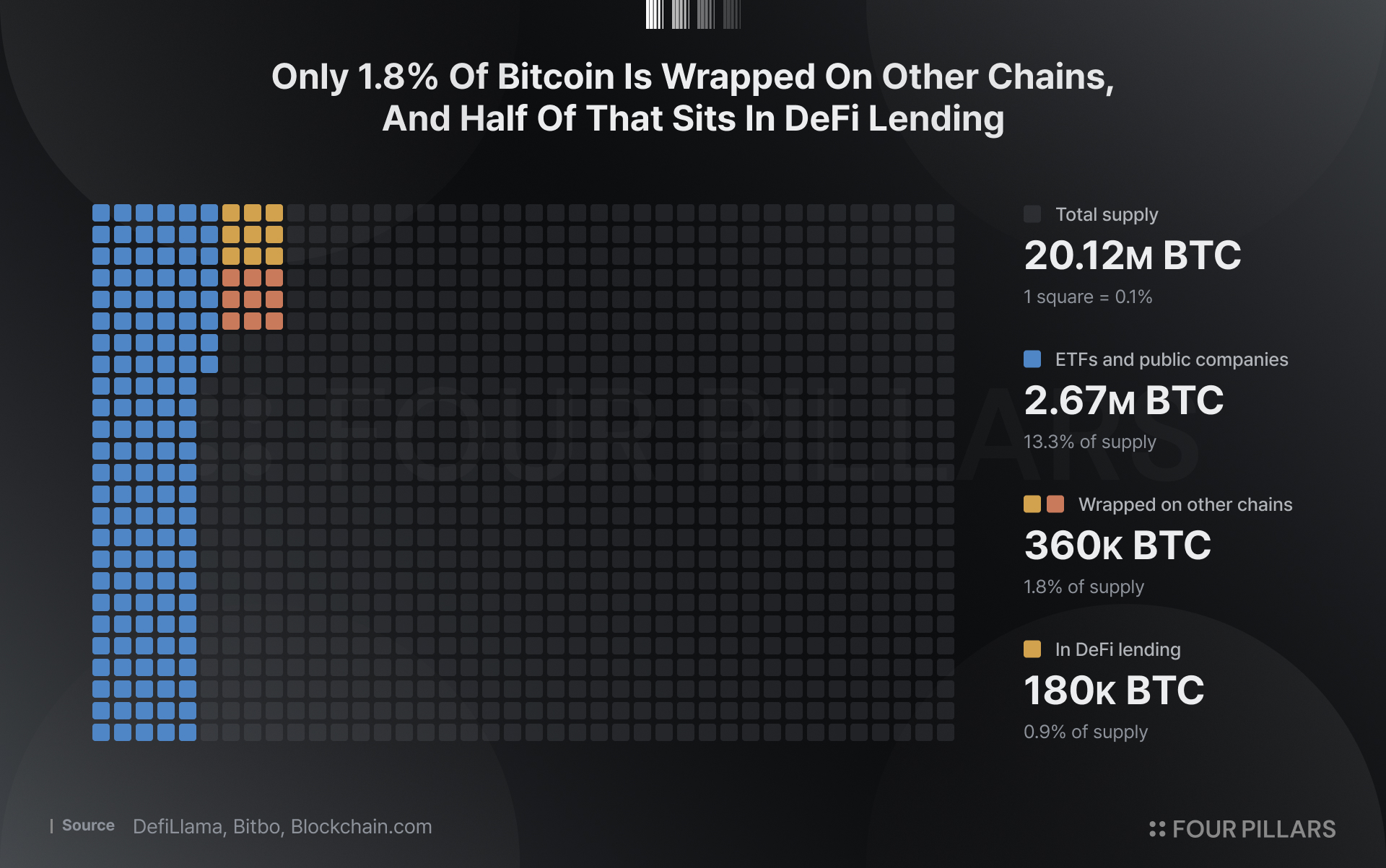
As of November 23, 2026, about 20.12 million BTC had been issued. Only about 360,000 BTC, or 1.8% of that supply, was represented on smart contract chains.
Even within that 1.8%, custodial tokens dominate. WBTC, cbBTC, BTCB, kBTC, and FBTC together account for 85% of the 360,000 BTC. About 180,000 BTC is actually deposited as collateral in DeFi lending markets. That is half the amount on smart contract chains and 0.9% of total BTC supply. Ethereum and Base account for 82% of those lending deposits. By protocol, most sit in Aave and Morpho.
Bitcoin ETFs hold about 1.44 million BTC and publicly traded companies about 1.23 million. Their combined 2.67 million BTC represents 13.3% of supply, more than seven times the amount bridged to other chains.
New ways to use BTC keep appearing, yet the total amount bridged has barely changed. WBTC supply peaked at about 285,000 in May 2022 and has since fallen to about 116,000. Some of that supply has shifted to cbBTC, which launched in September 2024 and has grown to about 103,000. Together, WBTC and cbBTC total about 219,000, still below the 2022 peak for WBTC alone. BTC is a leading store of value and a form of internet money, yet few assets move less or see less use.
4. Will more holders put their BTC to work?
I think there’s a good chance that idle BTC will start moving, because the mix of holders is changing. Until now, bitcoin holders have been reluctant to trust other chains. ETFs and publicly traded companies are now accumulating the most BTC. Even if they want to hold on to it, they will still need cash and ways to generate returns. If even a fraction of them put their BTC to work, the market will grow considerably.
Several projects are already courting those institutions. Circle emphasizes its status as a regulated issuer in its pitch to them. Sui devoted as much effort to institutional access for Hashi as it did to the design that puts validators in charge of the BTC. Anchorage Digital offers access to Hashi through its institutional wallet. A three-party settlement arrangement expected in early 2027 would allow institutions to pledge BTC while keeping it in custody. Hashi also obtained a legal opinion from Fenwick that deposits into and withdrawals from Hashi should be nontaxable under U.S. tax law. Aave is working with Babylon to accept BTC collateral in V4 without going through a custodian.
As crypto adoption spreads, I expect BTC to gain acceptance as collateral in traditional finance as well. In December 2025, the U.S. Commodity Futures Trading Commission (CFTC) launched a pilot allowing BTC, ETH, and USDC to be posted as margin for derivatives. JPMorgan reportedly plans to accept institutional clients’ BTC and ETH as collateral for loans.
If BTC becomes widely accepted as collateral in traditional finance, demand for wrapping it onchain will fall further. Holders who see bitcoin as an alternative to fiat money and refuse on principle to entrust it to anyone else are unlikely to move their coins either way. Demand for BTC-backed borrowing may grow more through traditional financial institutions than through onchain markets.
5. Closing thoughts
When people talk about going all in on an investment, they talk about tapping their severance pay or even borrowing against their homes. Bitcoin’s appeal as collateral of last resort says a great deal about how well suited it is to the role. Until now, borrowers had few options and often found them hard to trust. Today there are several ways to borrow against BTC.
I’m skeptical, though, that most of this borrowing will end up onchain. A lender can accept BTC as collateral without putting the loan onchain. Onchain, anyone can borrow around the clock without permission, all positions are public, and code enforces liquidations. Large traditional investors may see drawbacks in those same features. They cannot identify their counterparty, their own positions are visible to everyone, and there is no one to negotiate with if they face a margin call. The money borrowed against BTC may well be spent outside crypto. Public companies are likely to use the dollars for operating expenses or to pay down debt. Individuals might put them toward a home or a tax bill. For those uses, it’s simpler to borrow through a traditional lender that can put dollars straight into a bank account.
For now, I expect onchain loans backed by BTC to appeal mostly to people like me who want to buy more crypto with the proceeds. At least I can do that without mortgaging my home.
The author of this report may have personal holdings or financial interests in assets or tokens discussed herein. However, the author affirms that no transactions have conducted using material non-public information obtained in the course of research or drafting. This report is intended solely for general information purposes and does not constitute legal, business, investment, or tax advice. It should not be used as a basis for making any investment decisions or as guidance for accounting, legal, or tax matters. Any references to specific assets or securities are made for informational purposes only and should not be construed as an offer, solicitation, or recommendation to invest. The opinions expressed herein are those of the author and may not reflect the views of any affiliated institutions, organizations, or individuals. The opinions and analyses expressed herein are subject to change without prior notice. In addition, beyond the individual disclosures included in each report, Four Pillars, may hold existing or prospective investments in some of the assets or protocols discussed herein. Furthermore, FP Validated, a division of Four Pillars, may already be operating as a node in certain networks or protocols discussed herein or may do so in the future. Please see below links in the footer for FP Validated's participating network disclosures and for broader disclosure details.