Table of Contents
Researcher

Related Projects

Key takeaways
- Market selection drives execution cost. A $5M BTC sweep cost 1.5 bps against mid; $1M in HYPE cost 8.2 bps. Half the sampled mid-cap books could not fill $5M in most snapshots.
- Stock-perp liquidity follows cash-market hours. US-linked books lost roughly half their depth outside the underlying session. Where $5M remained fillable, it cost 1.7–3.7 times more.
- Displayed depth is not committed liquidity. Hyperliquid processes cancels before liquidity-taking orders within each consensus batch. TWAPs spread execution over time, so the final price is known only when the last slice fills, and each slice signals the trade while it is still being built.
- An RFQ prices the full size now, at a price the taker signs before anything executes. A sweep or a TWAP learns its average price only afterwards, and a TWAP in size can run for hours. The RFQ taker receives the agreed price or better, before fees, on whatever size fills. Desks with urgency value that certainty.
- Silhouette brings block execution to Hyperliquid through RFQ. Dealers compete to quote the full ticket before the trader commits, and the fill prints on Hyperliquid's book from a single request. The data show the clearest need in thinner markets, where large orders incur substantial impact or exceed displayed liquidity.
A tight spread says little about the cost of a large order. On Hyperliquid, markets that look liquid at the touch can become expensive within the first $1M. Some cannot accommodate the order at all.
Silhouette's RFQ service lets dealers compete to quote the full ticket before the client commits. It launched for Hyperliquid perpetuals on 19 October 2026, following xStocks on HyperEVM on 1 September. Our study of 42 markets finds a clear role for this execution model, concentrated in thinner books and larger orders.
1. Market Selection Matters More Than Ticket Size
We sampled Hyperliquid's public l2Book endpoint every five minutes from 01:45 UTC on 27 October to 01:45 UTC on 28 October 2026: 289 uninterrupted snapshots across eight market tiers. Sweep costs at $100k, $1M and $5M are measured against mid, averaged across buys and sells, before fees.
To extend the endpoint's twenty levels per side, we combined full-precision quotes with coarser aggregated views, priced at bucket midpoints. Using bucket edges changes no fillable median by more than 13%. The tables exclude pre-IPO market io:ANTH and two spot pairs, TSLAX and AAPLX, which had no offers.
A second 24-hour sample on 16 to 17 November 2026 reproduced the tier ranking at $1M and $5M, and the mid-cap and HIP-3 index and commodity medians within 12%. The majors and the single-stock perps cost a third to a half more at $5M, with BTC and ETH depth within 10 bps down by a quarter and a half.
Stock-linked books are split by underlying cash hours: US 13:30–20:00 UTC and KRX 00:00–06:30 UTC. The sample includes no weekend trading.
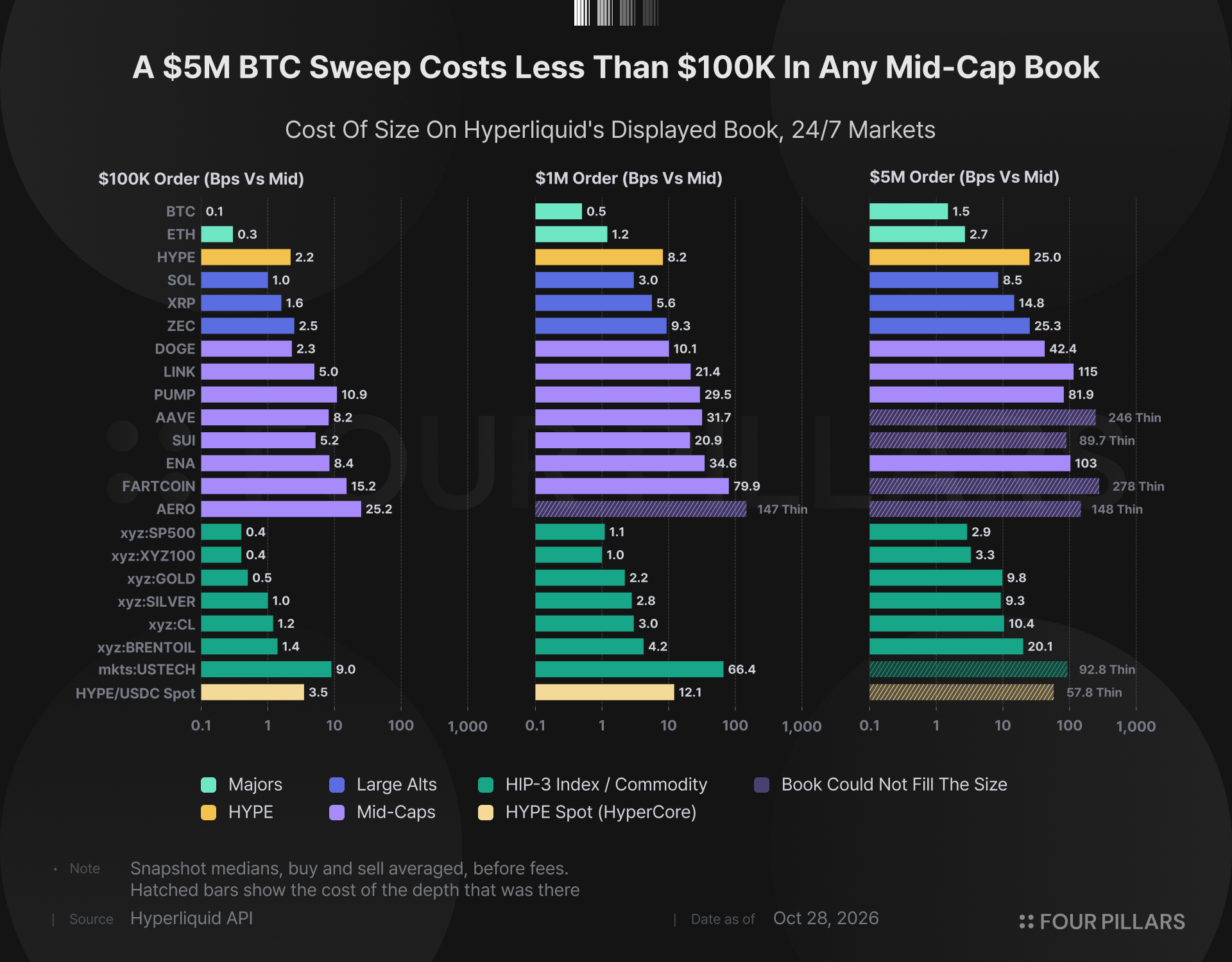
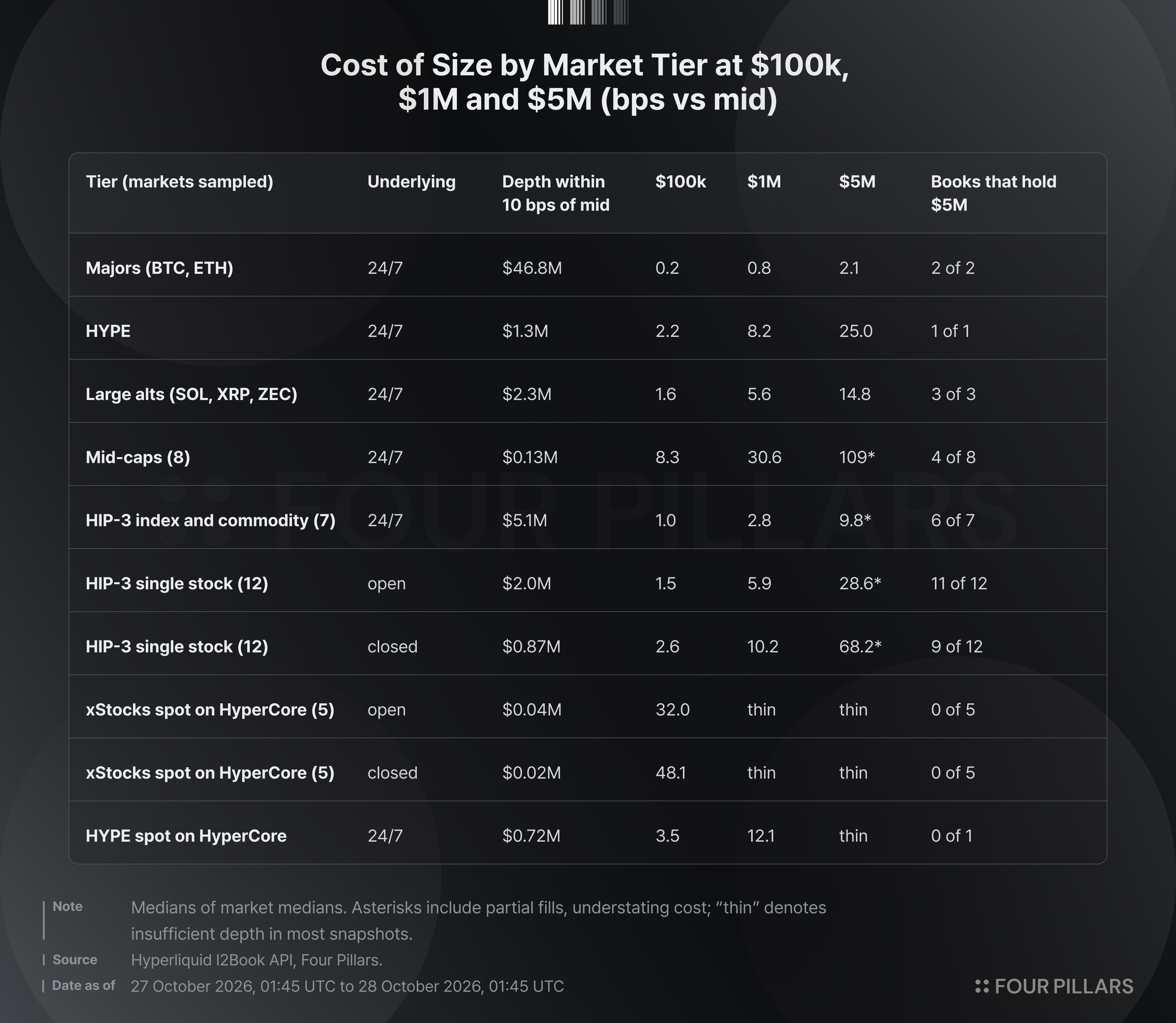
Increasing an order from $100k to $5M raises impact roughly tenfold. Changing the market matters far more: at $100k, BTC to FARTCOIN is a roughly 250-fold increase in cost.
HYPE makes the distinction plain. Its median spread of 0.13 bps almost matches BTC's 0.12 bps, yet depth within 10 bps is roughly one-fiftieth of BTC's and one-fifth of SOL's. A $1M sweep costs 8.2 bps; at $5M, impact reaches 25 bps, about three times SOL's.
HIP-3 spans both extremes. SP500 and XYZ100 hold more than twice SOL's depth within 10 bps and absorb $5M at about one-third of its cost. Gold, silver and the two crude markets cost 10–20 bps at that size. USTECH could not fill it in any snapshot.
Single-stock perps have a tighter touch than mid-caps but limited depth. During cash hours, the median $1M order costs just under 6 bps. Even the venue's largest single-stock perp, SK hynix's KRX-share market, costs 7.7 bps at $1M and 33.1 bps at $5M. Samsung never filled $5M.
For xStocks on HyperCore spot, availability is the larger constraint. Of seven sampled pairs, two had no offers; the remaining five held only $11k–$50k within 10 bps. A $100k order cost 25–55 bps during US hours and 36–97 bps outside them. None could fill $1M.
2. Stock-Perp Liquidity Follows the Cash Session
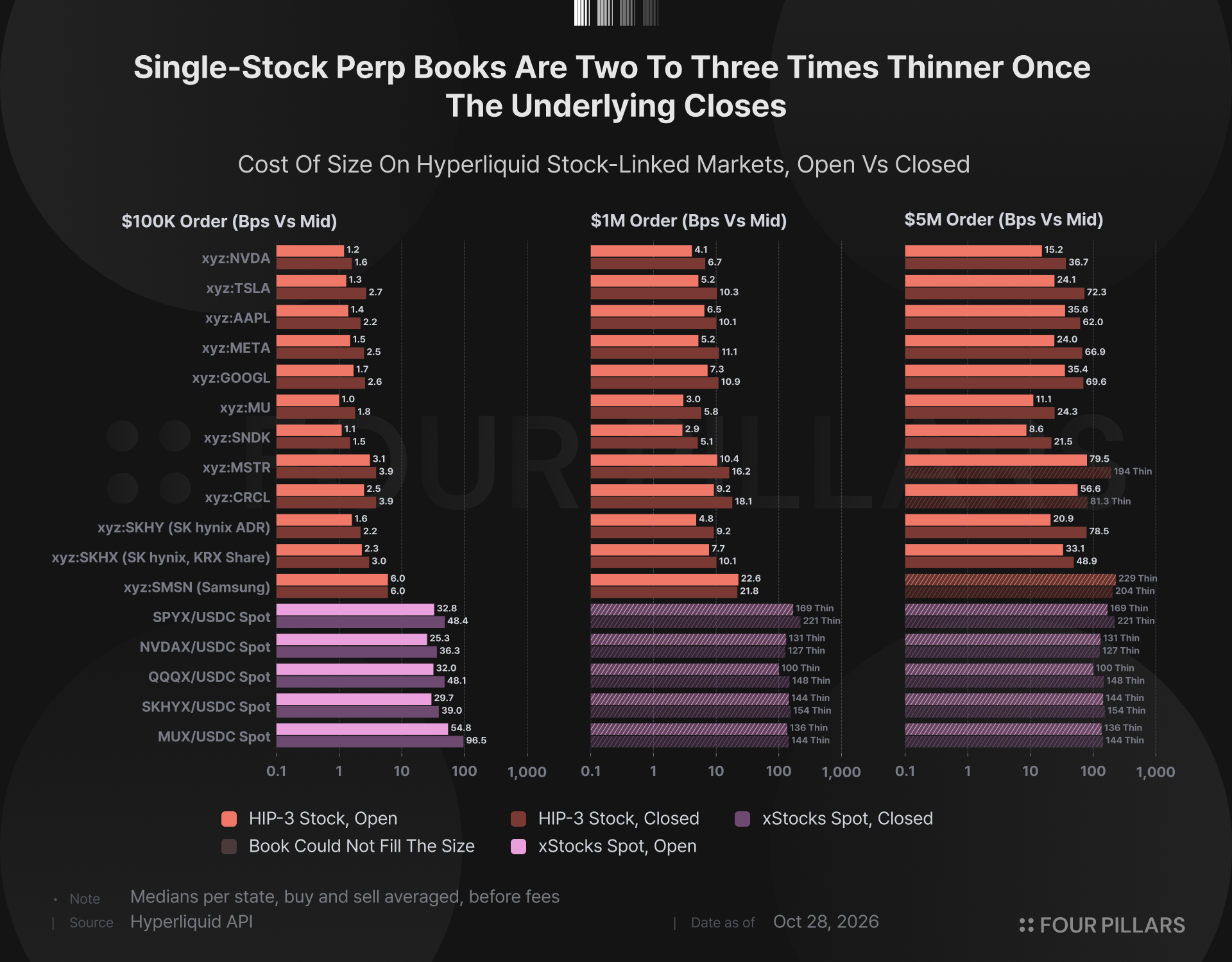
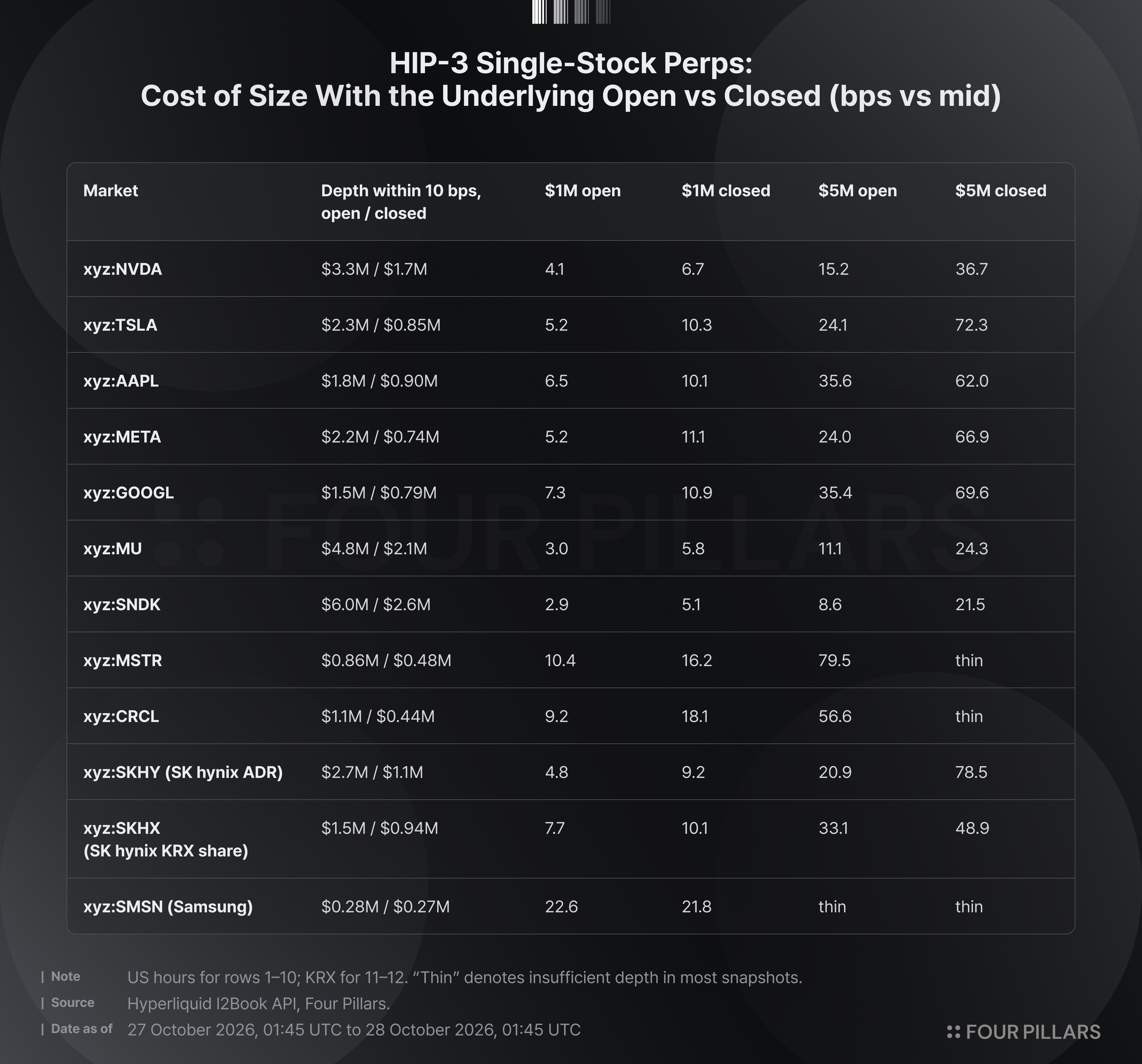
Every US-linked book is shallower outside New York hours: open-session depth is 1.8–3.0 times closed-session depth. Among names still fillable at $5M, costs rise 1.7–3.7 times. MSTR accommodates that size in only 41% of closed-hours snapshots; CRCL, just 1%.
SK hynix's KRX share follows Seoul hours, while Samsung remains thin in both states. Nor does an open cash market eliminate the cost of size: a $1M order in every US-linked name incurs impact of roughly 2–7.5 times Silhouette's 1.4 bps HIP-3 fee.
US cash equities trade 32.5 hours a week against 168 for these perps. Roughly four-fifths of the week falls outside the regular session. Weekend costs are not captured here, but the weekday results already show why open-session depth gives an incomplete view of execution conditions.
3. Cancels Take Priority Over Takers
A book sweep assumes the displayed liquidity remains available. Hyperliquid processes actions within each consensus batch in three groups: actions submitting no GTC (Good Til Cancelled) or IOC (Immediate or Cancel) orders, then cancels, then actions submitting at least one GTC or IOC order. Post-only orders fall in the first group; liquidity-taking orders fall in the third.
A maker's cancel therefore precedes a taker's order in the same batch, regardless of arrival sequence. Priority fees can improve a taker's position among takers, but cannot put it ahead of cancels. This protects makers against adverse selection; the taker receives whatever depth remains.
If quotes near mid are cancelled in that batch, the taker may have to reach further into the book and accept a worse average price than the screen suggested. A binding price limit may instead leave part of the order unfilled. The sweep estimates above can therefore understate realised execution costs: liquidity visible when the order is submitted may no longer be there when it executes. For a desk, that uncertainty is often the larger cost. Many would take a smaller fill at a known price over a full fill at a price learned only afterwards.
Working an order over time can reduce immediate impact. Hyperliquid's native TWAP uses slices at least thirty seconds apart, with a 3% slippage cap on each. The cost is time and information leakage: each slice prints while the rest of the orders are still to come. As Silhouette puts it, “every slice tells the market what you are doing.”
4. Thinner Books Offer Greater Scope for RFQ
As of 25 November 2026, Silhouette charges a 1.4 bps builder fee on perps requests below $500k and on HIP-3 requests at any size. From $500k, BTC, ETH and HYPE requests carry no Silhouette fee, and only Hyperliquid's own taker fee applies, as it would on a sweep. Comparing the applicable fee with displayed book impact provides an initial screen for RFQ demand; the realised result also depends on the dealer's quote. Cost is not the only variable. Time in and out of a position and certainty of price carry value of their own, and a desk may accept a quote above the book's estimate to secure both.
The opportunity varies by market:
- BTC, ETH and the leading HIP-3 indices: limited room at sampled sizes. BTC and ETH cost 1.5 and 2.7 bps even at $5M, so a quote has little to improve on whatever the fee, and SP500 and XYZ100 clear the HIP-3 fee by only 1.5 and 1.9 bps at that size.
- HYPE and large alts: more scope at $1M and above. HYPE costs 8.2 bps at $1M, and XRP and ZEC 5.6 and 9.3 bps. SOL is more compelling at $5M, as are commodities, which leave 8–19 bps above the HIP-3 fee at that size.
- Thin mid-caps and single-stock perps: opportunities begin earlier. Selected mid-caps cost 8–25 bps at $100k. Every sampled single-stock book exceeds the HIP-3 fee at $100k outside its underlying cash session; during US hours, the case is stronger at $1M.
- xStocks: $100k can cost tens of basis points, and no sampled book fills $1M. A quoted price is the only route to size the displayed book does not hold.
The live perps service covers BTC up to $1M per request, and ETH and HYPE up to $500k, the size from which the Silhouette fee falls away. On the displayed book, BTC cost 0.32 bps at $500k and 0.5 bps at $1M. ETH cost 0.77 bps at $500k, leaving less than a basis point for a dealer to improve on in either market. HYPE cost 5.3 bps at $500k, all of which a quote can compete for. HIP-3 requests opened on 10 November with the S&P 500 and a $500k cap. Its book cost 0.76 bps at $500k in our window and 0.86 bps in the November sample, in line with ETH and below the HIP-3 fee.
XYZ100 and SK hynix (xyz:SKHX) are also live for API takers, ahead of the web app. Both carry the 1.4 bps HIP-3 fee. SK hynix is the first single-stock perp a desk can request a quote on. In our window its book cost 7.7 bps at $1M and 33.1 bps at $5M.
The broader addressable market is in the thinner books above, where an agreed price can cover an order that is costly or impractical to execute on-screen.
5. Silhouette Brings Institutional Block Execution to Hyperliquid
Institutional markets have long used brokered blocks and dealer RFQ alongside exchange order books. In 2024, RFQ on Tradeweb and Bloomberg accounted for 57.5% of volume in the main European ETFs, versus 12.6% for Xetra, the largest lit venue, according to Dugast, Marta and Riva (2025).
The split is sharper in large tickets: above €3M, the sample records 10,416 RFQ trades against just 586 lit trades. For smaller, comparable tickets, price impact averaged 0.4 bps through RFQ and 3.8 bps on the book.
Silhouette started with shielded spot trading on Hyperliquid in February 2026. Talking to traders who move size, it found that what they wanted to protect was their intent before the trade rather than the trade itself. In its words, they “thought they wanted full privacy but in fact they just wanted optimal execution for the best possible price.”
Its RFQ model lets dealers compete for the full order before the client commits, with perps trades executing on Hyperliquid's own book. Once the taker accepts, Silhouette submits the maker's post-only order at the agreed price and size together with the taker's immediate-or-cancel order. The batch ordering described in section 3 places the maker's order ahead of the taker's, so the taker fills against the maker's order or against any better-priced order already resting. A request can settle in full, settle in part if another trader reaches the maker's order first, or fail, but it never fills at a worse price than the one signed, before fees.
For the larger tickets and thinner markets examined in this report, this offers an alternative to sweeping the book or working an order through successive slices. The value is not limited to price improvement. The taker knows the price before committing, and the position is entered or exited in a single request rather than over the hours a TWAP needs.
Silhouette's stated next steps are further HIP-3 markets, higher caps and more makers on each request, with a longer-term aim of multi-leg requests across spot, perpetuals and, when available, options.
We expect Silhouette to broaden execution options for investors trading in size and help Hyperliquid accommodate institutional demand.
The report is based on the independent research of the author sponsored/funded by Silhouette AG. The author of this report may have personal holdings or financial interests in assets or tokens discussed herein. However, the author affirms that no transactions have conducted using material non-public information obtained in the course of research or drafting. This report is intended solely for general information purposes and does not constitute legal, business, investment, or tax advice. It should not be used as a basis for making any investment decisions or as guidance for accounting, legal, or tax matters. Any references to specific assets or securities are made for informational purposes only and should not be construed as an offer, solicitation, or recommendation to invest. The opinions expressed herein are those of the author and may not reflect the views of any affiliated institutions, organizations, or individuals. The opinions and analyses expressed herein are subject to change without prior notice. In addition, beyond the individual disclosures included in each report, Four Pillars, may hold existing or prospective investments in some of the assets or protocols discussed herein. Furthermore, FP Validated, a division of Four Pillars, may already be operating as a node in certain networks or protocols discussed herein or may do so in the future. Please see below links in the footer for FP Validated's participating network disclosures and for broader disclosure details.