


Table of Contents
Researcher

Related Projects

Key Takeaways
- Funding, basis, and unlock discounts are all royalties on crypto speculative activity; because of this nature, synthetic dollars have shown thin yield when stablecoin demand runs high.
- Equity lock-up supply moves on IPO calendars and insider liquidity, uncorrelated with the crypto cycle.
- The surge in equity-perpetual volume from $84 million to $5.5 billion a day made equities hedgeable for crypto asset managers for the first time.
- A representative locked-share trade would earn roughly 20.5 points over a six-month hold, 15 from the entry discount and 5.5 from funding carry regardless of stock trading venue.
- The eligible lock-up pool is 4.5 times larger than filtered crypto unlocks.
- Every market that grows a liquid short from here, commodities, rates, whatever tokenizes next, feeds the same trade.
Neutrl is exploring extending its delta-neutral mandate to tokenized equities and pre-liquidity shares. What follows breaks down what this would mean, what a representative trade would earn, and why the opportunity is large, while the market paying for it is still young.
1. Yield-Backwards
A synthetic dollar carries a structural mismatch: its holders arrive when crypto cools, because that is when capital reaches for something that does not move. Concurrently, its yield softens since funding, basis, and unlock discounts are all royalties on crypto speculative activity. Until recently there was nothing outside the crypto cycle that could be hedged, so there was no way to escape the mismatch. This year, a second clock appeared.
During the first half of 2026, 30-day average volume across the top 30 altcoin perpetuals fell from $8.4 billion to $5.9 billion, a 30% contraction. As volume left, the funding and basis it pays for thinned with it. A delta-neutral book built entirely on crypto-native spreads earns its best returns for its smallest audience and its thinnest returns for its largest one. Better trade selection does not fix this, because essentially every trade in the set breathes with the same cycle.
However, equity lock-up supply breathes with a different one. Shares locked behind IPO schedules, employee windows, and fund structures come to market on their own timetables. A listing calendar fills, a fund hits a distribution deadline, an insider needs liquidity against a schedule set years earlier. None of these read Bitcoin. The discounts on that supply have been visible in private secondary markets for years. Access was blocked by hedging, not sourcing. A discount without a hedge is not yield, only exposure with a story attached.
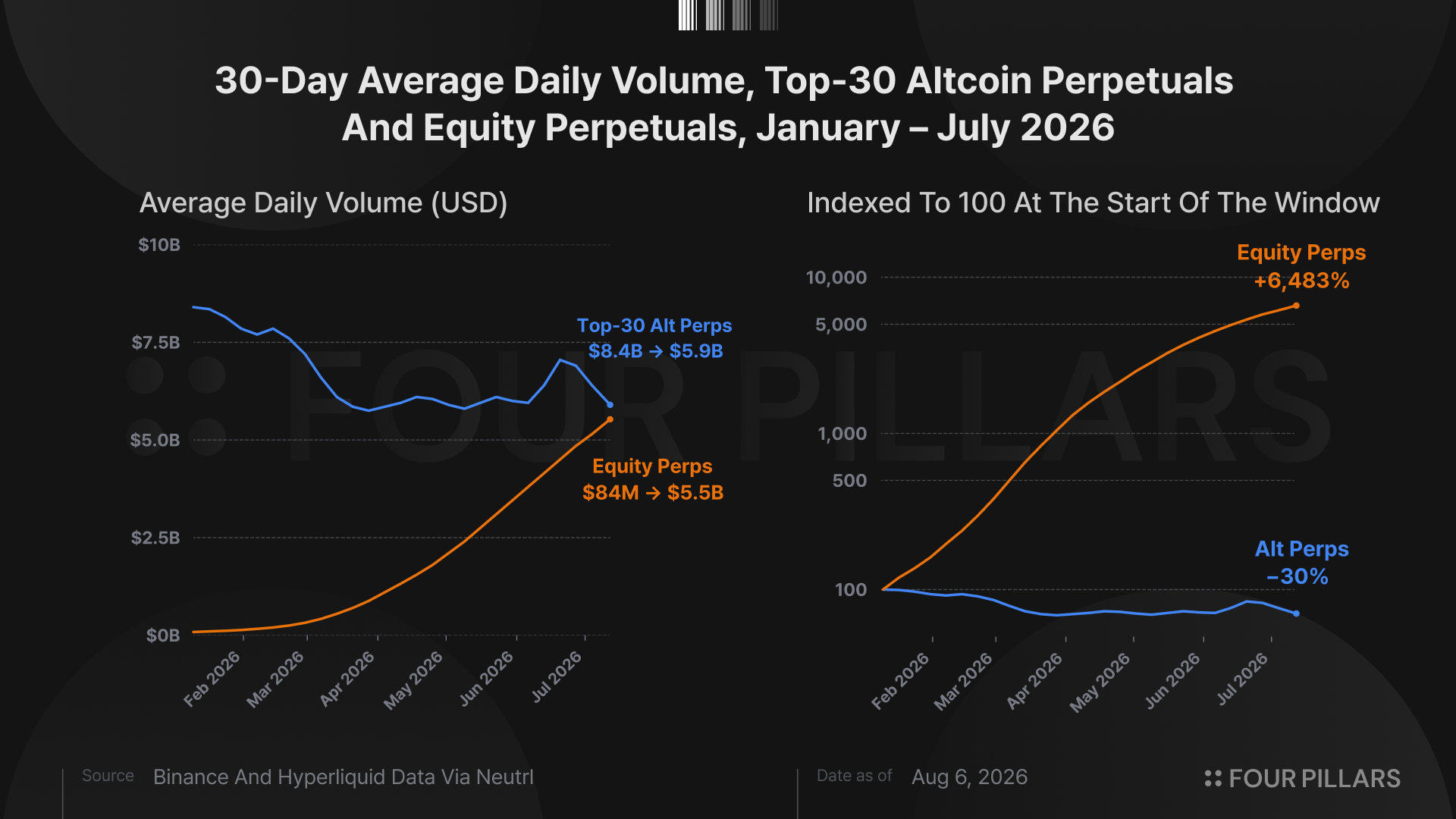
A market becomes investable when it becomes shortable. Tokenized-equity holders grew from roughly 70,000 last September to more than 670,000 by July. The perpetuals beside them took daily volume from $84 million to $5.5 billion in six months. With that move, an entire asset class of locked and discounted shares crossed the line from observable to investable.
That is the rationale behind Neutrl’s focus. Not another strategy added inside the same factor, but a yield source whose driver sits outside the crypto cycle.
2. Twenty Points Flat
The economics are easiest to see through one representative transaction of the kind Neutrl is evaluating, with names withheld while discussions continue. The desk would buy shares of a late-stage private company at a 15% discount to the reference price, locked for roughly six months around the listing (the 15% is neither a market average nor a standing rate, but the indicative terms of one transaction under evaluation). Discounts vary deal to deal with lock duration, transfer restrictions, and the seller's need for liquidity. Against the position it shorts an equal notional of the equity perpetual referencing the same name. Delta sits near zero from day one, so profit and loss no longer depends on where the stock trades. It depends on the discount converging as the lock expires, plus whatever the hedge pays along the way.
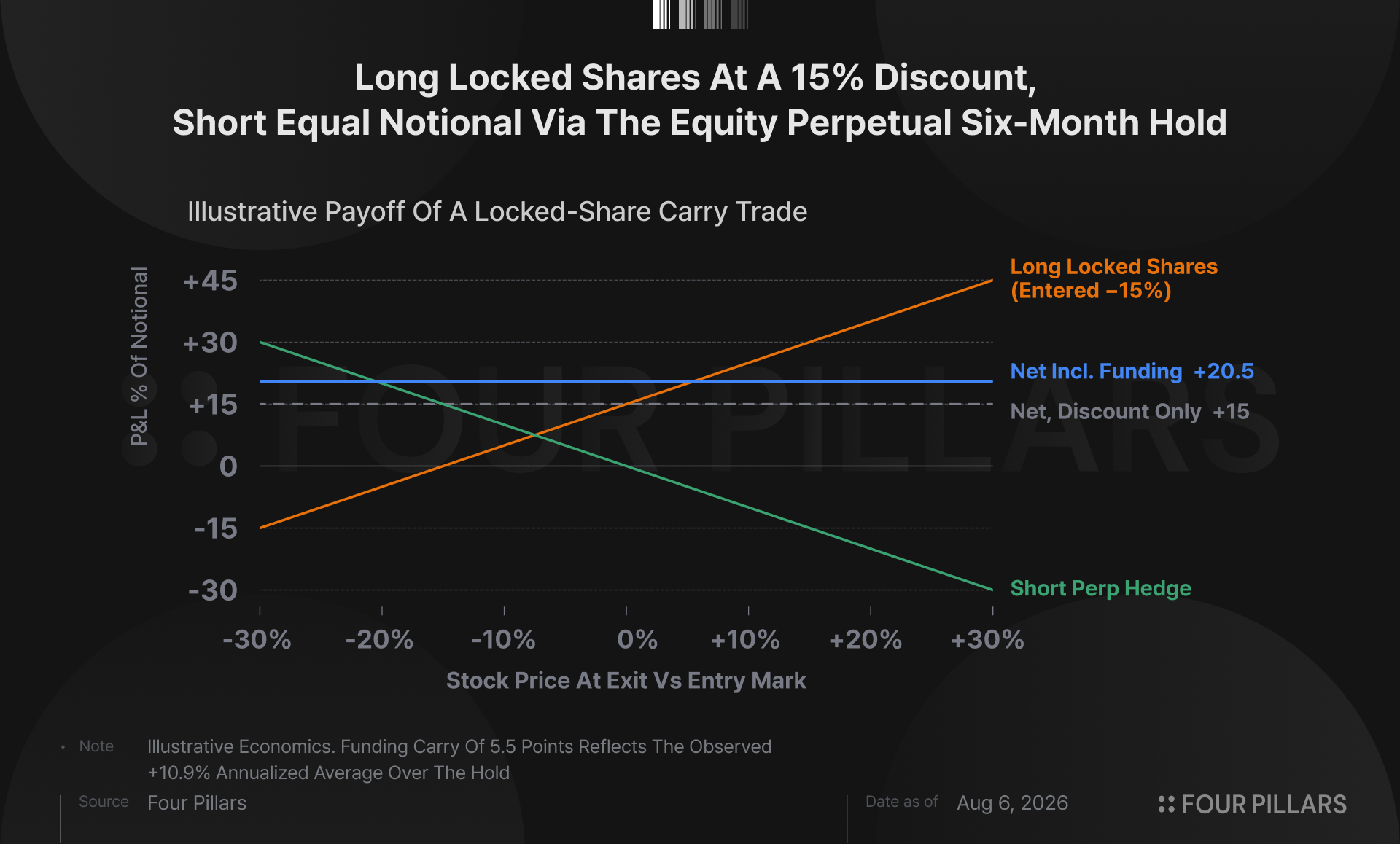
The hedge, unusually, pays. Across a measured window from late May to mid-July, funding on the perpetual averaged 10.9% annualized to the short side. The series swung between roughly minus 35% and plus 55% annualized inside that window. Volatility of that kind is typical of a funding market that professional capital has not yet flattened. Over the six-month hold, the carry adds roughly 5.5 points to the 15 captured at entry. The position lands near 20.5 points over the hold with directional exposure hedged out. The payoff is a flat line sitting twenty points above zero across every exit price the stock can print.
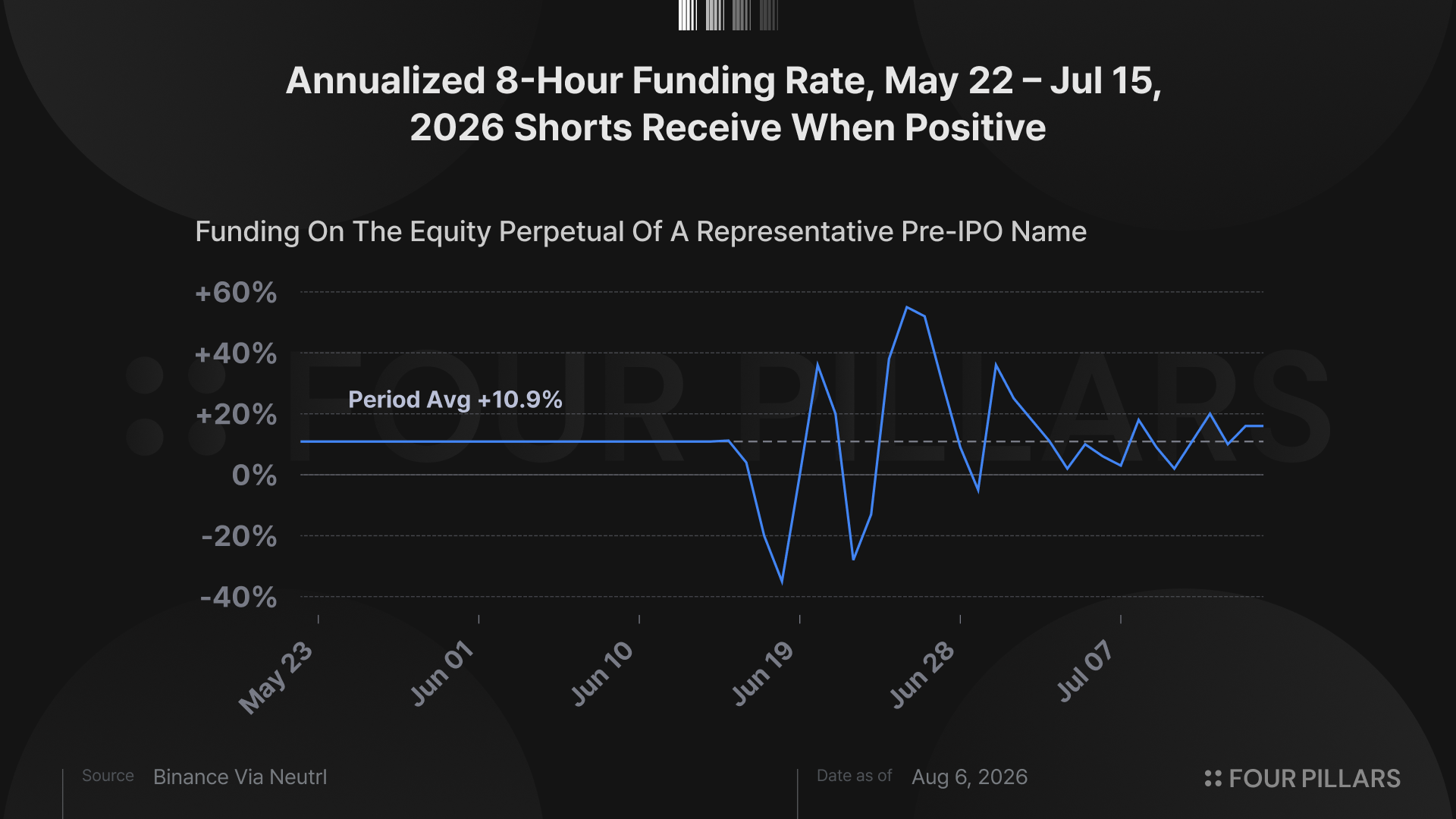
Why does a market pay its shorts this much? Because the demand is one-sided. The buyers of equity perpetuals are traders who want leveraged stock exposure around the clock, outside market hours and outside brokerage rails. They outnumber the professional balance sheets willing to sit on the other side. Young perpetual markets have always paid their shorts richly until enough arbitrage capital arrives to compress the spread. Equity perps sit at the beginning of that curve, and the pool behind them is large. Eligible equity lock-ups total roughly $48.2 billion after excluding the single largest name, about 4.5 times the filtered crypto-unlock pipeline. Including that name, the estimate rises to $1.74 trillion. Spreads are widest at the birth of a market. That is not a flaw in the thesis. It is THE thesis.
3. One Trade Over Everything Shortable
For the staker, the relevant change lies in independence. A yield stream sourced from listing calendars and lock-up expiries keeps paying through regimes where crypto-native carry goes quiet. That is when a stablecoin’s holders most need it.
Equities are the first market outside crypto to grow a liquid short. They will not be the last. Commodities are queued behind them, then rates, then whatever tokenizes next. Each new perpetual market that switches on adds a shelf of spread that was previously visible but unreachable. The expansion is the business model. Neutrl buys what is locked, shorts what is liquid, and keeps the difference wherever those two things coexist. That opportunity set compounds with tokenization.
The report is based on the independent research of the author sponsored/funded by Neutrl. The author of this report may have personal holdings or financial interests in assets or tokens discussed herein. However, the author affirms that no transactions have conducted using material non-public information obtained in the course of research or drafting. This report is intended solely for general information purposes and does not constitute legal, business, investment, or tax advice. It should not be used as a basis for making any investment decisions or as guidance for accounting, legal, or tax matters. Any references to specific assets or securities are made for informational purposes only and should not be construed as an offer, solicitation, or recommendation to invest. The opinions expressed herein are those of the author and may not reflect the views of any affiliated institutions, organizations, or individuals. The opinions and analyses expressed herein are subject to change without prior notice. In addition, beyond the individual disclosures included in each report, Four Pillars, may hold existing or prospective investments in some of the assets or protocols discussed herein. Furthermore, FP Validated, a division of Four Pillars, may already be operating as a node in certain networks or protocols discussed herein or may do so in the future. Please see below links in the footer for FP Validated's participating network disclosures and for broader disclosure details.


