

Table of Contents
Researcher

Related Projects

On October 27, Category Labs, the developer of Monad, unveiled Quantum Cadence, a post-quantum consensus protocol. Quantum Cadence is a quantum-resistant version of Cadence, the multi-proposer consensus protocol Monad introduced in July. Cadence itself has not reached mainnet yet. Quantum Cadence is better read as an early look at how Monad, a high-performance L1, plans to prepare for the post-quantum era.
Monad's Quantum Cadence goes in a completely different direction from Ethereum's post-quantum design. Ethereum wants to rebuild its quantum-vulnerable signature bundles in a quantum-resistant form. Monad gives up signature bundles altogether to become quantum resistant. Both are blockchains, and both run the same execution environment, the EVM. Why, then, do their approaches to the post-quantum era diverge so sharply?
Monad's Quantum Cadence
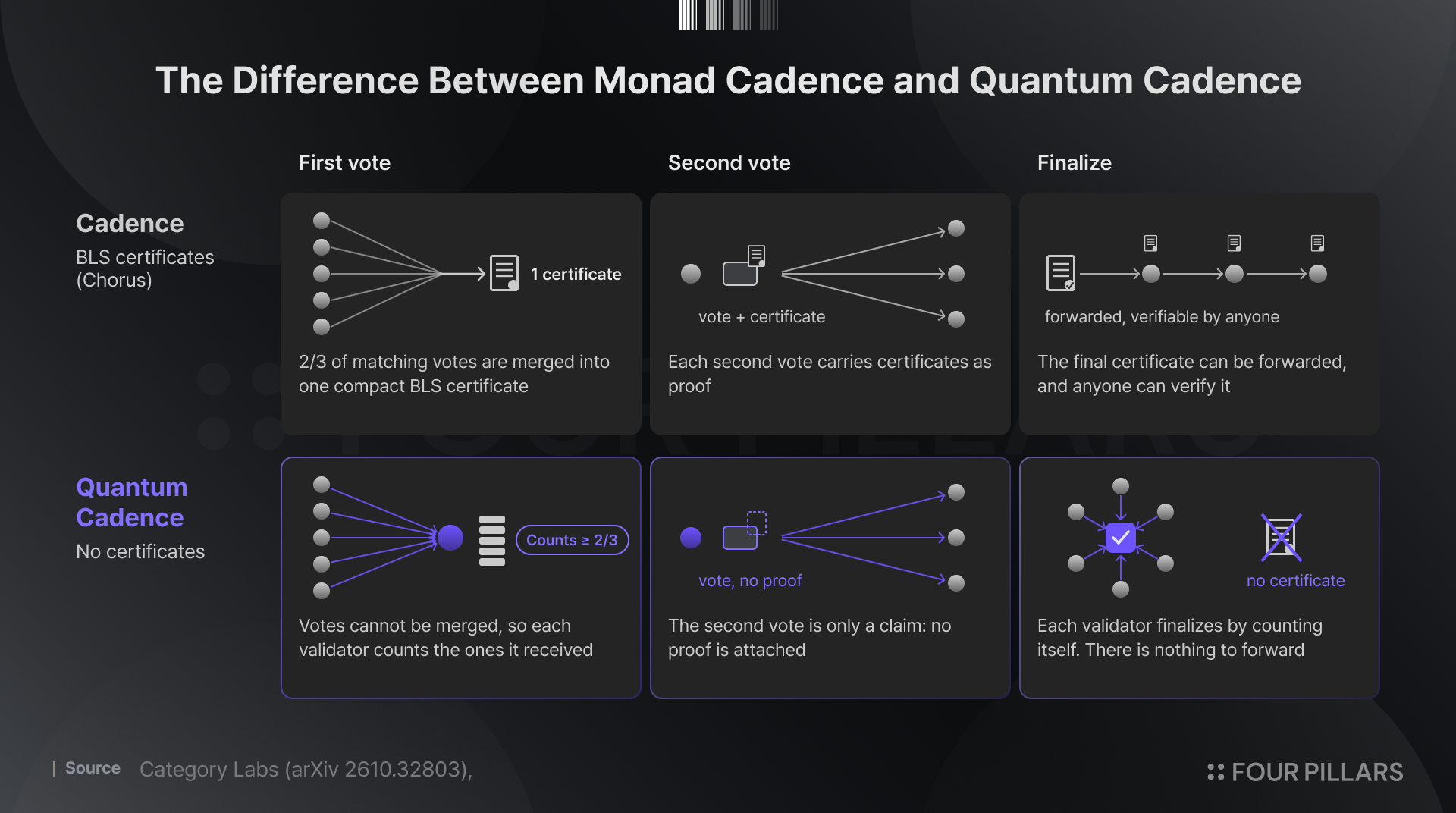
Most high-performance blockchain consensus today relies on quorum certificates (QCs). A QC is a bundle of signatures proving that at least two-thirds of validators voted for the same block, and validators pass these bundles to one another. BLS signatures keep this cheap, because hundreds of them can be aggregated into a single 96-byte signature. The problem is that quantum computers can break BLS.
Signatures that are safe against quantum computers are large, and they do not aggregate well. ML-DSA-44, standardized by NIST (the U.S. National Institute of Standards and Technology), produces a 2,420-byte signature. No post-quantum signature can yet be aggregated as compactly and quickly as BLS. Without aggregation, a certificate turns into a list of hundreds of large signatures. Monad's Cadence targets 100ms slots and lets multiple proposers submit blocks at the same time. It cannot afford to have every validator broadcast certificates like that in every slot.
So instead of waiting for a smaller post-quantum aggregate to appear, Monad removes the heavy signature bundles from consensus entirely. Each validator counts the votes it receives itself and checks for a quorum. Safety and liveness rest on authenticated channels and hashes rather than signatures. Post-quantum signatures are kept only to identify validators who misbehave. Each validator signs at most two votes per slot.
The paper published on October 23 ran a simulation with 200 validators on 1Gbps links, on the fault-free path, with 5,000-byte signatures. With 100 proposers, upload per validator actually fell by 27%, from 772Mbps under the original Cadence to 561Mbps. Time to finality was 231ms versus 229ms, practically the same.
Ethereum's problem is decentralization, Monad's is speed
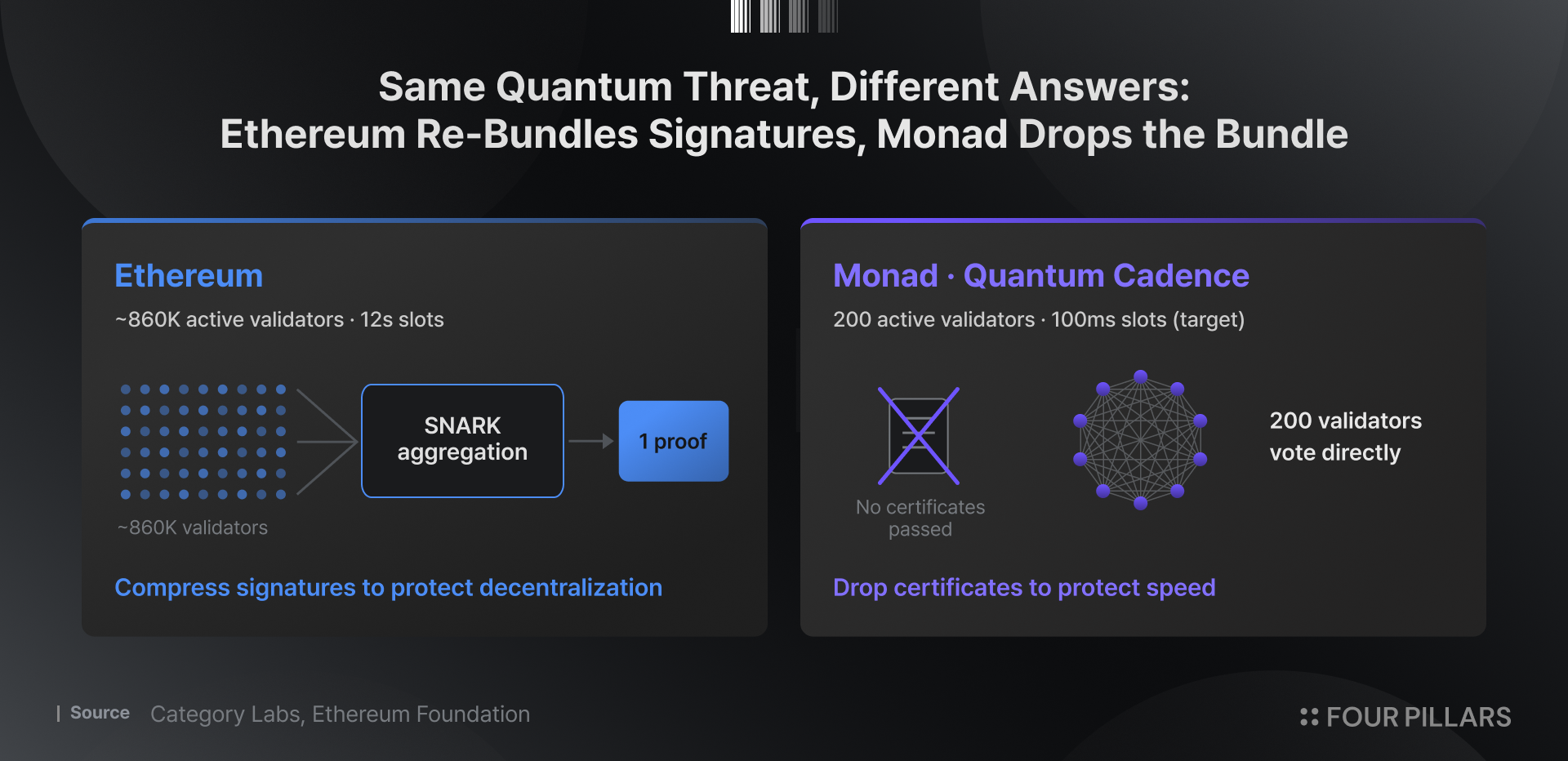
Ethereum had about 860,000 active validators as of early October. Anyone can join, and it is not realistic for such a widely distributed set of participants to count each other's votes directly. Ethereum therefore chose to rebuild the signature bundle. It plans to replace BLS with leanXMSS, a hash-based signature, and to aggregate those signatures, which cannot be combined as they are, by compressing them with SNARKs. Generating the proofs takes time, but Ethereum's long slot time (currently 12 seconds) leaves room to absorb it.
Monad is the opposite. Cadence targets a 100ms slot interval, which leaves no time to wait for SNARK aggregation. A small set of 200 validators, on the other hand, makes it possible for every validator to count everyone else's votes directly. In responding to the quantum threat, Ethereum chose a design that protects decentralization, and Monad chose one that protects speed.
Post-quantum signatures do not solve everything
NIST has standardized signature algorithms that can withstand quantum computers. Those standards do not apply as they are to every network in every situation. In blockchain consensus, switching to post-quantum signatures does not fix every problem. Each network has to prepare for its own problem early instead of waiting for someone else to solve it.
For Monad, the key to quantum resistance is not the signature algorithm. The problem has to be solved at the level of a consensus structure built on exchanging certificates. Other blockchain networks face the same question. EVM-compatible chains may be able to borrow Ethereum's work when they migrate account signatures. The consensus layer is their own problem, and no one will solve it for them.
Quantum computers capable of threatening blockchain networks do not exist yet, and most forecasts place their arrival in the early to mid 2030s. Still, the time left is not generous. Even Ethereum expects its L1 transition alone to run until 2029, and changing a consensus structure takes years from research to mainnet. This is likely why Monad released a quantum-resistant version of Cadence before Cadence itself has reached mainnet. Quantum resistance will not be settled by someone else setting a standard. It is homework each network has to work out on its own architecture.
The author of this report may have personal holdings or financial interests in assets or tokens discussed herein. However, the author affirms that no transactions have conducted using material non-public information obtained in the course of research or drafting. This report is intended solely for general information purposes and does not constitute legal, business, investment, or tax advice. It should not be used as a basis for making any investment decisions or as guidance for accounting, legal, or tax matters. Any references to specific assets or securities are made for informational purposes only and should not be construed as an offer, solicitation, or recommendation to invest. The opinions expressed herein are those of the author and may not reflect the views of any affiliated institutions, organizations, or individuals. The opinions and analyses expressed herein are subject to change without prior notice. In addition, beyond the individual disclosures included in each report, Four Pillars, may hold existing or prospective investments in some of the assets or protocols discussed herein. Furthermore, FP Validated, a division of Four Pillars, may already be operating as a node in certain networks or protocols discussed herein or may do so in the future. Please see below links in the footer for FP Validated's participating network disclosures and for broader disclosure details.


