


Table of Contents
Researcher

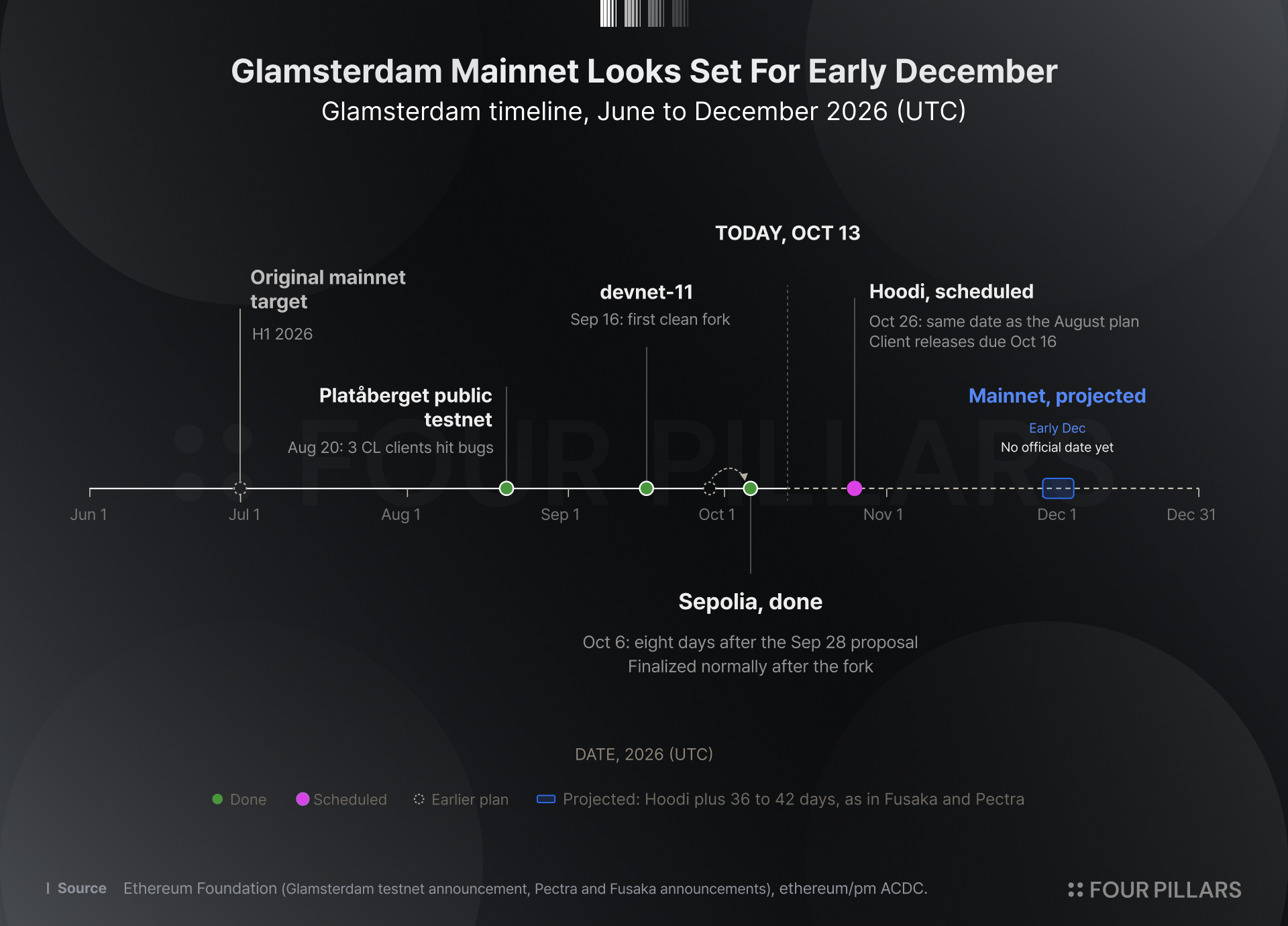
Glamsterdam mainnet looks set for early December
Glamsterdam was originally aimed at a mainnet launch in the first half of 2026. Delays have since pushed it toward the end of the year.
The main reason is that Glamsterdam is the biggest structural change to Ethereum L1 since the Merge. On the consensus layer, it changes how blocks are built (ePBS). On the execution layer, it changes how blocks are executed (BAL) and how gas is priced. With large changes landing on both layers at once, unexpected problems kept showing up where the two meet.
On August 20, Glamsterdam forked on Platåberget, a testnet set up only to test this upgrade. Three consensus clients ran into problems, including Lighthouse and Prysm, the two largest by share. Devnet-9, launched on September 1, also failed to reach finality.
Devnet-11 finally went through the fork cleanly on September 16. On October 6, the fork also succeeded on Sepolia, the public testnet used by application developers. The next step is Hoodi, the testnet for validator and staking infrastructure. If the Hoodi fork on October 26 goes through without issues, mainnet will most likely follow in early December.
Glamsterdam restructures L1 to raise the gas limit further
Glamsterdam is preparation for scaling Ethereum L1. Ethereum has often looked as if it cared only about L2s, but it has kept expanding L1 the whole time. The per-block gas limit, which sets how many transactions fit in a block, sat at 30 million from 2021 and then doubled to 60 million in 2025 alone. L1 capacity doubled in a single year.
Raising the gas limit without changing the structure only goes so far, though. Bigger blocks take longer to spread across the network, and the transactions inside them take longer to execute. To push the gas limit higher, the way blocks are built, propagated and executed has to change together. Glamsterdam is made up of proposals that change that structure.
That does not mean Glamsterdam will bring dramatic change right away. The most visible change for users will be lower base gas on simple transfers. After the fork, the mainnet gas limit will rise step by step as validators vote it up, and how high it will go has not been decided. Glamsterdam is the first step in Strawmap, the long-term roadmap that runs to 2029. It is groundwork for more L1 block space.
Ethereum upgrades are slow and complex, and they draw less attention than they used to
Ethereum upgrades are complex and slow for structural reasons. Unlike other blockchain projects, Ethereum has no single party that decides on protocol changes and ships them. Changes are agreed in public calls that anyone can join, and the Ethereum Foundation is only one participant. Client diversity adds to this: separate teams implement the same spec in different languages, and any mix of clients has to reach the same result. Institutions entering the space have made the interests at stake more complicated as well. Open source and decentralization come at a high price.
Ethereum forks used to be events for the whole crypto industry, and every proposal turned into a debate. Glamsterdam is the biggest structural change since the Merge and an important milestone for scaling L1, yet the market pays it far less attention. No one now sees Glamsterdam as the thing that will turn the market around. The era when technical progress drove market attention is over.
Today the market watches adoption signals instead: macro capital flows, stablecoins and tokenized real-world assets. But to handle the adoption that is close at hand, Ethereum has to be infrastructure that is ready for it. That is why Ethereum keeps publishing more concrete roadmaps and shortening its fork cycle, even though technical change no longer moves the market. We should keep following Ethereum's roadmap and the work of getting there.
The author of this report may have personal holdings or financial interests in assets or tokens discussed herein. However, the author affirms that no transactions have conducted using material non-public information obtained in the course of research or drafting. This report is intended solely for general information purposes and does not constitute legal, business, investment, or tax advice. It should not be used as a basis for making any investment decisions or as guidance for accounting, legal, or tax matters. Any references to specific assets or securities are made for informational purposes only and should not be construed as an offer, solicitation, or recommendation to invest. The opinions expressed herein are those of the author and may not reflect the views of any affiliated institutions, organizations, or individuals. The opinions and analyses expressed herein are subject to change without prior notice. In addition, beyond the individual disclosures included in each report, Four Pillars, may hold existing or prospective investments in some of the assets or protocols discussed herein. Furthermore, FP Validated, a division of Four Pillars, may already be operating as a node in certain networks or protocols discussed herein or may do so in the future. Please see below links in the footer for FP Validated's participating network disclosures and for broader disclosure details.


