Table of Contents
- Key Takeaways
- 1. Korea’s Digital Asset Basic Act Unveiled After More Than Three Years
- 2. What Changes: From ‘Virtual’ Assets to a Real Industry
- 3. Key Changes by Sector
- 3.1 Stablecoins: Issuance Initially Permitted for Bank-Majority Consortia
- 3.2 Digital Asset Businesses: Introduction of Activity-Based Licensing and Registration
- 3.3 ICOs: Domestic Token Sales Permitted Subject to Disclosure
- 3.4 Exchanges: Introduction of Listing Disclosure Obligations and Shareholding Limits
- 3.5 Market Making: Contractual Liquidity Provision Permitted
- 3.6 User Protection: Stronger Liability for Losses and Measures Against Unfair Trading
- 4. Conclusion: Ensuring the Regulatory Framework Reflects Market Realities
Researcher


Key Takeaways
- The proposed Digital Asset Basic Act moves beyond the existing user protection-focused regulatory framework to define business activities and responsibilities across the industry. It replaces the existing VASP filing system with an activity-based licensing and registration framework covering trading, brokerage, custody, and investment management, laying the groundwork for the growth of businesses such as OTC trading, custody, and prime brokerage.
- KRW-denominated stablecoin issuance will initially be permitted for bank-majority consortia, with fintech companies allowed to participate as the single largest shareholder. Foreign issuers will be required to establish a local office, register with the Financial Services Commission (FSC), hold a portion of their reserve assets domestically, and file token reports. This could restrict the domestic circulation of foreign stablecoins that struggle to meet these requirements.
- To encourage traditional financial institutions to enter the digital asset industry, the bill introduces special provisions simplifying licensing procedures for trust companies. This could also support the development of custody infrastructure for domestic spot ETFs, potentially shifting the digital asset financial services market, including custody and brokerage, toward traditional financial institutions.
- Exchanges will be subject to pre- and post-listing disclosure obligations and, in principle, a 20% shareholding cap. As the FSC can suspend or prohibit the listing and trading of tokens with inadequate disclosures, foreign projects listed on Korean exchanges should prioritize disclosures regarding airdrops, token burns, and changes in circulating supply, while maintaining ongoing communication with exchanges.
- Licensed digital asset trading service providers will be permitted to provide liquidity under contractual arrangements. While this opens the Korean market to foreign market makers, commercial viability remains a separate question given licensing and compliance costs, access to KRW markets, and foreign exchange regulations.
- The bill introduces a digital asset advisory business category, subjecting paid investment information services and compensated referral activities to filing requirements. Two-way exchanges of investment-related opinions with paying subscribers may require registration as an investment management service provider. Referral activities for foreign exchanges without the required Korean licenses or registrations will also be prohibited.
- On user protection, the bill imposes financial institution-level internal control and IT security requirements and introduces no-fault liability for losses caused by hacks and IT incidents. Violations of IT security requirements may also result in punitive fines of up to 10% of revenue, increasing security and risk management burdens for service providers.
- The Basic Act marks the beginning, not the completion, of the industry's institutionalization. For newly permitted businesses to translate into meaningful industry growth, market access for corporations and foreign investors must be expanded, the policy separating traditional finance from digital assets must be reconsidered, and KRW account and foreign exchange frameworks must be refined. The key is how effectively the remaining legislative process and implementing decrees reflect actual business conditions.
1. Korea’s Digital Asset Basic Act Unveiled After More Than Three Years
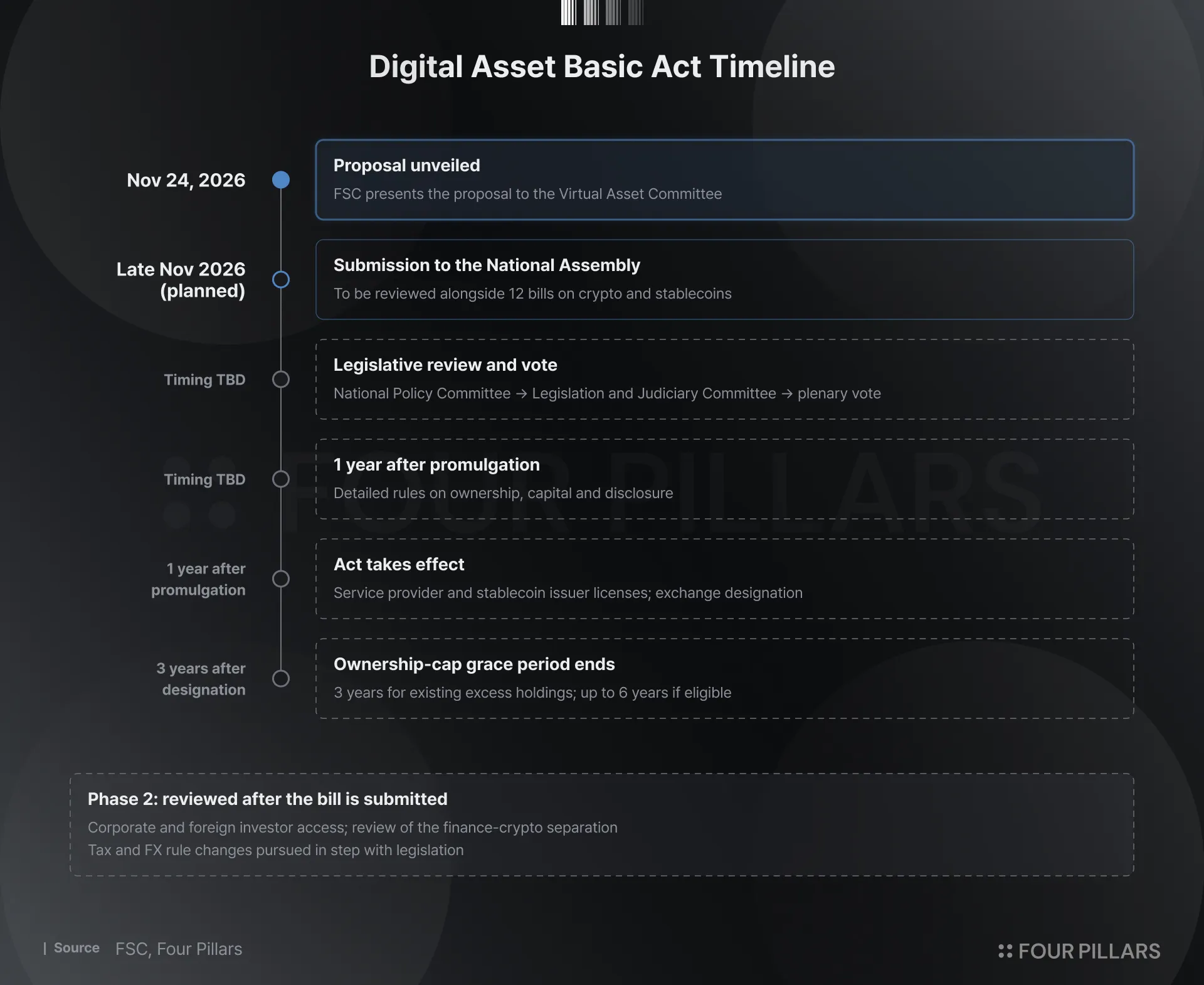
The Financial Services Commission (FSC) convened the Virtual Asset Committee on November 24, 2026, and the Digital Asset Bill was formally introduced on November 26.
Korea's virtual asset regulation began with the introduction of a VASP registration system under the amended Act on Reporting and Using Specified Financial Transaction Information, which took effect in March 2021. The Virtual Asset User Protection Act, effective from July 2024, marked the first phase of legislation. Introduced approximately three years and five months after the first-phase legislation passed the National Assembly, the Digital Asset Bill represents the second phase, extending beyond user protection to regulate entry requirements, business activities, and the issuance and circulation of digital assets.
As major economies continued to develop their regulatory frameworks, Korea's digital asset industry had been awaiting the enactment of the Basic Act. In 2026, Korea had approximately 11.18 million exchange accounts and recorded around $360 billion in trading volume in the first half, reflecting a highly active market. Given the size of the market, the slow pace of regulatory development has been disappointing.
The market has been particularly subdued recently, with first-half trading volume declining 44% from the previous half-year's approximately $646 billion. The announcement is especially welcome at a time when Korea's digital asset industry needs new businesses and sources of demand.
This article is primarily intended for overseas protocols. Major Korean financial institutions already interested in digital asset businesses likely have a much deeper understanding of the Basic Act and its practical business implications through their own business assessments. As such, projects looking to expand into Korea or whose tokens are already listed on Korean exchanges will likely benefit more from this article.
2. What Changes: From ‘Virtual’ Assets to a Real Industry
What will change once the bill is enacted? The government's proposal focuses on reducing uncertainty in the digital asset industry and establishing a regulatory foundation for new businesses to grow.
Korea's unclear digital asset regulations have long been a barrier to business expansion. There was no framework for issuing KRW-denominated stablecoins, and domestic ICOs had been banned since 2017. Liquidity provision risked being classified as market manipulation, while restrictions on corporate exchange accounts prevented institutional demand from entering the market. OTC trading, custody, and investment management also lacked dedicated regulatory frameworks, leaving exchanges as virtually the only viable business model in Korea's digital asset industry.
The government’s proposal seeks to broaden this previously narrow industry. The first noticeable change is its terminology. The proposal replaces the legal term ‘virtual assets’ with ‘digital assets’. The FSC explained that the change aims to improve alignment with global regulatory frameworks. Given that the term ‘virtual’ has conveyed a sense of assets lacking substance and reinforced their speculative image, the change can be understood as an effort by the government to shift perceptions of the industry.
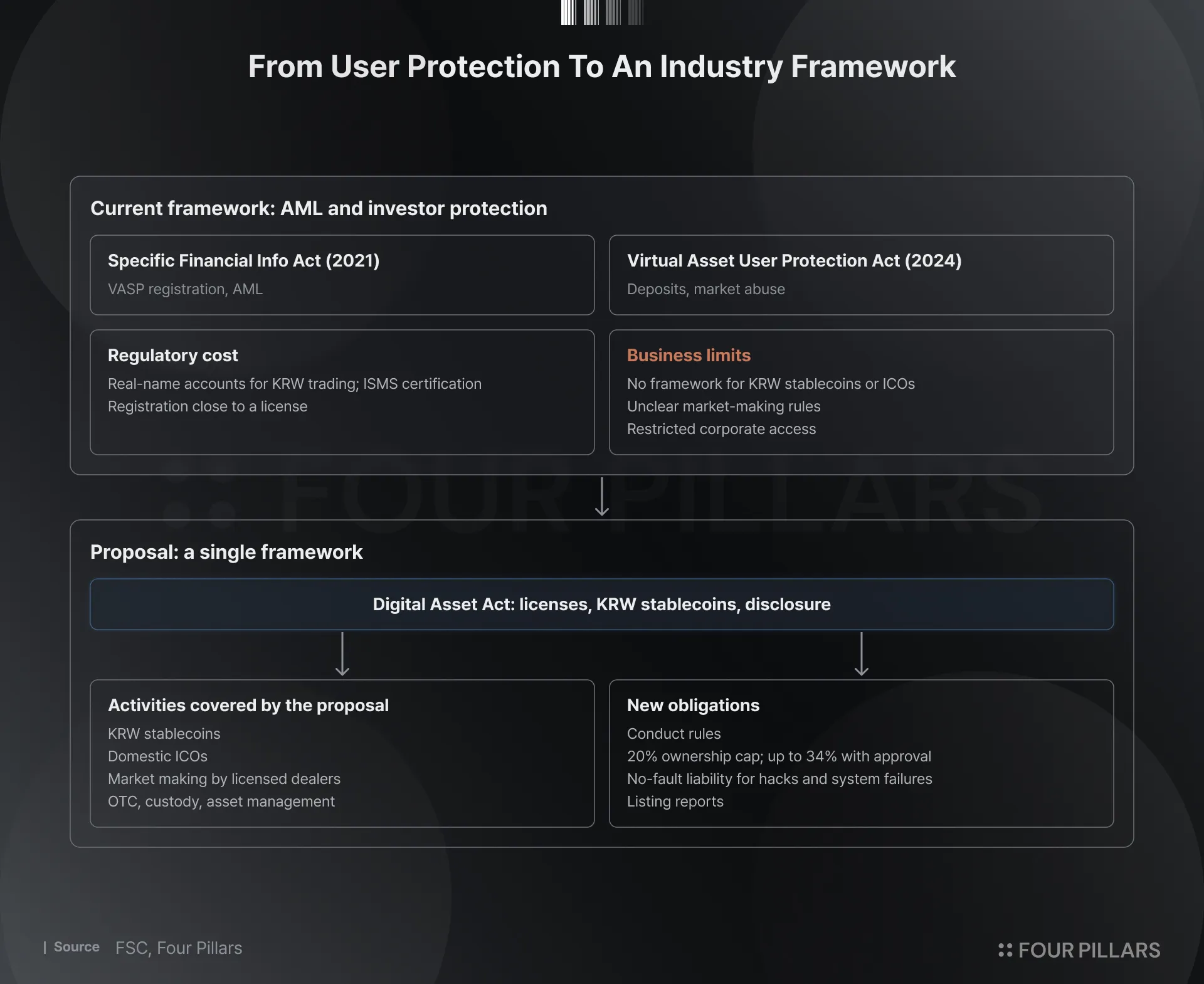
Beyond terminology, the approach to business regulation is also changing. The government's proposal categorizes digital asset businesses by activity and specifies the scope and obligations of each service provider. Previously, different businesses were regulated under a single VASP registration framework. As a result, businesses faced regulatory costs comparable to those of financial institutions, while the permissible scope of new services and associated responsibilities often remained unclear.
To address this, the government's proposal establishes clear standards for entry requirements, business activities, and responsibilities across business categories. For example, it classifies businesses into trading, brokerage, custody, and investment management, and establishes rules for KRW-denominated stablecoin issuance. Domestic token sales will also be permitted subject to disclosure procedures. At the same time, the proposal strengthens business conduct regulations and internal control requirements as business opportunities expand.
Below, we examine these key changes in detail across (1) stablecoin issuance, (2) activity-based licensing and registration, (3) domestic ICOs and issuance disclosures, (4) exchange operations and circulation disclosures, (5) liquidity provision, and (6) user protection.
For those who find the detailed explanations too lengthy or complex, we believe overseas companies and protocols should focus on the following:
- Foreign Stablecoin Issuers: For foreign stablecoins such as USDT currently circulating on Korean exchanges to remain listed, issuers must meet regulatory requirements, including establishing a domestic branch or business office and depositing a portion of their reserve assets with Korean financial institutions, register with the FSC, and file reports for individual tokens. Just as USDT faced delisting and trading restrictions on major European exchanges following the implementation of MiCA, foreign stablecoins that fail to meet Korean regulatory requirements could be removed from the Korean market. Unlike fiat-backed stablecoins with centralized issuers, decentralized and synthetic stablecoins with unclear issuing entities or on-chain reserve management may struggle to meet these requirements, further limiting their exchange listings and circulation within the regulated Korean market.
- Token Projects Listed on Korean Exchanges: To obtain or maintain listings on Korean exchanges, projects must adequately provide information required for disclosures, including issuance volume, circulating supply, project status, and risk factors. Large transactions by issuers, airdrops and burns that materially affect circulating supply, changes to core technology, and hacks will also be subject to ad hoc disclosure requirements, making ongoing information sharing and communication with Korean exchanges increasingly important. In particular, the FSC may order corrections where whitepapers or listing reports contain material misstatements or omissions and, if necessary, directly suspend or prohibit the listing and trading of the relevant tokens. As disclosure obligations also apply to existing listings, widespread delistings of projects unable to provide sufficient information or maintain ongoing disclosure capabilities cannot be ruled out.
- Foreign Spot and Futures Exchanges: Foreign exchanges have already faced restrictions on operating in Korea, but market entry is likely to become even more difficult. Operating a spot exchange requires multiple digital asset business licenses and designation by the FSC as a platform operator, creating significant barriers for foreign exchanges without an established entry route, such as acquiring an existing Korean exchange. Referral regulations will also be strengthened. Businesses receiving compensation from foreign exchanges for promoting their services must file as digital asset advisory service providers. Even after filing, they will be prohibited from promoting foreign exchanges that lack the required Korean licenses or registrations. As a result, existing referral-based user acquisition strategies in Korea are likely to face significant restrictions.
- Foreign Market Makers: By permitting contractual liquidity provision, the bill establishes a regulatory foundation for foreign market makers to enter the Korean market. However, operating in Korea requires establishing a domestic branch or business office and obtaining a digital asset trading license. Meeting regulatory requirements for equity capital, personnel, and internal controls may therefore involve considerable costs and time. Access to KRW markets and foreign exchange regulations must also be considered. Foreign market makers should assess whether Korea's trading volume, demand for liquidity provision, and expected revenue can offset market entry and compliance costs.
- Foreign Custodians: Foreign custody providers must establish a domestic branch or business office and obtain a digital asset custody license to provide custody services in Korea. Global custody provider BitGo has already established a Korean entity backed by investments from Hana Financial Group and SK Telecom and secured VASP registration in August 2026. Establishing a local business presence and securing the necessary licenses will be important for capturing early custody demand driven by broader domestic institutional participation and the introduction of spot ETFs. However, given the special provisions simplifying custody licensing procedures for existing financial institutions, foreign custodians should also consider strategies for competing and partnering with Korean financial institutions.
- Paid Subscription Channels: Businesses that provide advice on digital asset valuations or investment decisions to the general public for compensation must file as digital asset advisory service providers. Providing two-way investment-related communication or personalized advice to paying subscribers may require registration as an investment management service provider. However, regulatory burdens are likely to be relatively low for paid subscription channels or research platforms operated overseas for global customers that Korean users independently access and subscribe to. Conversely, businesses targeting the Korean market through Korean-language content, advertising to domestic users, or recruiting paying Korean subscribers should assess their domestic filing or registration obligations.
3. Key Changes by Sector
3.1 Stablecoins: Issuance Initially Permitted for Bank-Majority Consortia
3.1.1 Details
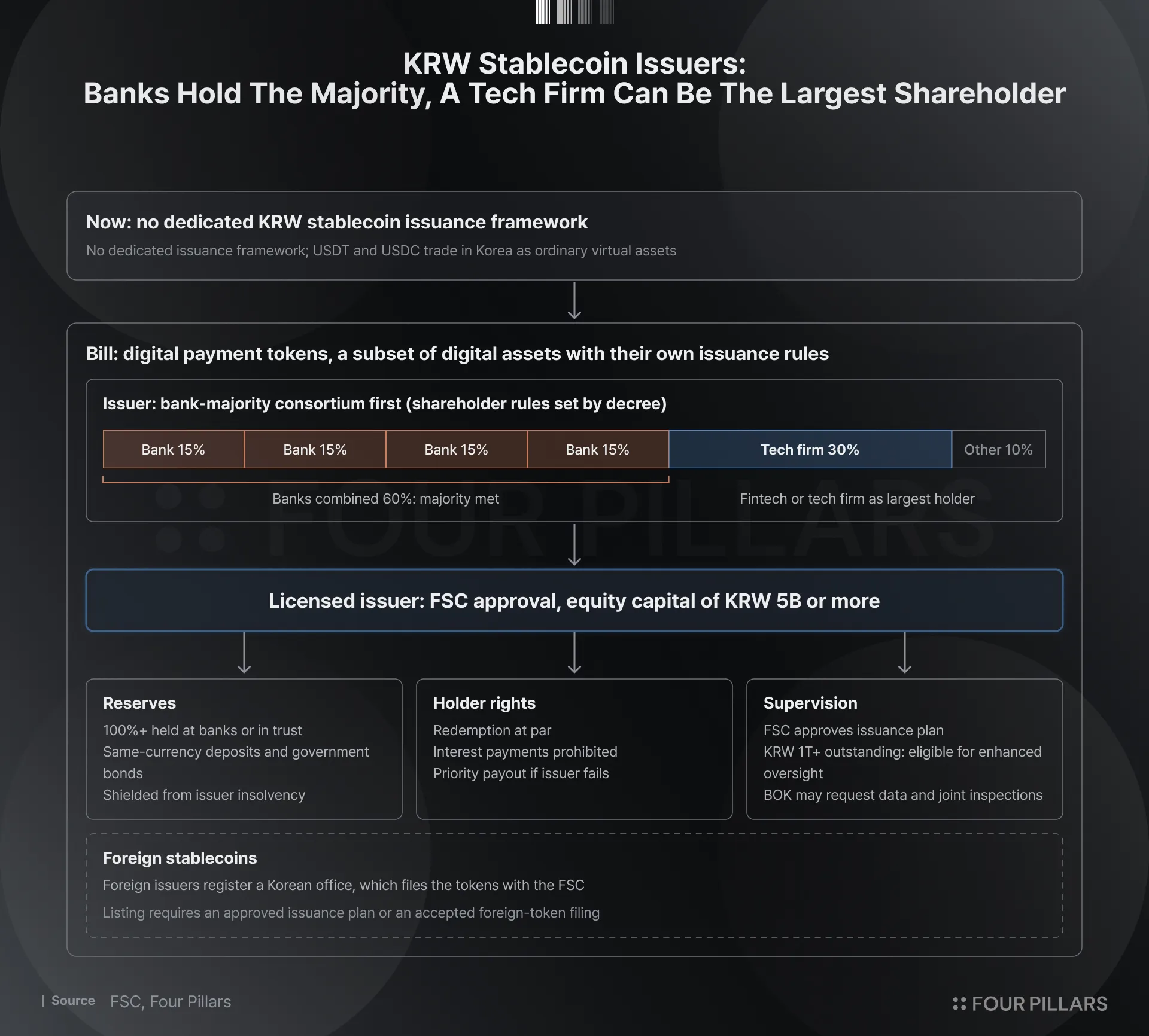
The government's proposal establishes stablecoin issuance requirements and user protection standards. The legal term is ‘digital payment token’, referring to a digital asset pegged to a single currency and primarily used as a means of payment. The key provisions are summarized below:
- Issuance Initially Limited to Bank Consortia: Participating banks must collectively hold a majority stake, while a fintech or technology company may be the single largest shareholder.
- Domestic Registration and Token Filing for Foreign Issuers: Foreign stablecoin issuers must establish a domestic business office, register with the FSC, and file reports for foreign stablecoins through that office. They must also maintain a minimum amount of operating funds in Korea and deposit or entrust a portion of their reserve assets with domestic reserve asset managers, such as banks.
- Prohibition of Rewards: Issuers, certain related parties, and digital asset service providers cannot offer economic benefits tied to holding periods. Exceptions, such as transaction-related benefits, will be specified by presidential decree.
- Reserve Asset Requirements: Reserve assets equal to or exceeding the outstanding issuance amount must be deposited or held in trust with institutions such as banks. Reserves must be invested in highly liquid assets, such as deposits and government bonds denominated in the pegged currency.
- Designation of Significant Tokens: Tokens with an outstanding issuance amount of at least KRW 1 trillion may be designated based on their impact and will be subject to enhanced supervision. Additional capital and liquidity management requirements apply, along with information requests and joint inspections by the Bank of Korea.
Issuers must obtain FSC approval by meeting a minimum equity capital requirement of KRW 5 billion and shareholder composition requirements specified by presidential decree. Initially, participating banks must collectively hold more than 50% of the equity, although a fintech or technology company may be the single largest shareholder. Notably, the FSC outlined the rollout sequence, explaining that issuance would initially be limited to bank consortia to ensure stable operations, including regulatory compliance and anti-money laundering, during the early stages.
Licensing as an issuer and approval to issue stablecoins are separate processes. Licensed issuers must submit an issuance plan covering the issuance period and limit, distribution methods, reserve asset management, and redemption plans for FSC approval. Material changes to an approved plan also require renewed approval.
Reserve assets equal to at least 100% of the outstanding issuance amount must be deposited or held in trust with institutions such as banks and invested in highly liquid assets, including deposits and government bonds denominated in the pegged currency. Under the FSC's proposed standards, US Treasuries would therefore not qualify as reserve assets for KRW stablecoins. Reserve asset holdings and redemption procedures must also be publicly available at all times, while reserve asset audits and business reports are required monthly.
Stablecoin holders have the right to redemption at face value. Issuers must redeem tokens without delay in money of equivalent value upon request and may appoint redemption agents to facilitate the process. However, issuers, certain related parties, and digital asset service providers are prohibited from directly or indirectly providing monetary or economic benefits tied to holding periods. Exceptions, including transaction-related benefits, may be specified by presidential decree.
The FSC may designate tokens with an outstanding issuance amount of at least KRW 1 trillion as ‘significant digital payment tokens’, considering factors such as user numbers and their impact on financial stability and monetary policy. Reaching the KRW 1 trillion threshold does not automatically trigger designation. Issuers of designated tokens must maintain additional equity capital and strengthen reserve asset liquidity management, risk assessment, and risk management frameworks.
Foreign issuers seeking to provide issuance and redemption services to Korean residents must establish a domestic branch or business office and register with the FSC. The registration review assesses user protection arrangements, including adequate home-country supervision, a Korean-resident representative, operating funds, and reserve asset management agreements. Foreign issuers must also deposit or entrust a portion of their reserve assets with domestic reserve asset managers, such as Korean banks. The amount of reserves required to be held domestically will be determined by presidential decree, considering the home country's supervisory framework and domestic stablecoin holdings and circulation. Registered domestic offices must separately file reports for foreign stablecoins they intend to handle in Korea. Only stablecoins whose filings have been accepted may be listed on Korean exchanges.
This approach is similar to the European Union's Markets in Crypto-Assets Regulation (MiCA). MiCA also requires stablecoin issuers to obtain authorization within the EU, submit whitepapers, and deposit a certain proportion of reserve assets with financial institutions, while restricting listings of stablecoins that fail to meet regulatory requirements.
3.1.2 Commentary
A distinctive feature of Korea's stablecoin bill is that it recognizes fintech companies as a separate category of participants, allowing them to become the single largest shareholder while banks collectively retain majority ownership. The government's example involves four banks each holding 15%, for a combined 60% stake, and a technology company holding 30%.
However, being the largest shareholder does not necessarily guarantee management control. If the banks exercise their voting rights collectively, they can outvote the technology company. Actual control will therefore depend on board composition, voting requirements, and executive appointment rights. Even if a fintech company leads technology development and service operations, obtaining approval from multiple banks for every major decision could slow business execution.
The actual business structure will therefore depend on the internal dynamics among consortium members and cannot be predicted from the government's proposal alone. The proposal merely establishes the broad issuance framework. Whether banks manage reserves and regulatory compliance while fintech companies operate services, and how responsibilities for major decisions and incident response are divided, will depend on negotiations among consortium members.
From a business perspective, it remains to be seen where initial demand will emerge. KRW stablecoins could be used across existing fintech retail payment networks or initially replace a portion of USDT, USDC, or KRW deposits on exchanges and on-chain. However, given the significant differences in why users hold KRW and USD, we do not expect demand for dollar stablecoins to translate directly into demand for KRW stablecoins.
Profitability will largely depend on issuance volume. As reserve asset income is the primary revenue source for issuers, distribution channels that can drive issuance growth are critical. However, the bill prohibits not only issuers but also certain related parties and digital asset service providers from offering rewards tied to holding periods. Since exceptions for transaction-related benefits may be specified by presidential decree, the extent to which payment and trading rewards are permitted will be a key variable in distribution strategies. JPYC has already illustrated the relationship between rewards and circulating supply for local-currency stablecoins. After DeFi service Unifi reduced its deposit yield from 5% to 2% in September, JPYC's circulating supply fell by more than a third within a week.
Foreign issuers must also secure domestic distribution channels. In particular, they must meet new operating requirements. To provide issuance and redemption services in Korea, they must establish a Korean branch based on their home-country authorization, register with the FSC, and secure a Korean-resident representative, operating funds, and user protection arrangements. Separate filings are also required for the domestic circulation of tokens issued overseas. Foreign stablecoins currently listed on Korean exchanges are expected to become ineligible for domestic circulation if their issuers fail to establish a local business office and register with the FSC once the Basic Act takes effect.
Another point to watch is how KRW stablecoins will interact with other forms of digital KRW while domestic and foreign issuers compete. The Bank of Korea has maintained that CBDCs and bank-issued deposit tokens should form the core of digital currencies, with stablecoins serving a supplementary role. However, if fintech companies rapidly expand stablecoin adoption through their existing user networks, bank-led initiatives could become largely symbolic government projects. Another possible structure is for deposit tokens and CBDCs to facilitate interbank and cross-border payments, while private stablecoins serve individual retail payments.
While the government's proposal establishes an issuance framework, which forms of money will actually be used and where will depend on the services banks and fintech companies introduce.
3.2 Digital Asset Businesses: Introduction of Activity-Based Licensing and Registration
3.2.1 Details
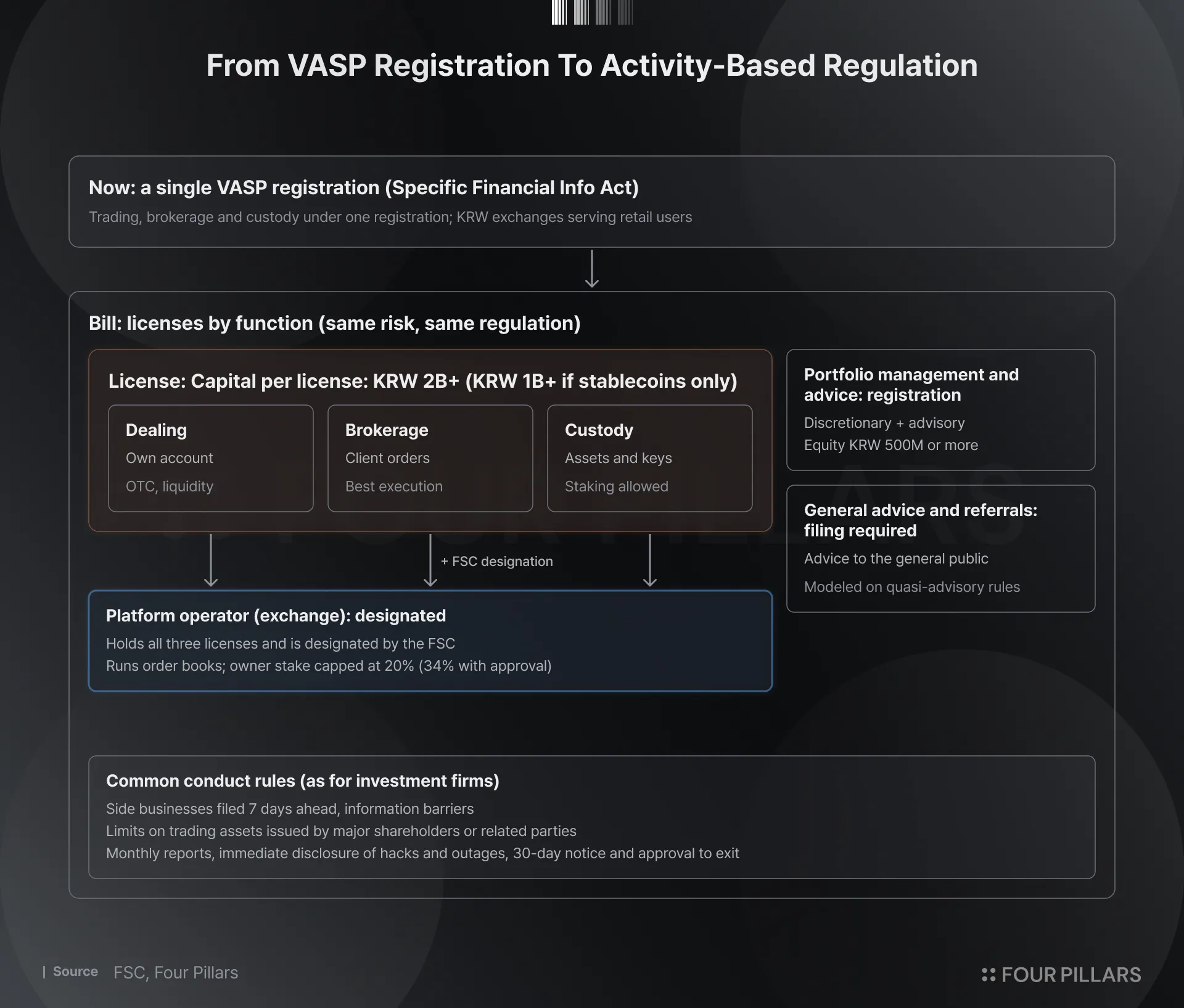
Korea's existing virtual asset service provider (VASP) regulations have centered on a filing system under the Act on Reporting and Using Specified Financial Transaction Information. VASP activities were classified into five categories: (a) buying and selling virtual assets, (b) exchanging virtual assets for other virtual assets, (c) transferring virtual assets, (d) custody and management of virtual assets, and (e) brokering, arranging, or facilitating trades and exchanges. Under this framework, KRW-market and coin-market exchanges, OTC service providers, custodians, and custodial wallet providers have operated by filing with the Korea Financial Intelligence Unit (FIU).
The main filing requirements included Information Security Management System (ISMS) certification and securing real-name verified deposit and withdrawal accounts for businesses handling KRW transactions. The regulatory focus was on anti-money laundering and user protection. Although business activities were categorized, there were no independent licensing and registration frameworks or differentiated equity capital requirements for each business category, distinguishing the existing system from the activity-based regulatory framework introduced by the Digital Asset Basic Act.
The FSC will abolish the existing VASP filing system and classify digital asset businesses into four categories: trading, brokerage, custody, and investment management. Under an add-on licensing model, businesses can combine multiple activities as needed.
- Trading: Businesses that trade directly with users using their own funds and assets, typically through institutional OTC desks or asset exchange services. This is similar to the role of dealers in traditional finance.
- Brokerage: Businesses that execute orders on behalf of users or connect buyers and sellers.
- Custody: Businesses that safeguard and manage users' digital assets and private keys, with the option to provide staking services.
- Investment Management: Businesses that manage clients' digital asset portfolios or provide investment advice.
Trading and brokerage are distinguished by whose account the transactions are conducted on. Trading service providers act as counterparties to users using their own funds and assets. Institutional OTC desks and asset exchange services are typical examples. In the overseas asset exchange model introduced by the FSC, the service provider quotes a price inclusive of fees when a user requests an asset exchange. If the user accepts, the provider directly sells or exchanges the assets.
Brokerage service providers, by contrast, execute orders on behalf of users or connect buyers and sellers in OTC markets. OTC transactions are also permitted under brokerage, but unlike trading, the provider's role is limited to intermediation. Exchanges that aggregate and competitively match orders from multiple users are classified separately. A brokerage license alone is insufficient to operate an exchange. Operators must obtain trading, brokerage, and custody licenses and be designated by the FSC as platform operators. Trading and brokerage service providers may also lend digital assets to clients. However, cash loans for trading purposes are prohibited, while eligible assets, client qualifications, collateral ratios, and loan periods will be determined by presidential decree.
Custody refers to businesses that safeguard and manage users' digital assets and private keys. Custodians must segregate client assets from corporate assets and establish safeguards against incidents such as hacks. They may also provide staking services with client consent. Custodians may participate directly in validation or use external validators but cannot entrust clients' private keys to third parties.
Investment management refers to businesses that manage clients' digital asset portfolios or provide investment advice. Notably, investment management did not exist as an independent business category under the previous VASP framework. Examples include discretionary investment services that adjust allocations to Bitcoin and Ethereum within client-defined mandates, or advisory services recommending which assets to hold and in what proportions. However, the bill generally prohibits pooling assets from multiple clients for collective investment. The new investment management category therefore formalizes digital asset discretionary investment and advisory services but does not immediately permit the establishment and operation of digital asset funds. Investment management registration alone also does not permit direct custody of client assets or the lending of money or other assets.
As mentioned earlier, exchanges fall under a separate category. Obtaining trading, brokerage, and custody licenses does not automatically authorize exchange operations. Operators must meet market operation requirements, including sufficient equity capital, market surveillance systems, and conflict-of-interest prevention mechanisms, and be designated by the FSC as ‘digital asset platform operators’.
Finally, the proposal establishes criteria for applying regulations to DeFi. Transactions executed automatically through smart contracts without intermediaries are generally not classified as digital asset business activities. However, where an identifiable party can influence changes to smart contracts, the service may be subject to regulation under the presidential decree. For example, if an operating team has the authority to upgrade contracts or modify trading conditions, automated transaction execution alone does not exempt the service from regulation. What matters is who actually controls the service, rather than whether it is labeled DeFi.
3.2.2 Commentary
Korea's exchange-centric market will now allow OTC desks, brokerages, independent custodians, and market makers to operate as specialized businesses. Combining multiple licenses could also enable prime brokerage models like Coinbase Prime, offering integrated trading, custody, and investment management services to institutional clients.
However, exchanges are subject to separate business restrictions. Even with trading, brokerage, and custody licenses, exchanges are generally prohibited from acting as direct counterparties to clients outside their own markets or providing investment management services to their own clients. Rather than exchanges offering every service directly, the market is expected to develop around a division of roles among separate trading, brokerage, and investment management service providers.
Notably, special provisions have been introduced to simplify market entry for existing financial institutions. Certain trust companies under the Financial Investment Services and Capital Markets Act will be deemed licensed simply by registering with the FSC when conducting digital asset business activities specified by presidential decree. While ordinary digital asset custodians must meet eight licensing requirements, including equity capital, business plan feasibility, and major shareholder and executive qualifications, eligible trust companies need to meet only three requirements: personnel and physical infrastructure, sound financial standing and social credibility, and conflict-of-interest prevention mechanisms. The review period is also shortened from three months for standard licensing to two months for registration.
By reducing duplicative regulatory burdens for financial institutions that have already undergone eligibility reviews during their existing licensing processes, these provisions could encourage banks and securities firms to enter the digital asset custody market, support the development of custody infrastructure for future spot digital asset ETFs, and promote prime brokerage services (PBS) for institutional investors. Specific eligibility criteria and permissible business activities will be determined by presidential decree.
The special provisions for trust companies are particularly relevant to the introduction of domestic spot Bitcoin ETFs. The scope of eligible underlying assets under the Financial Investment Services and Capital Markets Act and the ability of trust companies to hold digital assets in custody have long been identified as major legal obstacles to domestic spot digital asset ETFs. By lowering entry barriers for existing trust companies to directly provide digital asset custody services, the bill establishes a regulatory foundation for addressing the latter issue. However, the provisions themselves do not expand the scope of eligible underlying assets or trust property under the Act, meaning separate legislative and regulatory changes are necessary before spot ETFs can be launched.
Once the spot ETF market opens, new institutional demand could emerge for digital asset purchases, custody, and liquidity provision by asset managers. Securities firms and banks, in particular, could leverage their existing financial infrastructure and client bases to expand institutional digital asset services, including custody.
The Basic Act's special provisions simplifying market entry for existing financial institutions appear intended to make it easier for traditional financial institutions to provide services such as custody and brokerage. While it remains to be seen whether these businesses will be profitable and attract substantial participation from traditional financial institutions, the provisions could put existing Korean VASPs offering custody and brokerage services at a significant disadvantage.
Meanwhile, higher barriers to establishing new exchanges further reinforce the market structure dominated by Korea's five existing KRW exchanges. Launching an exchange requires trading, brokerage, and custody licenses, platform operator designation, and compliance with market surveillance, disclosure, security, and corporate governance requirements. Even after absorbing these costs, new exchanges must attract customers and liquidity from established platforms. New entrants are therefore likely to focus on specific business categories or partner with existing exchanges rather than operate their own.
However, for diverse businesses to emerge under the revised framework, corporate market participation must be expanded above all. While the government's proposal establishes a regulatory foundation for institutional trading, custody, and investment management services, it does not finalize the scope or timing of permitted corporate investment. As service providers prepare their offerings, the conditions allowing actual clients to enter the market must also be put in place.
3.3 ICOs: Domestic Token Sales Permitted Subject to Disclosure
3.3.1 Details
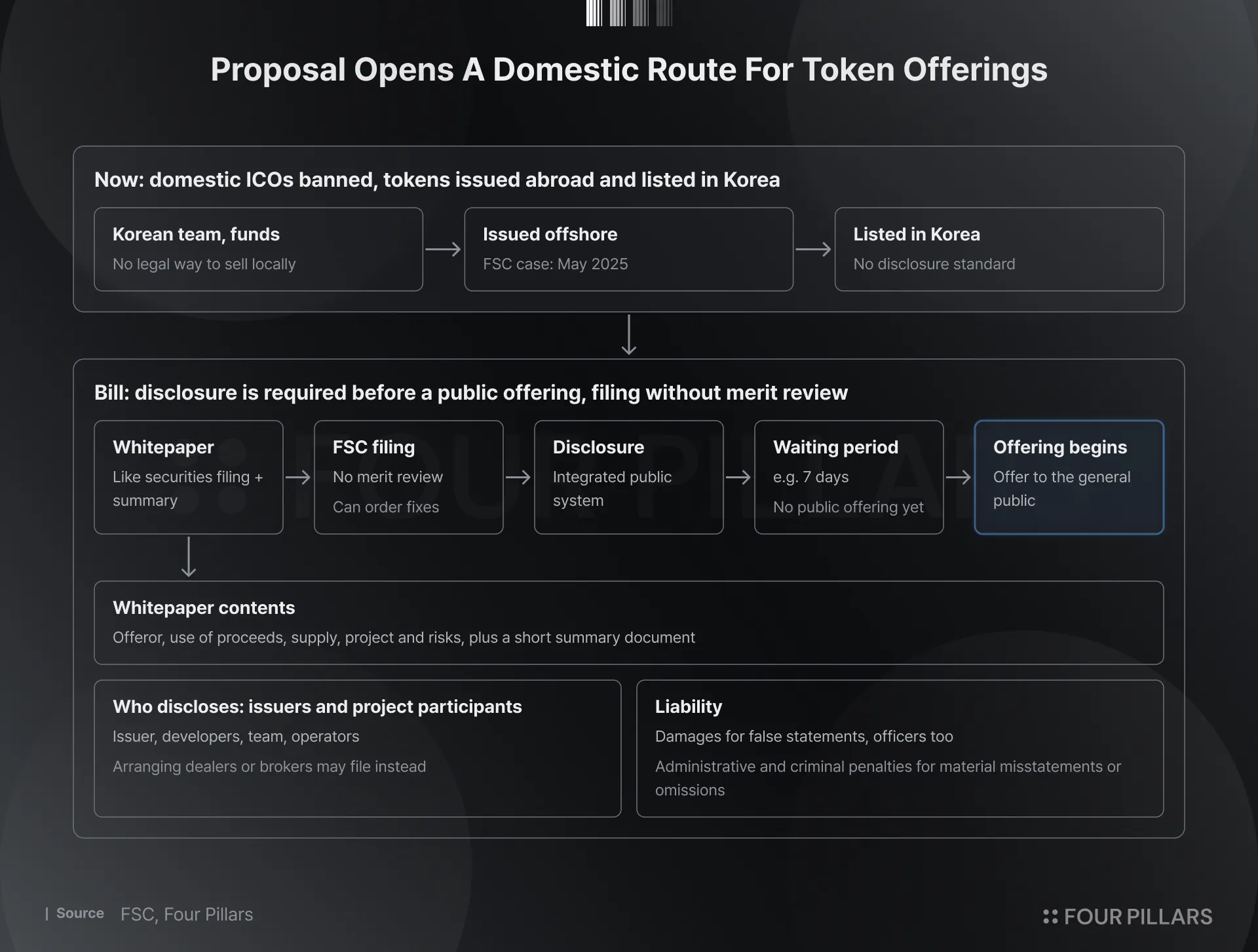
The government's proposal permits domestic token sales subject to whitepaper filing and disclosure requirements. The key provisions are as follows:
- Domestic ICOs Permitted: After filing a whitepaper with the FSC and publicly disclosing it, issuers may solicit investors to acquire tokens following a consideration period.
- Expanded Disclosure Responsibility: In addition to issuers, parties actively involved in token issuance and operations, including developers and project teams, may also bear disclosure responsibilities.
- Whitepaper and Information Document Submission: The use of proceeds, issuance volume, project details, and risk factors must be disclosed, along with a separate document summarizing key information.
- Liability for Inadequate Disclosures: Parties responsible for disclosures and their executives are liable for damages arising from material misstatements or omissions. The bill also establishes grounds for financial penalties and criminal punishment.
- Separate Issuance and Listing Procedures: Even after completing domestic token sale procedures, exchange listings require a separate review and circulation disclosure process.
Disclosure obligations are triggered by ‘solicitation to acquire tokens’. Regardless of whether tokens already exist or have yet to be created, soliciting the general public to purchase or subscribe to them triggers these obligations. For example, a project seeking to raise development funds by selling tokens to retail investors must first disclose information necessary for investment decisions. MiCA similarly requires, as a general rule, that a whitepaper detailing the issuing entity, key project information, token rights and obligations, and associated risks be prepared, submitted to the competent authority, and published before a public offering. Both frameworks focus on addressing information asymmetry at the point of sale and solicitation rather than token creation itself.
Domestic ICOs must also involve a trading or brokerage service provider responsible for managing investor funds and allocated tokens. Platform operators are excluded from this role, separating issuance support from exchange listing functions. Where the issuer is difficult to identify or the token was issued overseas, the trading or brokerage service provider arranging the sale may assume disclosure responsibilities.
Parties preparing a token sale must file a whitepaper with the FSC detailing the soliciting party, use of proceeds, issuance volume, project details, and risk factors. A separate digital asset information document must also be prepared to help investors easily review key information. The FSC reviews the documents and may require corrections to material omissions or supporting documents.
Once the filing is accepted, the whitepaper and related documents are published through an integrated disclosure system, and solicitation may begin after a consideration period. The FSC suggested seven days as an illustrative period, not a finalized requirement. Parties responsible for disclosures and their executives are liable for material misstatements or omissions in the whitepaper. The FSC is also granted investigative powers and the authority to request information.
This process is separate from exchange listings. Tokens sold domestically and subsequently traded OTC are subject to different rules from those listed on exchanges following a listing review. Permitting domestic ICOs does not guarantee exchange listings for the tokens sold.
3.3.2 Commentary
Korean projects have traditionally established overseas foundations to issue tokens before listing them on domestic exchanges. Even if domestic ICOs are permitted, it remains unclear how much issuance activity will return to Korea. The benefits of selling directly to Korean investors must outweigh extensive disclosure requirements, legal review costs, and potential liability for damages. Given the cost advantages of maintaining overseas foundations, existing structures are likely to persist.
The bill also does not specify monetary thresholds or simplified procedures for small-scale offerings. The EU's MiCA provides exemptions from whitepaper requirements for certain small offerings and offerings targeting qualified investors. Regulation Crypto Assets, proposed by the US SEC in August 2026, also outlines registration exemption pathways for offerings of $5 million over four years and $75 million over 12 months, subject to separate requirements. Korea delegates exemptions from issuance and circulation regulations for certain digital assets to presidential decree. What matters is whether the final framework adjusts disclosure and procedural burdens according to offering size. If preparation costs remain high, domestic ICOs could become a largely ineffective framework that early-stage projects struggle to use.
The distinction between securities and non-securities also remains an important issue. Tokens involving revenue sharing or buybacks require an assessment of their securities status based on their specific structure and holders' rights. If classified as securities, they are subject to the Financial Investment Services and Capital Markets Act. The bill excludes financial investment instruments from the definition of digital assets but does not provide detailed criteria for determining the securities status of individual tokens. For domestic ICOs to become commercially viable, issuers must be able to determine which regulatory framework applies to them. Clear assessment criteria and procedures are therefore needed.
3.4 Exchanges: Introduction of Listing Disclosure Obligations and Shareholding Limits
3.4.1 Details
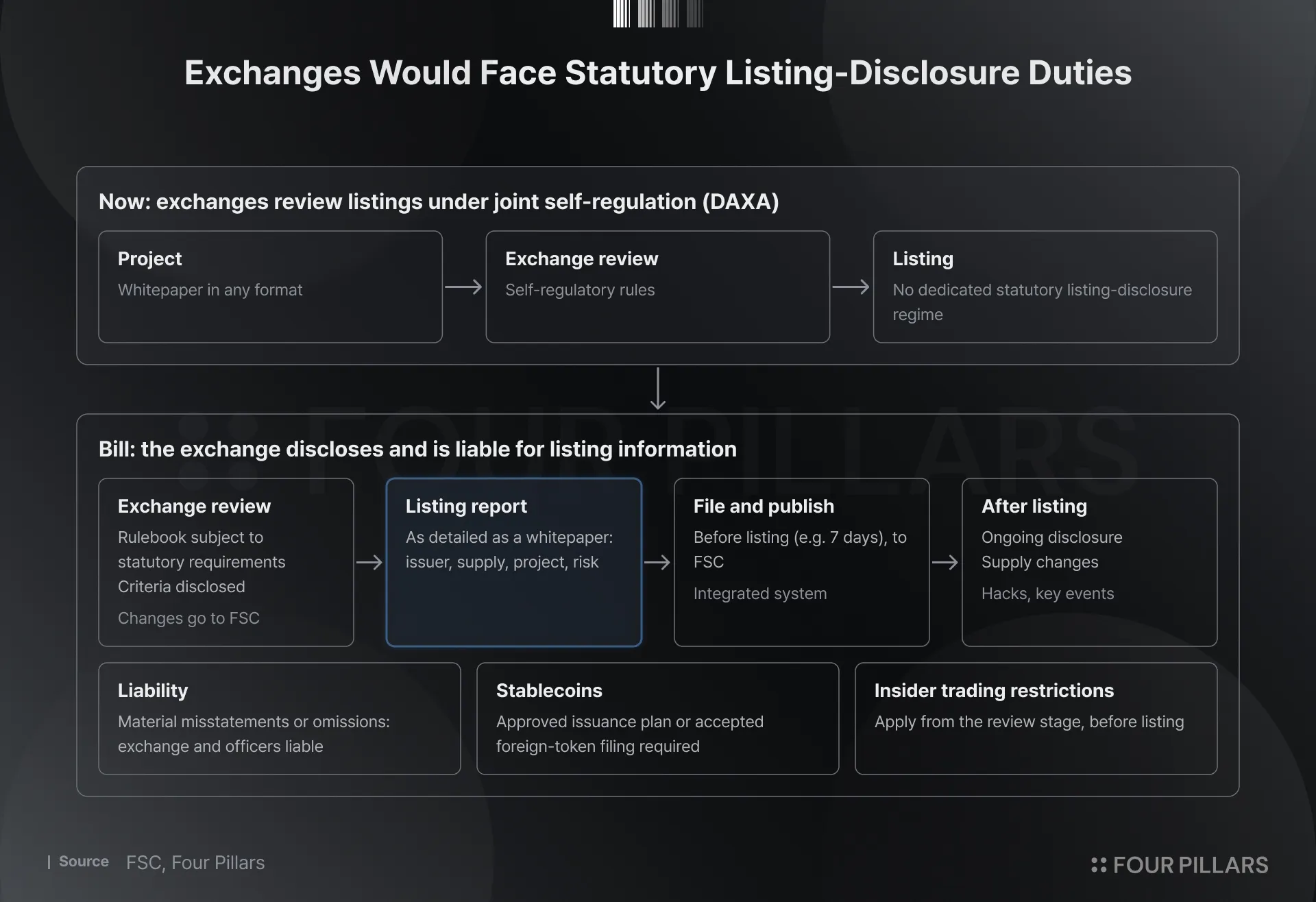
The government's proposal seeks to apply standards comparable to those governing alternative trading systems (ATS) in traditional finance to digital asset exchanges. Under the current Financial Investment Services and Capital Markets Act, shareholders of domestic ATSs are generally prohibited from holding more than 15% of outstanding voting shares, while certain financial institutions may hold up to 30% with FSC approval. These dispersed ownership requirements aim to prevent the concentration of control among particular shareholders and ensure fairness and neutrality in market operations.
Drawing on this regulatory approach, the government's proposal imposes disclosure obligations for listed tokens on exchanges and introduces shareholding limits. The intention is to regulate exchanges not merely as businesses executing trades but as infrastructure responsible for fair market operations. The key changes are as follows:
- Pre-Listing Disclosure: Exchanges must submit listing reports and digital asset information documents to the FSC and publish them through the integrated disclosure system.
- Post-Listing Disclosure: Information that could significantly affect prices, including changes in issuance volume and circulating supply, and hacks, must be disclosed immediately.
- Statutory Operating Rules: Exchanges must establish operating rules governing trade execution, listings and delistings, and suspicious trading surveillance, subject to FSC supervision.
- Introduction of Shareholding Limits: Shareholdings are generally capped at 20%. Approved shareholders, including financial institutions, will be permitted to hold up to 34% under presidential decree.
The platform operator designation discussed earlier is the starting point for these obligations. In addition to trading, brokerage, and custody licenses, exchanges must have sufficient equity capital, market surveillance systems, and conflict-of-interest prevention mechanisms. Once designated, exchanges are responsible for overall market operations, from listing reviews to trading and disclosures.
Before listing a token, exchanges must submit and publish a listing report and summary information document covering the issuer, issuance volume, project details, and risk factors. Submission deadlines will be determined by presidential decree, with the FSC citing seven days before listing as an example. Disclosure obligations continue after listing, and reports for tokens already listed on existing KRW exchanges must also be submitted and published within one year of the law taking effect.
The dispersed ownership requirements draw on the framework for alternative trading systems in capital markets. Shareholders are generally prohibited from holding more than 20% of an exchange's outstanding voting shares. The FSC plans to allow holdings of up to 34% with approval under presidential decree. Shareholding calculations may include not only directly held shares but also shares held by related parties and shares over which voting rights can be exercised through contractual arrangements.
However, shareholders exceeding the limit at the time of platform operator designation will receive a three-year grace period from the designation date. Shareholders of small and medium-sized exchanges meeting criteria specified by presidential decree, such as market share, may receive an additional grace period of up to three years at the FSC's discretion. Alongside dispersed ownership requirements, corporate governance requirements will include a majority of outside directors, the establishment of an audit committee, and rules governing the appointment and dismissal of compliance officers. The aim is to regulate not only major shareholders' ownership but also exchanges' internal decision-making and oversight structures.
3.4.2 Commentary
The biggest change for exchanges is that listing tokens will now entail disclosure responsibilities. Exchanges have previously reviewed issuance and circulation information during listing assessments, but they must now publish this information in listing reports and bear liability for material misstatements or omissions. Information previously used for internal reviews or reporting to the Financial Supervisory Service (FSS) will become public disclosures for investors. This could increase the burden of listing and maintaining foreign tokens whose issuers are unclear or difficult to obtain information from.
Mandatory disclosure is a positive signal of market maturity, but it also means more responsibilities for overseas projects. Foreign projects listed on Korean exchanges must continuously monitor material developments that could affect investors' trading decisions, including changes in token issuance and circulating supply, large transactions by issuers, airdrops and burns materially affecting circulating supply, changes to core technology, hacks, and IT disruptions.
In particular, the FSC will have the authority to order corrections where whitepapers or listing reports contain material misstatements or omissions and, if necessary, directly suspend or prohibit the listing and trading of the relevant digital assets. While individual listing reviews remain the responsibility of exchanges, stronger regulatory intervention powers mean overseas projects must pay close attention not only to their relationships with Korean exchanges but also to compliance with Korean disclosure regulations.
Information sharing and communication frameworks between projects and exchanges will become increasingly important to ensure Korean exchanges can meet their ad hoc disclosure obligations in a timely manner. While overseas projects' Korean market strategies have traditionally focused on exchange listings, community growth, and marketing, disclosure management, regulatory compliance, and investor relations (IR) are likely to become increasingly important.
These changes are also likely to affect exchange listing strategies. Even if exchanges seek to attract users through rapid new listings, information verification and report preparation take time, while inadequate disclosures entail liability for damages. Small and medium-sized exchanges may shift away from competing on the number of listings toward targeting specific customer segments or securing trading demand through partnerships with financial institutions.
Shareholding limits will also affect completed and ongoing exchange acquisitions and equity investments. Even if Naver Financial makes Dunamu a wholly owned subsidiary through a comprehensive share swap, maintaining 100% ownership beyond the grace period would be difficult if the proposed shareholding limits are introduced.
Mirae Asset Consulting, which acquired DigitalX (formerly Korbit), Bithumb Holdings, the largest shareholder of Bithumb, and Binance, the largest shareholder of GOPAX operator Streami, will all face potential ownership restructuring. Depending on the shareholding limits and exemptions established in the final legislation and presidential decree, potential responses may include divestment by existing shareholders or attracting new investors through third-party share issuances to dilute existing shareholders' stakes.
Mirae Asset Consulting, which acquired DigitalX (formerly Korbit), Bithumb Holdings, the largest shareholder of Bithumb, and Binance, the largest shareholder of GOPAX operator Streami, will all face potential ownership restructuring. Depending on the shareholding limits and exemptions established in the final legislation and presidential decree, potential responses may include divestment by existing shareholders or attracting new investors through third-party share issuances to dilute existing shareholders' stakes.
3.5 Market Making: Contractual Liquidity Provision Permitted
3.5.1 Details
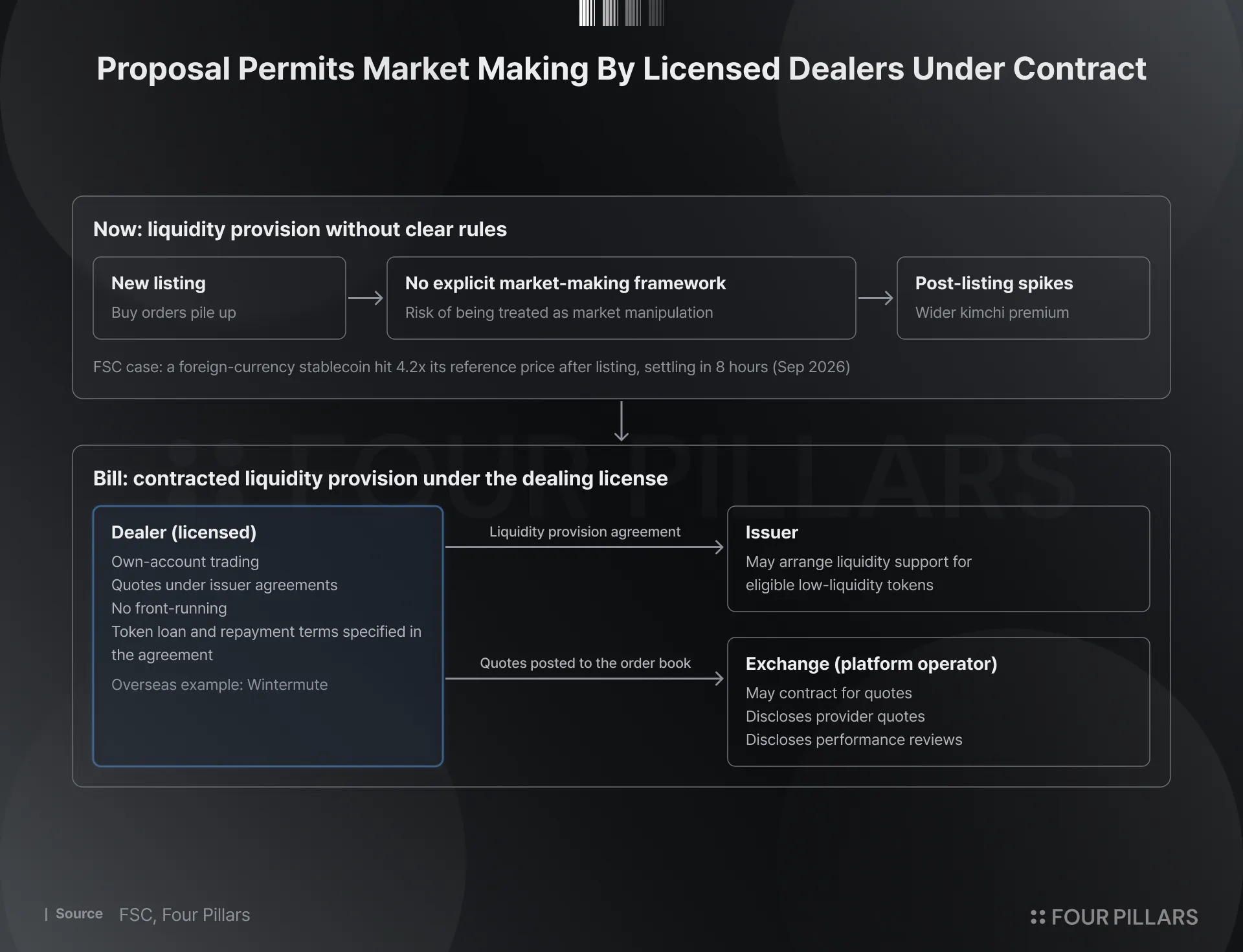
The bill permits licensed trading service providers to provide liquidity under contractual arrangements. The primary model involves agreements between trading service providers and issuers, with details to be specified by presidential decree. The key provisions are as follows:
- Liquidity Provision by Trading Service Providers: Liquidity provision is conducted under a trading license rather than a separate market-making license.
- Contractual Requirements: Contracts must specify eligible assets and markets, quotation periods and methods, compensation, and fees. If tokens are lent, lending and repayment terms must also be included.
- Exchange Evaluation and Disclosure: Exchanges must be notified of contract execution, termination, and material changes. Exchanges evaluate and disclose liquidity provision performance.
- Exchange-Arranged Liquidity Provision: Exchanges may arrange liquidity provision through trading service providers for assets that fall below criteria such as trading volume specified by presidential decree.
Trading service providers contracted by issuers provide liquidity by submitting buy and sell quotes on their own account. Contracts must specify which tokens will be traded in which markets, when and how quotes will be submitted, and the compensation involved. If issuers lend tokens to trading service providers for quotation purposes, lending amounts and repayment terms must also be included.
Trading service providers must notify the relevant exchange of contract execution, termination, and material changes. Exchanges evaluate and publicly disclose liquidity provision performance based on this information. In addition to issuer agreements, exchanges may arrange liquidity provision through trading service providers. However, eligible assets are limited to listed assets falling below criteria such as trading volume specified by presidential decree, which will also determine specific liquidity provision methods.
3.5.2 Commentary
The most interesting question is how much liquidity provision will reduce the Kimchi premium. One directly anticipated benefit is mitigating post-listing price spikes caused by insufficient liquidity. The FSC specifically cited JPYC's September 2026 domestic listing, when its price surged to 4.2 times its reference price before stabilizing eight hours later. Even stablecoin prices can surge when sell-side liquidity is insufficient. The need for liquidity provision has long been recognized, and the bill establishes a regulatory basis for conducting such activities.
Potential liquidity providers include specialized domestic trading firms, securities firm affiliates, and foreign market makers. However, securities firm affiliates must assess the extent to which financial institutions are permitted to enter the digital asset industry.
Korean financial institutions must also consider the capital requirements associated with holding digital assets on their own account. The Basel Committee on Banking Supervision (BCBS) applies a 1,250% risk weight to digital assets that fail to meet certain criteria (Group 2b), including Bitcoin. Banks holding such assets must effectively maintain minimum risk-based capital equivalent to the value of their holdings.
Foreign market makers may also enter the Korean market by establishing a domestic branch or business office and obtaining a trading license. However, obtaining a trading license does not automatically guarantee access to KRW markets. Providing liquidity in KRW markets requires domestic bank accounts and access to KRW settlement infrastructure, while foreign exchange regulations must also be considered. Actual market entry by foreign market makers will therefore depend on future presidential decrees, regulatory policies on corporate KRW trading, and banks' account-opening requirements.
3.6 User Protection: Stronger Liability for Losses and Measures Against Unfair Trading
3.6.1 Details
The bill strengthens user protection obligations and expands measures to address incidents and unfair trading. Beyond safeguarding client assets, it establishes rules for compensation following incidents and the return of assets when service providers exit the market. The key provisions are as follows:
- Financial Institution-Level Business Conduct Regulations: Service providers are subject to disclosure duties, prohibitions on improper solicitation, regulations on terms and conditions and advertising, and internal control requirements.
- Client Asset Protection: Client assets must be segregated from corporate assets and subject to audits, with restrictions on the offsetting and seizure of segregated assets.
- Stronger Liability for Losses: No-fault liability applies to hacks and IT incidents, with exceptions for intentional misconduct or gross negligence by users and certain blockchain disruptions.
- Compensation Funding and IT Security: Service providers must obtain insurance or mutual aid coverage, or set aside reserves. Incidents resulting from violations of IT security requirements may result in financial penalties of up to 10% of revenue.
- Stronger Measures Against Unfair Trading: Payment suspensions may last up to 12 months, including extensions, while account opening and trading restrictions may last up to five years.
No-fault liability applies to hacks and IT incidents. Exceptions may apply where users engage in intentional misconduct or gross negligence and the allocation of liability has been specified in advance in the terms and conditions. Liability may also be shared for incidents arising from circumstances specified by presidential decree, such as technical changes or operational disruptions in the underlying blockchain, provided the service provider has exercised sufficient due care. Service providers must also secure compensation funding through insurance, mutual aid coverage, or reserves.
If an incident occurs due to a failure to meet IT security requirements, financial penalties of up to 10% of revenue may be imposed. This holds service providers accountable for security violations independently of their compensation obligations to clients.
3.6.2 Commentary
For users, the most tangible change is the reduced burden of proving service provider negligence following an incident and a stronger legal basis for claiming compensation.
Other jurisdictions also regulate client asset custody alongside compensation mechanisms. Japan requires service providers to hold separate assets equivalent to client assets stored in hot wallets, while Hong Kong requires cold wallet storage and compensation arrangements. The EU's MiCA imposes liability on custodians for asset losses resulting from incidents attributable to them.
Korea's bill imposes liability regardless of fault, with exceptions for certain blockchain disruptions. In actual disputes, key considerations will include whether the incident originated within the exchange's systems or the underlying network, and what preventive measures the service provider had implemented.
4. Conclusion: Ensuring the Regulatory Framework Reflects Market Realities
Korean digital asset companies have long awaited the enactment of the Basic Act, but the government's proposal contains few provisions that significantly depart from existing market expectations. The newly introduced advisory and investment management categories also appear to largely adopt the existing regulatory frameworks for quasi-investment advisory, discretionary investment management, and investment advisory services under the Financial Investment Services and Capital Markets Act, rather than fully reflecting the unique characteristics of the digital asset industry. There is still a long way to go in establishing a distinct regulatory framework for the digital asset industry.
What particularly stands out in the government's proposal is its emphasis on encouraging traditional financial institutions to enter the market. Judging from the special entry provisions for trust companies and financial institution-level licensing and operating requirements, regulators appear to envision a market structure in which traditional financial institutions provide digital asset financial services such as custody and brokerage. While it remains to be seen how actively financial institutions will enter the market after assessing profitability, we believe there is a significant possibility that Korea's digital asset financial services market will shift toward traditional financial institutions over the medium to long term. For existing digital asset companies, this means both new business opportunities and stronger competitors.
Nevertheless, the significance of the Basic Act is clear. It establishes a foundation for conducting various business activities that were previously difficult to pursue due to regulatory uncertainty within a clear regulatory framework. At the same time, service providers face greater costs and responsibilities related to disclosures, internal controls, and user protection. Beyond technological and business capabilities, regulatory compliance capabilities will become an important source of competitive advantage.
However, establishing a regulatory foundation does not necessarily translate into business growth. Even if institutional trading, brokerage, custody, and investment management services are permitted, attracting clients may remain difficult if corporate market participation is restricted. Liquidity provision in KRW markets also requires addressing barriers to market entry and access to KRW accounts for domestic and foreign trading service providers. The FSC's proposed follow-up measures, including expanding market access for corporations and foreign investors, reconsidering the policy separating traditional finance from digital assets, and refining foreign exchange regulations, must also be implemented for newly permitted businesses to translate into meaningful industry growth.
Ultimately, the enactment of the Basic Act marks the beginning rather than the completion of the institutionalization of Korea's digital asset industry. The bill stipulates that the law will take effect one year after promulgation, but the timing of its passage through the National Assembly and promulgation remains uncertain, and many provisions still need to be specified by presidential decree. The extent of the changes brought about by the bill will depend on how effectively the remaining legislative process reflects industry feedback and actual business conditions. Beyond legally permitting new businesses, it is important to create an environment where companies can actually enter the market, compete, and generate profits. We hope the long-awaited Basic Act will serve as a catalyst for strengthening the competitiveness of Korea's digital asset industry rather than becoming a largely ineffective regulatory framework with limited practical applicability.
The author of this report may have personal holdings or financial interests in assets or tokens discussed herein. However, the author affirms that no transactions have conducted using material non-public information obtained in the course of research or drafting. This report is intended solely for general information purposes and does not constitute legal, business, investment, or tax advice. It should not be used as a basis for making any investment decisions or as guidance for accounting, legal, or tax matters. Any references to specific assets or securities are made for informational purposes only and should not be construed as an offer, solicitation, or recommendation to invest. The opinions expressed herein are those of the author and may not reflect the views of any affiliated institutions, organizations, or individuals. The opinions and analyses expressed herein are subject to change without prior notice. In addition, beyond the individual disclosures included in each report, Four Pillars, may hold existing or prospective investments in some of the assets or protocols discussed herein. Furthermore, FP Validated, a division of Four Pillars, may already be operating as a node in certain networks or protocols discussed herein or may do so in the future. Please see below links in the footer for FP Validated's participating network disclosures and for broader disclosure details.