Table of Contents
- Author's Comment
- 1. BlackRock Launches a Tokenized Hong Kong Dollar Fund That Accepts Stablecoins
- 2. Hong Kong Announces a Licensing Bill for Virtual Asset Dealing, Advisory, Management, and Custody
- 3. Singapore Settles Tokenized Central Bank Bills in Wholesale CBDC
- 4. Other Updates by Market
- Key Dates Ahead
Researcher

[ASA News] is a weekly newsletter where we share the most important news related to stablecoin in Asia. (2026.11.16~11.22)
Author's Comment
Hong Kong is becoming the strongest base in Asia for tokenization and stablecoin business.
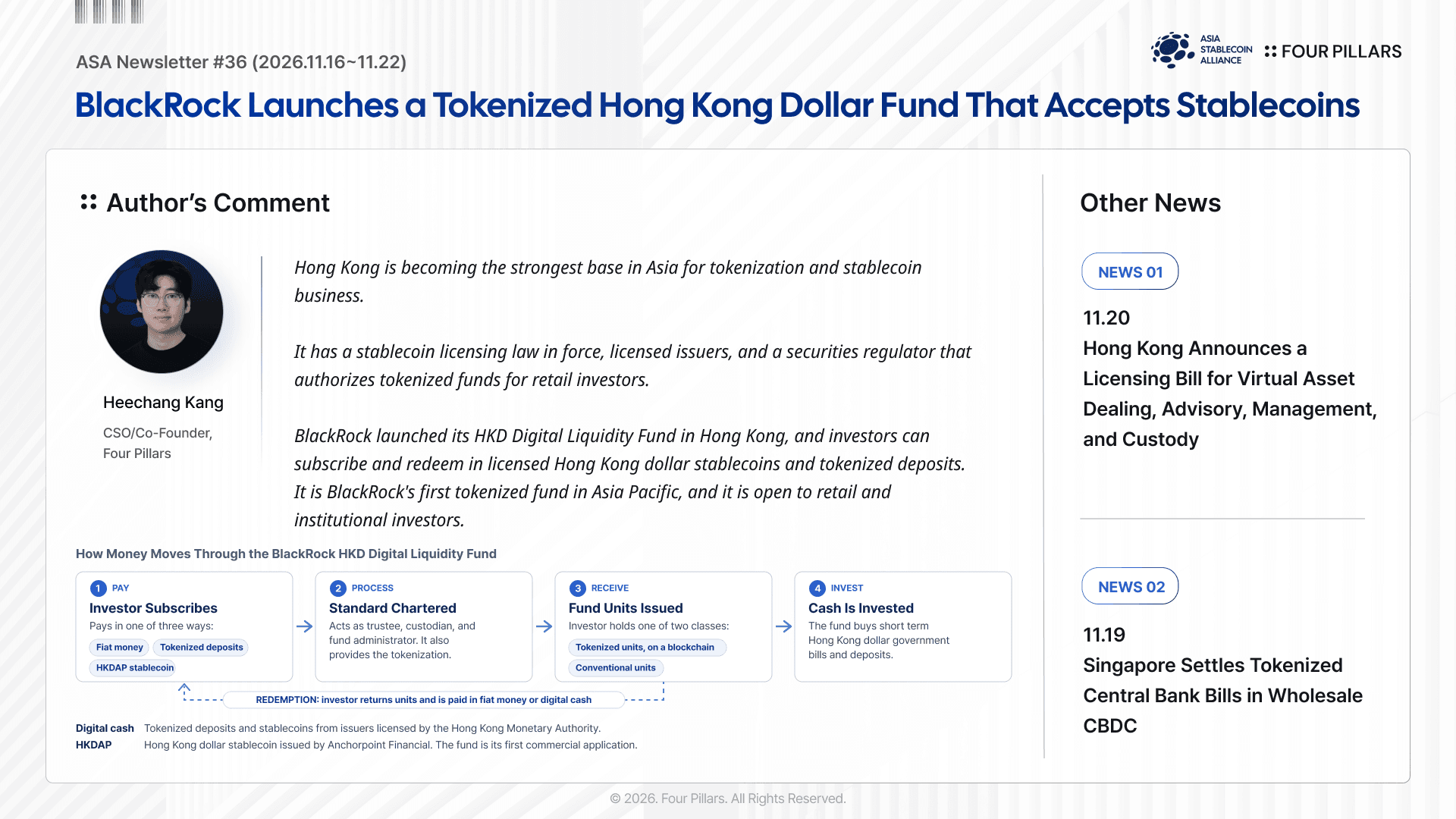
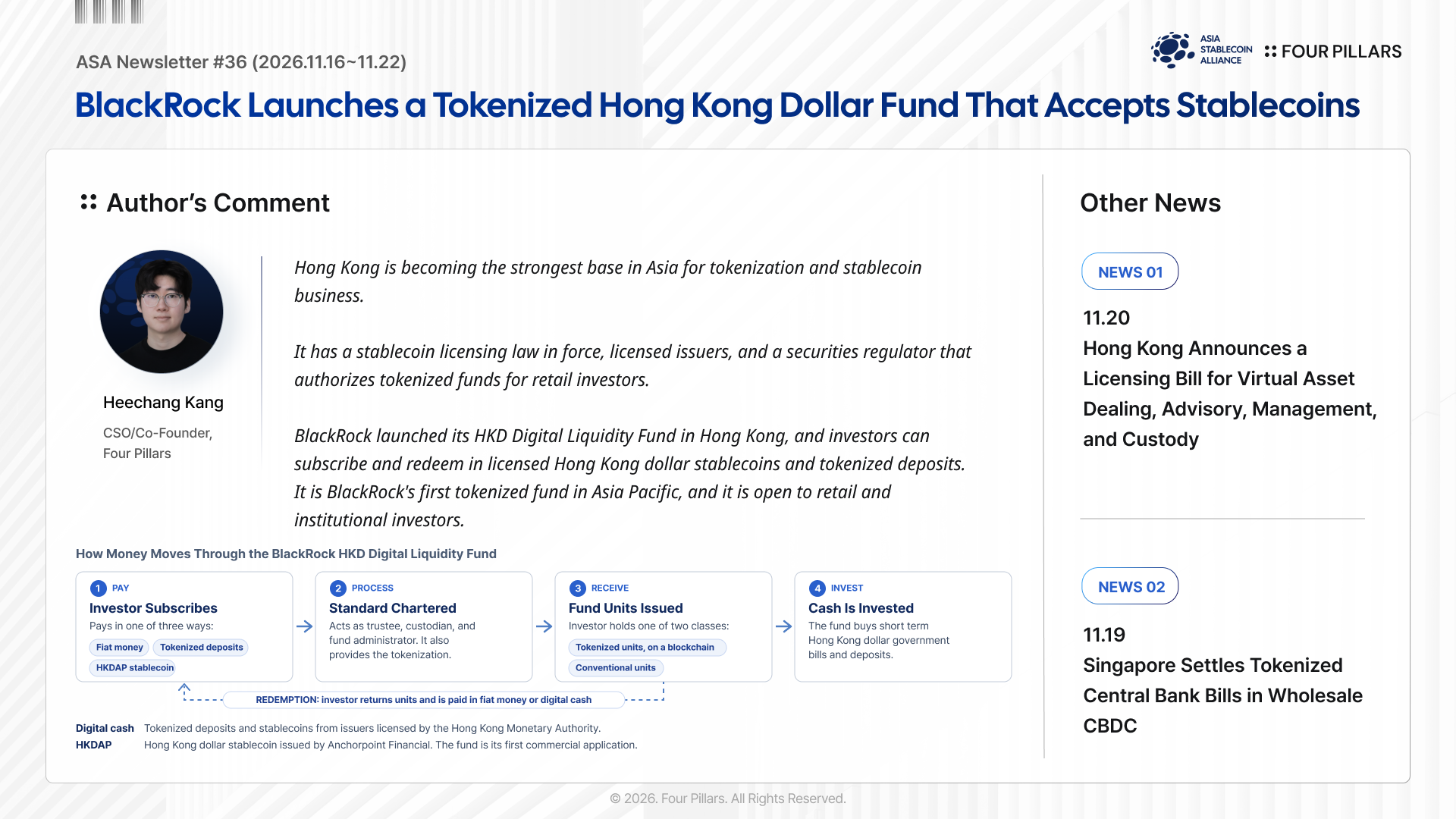
It has a stablecoin licensing law in force, licensed issuers, and a securities regulator that authorizes tokenized funds for retail investors. BlackRock launched its HKD Digital Liquidity Fund in Hong Kong, and investors can subscribe and redeem in licensed Hong Kong dollar stablecoins and tokenized deposits. It is BlackRock's first tokenized fund in Asia Pacific, and it is open to retail and institutional investors.
The fund gives HKDAP, the Hong Kong dollar stablecoin issued by Anchorpoint Financial, its first commercial use. Issuers licensed under the Stablecoins Ordinance now have a regulated investment product that accepts their tokens as cash, and asset managers have a working model for a retail tokenized fund in Hong Kong.
I expect more fund managers and licensed issuers to pair up in the coming months. The test I will watch is how much subscription volume arrives in stablecoins, because a fund that accepts a stablecoin gives holders a regulated place to earn a return on idle balances, and would show the demand.
Hong Kong also announced a bill on November 20 that brings virtual asset dealing, advisory, management, and custody under Securities and Futures Commission licensing, with first reading on December 2. Under current law, the licence requirement covers trading platforms, and the bill extends it to over the counter desks, advisers, asset managers, and custodians that serve Hong Kong clients.
1. BlackRock Launches a Tokenized Hong Kong Dollar Fund That Accepts Stablecoins
BlackRock formally launched the BlackRock HKD Digital Liquidity Fund in Hong Kong, as reported on November 22. The fund was established on November 16 with tokenized and conventional unit classes, after regulatory approval was announced on September 10.
The fund invests in short term Hong Kong dollar instruments such as government bills and deposits, and the tokenized class records unit ownership on a blockchain. It is BlackRock's first tokenized offering in Hong Kong and Asia Pacific, and it is open to both institutional and retail investors.
Investors can subscribe and redeem in fiat money or in digital cash, which covers tokenized deposits and stablecoins from issuers licensed by the Hong Kong Monetary Authority. HKDAP, the Hong Kong dollar stablecoin issued by Anchorpoint Financial, is a named channel, and the announcement describes the fund as the first commercial application of HKDAP.
Standard Chartered acts as trustee, custodian, and fund administrator and provides the tokenization. The fund forms part of BlackRock's work in the Hong Kong Monetary Authority's Project Ensemble.
2. Hong Kong Announces a Licensing Bill for Virtual Asset Dealing, Advisory, Management, and Custody
The Hong Kong government published the Virtual Asset Services Legislation (Amendment) Bill 2026 in the Gazette on November 20.
The bill amends the Anti Money Laundering and Counter Terrorist Financing Ordinance (Chapter 615) and extends the licensing regime beyond trading platforms to four more services, which are dealing, advisory, management, and custody.
Any person who carries on one of these businesses in Hong Kong must be licensed by or registered with the Securities and Futures Commission and must pass a fit and proper test. Banks and stored value facility licensees also fall within the regime and must register with the commission before they provide virtual asset services.
The bill excludes tokenized deposits from the definition of virtual assets, so banks can issue and use them for payments and settlement without a virtual asset licence. It also creates an offence for falsely claiming a title tied to virtual asset licensing status, with a maximum penalty of two years in prison.
The Securities and Futures Commission and the Hong Kong Monetary Authority both receive enforcement powers, and the bill goes to the Legislative Council for first reading on December 2. The press release does not state a commencement date, capital requirements, or transition arrangements for firms already operating.
3. Singapore Settles Tokenized Central Bank Bills in Wholesale CBDC
The Monetary Authority of Singapore said it issued S$100 million (about US$77 million) of four week tokenized MAS Bills on November 6, with maturity on December 4. The bills settled in wholesale central bank digital currency on the authority's test network.
Five primary dealers took part, namely DBS, HSBC Singapore, OCBC, Standard Chartered Singapore, and UOB. Their bids exceeded twice the amount on offer.
The authority will rename the test network SG Digital Ledger. It plans larger issuance volumes and more participating institutions, and sign ups for the next pilot round open in 2027.
Two related tests were announced in the same week. The authority and Deutsche Bundesbank tested wholesale central bank digital currency settlement of euro and Singapore dollar trades under Project Simbolon, and StraitsX linked the tokenised deposit networks of OCBC and Standard Chartered for US dollar payments that settled within minutes under the BLOOM initiative.
4. Other Updates by Market
- China: The Ministry of State Security warned on November 19 about illegal cross border transfers of personal data and said operators of illegal lookup databases reportedly settle in crypto assets. The Yueyang Public Security Bureau cancelled a RMB 2.745 million (about US$386,000) tender for crypto advisory services, which had required bidders to hold disposal authorization from a Hong Kong licensed exchange.
- Hong Kong: HSBC launched a tokenized Hong Kong dollar money market fund with a minimum subscription of 100 RedCoin units. The Hong Kong Monetary Authority will study interoperability between the Swift ledger and Project Ensemble for cross border tokenized deposits, and its November discussion paper proposes a Know Your Agent framework to verify the identity and delegated authority of AI agents. The Securities and Futures Commission added Hyperliquid and Hyperliquid Hong Kong to its list of suspicious virtual asset trading platforms, and HKEX targets 2027 for a pilot of tokenized warehouse receipt financing.
- India: Gate said it is working with lawyers in India to help users with frozen assets file a formal appeal. Merlin Chain said Indian law enforcement tagged its bridge address as linked to a scam in error.
- Indonesia: The House of Representatives passed the Asset Forfeiture Law, which covers crypto fraud and allows the state to seize fraudsters' assets. The Financial Services Authority received industry findings that identify three outstanding issues in asset tokenization, and the Deposit Insurance Corporation warned that sharp crypto price swings could spill over into banks.
- Japan: Materials from the Ministry of Finance study group show that Progmat will build a sandbox on the Canton Network testnet to issue tokenized government bonds, tokenized deposits, and stablecoins, and MUFG presented a repo pilot design that keeps bond title records on the book entry system. The government revised its basic policy on money laundering on November 19 and strengthened the police unit that traces crypto assets, and the Tokyo Regional Taxation Bureau found more than 3.9 billion yen (about US$26 million) of unreported income among 91 crypto users. Mitsui & Co. opened subscriptions for its first digital bond for individual investors, with about 2 billion yen (about US$13 million) planned.
- Malaysia: Maybank and Etiqa Life Insurance completed a pilot transaction in tokenized Malaysian Government Securities that paired tokenized securities with tokenized deposits. Maybank called it the first such transaction in Malaysia, and neither Bank Negara Malaysia nor the Securities Commission has confirmed that claim.
- Philippines: PDAX began accepting PYUSD, USDG, and USDPT for subscriptions to government Treasury bonds. Coins.ph restricted direct transfers to and from self custody wallets for its roughly 18.6 million users, and Binance's local partner BlockShoals Technologies remains in the preliminary phase of the Securities and Exchange Commission sandbox.
- Singapore: Monetary Authority of Singapore Managing Director Chia Der Jiun announced an agentic finance initiative on November 19, under which the authority is developing common protocols to verify the identity and delegated authority of AI agents that move funds. DBS and Circle now let eligible institutions mint and redeem USDC directly through DBS, and Visa Direct will let eligible Asia Pacific clients prefund cross border payouts with stablecoins, starting with dtcpay.
- South Korea: The National Assembly tax subcommittee did not pass the amendment that defers crypto taxation to 2029 on November 17, and the parties still disagree on a three year or five year loss carryforward after they agreed to keep the basic deduction at KRW 2.5 million (about US$1,800). The Financial Services Commission is reportedly drafting a pilot that would allow about 3,500 companies, including listed firms, to buy crypto assets. Lee Kangil of the Democratic Party said the government draft of the Digital Asset Basic Act could arrive as early as the week of November 23, and existing exchanges faced a November 20 deadline to renew their registration under the revised Specific Financial Information Act.
- Taiwan: The Taiwan Digital Asset and Future Capital Market Association held its founding meeting in Taipei with 46 members, including banks, securities firms, exchanges, and custodians.
- Thailand: Siam Commercial Bank became the first applicant to the Bank of Thailand sandbox for tokenised deposits, with SCBX and Token X supplying strategy and technology.
Key Dates Ahead
- 2026.11, Korea: Government draft of the Digital Asset Basic Act expected
- 2026.11, Thailand: Bank of Thailand stablecoin and BNPL rules begin rollout
- 2026.11, Japan: Progmat sandbox verification of tokenized JGB and onchain repo begins
- 2026.11, Australia: ASIC consultation on platform rules closes
- 2026.11.26, Thailand: Comment period on the stablecoin transfer cap closes
- 2026.12, Taiwan: Comment period on stablecoin issuance rules closes
- 2026.12.01, Japan: Coincheck revised terms of service take effect
- 2026.12.02, Hong Kong: First reading of the Virtual Asset Services Legislation (Amendment) Bill 2026
- 2026.12.03, Korea: Bank of Korea reporting on cross border transfers begins
- 2026.12.04, Singapore: First tokenized MAS Bills mature
- 2026.12.09, Korea: National Assembly regular session ends
- 2026.12.14, Hong Kong: HKEX begins digital Hong Kong dollar settlement for overnight margin
- 2026.12.16, Taiwan: Comment period on Virtual Asset Service Act sub regulations closes
- 2026 year end, Korea: Revised exchange security inspection standards
- 2027, Hong Kong: Crypto asset reporting by exchanges begins
- 2027, Hong Kong: HKEX target for a tokenized warehouse receipt financing pilot
- 2027, Singapore: Sign ups open for the next tokenized MAS Bills pilot round
- 2027.01.09, Korea: Ruling party target for passing the Digital Asset Basic Act
- 2027.01.18, United States: GENIUS Act takes effect
- 2027 early, Japan: FSA interim summary and public private roadmap
- 2027 Q1, Taiwan: Virtual Asset Service Act and sub regulations could take effect
- 2027.02.04, Korea: Token securities system takes effect
- 2027.02.27, Thailand: Travel Rule takes effect
- 2027.03, Japan: Megabank yen stablecoin commercial launch target
- 2027.04, Australia: ASIC platform rules take effect
- 2027.07.01, Australia: Indexation replaces the 50 percent CGT discount on crypto
- 2028 H1, Korea: Crypto tax guidelines published
- 2029.01.01, Korea: Digital asset income taxation takes effect under the deferral plan