


Table of Contents
- Key Takeaways
- 0. Do you really control your own money?
- 1. What does closed money mean?
- 2. What does open money change?
- 3. Why MetaMask?
- 3.1 Dollars inside the wallet: mUSD
- 3.2 When onchain money is used in the real world: MetaMask card
- 3.3 Another tool for open money: Agentic wallet
- 4. The endgame for wallets is open money
Researcher

Related Projects

Key Takeaways
- The balance in a banking app is not money you directly hold but a claim recorded on the bank's ledger. This closed money is permissioned, intermediated, and fragmented, and its friction surfaces the moment money crosses systems or borders.
- Open money shifts the center of money from institutional accounts to user wallets. A wallet is not a box that stores assets but a key that moves them, and with self custody as the foundation, money becomes programmable and composable.
- MetaMask shows the wallet evolving into an operating system for money by stacking mUSD, the card, and agentic payments on top of it. Storage, spending, payment, and even agent delegation converge into a single wallet, which is why the endgame for wallets is open money.
0. Do you really control your own money?
Open the banking app on your phone. When we see the balance in the center of the main screen, we naturally think that this number is our money. In daily life, this belief rarely causes problems. Salaries arrive on time, and card payments and transfers take only a few taps. In countries with well built financial infrastructure, there is little friction in the UX, or user experience. For that reason, most people have no reason to ask, “Do I directly own this money?”
But the picture changes when we look at the structure. The balance in a banking app is not a pile of physical cash. It is closer to a number on a ledger that records the bank’s obligation to pay me that amount. In other words, it is less like cash in my hand and more like a claim against the bank. As long as this money is a claim recorded on the bank’s ledger, it is hard to say that the final authority to move it belongs entirely to me.
Most of the time, this fact is not visible. But when a transfer limit applies or an account is frozen, the balance can still appear intact while not a single cent can be moved. It looks like my asset. Structurally, however, it is a right against the bank, which means that the authority to block or freeze it also exists outside me.
If this is the friction that comes from the legal nature of money, we also need to consider the fragmented infrastructure through which money moves. Even when an account is fine and no limit applies, friction appears the moment money has to move into another system. Consider an overseas transfer. Filters that did not exist within the same currency zone start to appear: foreign exchange, intermediary banks, fees, and business days. I cannot fully control when my money will arrive.
These two types of friction come from the same structure: institutions hold my money in closed ledgers, and those ledgers are fragmented from one another. Having money and being able to move that money as I choose are therefore two very different things. We can call the money we encounter in daily life with these characteristics “closed money.” The bottlenecks created by this structure are usually hard to see. They become clear when money crosses borders, moves across platforms, or passes between different systems.
Can this closed structure be opened? Open Money is an attempt to address this bottleneck. Its basic idea is to let money flow like the internet, without keeping it locked inside specific institutions or national borders.
1. What does closed money mean?
To understand open money, we first need to look at closed money.
First, closed money is permissioned. To move money, someone’s approval is required. A bank approves a transfer, a card company approves a payment, and a payment network processes the transaction. The user presses a button, but the actual movement of money is authorized inside the system.
Closed money is intermediated. There is always a third party between me and my assets. A banking app is a window into the bank’s ledger. A brokerage app is a screen that reflects the broker’s account system. A payment app may offer a smooth UX on the surface, but it is ultimately an interface built on top of banks, card companies, and merchant settlement networks.
Finally, closed money is fragmented. Money in a bank account, money in a brokerage account, a balance in a payment app, an exchange balance, and dollars in an overseas account all appear to be “my money.” In reality, they are spread across different systems. When money moves from one system to another, new procedures such as withdrawal, deposit, settlement, and approval are required each time.
This structure is stable. It includes consumer protection, allows for recovery in many cases, and is familiar to users. For that reason, arguing that “banks are fake” makes the case for open money weaker. People already use banks well, and this system has remained in place for hundreds of years.
The real question is this: Should money still remain this closed in an age when it moves over the internet? Music moved from files to streaming. Software left CDs and settled in the cloud. Information now crosses the boundaries of portals and apps through APIs. Yet money is still scattered across institution specific ledgers. Open money focuses on this point.
2. What does open money change?
Open money shifts the center of money from institutional accounts to user wallets.
In the world of open money, users connect to the network with their wallets. Here, a wallet is not just an app. Onchain, a wallet is an account, a login, signing authority, and the key that moves assets. If a banking app is a window into a ledger, a wallet is closer to the authority to move assets directly.
Of course, the assets are not physically inside the wallet. Onchain assets are recorded at addresses on a blockchain, and the wallet manages the private keys and signing authority that can move the assets at those addresses. Put simply, a wallet is less a box that holds money and more a key that moves money.
Holding this key directly is self custody. Self custody does not simply mean “I store it myself.” It means that, instead of depositing money into someone else’s account, I control the asset directly with a key that I hold. The core of open money is control.
Blockchain fits this structure for a clear reason. It turns money into a state on a public network rather than a record in a specific company’s database. Anyone can see the same rules, use the same address system, and interact with the same protocols. Assets move 24 hours a day, can include conditions and logic through smart contracts, and allow services to connect with one another without permission.
This is programmable money and composable money. Money is no longer just a number that is sent and received. It can be combined with code, move automatically, connect with other financial protocols, and settle directly on a global network.
At this point, blockchain moves from an abstract technology discussion into an experience that users can feel. Examples include freelancers receiving payments from overseas clients, startups paying team members across several countries, and users who want to hold and use stablecoins outside exchanges. The same applies to people involved in internet native economic activity, such as games, creators, and AI agents, as well as onchain users who move assets in markets that are open around the clock. What matters to them is that money can move without being locked inside a specific bank, country, or app.
This structure is not a finished alternative by itself. Self custody gives users control, but it also gives them responsibility. Key management, phishing, mistaken signatures, and recovery remain risks that users must handle. The main question for open money is therefore not simply whether “users control their money directly.” It is whether security and UX friction can be reduced while that control remains with the user.
3. Why MetaMask?
At the center of this shift is the self custody wallet, and MetaMask is a clear example of how a wallet can evolve into a money platform.
It started as a simple wallet. Before MetaMask, interacting with the Ethereum network meant dealing with the command line. Running a node, connecting to RPC endpoints, handling private keys directly, and signing transactions one by one were barriers that most ordinary users could not cross. MetaMask lowered that barrier with a browser extension. Creating an Ethereum account, connecting to dapps, and signing transactions became a matter of a few clicks.
As more wallets with this structure appeared and time passed, the role of the wallet began to change. At first, it stored tokens. Then it became a way to log in to dapps. Later, it took on swaps, bridges, and connections across multiple chains. Now stablecoins, card payments, yield products, and derivatives are entering the wallet. One constant runs through this shift: financial functions are being absorbed into the wallet on the basis of self custody.
Existing fintech super apps also add many functions. They bring transfers, investing, cards, points, and loans into one app. But most of them operate on platform accounts and the ledgers of partner financial institutions. Users get a convenient app, but the money remains inside closed systems.
MetaMask is moving in a different direction. It puts the user’s wallet at the center of financial activity. Whether the user swaps, holds stablecoins, bridges assets, or uses a card, the starting point is the user’s wallet, not a platform account. This may look like a small difference, but in the structure of open money, it is the main point. Control over money moves from the platform account to the user’s wallet.
3.1 Dollars inside the wallet: mUSD
MetaMask’s mUSD shows this direction.
There are already several dollar based stablecoins in the market. What sets mUSD apart is not issuance itself, but the fact that it can be handled directly within the wallet experience. Users can hold a dollar based asset in the wallet, swap it, bridge it, deposit it into DeFi when needed, and use it for payments.
Previously, this flow was split into several steps. Users bought assets on an exchange, sent them to a wallet, connected to a dapp, and then sent them back to an exchange to cash out. This was cumbersome even for onchain users. For ordinary users, it was a real entry barrier. They simply wanted to use money, but they kept having to act like plumbers. They had to know which chain to use, which network to withdraw to, what a bridge is, and why fees are needed.
mUSD brings these steps into the wallet. When a dollar based asset sits inside the wallet and connects to both onchain finance and real world payments, the wallet is no longer just a place for storage. It becomes a structure where storage, use, and payment can happen in one wallet.
Furthermore, mUSD held in the user's Money Account generates an annual percentage yield (APY) of up to 6%. This is not interest paid directly by MetaMask, but rather a variable yield automatically generated as the deposited funds are utilized in the on-chain lending market. Importantly, there is no lock-up period, allowing users to freely spend, send, and trade their funds at any time.
3.2 When onchain money is used in the real world: MetaMask card
For open money to work as intended, it must eventually be spendable.
Even if users manage their assets well onchain, the experience may remain incomplete for the mass market if they cannot buy a cup of coffee at a nearby cafe. In practical terms, people care more about money that can actually be used for payment than about financial philosophy. This is why the MetaMask card matters.
Many existing crypto cards work by requiring users to deposit assets into an exchange or card company account. They are convenient, but they return users to a custody based structure. To use crypto, users end up depositing assets with a third party.
The MetaMask card keeps assets in the user’s wallet until just before payment. Users can connect assets in their wallet to real world card payment networks. This is the moment when onchain assets stop being numbers inside an investment app and become a payment method in daily life.
This is the most direct image of open money. Money stays in my wallet until just before payment, then is used at a real world merchant when needed. The center of storing, managing, and spending money becomes one wallet.
There are still practical constraints, including supported countries, issuers, card networks, regulation, and merchant policies. These are still being addressed, so users in different regions do not yet have the same experience. Even so, the direction shown by MetaMask is clear. The wallet is becoming the interface between onchain assets and offline payments. At this point, the wallet is no longer a “coin storage app.” It is a payment interface for using money in practice.
3.3 Another tool for open money: Agentic wallet
Let’s move to a more future oriented topic. Everything discussed so far has had one assumption: the party that moves and uses money is a person.
But what happens if the party spending money is not a person? In an era when AI agents conduct research, renew subscriptions, and settle costs for each API call, that assumption begins to weaken. If a human must approve a signature popup every time an agent makes a payment, it is not automation. This is the bottleneck in agentic payment. Transactions need to occur at machine speed, but human decisions enter every transaction.
The simplest solution is to hand the agent the entire private key. But this directly breaks self custody. Once the key is handed over, the agent can use the whole wallet at will, and the user loses control. Automation is gained at the cost of the very control that open money was meant to preserve.
MetaMask is taking a different path. Smart Accounts use account abstraction to delegate only specific permissions without handing over the key. With ERC 7710 delegation and ERC 7715 permission requests, users can grant an agent limited authority, such as “use up to 10 USDC per day, for one month, only to buy ETH.” The agent can transact without human intervention within that limit, while control of the full wallet remains with the user. This is where automation and self custody can coexist without conflict.
This structure itself is not an entirely new idea. In 2023, MetaMask had already presented a similar idea in the form of a “trusted session.” Once a user approved a session key, transactions within that scope did not require a new signature each time. A typical example at the time was a blockchain game where users did not want to deal with wallet popups for every action. This idea, which started with games, was standardized through ERC 7710 and ERC 7715. It has now become a basis for delegating authority to agents rather than humans.
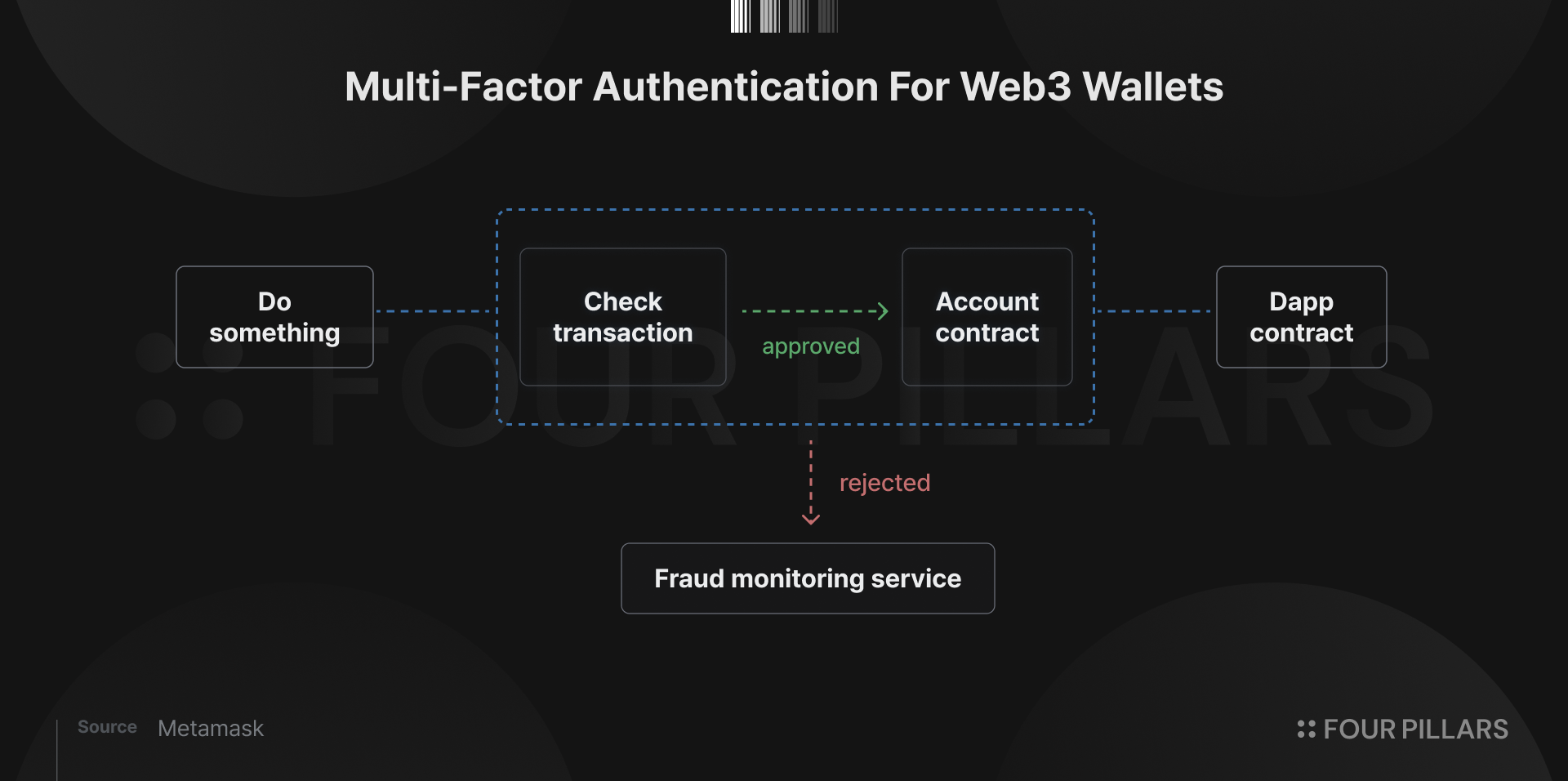
When x402 is added to this structure, the framework for agentic payment comes together. x402 defines a machine readable payment flow on top of HTTP. Based on ERC 7710 delegation, agents can pay per request, subscribe autonomously, and stream micropayments without manual wallet operation. This structure is difficult to achieve in the world of closed money, where humans approve each step. A payment network where machines send money directly to machines under defined conditions opens on top of the wallet.
Source: X (@MetaMask)
One place where this attempt can be seen is the Smart Accounts Kit Hackathon, co hosted by MetaMask. With 321 builders and 142 submissions, it recorded the highest number of projects among MetaMask hackathons. The theme was applications in which agents pay autonomously, and agents also took part as judges.
On top of open money, the wallet eventually becomes a permission layer through which agents delegated by humans can move money. If the wallet is the operating system for money, agentic payment is the moment when that operating system opens to agents as well as humans.
4. The endgame for wallets is open money
Let’s return to the title. The wallet began as a simple signing tool. Sending tokens, connecting to dapps, and approving transactions were all it did.
But if the wallet is the key that moves the user’s assets, more financial functions will naturally be built on top of it. Swaps, bridges, stablecoins, yield products, card payments, multichain functions, and derivatives trading enter the wallet. This is not a simple list of features. It is the process of the wallet becoming the operating system for money.
In the world of closed money, financial apps were windows into institutional systems. In the world of open money, the wallet is the user’s starting point for handling money directly on the network. The question is not whether wallets will fully replace banks. The point is that a new option appears. Existing finance will continue to handle routine domestic payments well. But money that is global, programmable, and able to move across apps and protocols requires a different structure. The wallet is at the center of that structure.
If the balance in a banking app is a number on a ledger, an onchain wallet is the key that directly moves assets. Closed money brings users into a system. Open money lets users move across systems with their own wallets.
That is why the endgame for wallets is open money. Token storage, dapp login, and NFTs were intermediate stops. The destination is a new layer where users directly control their money and move it freely, so that money can move like the internet.
The report is based on the independent research of the author sponsored/funded by MetaMask. The author of this report may have personal holdings or financial interests in assets or tokens discussed herein. However, the author affirms that no transactions have conducted using material non-public information obtained in the course of research or drafting. This report is intended solely for general information purposes and does not constitute legal, business, investment, or tax advice. It should not be used as a basis for making any investment decisions or as guidance for accounting, legal, or tax matters. Any references to specific assets or securities are made for informational purposes only and should not be construed as an offer, solicitation, or recommendation to invest. The opinions expressed herein are those of the author and may not reflect the views of any affiliated institutions, organizations, or individuals. The opinions and analyses expressed herein are subject to change without prior notice. In addition, beyond the individual disclosures included in each report, Four Pillars, may hold existing or prospective investments in some of the assets or protocols discussed herein. Furthermore, FP Validated, a division of Four Pillars, may already be operating as a node in certain networks or protocols discussed herein or may do so in the future. Please see below links in the footer for FP Validated's participating network disclosures and for broader disclosure details.


