

Table of Contents
Researcher

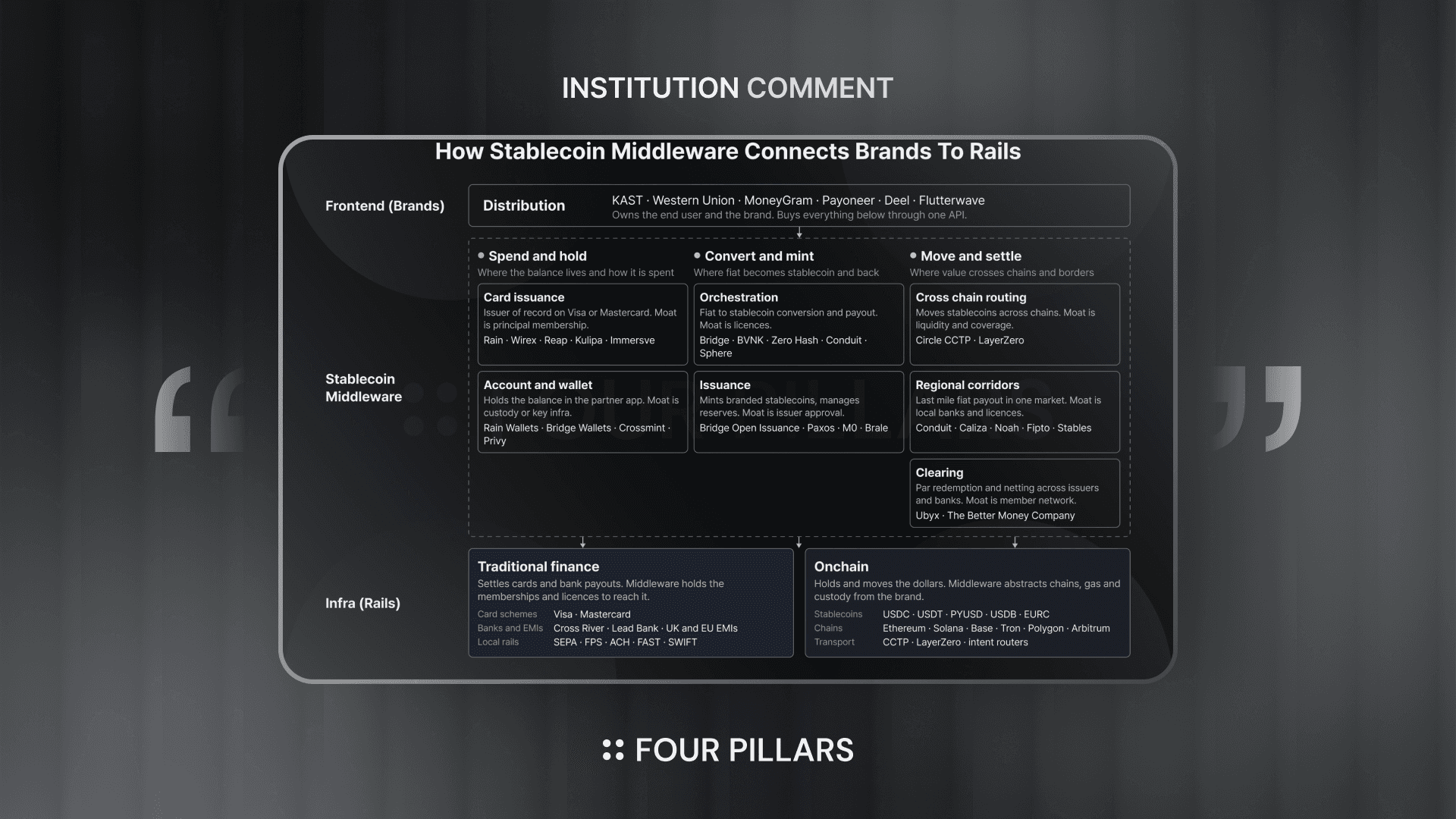
Let’s first define stablecoin middleware.
It is the set of licensed and technical intermediaries that sit between a customer facing brand and the underlying rails. In simple terms, they facilitate the connection of on chain activity and traditional finance activities.
Most users of Etherfi, Western Union, and Klarna do not know what happens behind the scenes.
The brand owns the user, while the rails, including Visa, Mastercard, banks, and blockchains, handle settlement. Middleware manages everything in between from compliance, licensing, conversion, custody, card authorization, to payouts.

Three Middleware Groups Have Been the Most Successful Business Models.
First, card issuance platforms such as Rain, Wirex, Bridge, and Kulipa have built their businesses on scheme membership. Rain and Wirex are principal members of both Visa and Mastercard. Bridge is the newest entrant, having expanded its Visa partnership in March 2026 to cover card issuance.
Principal member status, which very few firms obtained, allows these platforms to act as the issuer of record and settle directly with the networks. This lets partners such as KAST, Western Union, and MoneyGram launch cards through a single integration without a sponsoring bank.
Second, orchestration platforms such as Bridge, BVNK, Zero Hash, and Conduit have built their businesses on licensed fiat and stablecoin relationships. Teams that need a vendor to act as the regulated entity shortlist Bridge, BVNK, Zero Hash, or Conduit for this reason.
For example, traditional brokerage platforms such as Interactive Brokers use Zero Hash to let users fund their account balances with stablecoins.
Third, wallet infrastructure providers such as Privy, Dynamic, and Turnkey have built their businesses on owning the user’s onchain account. Their embedded wallets let an app create a wallet for every user at sign up, so the user never handles a seed phrase or installs a separate wallet app, while private keys stay protected in secure enclaves or split across parties.
This group has consolidated quickly. Stripe acquired Privy in June 2025 and Fireblocks acquired Dynamic in October 2025. According to Stripe CEO Patrick Collison, Privy has grown wallet assets 25 times, monthly active developers 3 times, and revenue 9 times since joining Stripe.
Wallet providers also already sit underneath the other two groups. Zero Hash uses Dynamic to let businesses send and receive stablecoin payments.
All Three Groups Are Now Moving into Each Other’s Territory.
- Rain has added embedded wallets that link users’ balances to cards, virtual accounts, onramps, offramps, and payouts.
- Bridge has expanded in the other direction, offering financial accounts in more than 100 countries and Visa card issuance tied to stablecoin balances.
- BVNK is adding wallets and spending experiences, and Mastercard has acquired it for up to $1.8 billion.
- Crossmint has expanded from wallets into payments, joining the Solana Foundation’s developer platform in March 2026 as an official partner for wallets, onramps, and offramps, and launching a card payments API for AI agents with Visa Intelligent Commerce in June 2026.
Interestingly, BVNK has also moved beyond its original category since Mastercard completed the acquisition in August 2026. Yesterday, the two companies launched Mastercard Global Money Platform, which combines Mastercard’s global payments network with BVNK’s stablecoin infrastructure through a single API, so businesses can move and manage both fiat and stablecoins without juggling separate accounts, vendors, and prefunded balances in each market.
The vendor that once handled a single step now wants to own the wallet, hold the balance, issue the card, and manage the payout. This raises switching costs for every institution that integrates with it.
What If Middleware Keeps Getting Fatter?
These companies have built a moat by making things run smoothly. That creates revenue, which they can use to expand into more categories and make even more parts of the experience seamless.
Traditional firms have quickly claimed a share of the market to avoid being threatened by expanding middleware providers. Stripe acquired Bridge and Privy, Mastercard acquired BVNK, Fireblocks acquired Dynamic, and Visa invested in Rain, among other moves.
What happens when they have max-improved the experience by making it smoother?
Expanding into non-stablecoin assets, new regions, and partnerships may be relatively easy. Expanding into new categories, such as stablecoin issuance, as Bridge has done, could be more challenging, but it also opens up new market opportunities.
Regulatory uncertainty is limiting faster and broader expansion, making this a timely opportunity for middleware providers to get fatter, and the timing for these companies to blitzscale is still uncertain (especially in asia) but we can now see where these middleware business are expanding into.
The author of this report may have personal holdings or financial interests in assets or tokens discussed herein. However, the author affirms that no transactions have conducted using material non-public information obtained in the course of research or drafting. This report is intended solely for general information purposes and does not constitute legal, business, investment, or tax advice. It should not be used as a basis for making any investment decisions or as guidance for accounting, legal, or tax matters. Any references to specific assets or securities are made for informational purposes only and should not be construed as an offer, solicitation, or recommendation to invest. The opinions expressed herein are those of the author and may not reflect the views of any affiliated institutions, organizations, or individuals. The opinions and analyses expressed herein are subject to change without prior notice. In addition, beyond the individual disclosures included in each report, Four Pillars, may hold existing or prospective investments in some of the assets or protocols discussed herein. Furthermore, FP Validated, a division of Four Pillars, may already be operating as a node in certain networks or protocols discussed herein or may do so in the future. Please see below links in the footer for FP Validated's participating network disclosures and for broader disclosure details.


