
Table of Contents
- Key Takeaways
- 1. This Month's Ethereum Discussion Summary
- 2. Newly Drafted EIPs
- 2.1 Core / Networking Layer
- 2.2 Data / Messaging / Transaction
- 2.3 Account / Contract / Token Standard / Wallet
- 2.4 Application
- 3. Progression of Existing EIPs
- 3.1 Core / Networking Layer
- 3.2 Data / Messaging / Transaction
- 3.3 Account / Contract / Token Standard / Wallet
- 3.4 Application
- 4. Keeping Ethereum’s Knowledge Open
Researcher

Related Projects

Key Takeaways
- October saw a sharp rise in new EIPs and progress on existing proposals. Core work focused on execution, gas accounting, and data transmission to support higher throughput through Glamsterdam, while ERCs sought to standardize approvals, management, and use of on-chain assets in finance and everyday services.
- The impact on existing services and users also came into focus. EF delayed Glamsterdam’s Hoodi rollout and the gas limit increase for further compatibility checks with existing contracts, while introducing safeguards that verify transaction outcomes and privacy tools that separate API usage from payment information.
- As these changes and their effects grow more complex, helping new contributors understand the reasoning behind them becomes increasingly important. Organizing EIP design decisions, discussion histories, and relationships between proposals, then making them accessible through education and research, is also part of keeping Ethereum decentralized.
Ethereum pioneered the concept of smart contracts by integrating programmability into a distributed ledger architecture, thereby expanding the functional scope of blockchain systems. This design philosophy has been progressively formalized through the Ethereum Improvement Proposal (EIP) process, enabling the network to evolve beyond a simple store of value into an infrastructure capable of supporting real-world businesses and a wide range of use cases. As this evolutionary process continues, broader participation in EIP deliberations - by opinion leaders with heterogeneous perspectives and problem framings - may further enrich the development of a digital-native economic paradigm.
This article presents a high-level examination of EIP trends by reviewing proposals newly accepted into the Draft stage on a monthly basis, alongside proposals that have undergone meaningful status transitions. Through this analysis, we aim to provide builders and business stakeholders with a more structured understanding of the evolving EIP landscape and to offer a conceptual foundation for identifying and developing new value propositions within their respective areas of activity.
The EIP-related data referenced in this article was collected and analyzed using the official GitHub repositories for EIP, ERC, and RIP.
1. This Month's Ethereum Discussion Summary
New EIP activity rebounded sharply in October after two quieter months, as Glamsterdam’s main protocol changes and the proposals supporting them advanced together. A total of 22 EIPs entered Draft, up 12 from September, while 36 existing proposals changed status. Most moved to the next stage, though EIP-8333 was withdrawn.
Many of the Core and Networking EIPs that advanced are directly tied to Glamsterdam. EIP-7732 separates block proposers and builders at the protocol level, while EIP-7928 records accessed accounts, storage locations, and updated values in block access lists (BALs), supporting parallel execution and data prefetching. Alongside them, EIP-8037 introduces separate metering for state creation, and EIP-8038 adjusts the cost of accessing and writing existing state. Taken together, these proposals would reshape execution and gas accounting to increase throughput per block while keeping nodes’ storage and execution demands manageable.
Among the new proposals, several focused on more efficient data transmission to support these changes. EIP-8247 reduces redundant transmission by replacing addresses and storage keys already included in recent BALs with short references, while EIP-8411 splits execution payloads into chunks that can be verified and relayed as they arrive. EIP-8364 reduces server workload by specifying data locations and traversal order more compactly in SSZ proof requests. Separately, EIP-8450 proposes advance registration of post-quantum keys, giving validators a way to prepare before the signature scheme itself changes.
ERC proposals focused on standardizing the workflows needed to use on-chain assets in financial operations and everyday services. ERC-7963 incorporates financial institutions’ payment instruction approvals into token transfer conditions, while ERC-8348 provides a common way to query and handle lease payment schedules, overdue status, and rights to receive payments. ERC-8426 introduces an interface connecting NFT tickets and memberships to passes in Apple Wallet and Google Wallet. Existing proposals also advanced, including ERC-8262 for verifying whether private information meets specified rules, ERC-7945 for private token interfaces, and ERC-8325–8329 for managing RWA assets, documents, permissions, and histories. Across these proposals, work continued on the standards needed to approve, manage, and use assets after issuance.

Source: Ethereum
Glamsterdam’s testnet rollout also progressed in October, though checks on its impact on existing applications led to a delay. Following the Sepolia upgrade on October 6, the Ethereum Foundation (EF) announced the Hoodi rollout schedule on October 16. Six days later, however, it postponed the Hoodi upgrade to further examine how EIP-8037 interacts with existing mainnet contracts, also putting the planned gas limit increase to 200 million on hold. As Ethereum expands capacity, checking that existing applications still work under the revised gas schedule has become just as important.
User security discussions looked beyond what users sign to what actually happens when a transaction executes. On October 5, EF’s Access cluster introduced native transaction assertions as a research topic under the Trillion Dollar Security initiative. Even if users review a signing prompt or simulation, the state can change before execution, so the proposal would check the final outcome and revert the transaction if user-defined conditions are not met. EIP-7906, one possible implementation, would perform final checks on minimum amounts received, spending limits, and whether users retain control of their accounts, letting them set safeguards for transaction outcomes.
In privacy, efforts to separate service usage from payment information led to a working implementation. On October 1, EF’s dAI team unveiled zkAPI, developed with the Open Anonymity Project and available on Ethereum mainnet. Users deposit funds into a vault, then use ZK(zero knowledge) proofs to demonstrate they can pay for API requests, making it difficult for providers to identify which deposit funded a given request. Although zkAPI does not hide request contents or IP addresses, it offers a way to limit the usage histories that build up around payment accounts when accessing AI services or blockchain RPCs.
2. Newly Drafted EIPs
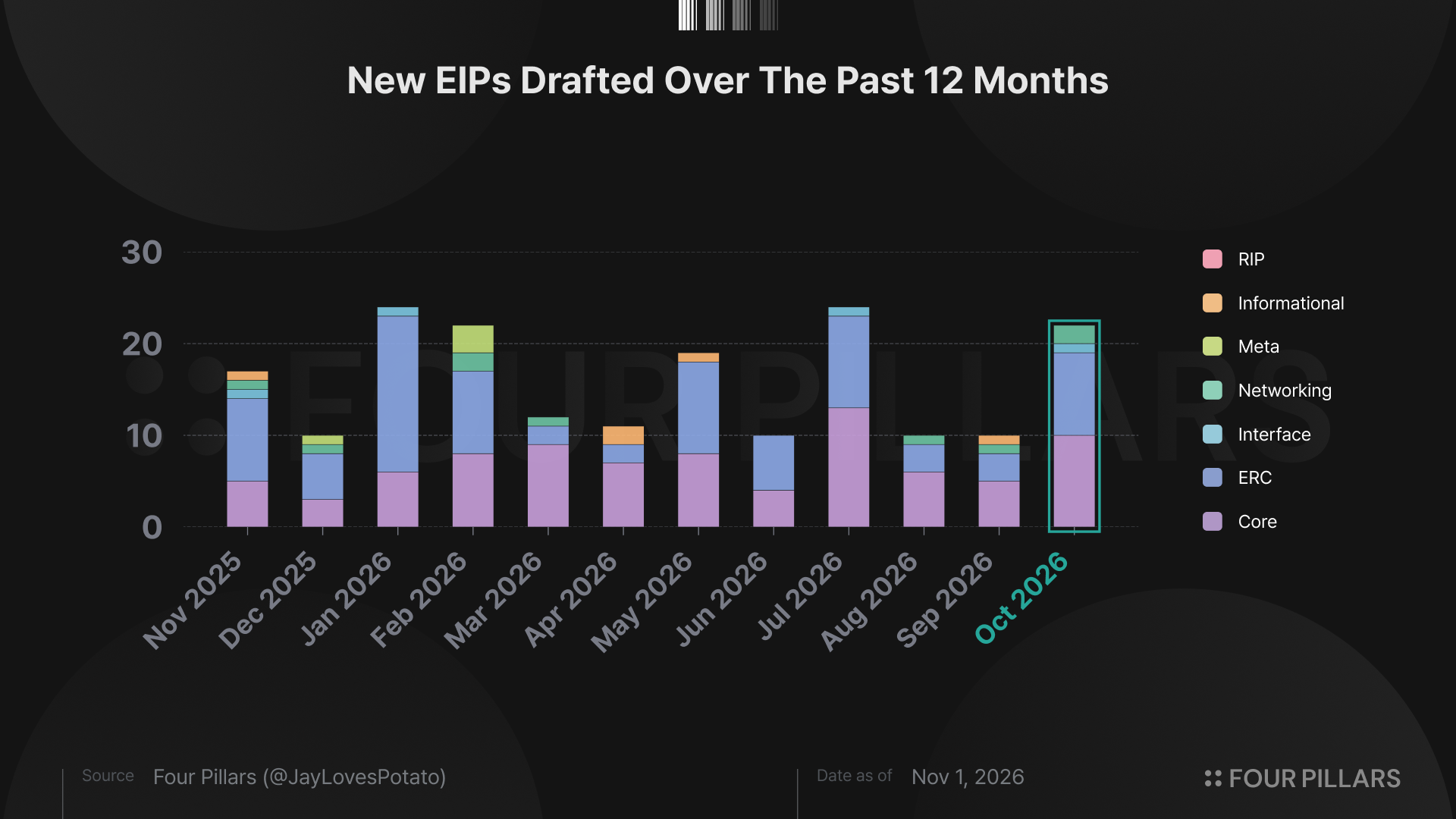
A total of 22 new EIPs entered Draft in October, up 12 from the previous month. Most were Core EIPs proposing changes to the network itself, or ERCs defining standards for applications.
Below, we break down these new proposals by category and take a closer look at those worth watching.
2.1 Core / Networking Layer
2.1.1 EIP-8364: SSZ Compact Multiproofs
Verifying Ethereum data does not require downloading all of it. With a Merkle proof, a client needs only the relevant data and a few supporting hashes to check whether it belongs to a known root. A multiproof verifies several pieces of data together, reducing transmission by including shared supporting hashes only once. For services that request proofs frequently, however, efficiency also depends on how clients specify the data they need and how servers retrieve it.
Existing SSZ multiproofs identify the target data using generalized indices, numbers that represent positions in the tree. The server then calculates which supporting hashes are needed and the order in which to retrieve them. EIP-8364 proposes replacing this request with compact instructions for traversing the tree. The client prepares these instructions in advance, and the server follows them to assemble and return the proof.
These instructions form the proof descriptor, which follows two rules: 0 means descend into the left and right children, while 1 means retrieve the value at that position and stop descending along that branch. If the target data and supporting hashes comprise N nodes, the descriptor takes 2 * N - 1 bits. It compresses the information describing where those values sit in the tree, rather than the 32-byte values themselves.
The same descriptor also guides verification. The client combines and hashes the returned values in the specified order, then checks the result against the known root. For light clients and proof APIs, this could spare servers from calculating supporting node positions and traversal order for every request. Widely scattered targets can produce longer descriptors, though, so the format does not reduce transmission size in every case.
A matching root alone does not guarantee that the proof covers the data the client intended to verify. The client must construct the descriptor from its target positions or check it against them, and verify length information for lists whose structure depends on their length. EIP-8364 therefore adds a new format while preserving the existing SSZ structure and proof formats. Its practical value lies in simplifying both proof requests and server processing for services that fetch proofs on demand.
2.1.2 EIP-8450: Post-Quantum Consensus Key Registry
Preparing Ethereum for quantum computers means being able to change signature schemes without stopping the network. The BLS signatures validators use today would become insecure against a sufficiently powerful quantum computer, but choosing a replacement does not mean every operator will be ready at once. EIP-8450 proposes registering post-quantum keys in advance to bridge that gap. Operators could test new keys and software while the network continues using BLS, with the actual signature switch left to a later hard fork.
Registering a new key requires both authorization from the existing validator and proof that the operator holds the new private key. The operator signs the registration with the existing BLS key, then signs with the new scheme, leanXMSS, to demonstrate control of that key. Nodes verify both signatures before recording the new public key in the consensus layer. Since the key is not immediately used for validator duties, operators can check that key generation and signature verification work before the transition.
Changing signature schemes also requires revisiting how validators are randomly selected for certain duties. BLS produces a unique valid signature for a given key and message, allowing it to support random selection, whereas leanXMSS leaves room to choose among signatures for a favorable outcome. To prevent this, validators commit to random outputs in advance by registering a verification value called vrf_root. When an output is later revealed, other nodes can check it against that commitment, with the rules for its use left to a future fork.
For operators, a major change is the need to track signature usage alongside the private key. Each leanXMSS signature uses a different one-time signing position, or “leaf,” and reusing one creates a risk of forgery. Restoring an old backup after a failure, for example, could make a previously used leaf appear unused, so restoring the key file alone is not enough to resume signing safely. EIP-8310, which EIP-8450 references, addresses this by requiring signers to check the latest usage record and securely persist the updated state before releasing a signature.
Advance registration could help the network assess when it is ready to switch, though registering a key once does not guarantee that it will still work on transition day. Registration and key updates also rely on BLS authorization, so Ethereum would need to switch before quantum attacks become viable, or freeze key updates through a separate fork. EIP-8450 would let operators begin the work early and give the network a way to track their progress toward a post-quantum transition.
2.1.3 Other(s)
- EIP-8357: EVM Verification Key Registry
- EIP-8358: Net Gas Metering for Account Changes
- EIP-8374: Persist Warm Access Sets Across Reverts
- EIP-8408: eth/73 - Indexed Cell Requests
- EIP-8425: Quantum Freeze and Account Recovery
- EIP-8433: Retire 0x00 Validators
- EIP-8435: Last-Written Block in PBT Leaves
2.2 Data / Messaging / Transaction
2.2.1 EIP-8247: Ancestor-Indexed BALs
When validating a block, Ethereum nodes read account balances and contract storage values from disk. EIP-7928 proposes block access lists (BALs) to speed up this process by identifying the accounts and storage locations needed in advance. When consecutive blocks access the same data, however, their lists repeat the same addresses and storage keys, increasing transmission size. EIP-8247 proposes replacing these repeated entries with numbered references to earlier lists.
A BAL contains account addresses, storage keys, and values changed during execution. Storage keys identify where particular values are stored within a contract. With this list, nodes can read multiple pieces of data from disk in parallel before verification. EIP-8247 reduces the data needed to transmit these lists by encoding repeated addresses and storage keys more compactly.
Suppose the current block uses the third address in the previous block’s list. Instead of including the full address again, it can simply refer to “the third address in the previous block.” Storage keys work similarly, with references specifying both the account and the key’s position within it, based on a sorted list of all keys read or modified for that account. References point to the most recent occurrence within the preceding eight blocks; if no match exists, the full address or key is included.
A node receiving a new block retrieves the referenced addresses and keys from earlier lists, reconstructs the new list, and then validates it. To support this, nodes retain recent lists with all references already resolved, so looking up “the third address in the previous block” requires checking only that list. Address and storage key counts per block are also based on the fully reconstructed list.
The proposal estimates that this approach could reduce BAL size by roughly 30–50%. More frequent reuse of addresses and keys offers greater potential savings, though the actual reduction depends on how compactly the references can be encoded. In return, nodes must retain the previous eight blocks’ lists and perform the additional lookups needed to resolve each reference.
2.2.2 EIP-8411: Fast Execution Payload Broadcast
Processing more transactions per block requires more than faster execution. The data carrying those transactions also has to reach nodes across the network on time. EIP-7732 seeks to give nodes more time for execution by separating block consensus from execution verification, but as payloads grow, transmission could become the next bottleneck. EIP-8411 addresses this by splitting execution data into smaller chunks for broadcast.
Under EIP-7732, a builder selects transactions, assembles an execution payload, and submits a bid, revealing the promised data once its bid is included in a block. A subset of validators called the PTC checks whether that data arrives on time. When payloads are sent in full, however, each intermediate node must finish downloading before forwarding them. Duplicate transfers arriving over different paths are also difficult to stop, wasting bandwidth that could otherwise carry new data.
EIP-8411 divides the payload and its accompanying information into 64 chunks. The builder combines their hashes into a Merkle tree and includes its root, payload_chunks_root, in the bid. Each chunk carries a Merkle proof against this root, allowing nodes to check that it matches the builder’s commitment before receiving the full payload. Nodes verify the bid’s signature once, then check each chunk’s proof, avoiding the need for a separate signature on every chunk.
Once verified, a chunk can be forwarded immediately, without waiting for the rest. While one node receives later chunks, the next can already receive earlier ones, allowing transfers across multiple hops to overlap. After collecting all the chunks, nodes concatenate them in order to reconstruct the original data and check it against the payload hash recorded in the block. Matching the builder’s commitment does not establish that the transactions execute correctly, so execution verification remains a separate step.
The proposal highlights the need to rethink data propagation as block sizes grow. Overlapping receipt and forwarding could help larger payloads reach the network within the allotted time. The current draft still requires every chunk, however, so a few late arrivals can delay reconstruction. Erasure coding, which would allow recovery from only a subset of chunks, remains a possibility for future work, while adopting EIP-8411 would require a fork and client updates.
2.2.3 Other(s)
- None
2.3 Account / Contract / Token Standard / Wallet
2.3.1 ERC-7963: Oracle-Permissioned ERC-20 with ZK Proofs
When financial institutions move funds using tokens, they need to ensure each transfer matches what was approved internally. A company paying a supplier, for example, may require prior approval of the recipient and amount, but standard ERC-20 transfers do not check those approvals. Even after internal sign-off, the on-chain transfer could differ from the authorized payment. ERC-7963 proposes a common standard in which an external approval contract validates payment instructions and permits only transfers that meet the approved conditions.
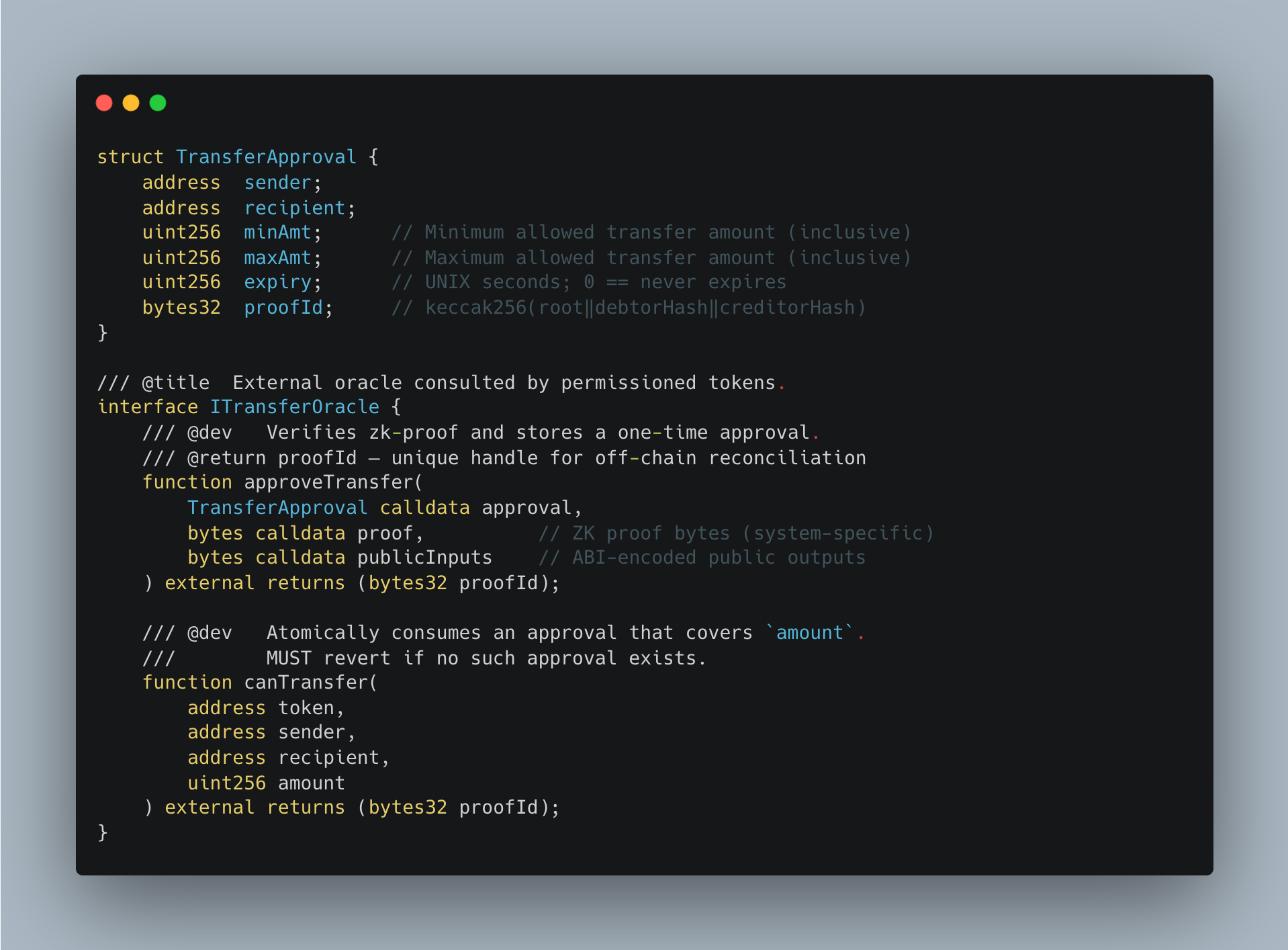
The process has two stages: validating a payment instruction to register an authorization, then consuming that authorization when funds move. An external contract called the Transfer Oracle first verifies a ZK proof through approveTransfer, storing a one-time authorization that specifies the sender, recipient, permitted amount range, and expiry. Before updating balances, the token contract calls canTransfer to check these conditions and reverts the transfer if no valid authorization exists. Each authorization is consumed when used, preventing it from authorizing multiple payments.
Zero-knowledge proofs check that the information used for approval is consistent without revealing the full payment instruction. The JSON instruction is first converted into a canonical format and organized into a Merkle tree, allowing the proof to establish that the sender, recipient, amount, currency, and deadline all belong to the same instruction. This prevents someone from combining details from different instructions to construct a payment that was never approved. The sending and receiving addresses and the transfer amount, however, remain public.
The design also accommodates payments whose final amount is unknown at approval. For a payment involving currency conversion, for example, minAmt and maxAmt can define an approved range, with the transfer executed within that range once the exchange rate is fixed. A proofId links the on-chain transfer to its underlying off-chain payment instruction, while issuers can change the oracle’s approval logic without redeploying the token. Wallets and service providers would still need to arrange prior authorization and explain failures caused by missing or expired approvals, even when using standard ERC-20 calls.
These checks do not establish that the payment instruction itself is trustworthy. Separate rules must determine who can issue instructions, how customer information maps to sending and receiving addresses, and how to prevent the same instruction from being reused on another network. The proposal is currently in Review, and the proof verifier in its reference implementation is only an illustrative placeholder that does not verify actual ZK proofs. Its value lies in defining how financial institutions can enforce internal approvals through on-chain transfer conditions and trace those transfers back to their authorization.
2.3.2 Other(s)
- ERC-8176: Descriptor Attestations for ERC-7730
- EIP-8317: Contract Storage Layout Descriptor Format
- EIP-8397: Frame Authenticator Signatures
- ERC-8441: Hybrid post-quantum stealth address scheme
2.4 Application
2.4.1 ERC-8348: Financial Lease
A financial lease lets a customer use a vehicle or equipment supplied by a leasing company, pay in installments, and potentially purchase it at the end of the contract. The leasing company can raise funds by selling its rights to future payments, but trading those rights on-chain requires investors to see the payment schedule, outstanding balance, and any overdue payments. If each leasing company provides this information differently, trading platforms and asset managers must build separate integrations for each contract. ERC-8348 proposes a common standard for accessing lease information, processing payments, and transferring payment rights.
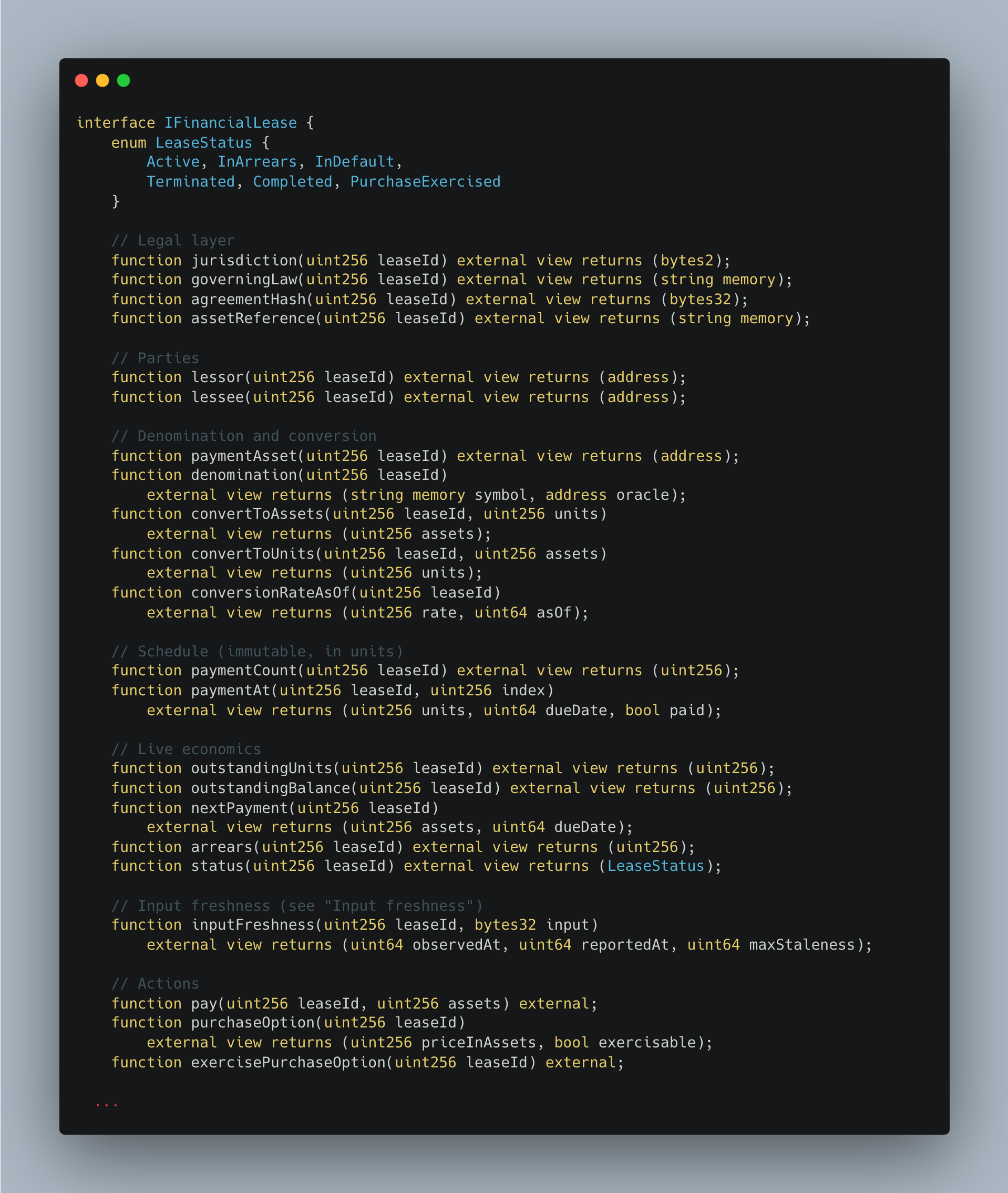
Where ERC-4907 separates NFT ownership from the right to use it for a set period, ERC-8348 also covers payment schedules, arrears management, and the option to purchase the asset at the end of a financial lease. Each contract receives a leaseId, and the right to receive lease payments is represented by an ERC-721 token with the same ID. Transferring that token to another investor also transfers the right to future payments.
Payment calculations distinguish between the unit in which the contract is denominated and the token used to pay. An inflation-linked lease, for example, can define its payment schedule in inflation-indexed units, then use convertToAssets to calculate the amount due in ERC-20 tokens. This allows fixed and inflation-linked contracts to be queried and processed through the same interface. Payment records also preserve the conversion rate applied, making it possible to check both the amount paid and how it was calculated.
The standard distinguishes InArrears, meaning a payment is overdue, from InDefault, which requires an authorized party to formally declare a default. A missed payment does not automatically terminate the lease or trigger repossession, and if stale index data prevents payment calculations, default actions are restricted, with a grace period after updates resume. The inputFreshness interface also reports when asset or insurance information was verified and when it was posted on-chain. Investors can therefore assess whether a recent update reflects recent conditions.
A common interface could reduce integration work for asset managers and make it easier to compare leases or combine them into portfolios. Interest calculations and credit assessments remain implementation-specific, however, and the standard does not guarantee the accuracy of on-chain information or the legal enforceability of token holders’ rights. ERC-8348 provides a consistent way to read and manage different lease contracts. Turning those contracts into investable products still requires reliable data sources and a legal framework that supports the associated rights.
2.4.2 ERC-8426: Wallet Pass Extension for NFTs
NFT memberships and concert tickets still need to be easy to use at the door. Opening an issuer’s website and connecting a crypto wallet each time is more cumbersome than pulling up a ticket in a phone’s wallet app. ERC-8426 proposes an extension to ERC-721 that lets users save NFT tickets and memberships as passes in Apple Wallet or Google Wallet.
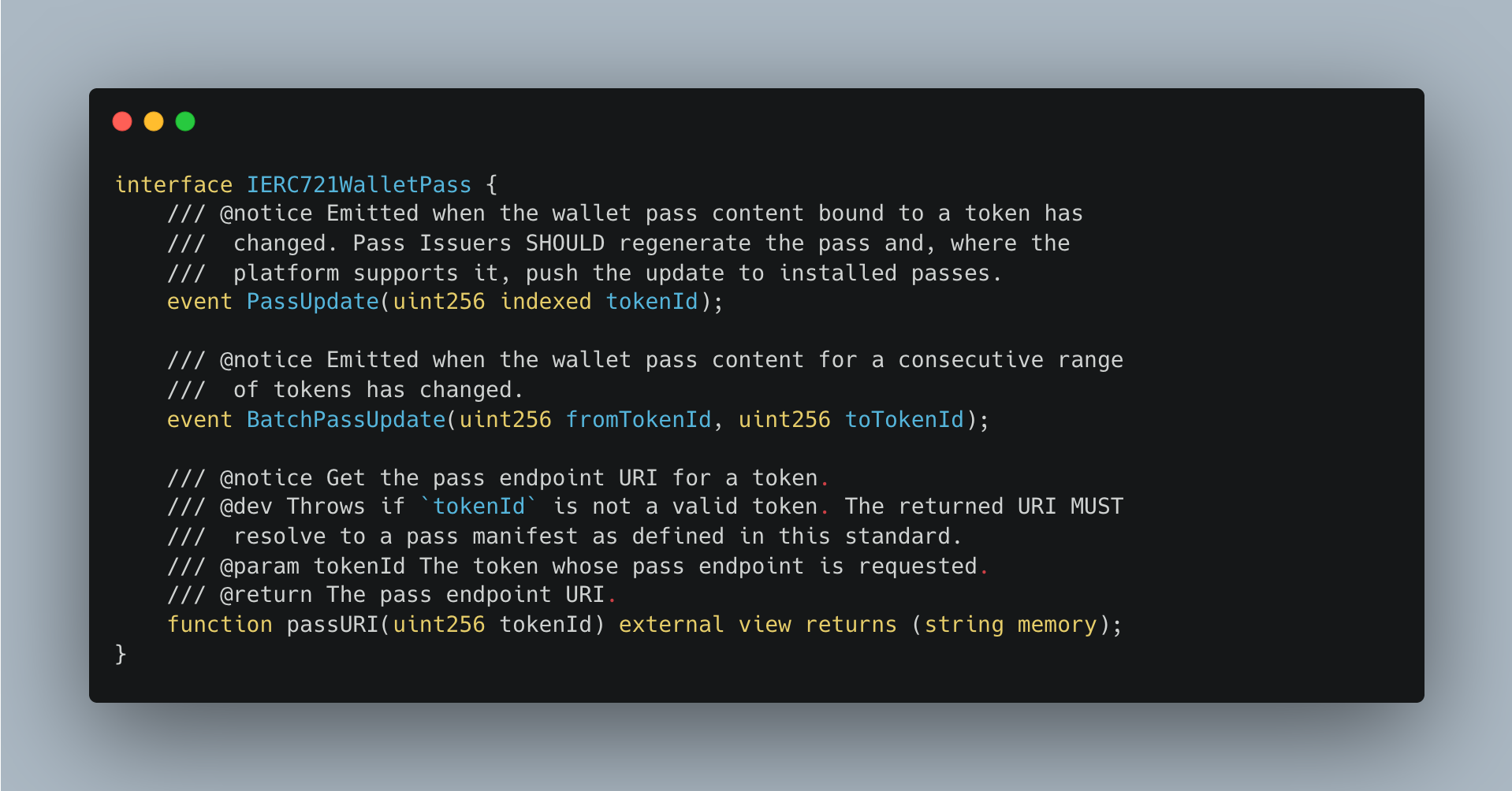
The proposal adds a query function, passURI(tokenId), to the NFT contract. It returns a URI pointing to a JSON document with platform-specific issuance links for services such as Apple Wallet and Google Wallet. NFT marketplaces and wallet apps can read this document to display buttons such as “Add to Apple Wallet.” This gives them a common way to find pass issuance links across different issuers.
When on-chain information shown on a pass changes, the NFT contract emits a PassUpdate event. Pass details may change even when the NFT’s description and image stay the same, so the proposal provides a separate signal for pass updates. The issuance server responds by regenerating the pass and, where the platform supports it, pushing updates to passes users have already saved.
Because passes can be copied or shared, holding one does not prove NFT ownership. Before allowing a request through a pass link to change on-chain state, the issuance server generally verifies the requester’s account signature and checks ownerOf to confirm that the account still owns the NFT. This prevents a former owner from exercising ownership rights through an old pass left on their phone after selling the NFT.
With this extension, users could access tickets and memberships through familiar mobile wallets, while marketplaces and wallet apps could offer passes from different issuers through a common interface. Issuance servers and mobile platforms would handle pass creation and updates. A server outage could prevent users from obtaining new passes or receiving current information, but NFT ownership and transfers would continue to be handled on-chain.
2.4.3 Other(s)
- ERC-8259: AI Agent Identity & Threat Registry
- ERC-8376: Token Launch Abuse Detection and Remediation
- ERC-8436: Agent Collective Decision Framework
- ERC-8444: Agentic Resource Discovery (ARD) Onchain
3. Progression of Existing EIPs
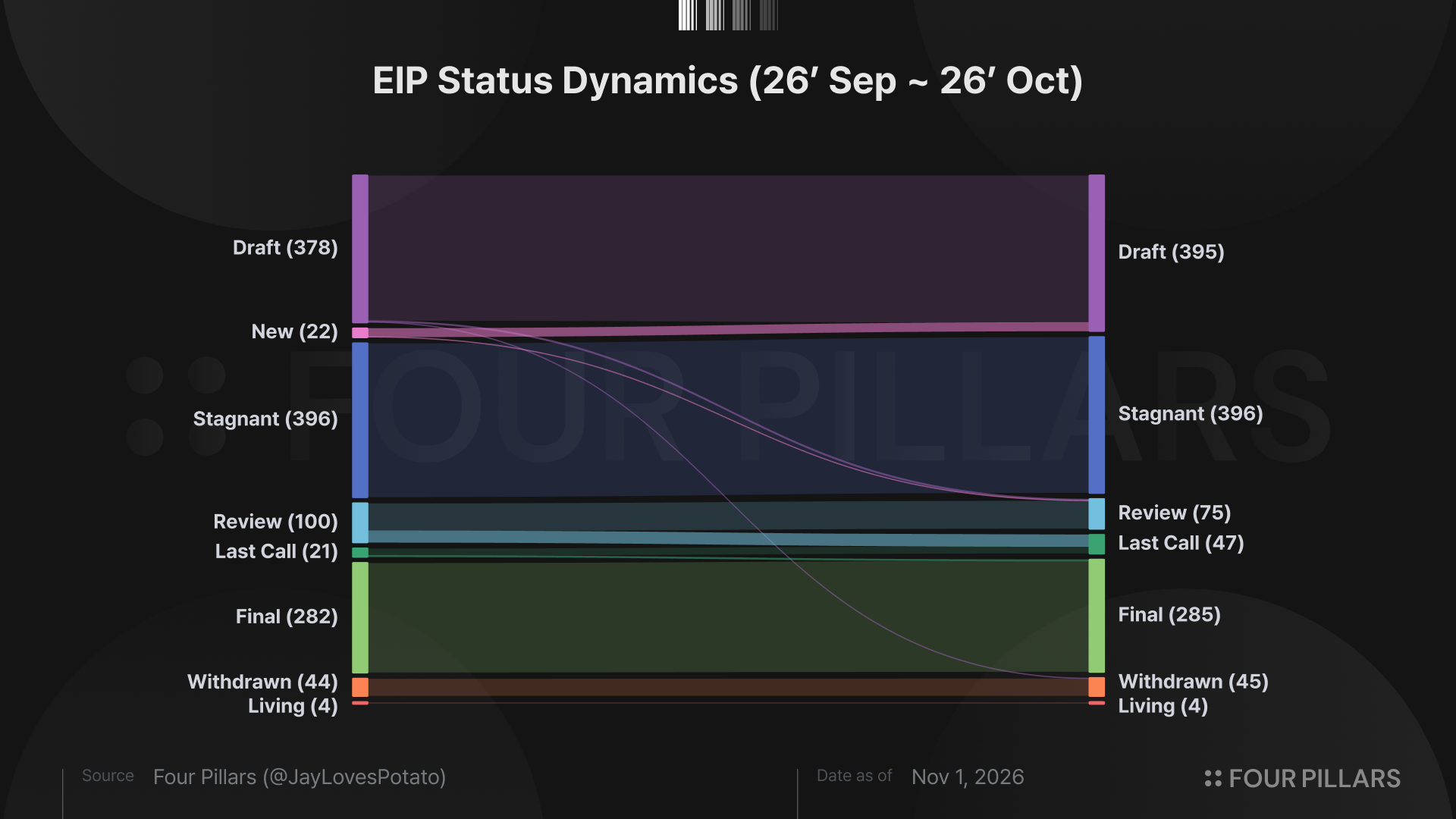
Beyond the 22 new proposals, 36 existing EIPs changed status in October. Most advanced through the standardization process, moving to stages such as Draft, Review, Last Call, or Final, while one, EIP-8333, was withdrawn.
Notable ERCs that advanced include ERC-8262, an interface for verifying proofs that specified rules have been met without revealing sensitive source information, and ERC-7945, which defines query, transfer, and approval interfaces for tokens with private balances and transfer amounts. Other proposals include EIP-8153 and EIP-8167 for managing and querying modular contracts, alongside EIP-8325–8329 for RWA assets, documents, permissions, and histories.
Outside ERCs, much of the progress centered on Glamsterdam’s main changes. EIP-7732 separates block proposers and builders at the protocol level, while EIP-8037 and EIP-8038 revise gas accounting for state creation and for accessing and writing existing state. EIP-8061 raises processing limits for validator exits and balance consolidations, with a separate limit for consolidations, while EIP-7928 records accessed accounts, storage locations, and updated values in a standardized data structure.
Other EIPs worth noting are listed below.
3.1 Core / Networking Layer
- EIP-2780: Resource-Based Intrinsic Transaction Gas
- EIP-7778: Block Gas Accounting without Refunds
- EIP-7843: SLOTNUM Opcode
- EIP-7904: Compute Gas Cost Analysis
- EIP-7954: Increase Maximum Contract Size
- EIP-7975: eth/70 - Partial Block Receipt Lists
- EIP-7976: Increase Calldata Floor Cost
- EIP-7979: Call and Return Opcodes for the EVM
- EIP-7981: Increase Access List Cost
- EIP-7997: Deterministic Factory Contract
- EIP-8024: Backward Compatible SWAPN, DUPN, EXCHANGE
- EIP-8045: Exclude Slashed Validators from Proposing
- EIP-8066: Upgrade Mascots
- EIP-8070: eth/72 - Sparse Blobpool
- EIP-8173: Foundations of EVM Control Flow
- EIP-8189: snap/2 - BAL-Based State Healing
- EIP-8261: Gas Limit Schedule
- EIP-8282: Builder Execution Requests
3.2 Data / Messaging / Transaction
- EIP-7708: ETH Transfers Emit a Log
- EIP-8136: Cell-Level Deltas for Data Column Broadcast
- EIP-8159: eth/71 - Block Access List Exchange
3.3 Account / Contract / Token Standard / Wallet
- None
3.4 Application
- None
4. Keeping Ethereum’s Knowledge Open
As noted in the introduction, the Ethereum Foundation postponed Glamsterdam’s Hoodi testnet upgrade on October 22 to take a closer look at how EIP-8037 interacts with existing mainnet contracts. It also put the planned gas limit increase to 200 million on hold. The delay highlights a basic challenge: introducing new rules means making sure the services already running on Ethereum can continue to work under them.
EIP-8037 changes how Ethereum charges for creating new state, separating those costs from execution to support higher throughput without overwhelming nodes’ storage capacity. But it also interacts with other gas-related proposals, with possible effects on gas estimates from wallets and RPC services, and on existing contract behavior. Assessing these changes requires more than reading the new specification. It also means understanding why the current rules exist and how changes elsewhere might affect them.
That becomes harder as Ethereum grows more complex. New contributors have to learn the code while catching up on years of debate and design decisions. If the only way to understand a decision is to ask someone who was there, newcomers have little basis for reviewing it independently or challenging its assumptions. Simplifying Ethereum therefore calls for two kinds of work: removing unnecessary rules and dependencies, and making the reasons for keeping the rest easier to find.
Much of this history is already public, in the EIP repository, Ethereum Magicians, and elsewhere. The difficulty is piecing it together, with specifications, revisions, and discussions spread across sources and few clear paths between related proposals. Organizing EIPs by the problems they address and the rules they change would give newcomers a starting point, especially if each proposal also pointed to its dependencies and competing approaches. Linking those materials to key decisions and unresolved questions would make it easier to follow the debate without reconstructing it from scattered records.
Education and research can help turn those records into something people can use. Proposal authors and client teams can explain design choices and connections between EIPs, developers and infrastructure operators can document the effects on services and operations, and educators and researchers can organize that knowledge by topic and what readers need to know first. EF and other supporting organizations should fund the ongoing work of keeping these resources useful and current. No one needs to memorize Ethereum’s entire history, but contributors should be able to find the background relevant to their work and judge it for themselves. Keeping that knowledge accessible is part of keeping Ethereum decentralized.
The author of this report may have personal holdings or financial interests in assets or tokens discussed herein. However, the author affirms that no transactions have conducted using material non-public information obtained in the course of research or drafting. This report is intended solely for general information purposes and does not constitute legal, business, investment, or tax advice. It should not be used as a basis for making any investment decisions or as guidance for accounting, legal, or tax matters. Any references to specific assets or securities are made for informational purposes only and should not be construed as an offer, solicitation, or recommendation to invest. The opinions expressed herein are those of the author and may not reflect the views of any affiliated institutions, organizations, or individuals. The opinions and analyses expressed herein are subject to change without prior notice. In addition, beyond the individual disclosures included in each report, Four Pillars, may hold existing or prospective investments in some of the assets or protocols discussed herein. Furthermore, FP Validated, a division of Four Pillars, may already be operating as a node in certain networks or protocols discussed herein or may do so in the future. Please see below links in the footer for FP Validated's participating network disclosures and for broader disclosure details.