Table of Contents
- Key Takeaways
- 1. This Month's Ethereum Discussion Summary
- 2. Newly Drafted EIPs
- 2.1 Core / Networking Layer
- 2.2 Data / Messaging / Transaction
- 2.3 Account / Contract / Token Standard / Wallet
- 2.4 Application
- 3. Progression of Existing EIPs
- 3.1 Core / Networking Layer
- 3.2 Data / Messaging / Transaction
- 3.3 Account / Contract / Token Standard / Wallet
- 3.4 Application
- 4. What Robinhood Chain's Success Reveals About L2s and Ethereum's Dilemma
Researcher


Key Takeaways
- August saw fewer new EIPs, but existing Core EIPs made notable progress. At the Core layer, discussions became more concrete around distributing the costs and burdens of state preservation, block production, data propagation, and execution verification. On the ERC side, proposals focused on standardizing functions that applications had previously implemented on their own, including module composition, fund management, and policy validation.
- Also, the EF began moving key priorities toward real-world testing and deployment readiness. It tested major Glamsterdam changes on public testnets and against historical mainnet data, supported the migration of existing applications, and expanded its efforts into frontend security and AI-assisted post-quantum research.
- Meanwhile, Robinhood Chain’s success showed that major financial institutions can use Ethereum technology to bring existing assets and users onchain. At the same time, it revealed that when transactions and revenue remain within enterprise-run L2s, L2 growth does not necessarily translate into Ethereum’s growth, raising the question of how Ethereum can strengthen the value that only it can provide.
Ethereum pioneered the concept of smart contracts by integrating programmability into a distributed ledger architecture, thereby expanding the functional scope of blockchain systems. This design philosophy has been progressively formalized through the Ethereum Improvement Proposal (EIP) process, enabling the network to evolve beyond a simple store of value into an infrastructure capable of supporting real-world businesses and a wide range of use cases. As this evolutionary process continues, broader participation in EIP deliberations—by opinion leaders with heterogeneous perspectives and problem framings—may further enrich the development of a digital-native economic paradigm.
This article presents a high-level examination of EIP trends by reviewing proposals newly accepted into the Draft stage on a monthly basis, alongside proposals that have undergone meaningful status transitions. Through this analysis, we aim to provide builders and business stakeholders with a more structured understanding of the evolving EIP landscape and to offer a conceptual foundation for identifying and developing new value propositions within their respective areas of activity.
The EIP-related data referenced in this article was collected and analyzed using the official GitHub repositories for EIP, ERC, and RIP.
1. This Month's Ethereum Discussion Summary
The most notable feature of August’s EIP activity was that the number of new proposals returned to roughly the level seen two months earlier, while existing EIPs, particularly Core EIPs, advanced at a steady pace. A total of 10 new EIPs were proposed, down 14 from the previous month, while 25 existing EIPs moved to the next stage and none were withdrawn.
Among the newly proposed Core EIPs, EIP-8321 decouples RANDAO from BLS signatures by introducing a hash chain, while EIP-8347 proposes migrating the existing MPT state to a PBT offline and switching to the new structure at a predetermined hard fork. EIP-8371 distributes blob recovery across the network, while EIP-8390 replaces the sync committee with a zero-knowledge finality proof, supporting future use cases such as light client operation. Together, these proposals seek to reduce Ethereum’s reliance on specific cryptographic schemes, high-performance nodes, and small groups of validators.
At the application layer, ERC proposals showed a broader effort to turn complex execution processes into shared interfaces that can be used across contracts and services. ERC-8349 replaces function selectors with one-byte indices that identify which facet to execute, simplifying deployment and upgrades at the module level. ERC-8187 introduces a Token Puller interface that allows payments to draw from assets deposited in vaults or lending protocols, within limits authorized by the user. Meanwhile, ERC-8354 uses zero-knowledge proofs to verify whether an AI agent’s actions satisfy a private policy before execution. Overall, these proposals aim to standardize processes that applications have traditionally implemented on their own, including module composition, funding, and policy validation.
Among existing EIPs, several long-discussed protocol changes advanced to the next stage. Notable examples include EIP-4444, which allows old block and receipt data to be pruned; EIP-7732, which separates block proposers and builders at the protocol level; and EIP-8025, which introduces optional stateless validation using execution proofs. Other proposals also progressed, including EIP-8037, which meters state creation through a separate state gas mechanism; EIP-8070, which distributes the burden of blob storage and propagation; and EIP-8189, which improves state synchronization using BALs.
In short, August was defined less by the volume of new proposals than by the maturation of Core EIPs that reshape Ethereum’s long-term cost structure and division of responsibilities across state preservation, block production, data propagation, and execution verification.
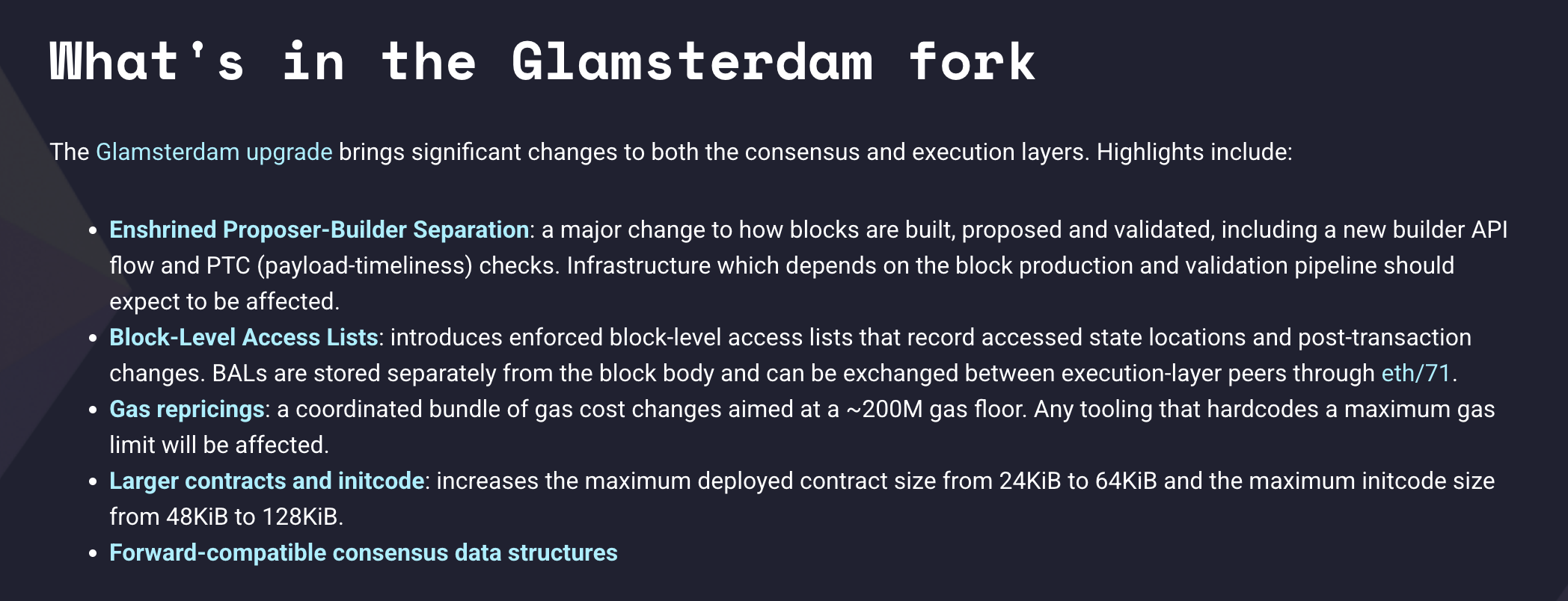
Source: blog.ethereum.org
Meanwhile, after defining its key priorities under the new organizational structure through July, the Ethereum Foundation began moving them into practical testing and deployment preparation in August. On August 17, the EF Protocol DevOps team announced the Platåberget testnet, a public testing environment for major Glamsterdam changes. The testnet incorporates ePBS, Block-Level Access Lists, and gas repricing, and allows solo stakers, DVT projects, and large operators to register their own validators and builders to test the new block production flow. This marks Glamsterdam’s transition from short-lived, client-focused devnets to a public validation phase involving the operators and application developers who will be directly affected.
In parallel, the EF worked to assess how the new scaling architecture could affect existing applications. On August 24, EF Protocol Research, EthPandaOps, and the Specifications team published an analysis applying the gas repricing changes in EIP-8037 and EIP-8038 to historical mainnet transactions. Most contracts were unaffected, but some could fail or suffer degraded performance because of assumptions about existing gas limits. The EF provided tools for identifying affected applications and began contacting relevant builders directly. In effect, it is adjusting the costs of state creation and access to support higher gas limits while pairing protocol changes with migration support to prevent existing applications from breaking unexpectedly.
In security, the EF moved to broaden both the scope of protection and the ways researchers can contribute. On August 5, the EF Access cluster announced its support for WEBCAT, which verifies whether the code served by a website matches the version published by its developer. This extends Ethereum’s security efforts beyond consensus and smart contracts to the frontends of wallets and decentralized applications. On August 20, the Formal Verification team also launched the better.codes public research challenge, allowing anyone to use their own AI agent to improve the security of post-quantum SNARKs and have the results formally verified in Lean.
2. Newly Drafted EIPs
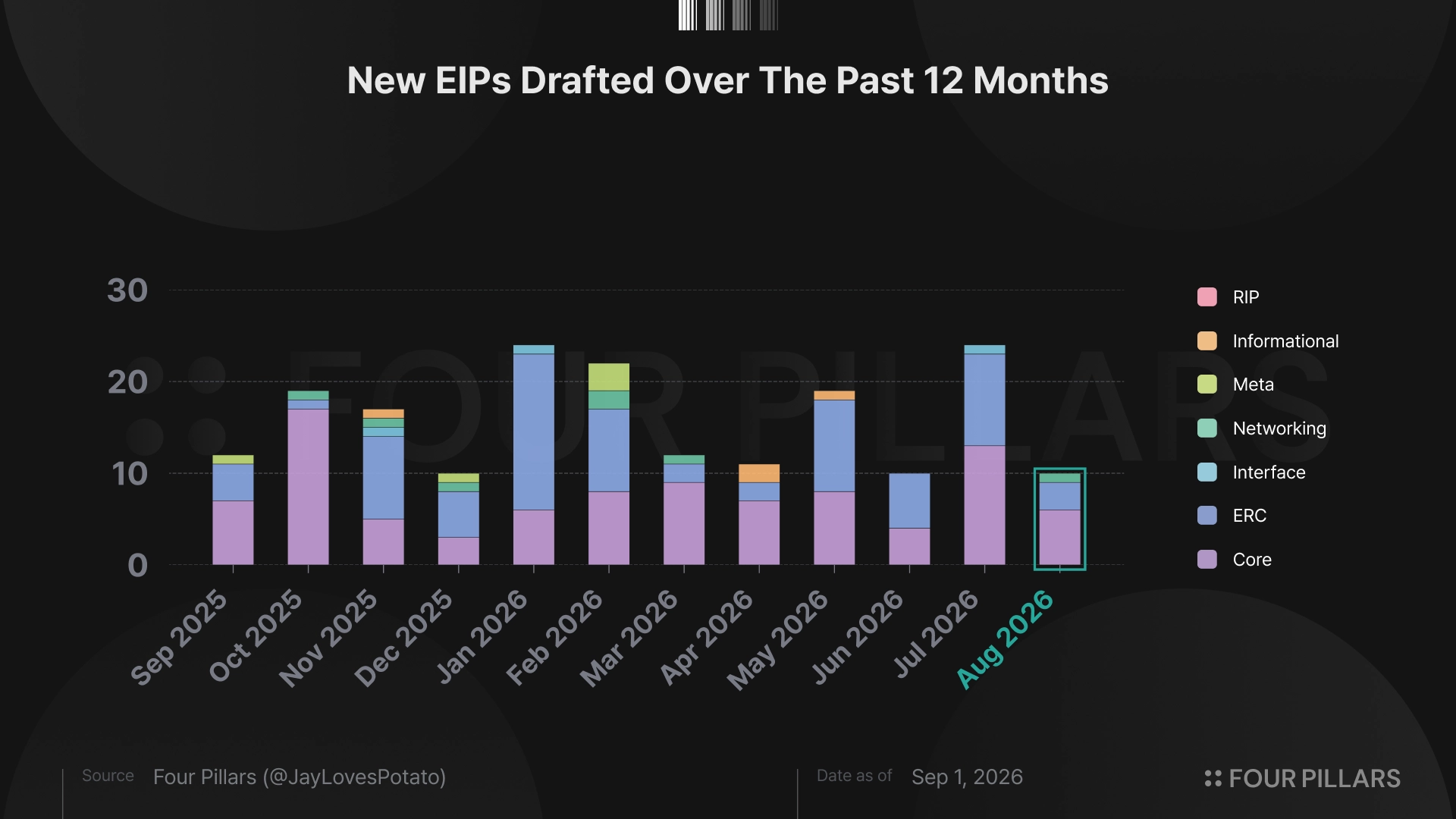
A total of 10 new EIPs were adopted in August, down 14 from the previous month. Most were either Core EIPs proposing changes at the network level or ERCs defining standards for the application layer.
Below, we classify the EIPs newly moved to Draft status and take a closer look at the proposals that warrant particular attention.
2.1 Core / Networking Layer
2.1.1 EIP-8321: Hash-Chain RANDAO
Ethereum randomly assigns validators to propose blocks. The randomness used for this assignment is generated by RANDAO, which continually mixes contributions from multiple block proposers: RANDAO contribution = BLS signature(validator private key, epoch number).
Today, each contribution is a BLS signature over the epoch number. When the same validator signs the same message, the result is always unique, so a validator cannot generate multiple signatures, compare the resulting proposer assignments, and submit only the most favorable one.
The problem is that BLS signatures were not designed to withstand quantum attacks. If an attacker recovers a validator's private key, they could calculate its future contributions in advance and predict upcoming proposer assignments. Simply replacing BLS with a post-quantum signature scheme would not fully solve the problem, since some post-quantum schemes, such as XMSS, can produce multiple valid signatures for the same message. A validator could then compare how each signature changes RANDAO and choose the one that produces the most favorable assignment.
EIP-8321 replaces signature-based contributions with values revealed sequentially from a precomputed hash chain. A validator repeatedly applies the BLAKE3 hash function to a random secret value, c_0, creating a long chain and registering only its final value, c_n, onchain. Each time the validator proposes a block, it reveals the preceding value in the chain, and the protocol verifies that hashing the new value once produces the value stored previously. Because every future reveal is fixed at registration, the validator cannot generate or choose a favorable value after seeing its proposer schedule.
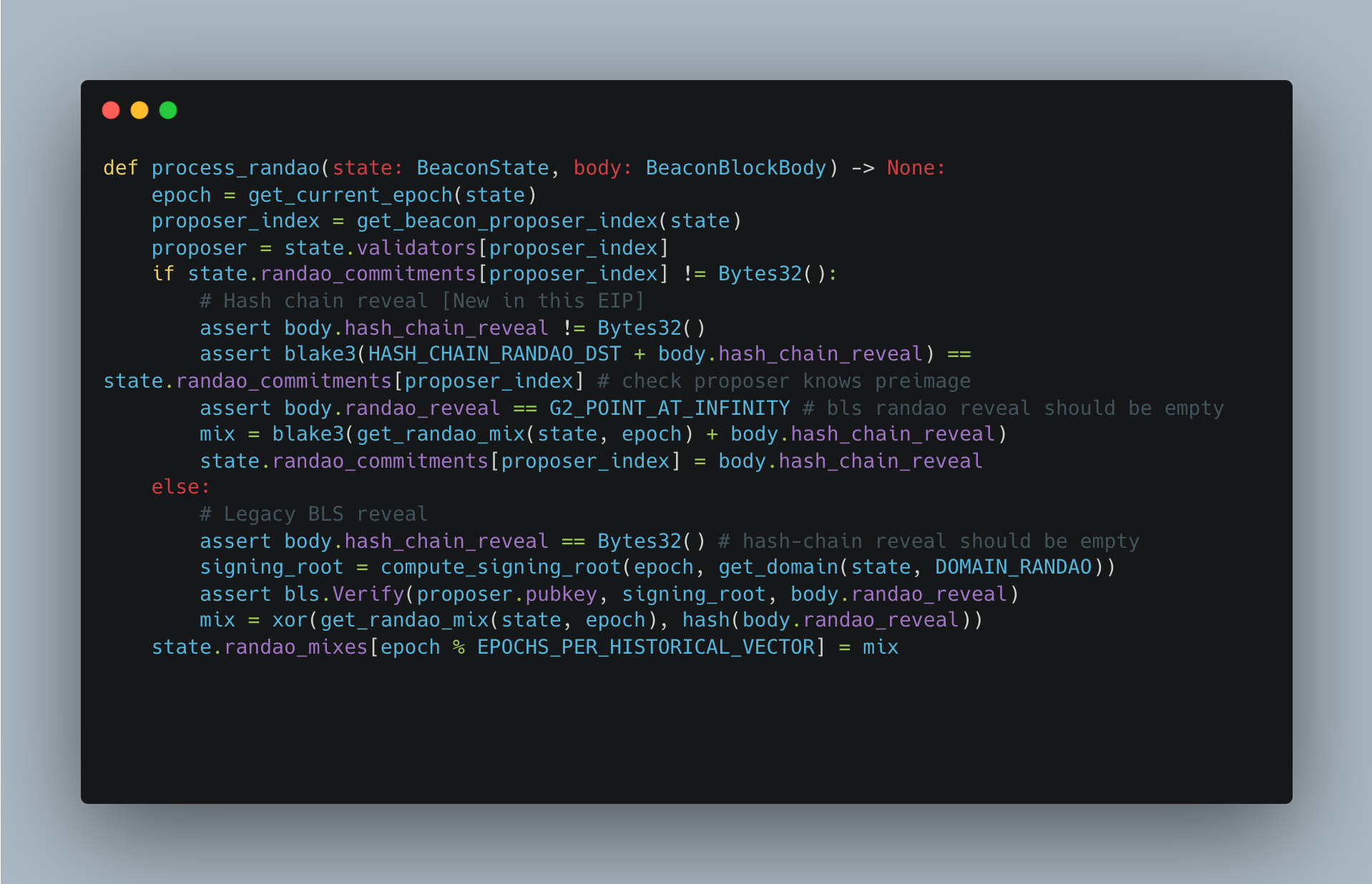
Each newly revealed value is mixed into the existing RANDAO value using mix = blake3(mix + reveal). Reusing the same value produces an entirely different result rather than canceling an earlier contribution, making it difficult for validators to copy and offset one another's inputs. A registered hash chain becomes active after three epochs, while validators that have not migrated can continue using the existing BLS method. Applications also continue receiving values in the same format, including through PREVRANDAO, so the execution layer and smart contracts do not need to change when the generation method does.
This proposal alone does not make Ethereum's entire consensus process quantum-safe. BLS is still used to register the hash chain and sign blocks, and validators can still exert limited influence over RANDAO by withholding a reveal and forfeiting their block reward. An operator that loses the hash-chain secret or registers an incorrect value cannot replace it midway and must exit and register the validator again. The significance of EIP-8321 is therefore more focused: it decouples RANDAO from the properties of BLS in advance, making future signature-scheme migrations easier.
2.1.2 EIP-8347: Offline State Migration to the PBT
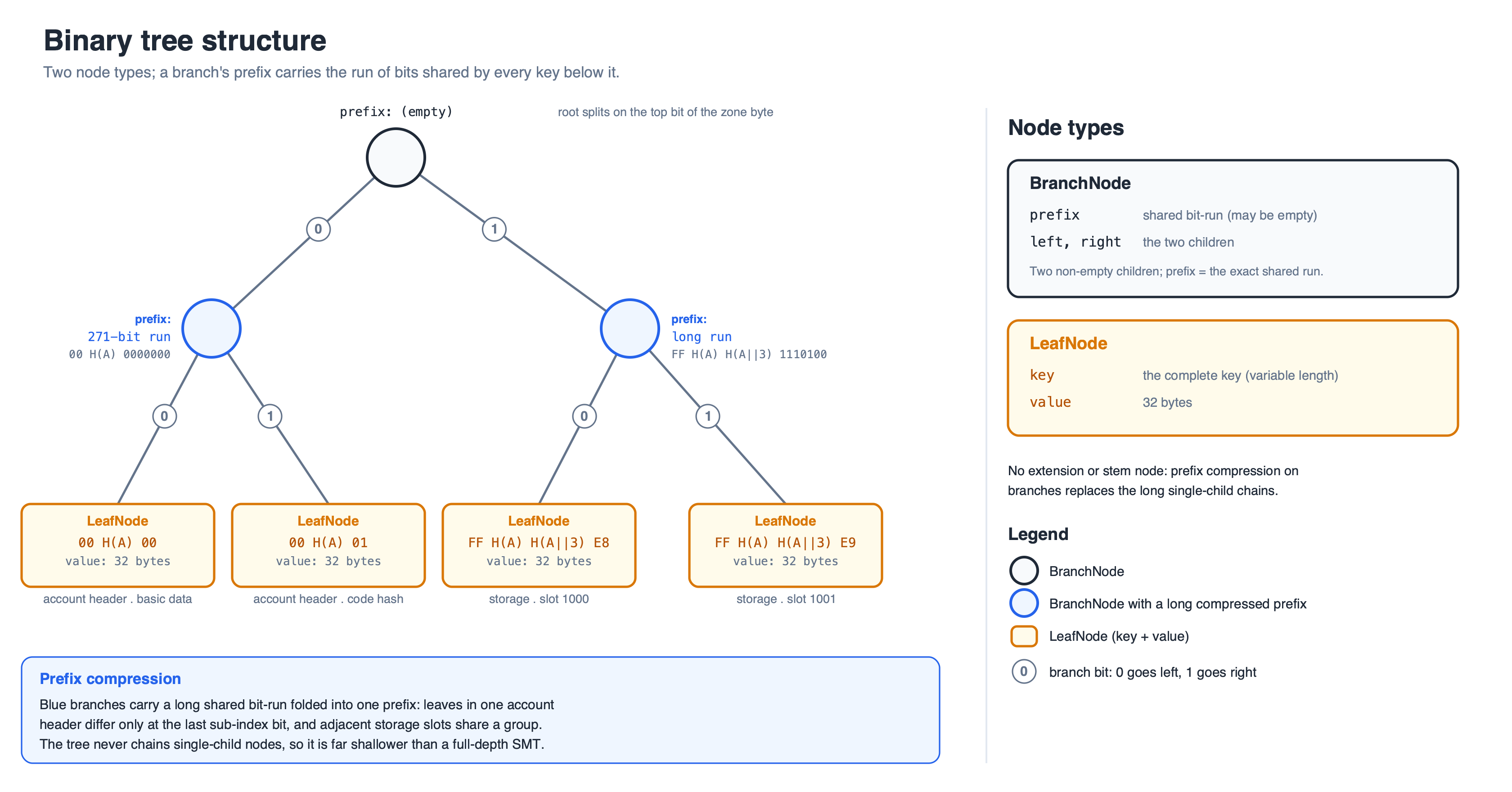
Source: EIP-8297
Ethereum records every account balance and contract datum in a Merkle Patricia Trie, or MPT. The MPT, however, requires large proofs to verify state and is difficult to handle with zero-knowledge proofs, making it poorly suited to Ethereum's long-term scaling needs. EIP-8297 proposes replacing it with the Partitioned Binary Tree, or PBT, a simpler structure designed for more efficient proofs. Yet designing a new tree is only half the challenge; the state already accumulated across the network must also be migrated safely. EIP-8347 addresses how to move this vast body of data from the MPT to the PBT.
The most intuitive approach would be to migrate part of the state with each new block. This would require every node to track which data had already been converted, while supporting both structures throughout the transition. Bridges and light clients that verify state proofs would also need separate logic for a hybrid state. To avoid this complexity, EIP-8347 proposes completing the conversion in advance and switching to the PBT at a predetermined hard fork.
First, a finalized block that is no longer expected to revert is designated as the ANCHOR_BLOCK. The full state at that point is then converted into a PBT-formatted snapshot, effectively a file that reorganizes every account and contract datum according to the new storage structure.
The snapshot is verified once against each structure. Nodes first rebuild the PBT and confirm that it matches the proposed root, then process the same data through the existing MPT to reproduce the stateRoot recorded in the ANCHOR_BLOCK. Changes to balances, storage, and other state after the anchor block are applied through the Block-Level Access Lists, or BALs, introduced by EIP-7928. Rather than reexecuting every transaction since the anchor, nodes copy only the values that actually changed in each block into the new ledger.
Before activation, validators independently calculate and publish a PBT root for every block as a shadow root, allowing different clients to confirm that they reach the same result. Once the PBT_ACTIVATION_FORK occurs, the stateRoot in each block header is calculated from the PBT rather than the MPT. Both structures are retained until the fork is finalized so the network can recover if something goes wrong.
This approach avoids keeping both trees within the consensus rules for an extended period and reduces the state-tree migration to a single, clearly defined transition. However, participating nodes would need roughly 300 GB of additional storage during the mainnet transition, along with infrastructure capable of reliably distributing large snapshots and preimages. Systems that verify state proofs directly, including bridges, light clients, and services built around eth_getProof, would also need to support the new PBT proof format.
2.1.3 EIP-8371: RowDAS - Distributed Blob Reconstruction
PeerDAS divides blob data into columns and assigns each node only a subset to store, removing the need for every node to download the entire dataset. If some data does not propagate in time, however, a node holding at least half of the 128 columns must reconstruct the missing portion. In practice, supernodes that subscribe to every column often reconstruct the same blob independently. As the number of blobs grows, so do their CPU and bandwidth requirements, creating a paradox in which higher throughput makes data recovery more dependent on high-performance nodes. EIP-8371 proposes RowDAS, which distributes reconstruction work across the network to ease this bottleneck.
In PeerDAS, each blob corresponds to a row, while every node holds only the cells from its assigned columns across multiple blobs. RowDAS adds 128 row subnets, labeled data_row_{subnet_id}, alongside the existing column subnets and assigns each blob to a different row subnet in every slot. Each node is also assigned to one row subnet based on its node ID, and nodes within the same subnet share the cells they hold. Even if no individual node has enough data, the subnet can reconstruct the remaining cells once it collectively gathers at least 64 of the row's 128 cells.
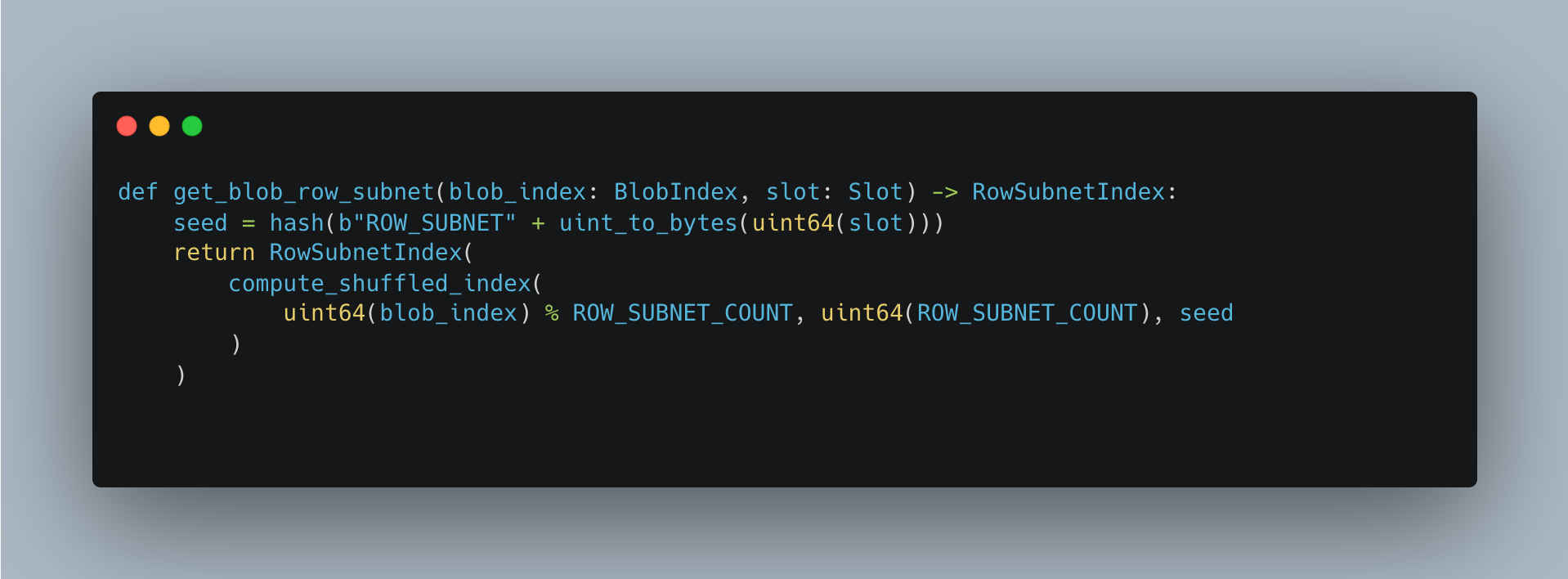
The mapping between blobs and subnets changes pseudorandomly each slot through compute_shuffled_index, preventing work from remaining concentrated in one subnet. By contrast, each node's assigned row subnet remains fixed regardless of the blob count, so a change in the blob limit does not require network connections to be reconfigured. Nodes advertise the positions of the cells they hold through a bitmap and cancel scheduled work if another node has already completed the reconstruction. Before any cell received through a row subnet is relayed or used for reconstruction, it is verified against the blob's KZG commitment.
Reconstruction proceeds in three stages. First, a row-reconstruction node that subscribes to at least 64 columns reconstructs its assigned row. If the row remains incomplete after a set period, a supernode fills the gap. Finally, an ordinary node can participate if it has gathered at least 64 cells from the same row subnet. Since ordinary nodes act only when the earlier stages fail, their routine CPU burden remains limited while still providing a fallback path that can recover data without supernodes. Based on the proposal's estimate of roughly 12,000 nodes distributed evenly across 128 row subnets, about 94 nodes would help collect data within each subnet.
RowDAS does not resolve every limitation of PeerDAS. Bandwidth for data sampling still scales with the number of blobs, and the proposal does not allow an L2 node to retrieve only a particular blob it needs. Operating new row subnets and bitmap messages also adds complexity to client and peer management, while parameters such as the waiting period between reconstruction stages remain unsettled. Even so, RowDAS leaves the existing column subnets responsible for data availability and distributes only the recovery work. It can therefore reduce the operational cost and reliance on supernodes required for future blob scaling without materially changing PeerDAS's security assumptions.
2.1.4 EIP-8390: Remove the Sync Committee
An Ethereum light client verifies the latest blocks without downloading the blockchain's full history. Checking signatures from hundreds of thousands of validators each time would be prohibitively expensive, so the network currently delegates this task to a Sync Committee of 512 validators sampled at random from the full validator set. This was a practical compromise in 2021, but it also left light-client security dependent on a small group rather than Ethereum as a whole.
The Sync Committee consists of 512 validators and rotates roughly every 27 hours. Rather than checking consensus across the entire validator set, a light client accepts a block header signed by at least two-thirds of the committee. The problem is that committee members are not slashed solely for signing a fraudulent header. EIP-7657 proposes such a slashing mechanism, but it does not resolve the structural limitation that light clients still depend on the judgment of 512 validators rather than the full set.
EIP-8390 proposes compressing proof that the entire active validator set finalized a particular checkpoint into a zero-knowledge proof. An external prover verifies the BLS signatures and stakes of many validators, then creates a short proof that a light client can check within milliseconds. Put simply, instead of asking a committee of 512 representatives, the client verifies a compressed receipt of the full validator set's consensus. Light clients could then inherit Ethereum's underlying economic security, where reversing finality requires at least one-third of the stake to risk being slashed.
To make this possible, EIP-8390 removes sync_aggregate, current_sync_committee, and next_sync_committee from the consensus layer, along with process_sync_aggregate and the committee-rotation logic used during block processing. Related network messages and Beacon APIs would also disappear, as would validators' duties to sign and aggregate Sync Committee messages. No execution-layer changes are required. After the hard fork, blocks containing sync_aggregate would be considered invalid, and the relevant signature domains would be retired to prevent past signatures from being reused elsewhere.
Because the proposal does not redirect SYNC_REWARD_WEIGHT = 2/64 to other rewards, total consensus-layer issuance and the corresponding portion of staking rewards would fall by approximately 3.125%. Existing Altair light clients and related APIs would cease to work, requiring clients and infrastructure to migrate. More importantly, EIP-8390 does not specify who will continuously generate and distribute these zero-knowledge proofs or how that work will be compensated. It is therefore better understood not as a complete plan to remove the Sync Committee immediately, but as a design direction for moving light-client security from a small sample to full-validator consensus once reliable public proof infrastructure is available.
2.1.5 Other(s)
- EIP-8363: Tapered Issuance Burn*
- EIP-8368: CPSB Recalibration for New Gas Limit
- EIP-8372: Normalized state gas limit
*For an overview and discussion of EIP-8363, see the following two previous articles from Four Pillars:
- Monthly EIP - Jul 2026 (ft. What the Issuance Debate Reveals About Ethereum Governance)
- Does Ethereum Need to Cut Issuance Right Now?
2.2 Data / Messaging / Transaction
None
2.3 Account / Contract / Token Standard / Wallet
2.3.1 ERC-8349: Index-Based Multi-Facet Proxy
Source: ERC-2535
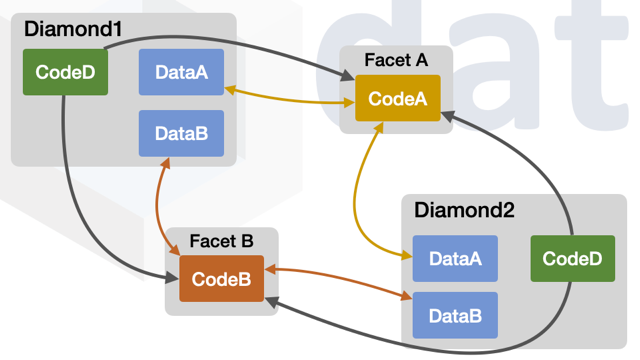
Protocols that continually add features, such as DeFi applications, cannot easily fit all their execution logic into a single smart contract. The Diamond architecture defined by ERC-2535 presents one external address and shared state while dividing internal logic among facets for functions such as tokens, trading, and administration. Each facet contains multiple functions, and the router locates the correct facet through the function's selector, a four-byte identifier.
Development, audits, and upgrades take place at the facet level, but routing information is managed function by function. As a protocol grows, the number of selectors that must be registered increases, making facet replacement more complex.
Under the Cento architecture proposed by ERC-8349, a one-byte index appended to the end of the calldata identifies the facet to execute. The facet index selects the module, while the selector identifies the function within that module. If a facet contains 20 functions, ERC-2535 requires 20 separate selector -> facet mappings, whereas Cento manages a single index -> facet mapping. Because the index is a uint8, one router can connect up to 256 facets.
Standard calldata takes the form function(args) + index. The router reads the final byte, finds the registered facet, removes the index, and forwards the remaining data through DELEGATECALL. The facet receives the same function(args) calldata as a conventional contract call and executes the function matching the selector, preserving existing Solidity code and ABI encoding. Standard interfaces such as ERC-165 and ERC-173, which wallets and explorers call through conventional selectors, are handled through a separate compatibility path.
Upgrades also occur at the facet level rather than the function level. atomicUpdate() installs, replaces, or removes multiple facets, changes supported interfaces, and migrates stored data within a single transaction, reverting every change if any step fails. Changes are recorded through the AtomicUpdate event, while functions such as getFacetEntries() and getFacetAt(index) reveal which facets are currently installed. Developers therefore spend less time updating large numbers of selectors, while governance and audit tools can track protocol changes by facet.
ERC-8349 remains in Draft and does not define how facets should share storage, who should authorize upgrades, or what governance process should apply. Because every facet executes against the router's storage, a malicious or faulty facet could corrupt data or steal funds, and storage collisions must be prevented separately. The specification specifically recommends rejecting EIP-7702 delegated accounts during installation. If such an account were registered as a facet, external authority could change its execution code and alter protocol logic without updating the routing table.
2.3.2 Other(s)
- None
2.4 Application
2.4.1 ERC-8187: Token Puller
Stablecoin payments and subscription services generally assume that the user's wallet already holds spendable tokens. If assets are deposited in a lending protocol or vault, the user must first withdraw them, while a payment service that handles this step directly needs custom integration logic for every underlying protocol. Users must therefore either forgo yield by keeping funds idle in their wallet or distribute payment balances across several accounts. ERC-8187 proposes a common method that lets a payment service pull the required amount within a user-defined limit, without needing to know where the assets are deposited.
The existing ERC-20 approve and transferFrom functions can pull only tokens held directly in a wallet. ERC-2612 Permit changes the approval process into a signature, but does not abstract the source of funds. ERC-8187 places an IPuller contract between the user and the application, allowing a payment provider or application to request only the required token and amount without knowing where the asset is held. Depending on its implementation, the Puller can redeem vault shares, withdraw assets from a lending protocol, or execute a swap before sending the tokens to their destination. Rather than creating a new token standard, the ERC places a common withdrawal and payment interface over different asset-management strategies.
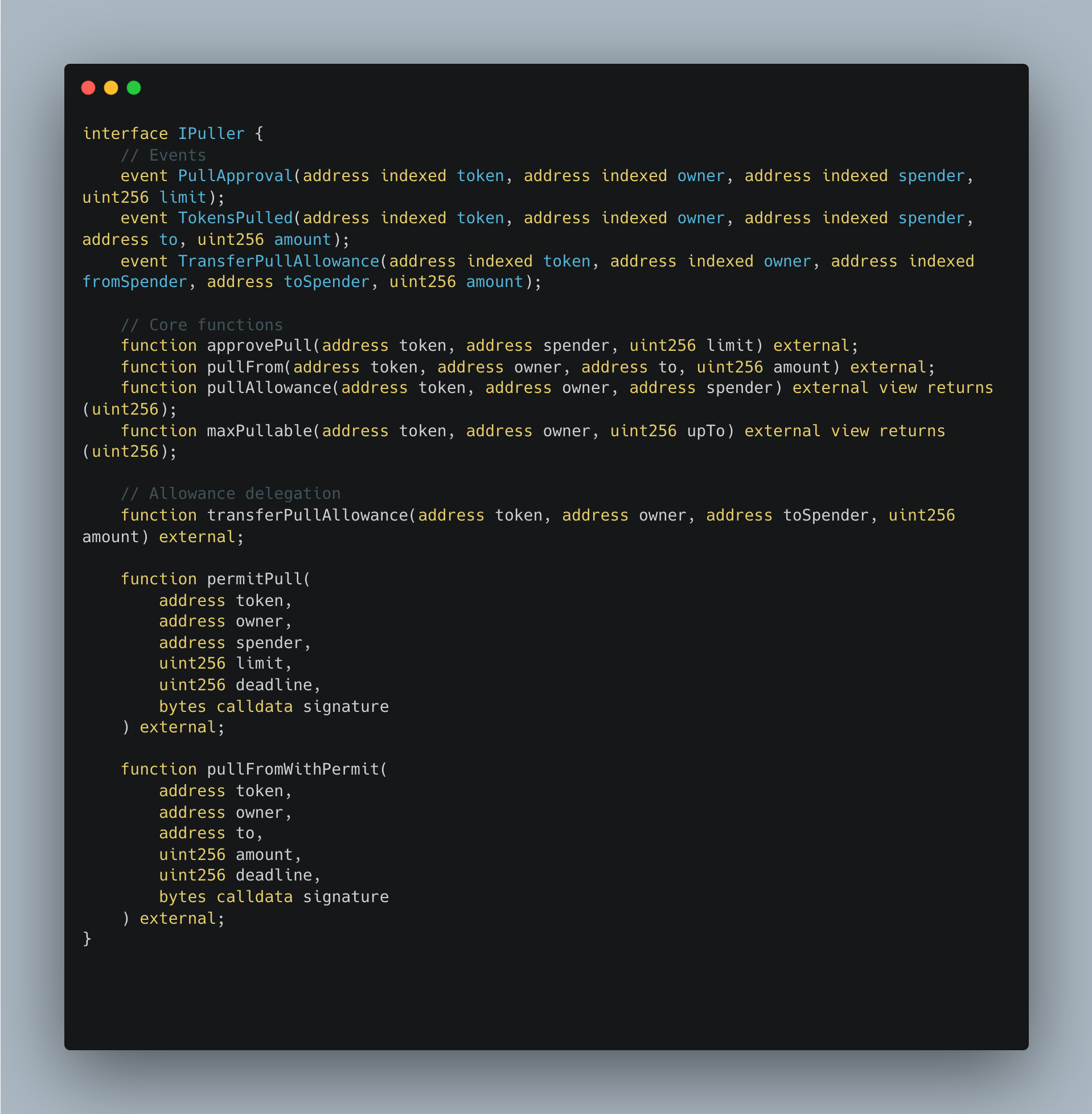
The user calls approvePull(token, spender, limit) to set the amount of a given token that a particular spender may pull. When the spender later calls pullFrom(token, owner, to, amount), the Puller checks the remaining allowance, sources the funds, and transfers exactly amount to the to address. If any step fails, the entire execution reverts. maxPullable(token, owner, upTo) returns the amount currently available under the strategy and stops once it reaches upTo, reducing the cost of implementations that check several funding sources in sequence. Puller allowances are tracked separately from standard ERC-20 allowances, allowing users to distinguish ordinary token permissions from payment rights tied to a specific funding strategy.
Approval can be granted through either an onchain transaction or an EIP-712 signature containing token, spender, limit, nonce, and deadline. pullFromWithPermit combines approval and withdrawal in one transaction. Even if someone front-runs the signature and consumes its nonce, the spender can continue attempting a withdrawal under the allowance already established, reducing the risk of a denial-of-service attack through permit front-running. Through transferPullAllowance, a spender can also transfer part of its allowance to another address or relinquish it by sending it to address(0). This could support a structure in which a guardian controls the total budget and replenishes separate limits for individual payment services. A smart account that implements IPuller directly could combine asset management and spending controls at the account level without an intermediary contract.
In practice, the main benefit is that users can automate subscriptions and recurring payments while keeping assets productive until they are needed, without requiring payment providers to integrate with every vault and lending protocol separately. ERC-8187 does not, however, standardize the security of the funding strategy. Calls to external protocols may introduce reentrancy, oracle manipulation, slippage, or withdrawal failures, while unlimited allowances and transferable permissions can amplify losses if a spender is compromised. Implementing the Puller directly within a smart account also means that an error could affect the entire account, making module isolation and strict allowance limits essential. The reference implementation has not yet been audited, and ERC-1271 and ERC-6492 verification remains incomplete. For now, ERC-8187 is best understood not as finished payment infrastructure, but as an early standard for allowing applications to share a common pattern: drawing from productive assets only when they are needed.
2.4.2 Other(s)
3. Progression of Existing EIPs
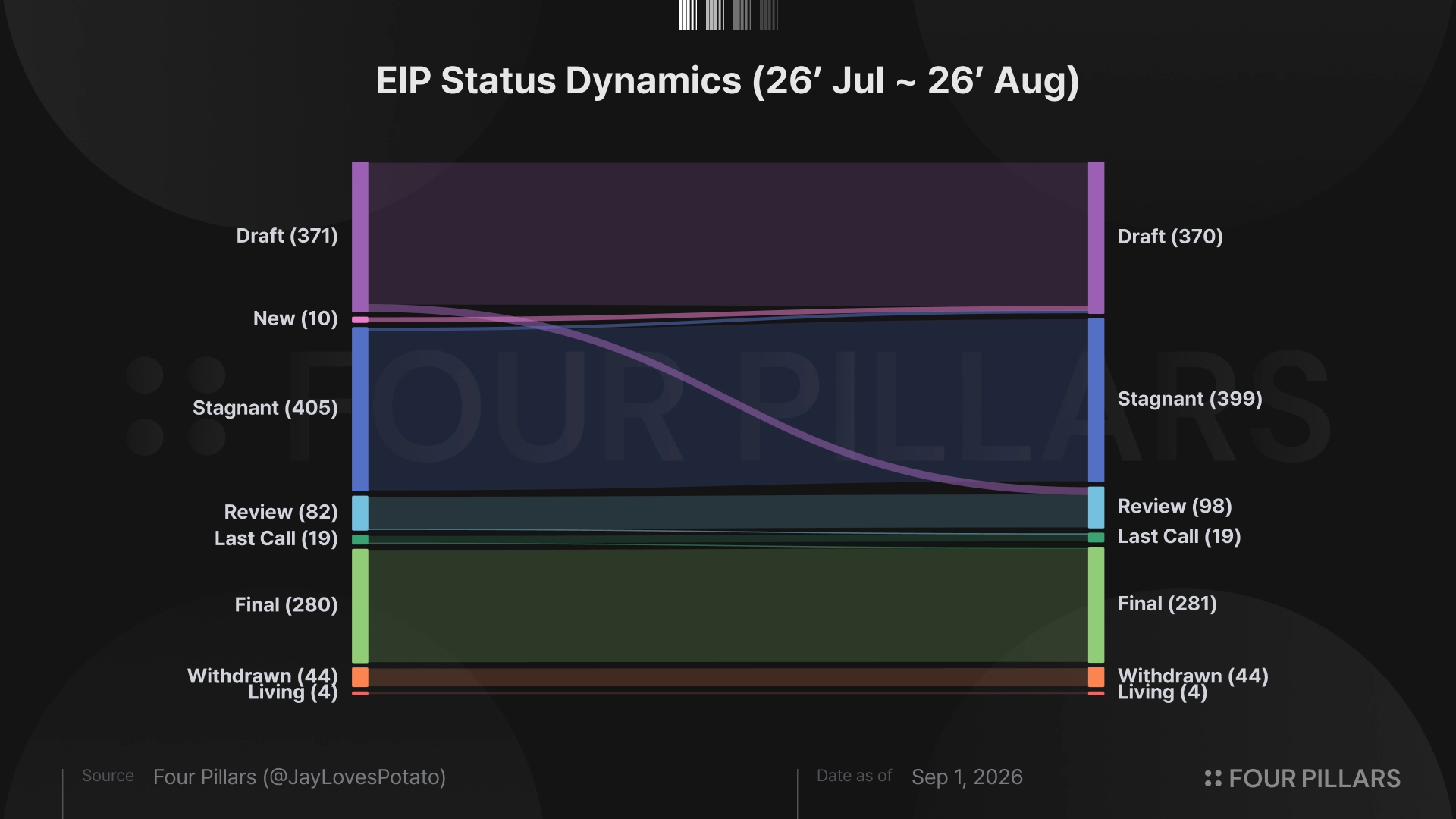
Beyond the 10 newly adopted proposals, 25 existing EIPs changed status during August. Every one advanced toward final adoption, moving to stages such as Final, Last Call, Review, or Draft, while none moved to Withdrawn.
Notable ERCs included ERC-5516, which allows a single non-transferable Soulbound Token to be jointly issued to multiple accounts and reused; ERC-7945, an interface for confidential fungible tokens that supports transfers and approvals while hiding balances and transfer amounts; and ERC-8153, which simplifies deployment and upgrade management by allowing Diamond facets to expose their own function selectors.
Notable EIPs outside the ERC category included EIP-4444, which allows execution clients to stop serving block and receipt data older than one year over P2P and prune it locally; EIP-7732, which introduces Enshrined Proposer-Builder Separation, or ePBS, to separate block proposers from execution-payload builders at the protocol level; and EIP-8025, which enables optional stateless validation through execution proofs without reexecuting the payload. Other proposals included EIP-8037, which reprices state creation for new accounts, storage, and code on a per-byte basis and meters it through separate state gas; EIP-8070, which introduces a sparse blobpool so nodes store and propagate only the blob data assigned to them, reducing bandwidth requirements; and EIP-8189, which replaces trie-node healing in snap sync with state recovery based on Block-Level Access Lists.
Other proposals worth noting include the following.
3.1 Core / Networking Layer
- EIP-2780: Resource-based intrinsic transaction gas
- EIP-3298: Remove storage-clear refund and refund cap
- EIP-5920: PAY opcode
- EIP-7666: EVM-ify the identity precompile
- EIP-7709: Read BLOCKHASH from Storage and Update Cost
- EIP-7773: Hardfork Meta - Glamsterdam
- EIP-7843: SLOTNUM opcode
- EIP-7975: eth/70 - partial block receipt lists
- EIP-8038: State-access gas cost update
- EIP-8045: Exclude slashed validators from proposing
- EIP-8061: Increase exit and consolidation churn
- EIP-8066: Upgrade Mascots
- EIP-8159: eth/71 - Block Access List Exchange
- EIP-8261: Gas Limit Schedule
- EIP-8282: Builder Execution Requests
3.2 Data / Messaging / Transaction
3.3 Account / Contract / Token Standard / Wallet
- None
3.4 Application
- None
4. What Robinhood Chain's Success Reveals About L2s and Ethereum's Dilemma

Source: Robinhood
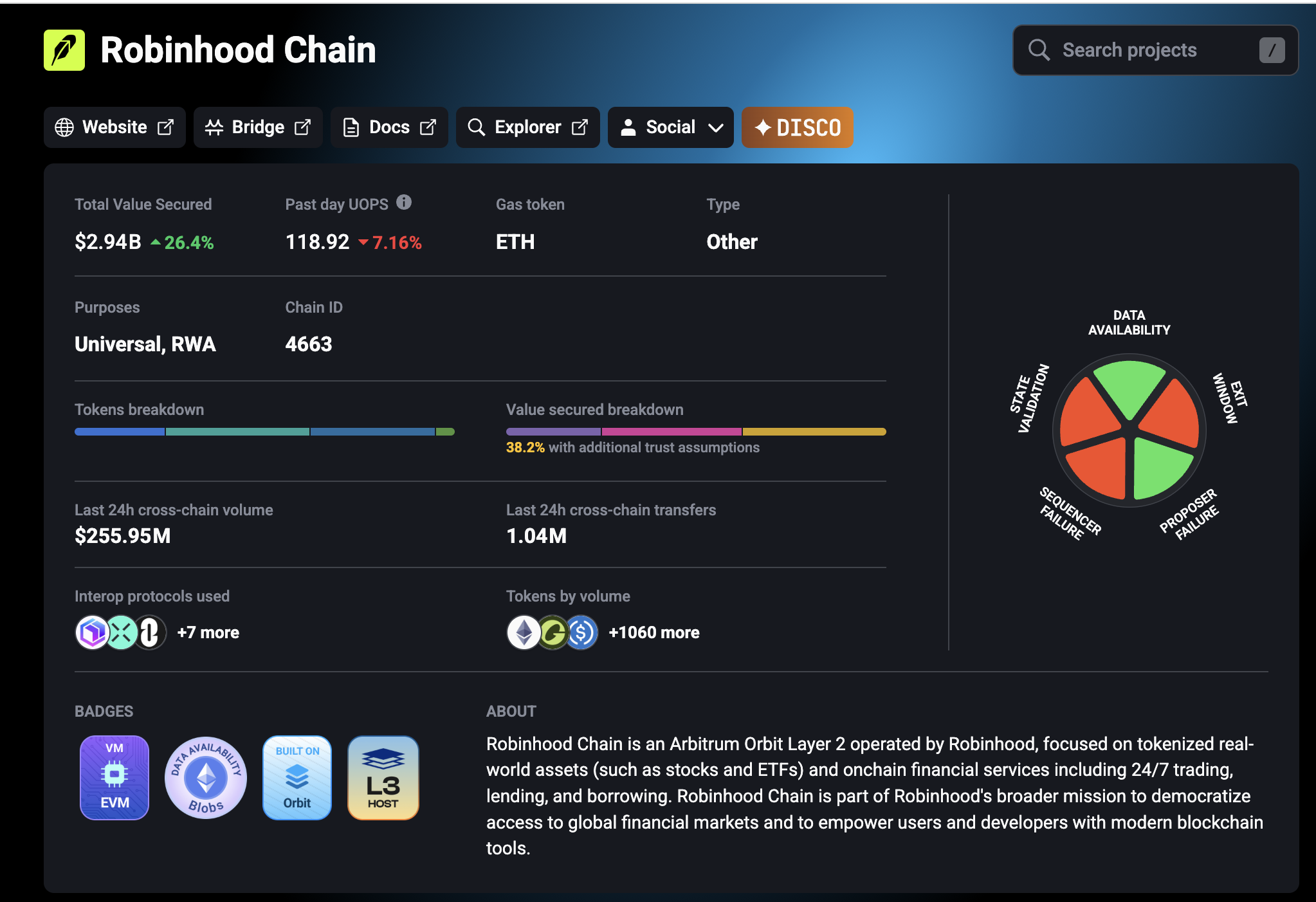
Robinhood Chain shows that the criteria for L2 success are changing. Robinhood moved its existing customers and financial products onto a proprietary chain, connected tokenized equities to DeFi, and captured sequencer revenue in the process. By attracting substantial assets and transaction volume from launch, Robinhood Chain is clearly a success. However, whether that success accrues equally to Robinhood, Arbitrum, and Ethereum is a separate question.
Robinhood's decision to launch its own L2 is relatively straightforward. It can use Arbitrum and Ethereum technology while securing dedicated blockspace and designing transaction processing, fee mechanics, and regulatory controls around its own requirements. Because the chain posts transaction data to Ethereum blobs and uses ETH as its gas asset, it can benefit from Ethereum's data availability and finality with less cost and operational burden than building a new L1 from scratch. For enterprises, an L2 is becoming less a destination for decentralization and more a form of onchain infrastructure that can be configured around the functions and controls they need.
Source: L2BEAT
Therefore, calling Robinhood Chain an Ethereum L2 is therefore not technically incorrect. However, its classification as an L2 should be distinguished from a claim that it inherits Ethereum-level security. “The Stage” framework is not a test of whether a network qualifies as an L2, but a maturity framework showing how far trust in operators has been replaced by code and enforceable user rights. L2BEAT currently classifies Robinhood Chain as “Other” rather than a Stage 0 to 2 rollup because there are too few independent parties able to verify its state and challenge invalid transitions.
In practice, the validators able to challenge an invalid state on Robinhood Chain are limited to Offchain Labs and Alchemy. Its centralized sequencer can invalidate a transaction even if the user forces its inclusion through Ethereum, while an eight-member Security Council can modify the system immediately with seven signatures and no waiting period. Ethereum makes Robinhood Chain's published data available and allows its transaction history to be reconstructed, but it does not necessarily prevent operator censorship or a malicious upgrade. Robinhood Chain entrusts its data to Ethereum without surrendering ultimate control.
Self-custody must also be understood within these limits. Users hold their own private keys, but they are not guaranteed the stronger form of self-sovereignty in which they can always transact and withdraw assets without the operator's cooperation. A regulated financial institution, however, must be able to freeze transactions or assets in response to court orders, sanctions, and security breaches. For Robinhood, these controls may therefore be safeguards required to meet its obligations rather than flaws to be removed. The main reason an enterprise L2 may not advance to Stage 2 is likely not a lack of technical capability, but a structural conflict between trust minimization and the operating requirements of a regulated financial institution.
Source: L2BEAT
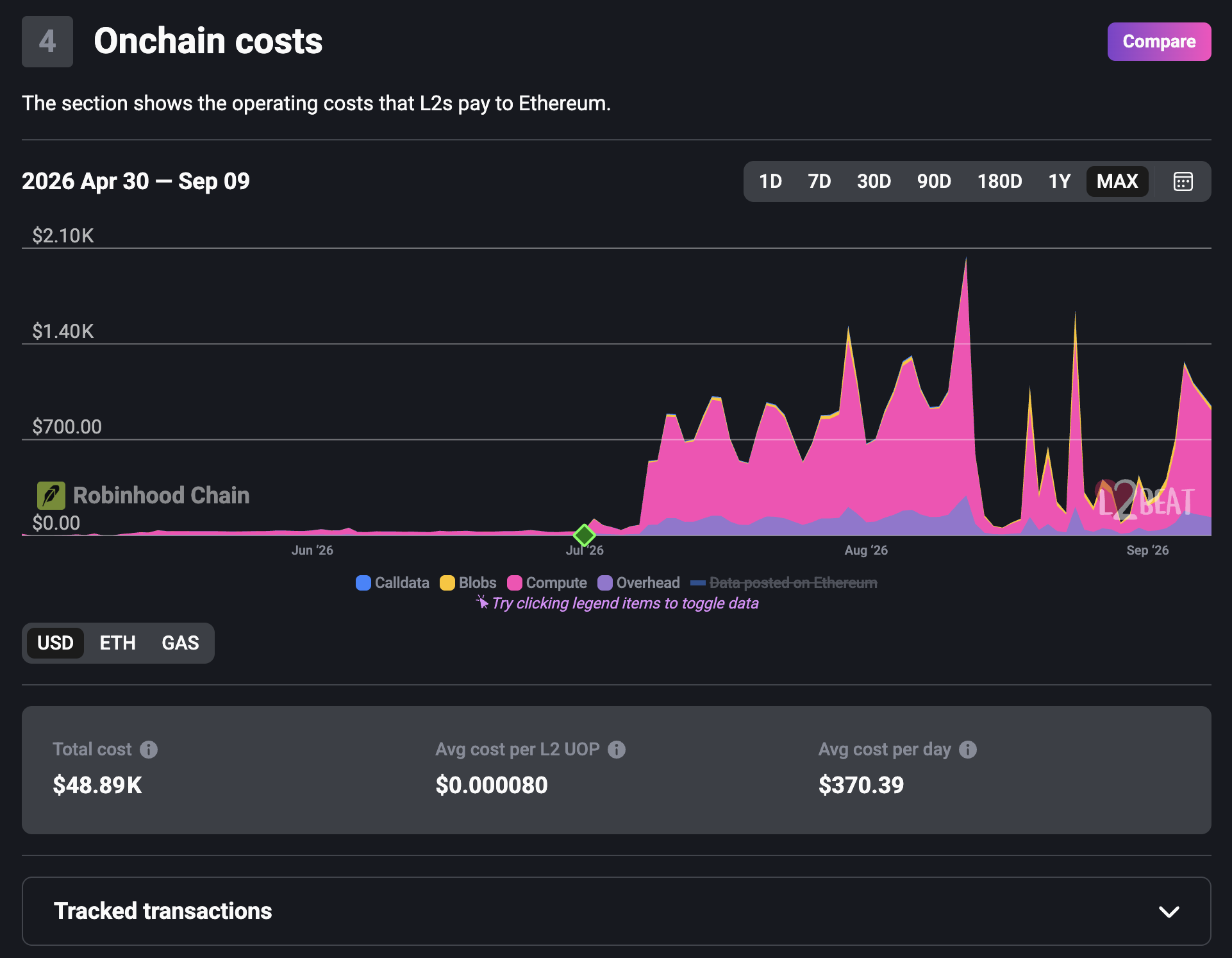
The same gap appears in the economics. Robinhood Chain has processed more than 600 million transactions since late April, yet paid only about $49,000 in onchain costs to Ethereum over the same period, or roughly $370 per day. According to a separate onchain analysis, Robinhood Chain collected around $4.5 million in fees on September 3 while paying Ethereum approximately $400. Cheap blobspace is an intended outcome of Ethereum's scaling roadmap, but it also explains why L2 transaction volume and revenue cannot be counted directly as value accruing to Ethereum.
The recent spike in gas fees makes the tradeoffs of a dedicated L2 even clearer. When a small number of trading addresses generated most of the additional demand, gas prices on Robinhood Chain rose roughly 25-fold in 11 days. Because the chain has no priority fees, ordinary users also had to pay the higher base fee. A dedicated chain gives an enterprise control over capacity and fee policy, but that decision-making power and the resulting revenue remain concentrated in the operator. L2s relieve congestion on Ethereum while creating new bottlenecks and fee markets owned by individual operators.
Robinhood Chain suggests that the L2 market will not converge on a single model. Some rollups will pursue trust minimization through permissionless validation, forced withdrawals, and constrained upgrade authority. Many enterprise L2s, however, are likely to remain onchain service platforms optimized for regulatory compliance, performance, and revenue capture. As rollup stacks become standardized, launching a chain increasingly resembles adopting cloud infrastructure rather than completing a research and development project. If networks with materially different security models are all grouped under “the Ethereum L2 label”, users may mistake the control risks of an enterprise chain for security guaranteed by Ethereum itself.
The larger concern is that, if this pattern continues, Ethereum's role could shrink to that of a low-cost data provider. If users remain on enterprise L2s, fees accrue to operators, technology revenue flows to rollup stacks, and Ethereum receives only modest blob fees, the ecosystem can expand while Ethereum's economic value is diluted. ETH's use as gas and collateral, along with the indirect benefit of enterprises choosing the Ethereum brand, still matters, but these effects could weaken if operators switch to another data availability layer or gas token. For L2 growth to translate into Ethereum's growth, the relationship must rest on stronger structural dependencies than data publication alone.
Bringing every activity back to L1 or forcing enterprise L2s to reach Stage 2 is not a realistic answer. Ethereum should focus on becoming the neutral market where mutually distrusting companies, protocols, and users can jointly issue assets and settle transactions. This requires improving L1 capacity and account UX, while ensuring that assets and liquidity across L2s remain connected through Ethereum and that user withdrawal rights and final settlement are separated from operator discretion. Censorship resistance, privacy, and permissionless validation must also become tangible product benefits rather than abstract principles.
Ultimately, Robinhood Chain's success is both an opportunity and a warning for Ethereum. It is meaningful that a major financial institution has used Ethereum technology to bring existing assets and users onchain. But if transactions and revenue remain within an enterprise L2 and its connection to Ethereum remains optional, that growth will not accumulate as value for Ethereum. The priority is not simply to increase the number of L2s, but to give users who do not want to trust any single company, and companies that cannot fully trust one another, a reason to choose Ethereum as their shared foundation. Ethereum should be a network anyone can leave, but also one that makes clear what they give up when they do.
The author of this report may have personal holdings or financial interests in assets or tokens discussed herein. However, the author affirms that no transactions have conducted using material non-public information obtained in the course of research or drafting. This report is intended solely for general information purposes and does not constitute legal, business, investment, or tax advice. It should not be used as a basis for making any investment decisions or as guidance for accounting, legal, or tax matters. Any references to specific assets or securities are made for informational purposes only and should not be construed as an offer, solicitation, or recommendation to invest. The opinions expressed herein are those of the author and may not reflect the views of any affiliated institutions, organizations, or individuals. The opinions and analyses expressed herein are subject to change without prior notice. In addition, beyond the individual disclosures included in each report, Four Pillars, may hold existing or prospective investments in some of the assets or protocols discussed herein. Furthermore, FP Validated, a division of Four Pillars, may already be operating as a node in certain networks or protocols discussed herein or may do so in the future. Please see below links in the footer for FP Validated's participating network disclosures and for broader disclosure details.