


Table of Contents

1. Crypto Capital Has Always Moved with the Market
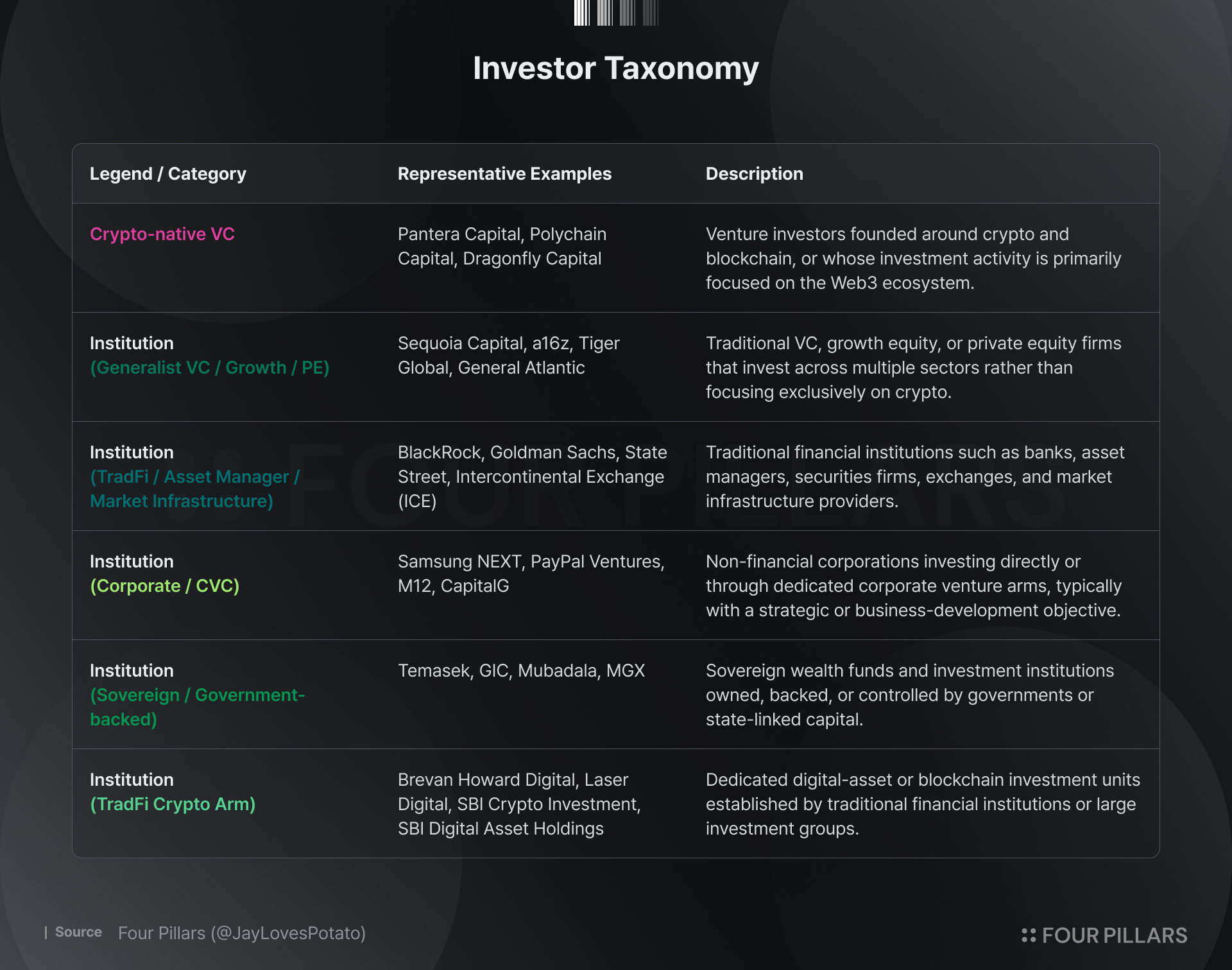
Crypto’s growth was never driven by a single type of investor. Capital entered from retail investors, crypto-native VCs, generalist VCs, growth investors, private equity firms, traditional financial institutions, corporates and CVCs, and sovereign wealth funds, with participation shifting alongside market conditions. That capital then flowed through projects and companies to developers, infrastructure providers, exchanges, market makers, and the broader ecosystem, forming the market’s funding base.
As a result, who is supplying capital to crypto, and how aggressively, can serve as a useful proxy for market interest and risk appetite.
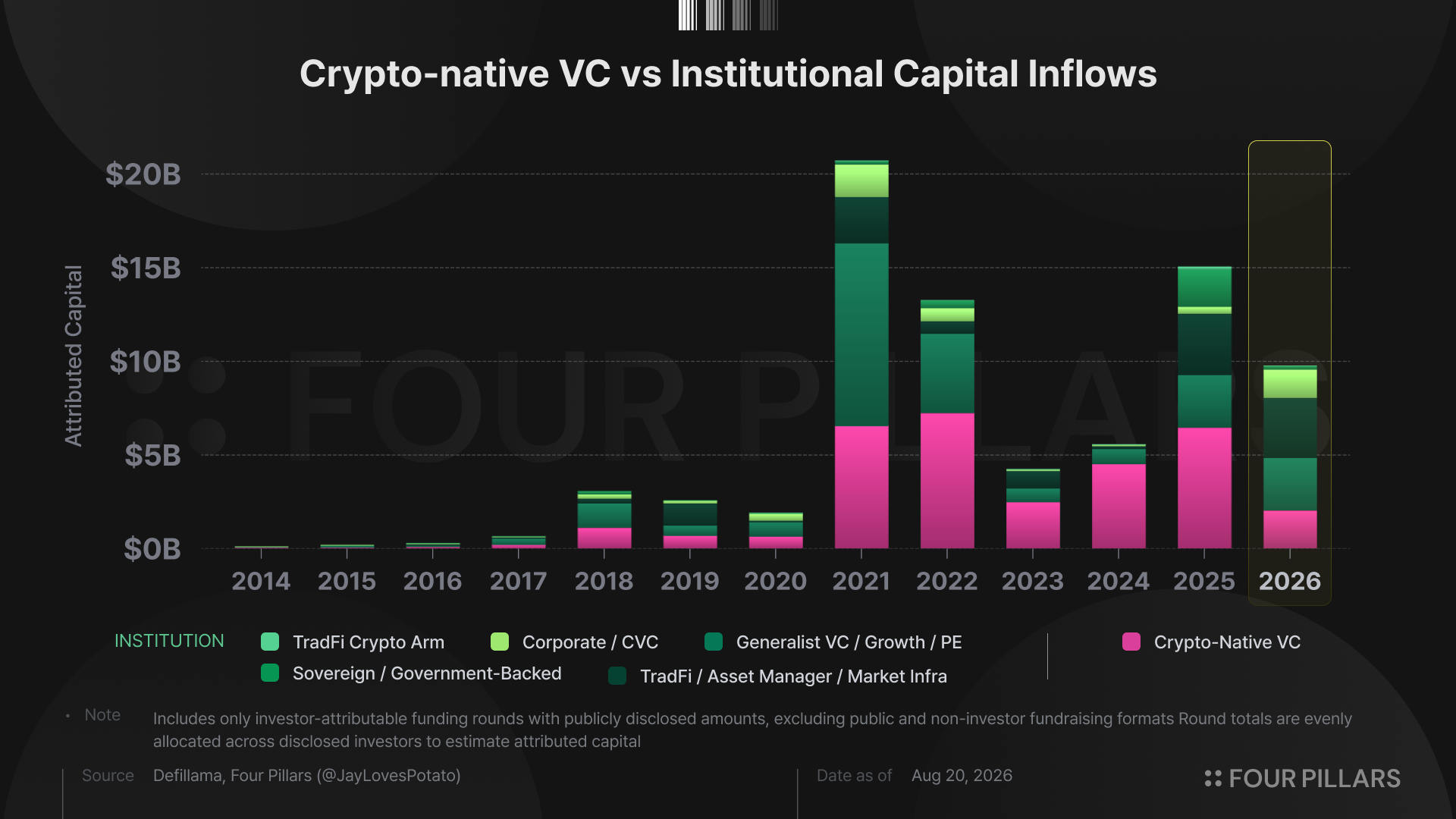
The above data shows that these flows have tracked market cycles relatively closely. Attributed Capital peaked at roughly $25B in 2021, fell sharply through 2022 and 2023, then began recovering in 2024. By 2025, as RWAs and stablecoins gained momentum, it had rebounded to more than $15B. In 2026 YTD, however, it has eased back to around $10B.*
What is more interesting this year, though, is not the amount of capital being deployed, but who is newly supplying it. The center of gravity among new investors is increasingly shifting toward traditional financial institutions and corporates.
*This chart includes only fundraising rounds in DeFiLlama’s Raises dataset where both the disclosed amount and participating investors are identifiable. Public fundraising from retail investors and other non-investment forms of financing are excluded.
2. TradFi Institutions and Corporates Are Emerging as New Sources of Capital
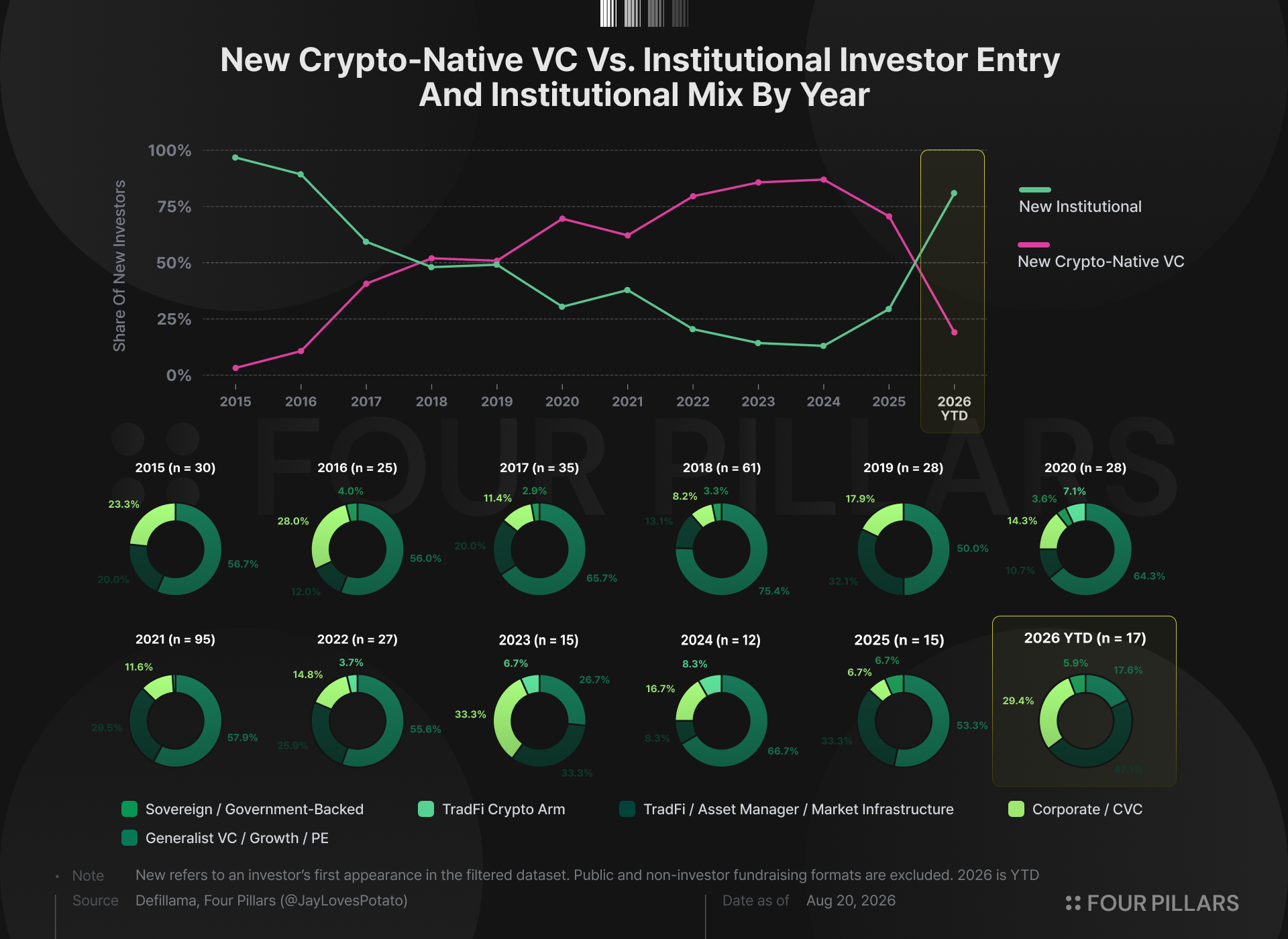
In 2026 YTD, 17 institutional investors entered crypto for the first time, already exceeding the 15 recorded during all of 2025. This stands in sharp contrast to crypto-native investors, whose number fell from 36 in 2025 to just 4 in 2026 YTD.
The composition of these new investors has shifted even more sharply. Generalist VC / Growth / PE investors accounted for 53.3% of new institutional investors in 2025, but just 17.6% in 2026 YTD. By contrast, TradFi / Asset Manager / Market Infrastructure firms now account for 47.1%, while Corporate / CVC makes up another 29.4%. Combined, they represent 76.5% of new institutional entrants, up from 40.0% in 2025.
This may be more than a simple change in the investor roster. Traditional financial institutions and corporates are more likely to invest strategically, because they can also become customers, business partners, or direct users of the infrastructure they back.
Korea Capital Market Institute(KCMI), for example, interprets BlackRock’s investment in Circle, as well as financial institutions’ investments in Digital Asset, Fireblocks, and Securitize, as more than financial bets. In its view, these investments also give incumbents access to new technologies, help integrate those technologies into existing services, and strengthen their position in the next generation of financial infrastructure.
Individual deals show the same pattern. Digital Asset explicitly described its $135M raise in 2025 as a strategic funding round, bringing together traditional financial institutions such as Tradeweb, BNP Paribas, DTCC, and Goldman Sachs, alongside crypto-native investors including Polychain. Fnality has similarly assembled a shareholder base that includes Bank of America, Citi, Tradeweb, UBS, Goldman Sachs, and DTCC, while building institutional settlement infrastructure those firms can potentially use themselves.
The broader investment activity of banks points in the same direction. According to research by Ripple, CB Insights, and the UK Centre for Blockchain Technologies, global banks participated in 345 blockchain investments between 2020 and 2024, including 33 rounds worth more than $100M. Their areas of focus were closely tied to their core businesses: institutional trading, tokenization infrastructure, payments, and digital asset custody.
In other words, the question behind institutional capital is gradually expanding from “Which crypto company will appreciate in value?” to “Which crypto infrastructure will we actually need for our business?”
3. Will This Institutional Capital Flow Into the Broader Crypto Market?
The effect is likely to be far more selective than in previous cycles.
In the past, a larger share of capital was financial capital betting on the growth of the market itself. Abundant retail liquidity supported valuations and exit opportunities, allowing not only projects but also infrastructure providers, market makers, media companies, marketing firms, and other ecosystem participants to benefit from the same expansion.
Today, capital is being spread across competing areas such as AI and public equities, while investment within crypto itself is becoming more selective, concentrating on infrastructure with clear demand or operational necessity. If institutional demand ultimately remains concentrated around payments, custody, settlement, and tokenization, then even a growing institutional crypto market may not recreate the broad ecosystem-wide spillovers seen in earlier cycles.
That said, large financial institutions and payment companies do not build every capability from scratch. After acquiring stablecoin infrastructure company Bridge in 2025, Stripe integrated it into its own payments and stablecoin issuance stack. In 2026, Mastercard moved to acquire BVNK for up to $1.8B, directly connecting stablecoin payment infrastructure with its existing payment rails. BlackRock followed a similar model with Securitize: it led the company’s $47M strategic funding round, then used Securitize as the issuance and tokenization infrastructure provider for BUIDL, its first tokenized fund, which later grew to more than $1B in assets under management.
So as institutionalization progresses, not every function will be absorbed into traditional financial institutions. A parallel model is also taking shape, where institutions invest in, acquire, or partner with proven crypto infrastructure providers, then integrate those capabilities into existing financial products and distribution channels.
This demand may become even clearer as regulation becomes more concrete. In Korea, for example, broader corporate participation in crypto markets also brings practical requirements around custody, internal controls, and transaction management. That naturally creates a division between what institutions will build internally and what they will source from specialized external providers.
For existing crypto companies, then, the opportunity is less about waiting for a vague trickle-down effect from institutional capital, and more about turning existing capabilities into things institutions are willing to buy today. Key management, validator and node operations, security, transaction monitoring, onchain data, and reporting are obvious examples of areas where crypto-native firms already have meaningful expertise.
In short, institutional capital is more likely to accelerate a new B2B market around capabilities that institutions need but do not want to build themselves, rather than broadly lifting the entire crypto market again. For existing players, the key question is therefore simple: Of the things we already do well, what will institutions actually pay for?
The author of this report may have personal holdings or financial interests in assets or tokens discussed herein. However, the author affirms that no transactions have conducted using material non-public information obtained in the course of research or drafting. This report is intended solely for general information purposes and does not constitute legal, business, investment, or tax advice. It should not be used as a basis for making any investment decisions or as guidance for accounting, legal, or tax matters. Any references to specific assets or securities are made for informational purposes only and should not be construed as an offer, solicitation, or recommendation to invest. The opinions expressed herein are those of the author and may not reflect the views of any affiliated institutions, organizations, or individuals. The opinions and analyses expressed herein are subject to change without prior notice. In addition, beyond the individual disclosures included in each report, Four Pillars, may hold existing or prospective investments in some of the assets or protocols discussed herein. Furthermore, FP Validated, a division of Four Pillars, may already be operating as a node in certain networks or protocols discussed herein or may do so in the future. Please see below links in the footer for FP Validated's participating network disclosures and for broader disclosure details.


