


Table of Contents

*This is a joint research initiative on “Asia CEX Research” with SurfAI.
Listings accelerate in the second half
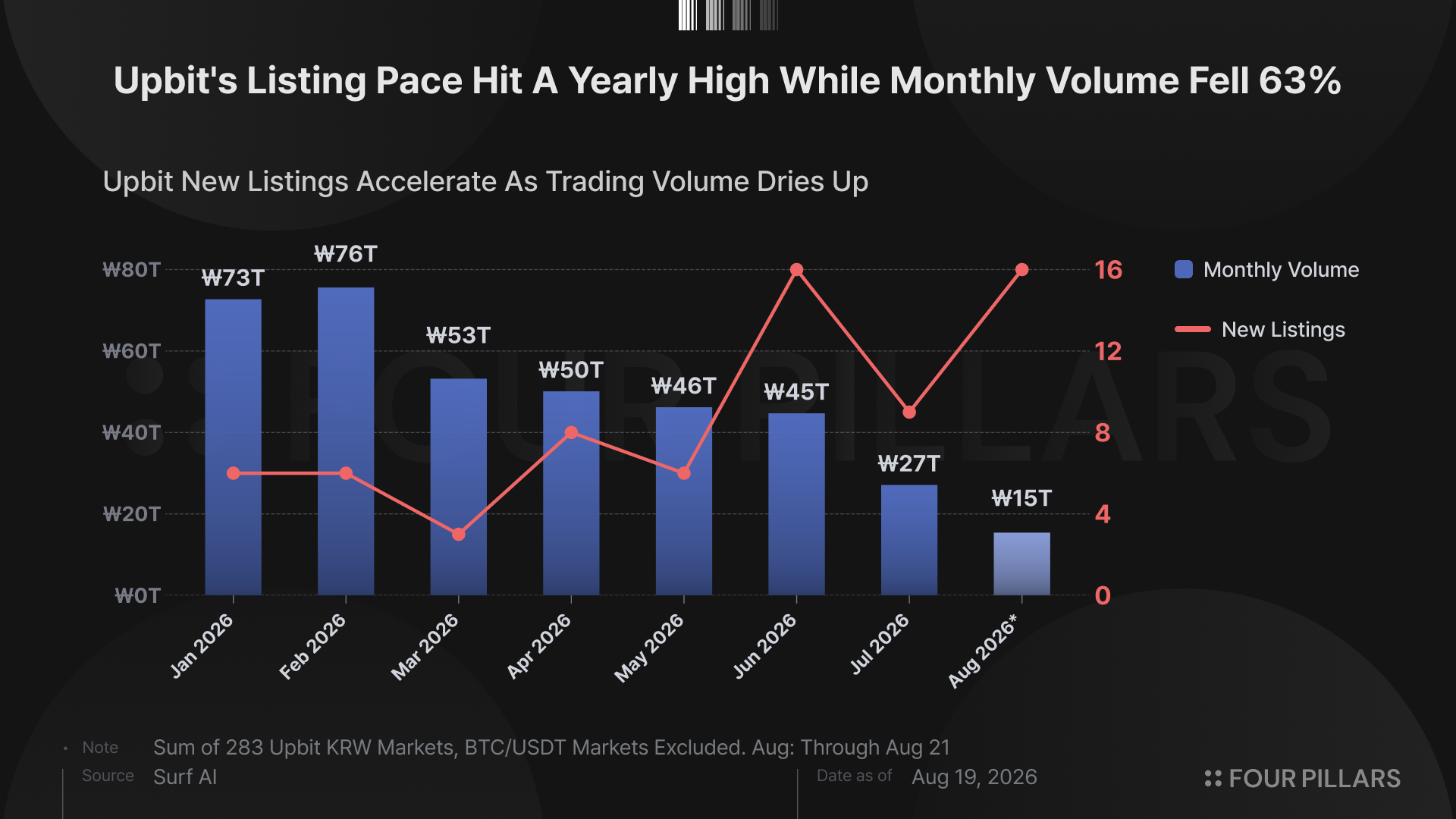
I compiled Upbit's new listings by month using the Surf AI. The listing pace has clearly picked up since June. Over the same period, monthly KRW-market trading volume fell 63%, from ₩72.7T in January to ₩27.1T in July, and BTC slid from ₩118M to the ₩90M range. Upbit is listing more coins in the downturn than it did when the market was active.
The last line of defense for Upbit's volume
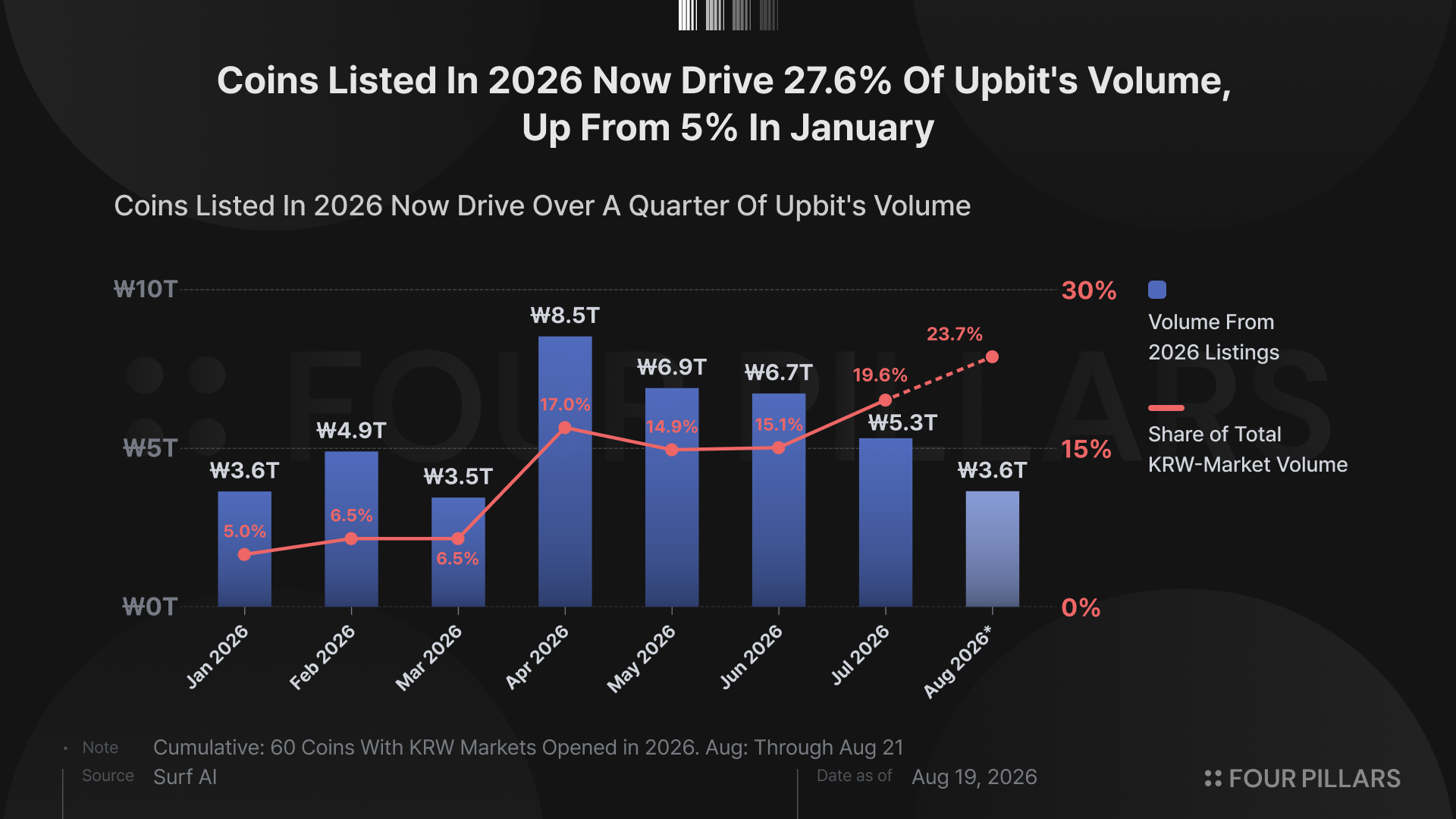
So did the growing number of listings actually create volume? 61 coins have opened KRW markets on Upbit this year as of August. Together they generate ₩3–8T in trading volume every month. Even as total volume shrank to a third, volume from this year's listings grew from where it started the year.
As a result, the share of total volume coming from coins listed this year climbed from 5% in January to 27.6% in August. Given that Upbit charges a flat fee across KRW markets, close to a quarter of its fee revenue now comes from coins listed this year.
At the individual level, a new listing averages 1.2% of total market volume over its first 30 days, with strong debuts reaching 4–5% (CHIP 4.8%, RE 4.0%, SLX 3.8%). Among August listings, CAP has recorded 4.5% in its first 16 days and counting.
Stablecoins (USDS, RLUSD, USDG), by contrast, sit under 0.1%. Even a fresh listing brought them practically no volume.
Where the Upbit listing premium stands
In short, new listings are effectively the only volume lever Upbit can pull on its own during a market downturn. But the lever is not growing the pie or reviving the market. Within a sharply shrinking total, only the share of newly listed coins has grown.
Korean digital-asset exchanges, led by Upbit and Bithumb, have long been considered strategically valuable as the sole gateway to KRW exposure in crypto. This year, however, the "Upbit listing" is being used less as an event that creates new demand than as a tool to defend shrinking volume.
That the listing premium still works means there are still buyers left in this market. But pulling the lever more often also means there are few other levers to pull. Premium is a product of scarcity, and right now it is being spent, bit by bit, to defend volume in a down market. Whether the strategic value of KRW liquidity remains intact when the market turns is an open question.
The author of this report may have personal holdings or financial interests in assets or tokens discussed herein. However, the author affirms that no transactions have conducted using material non-public information obtained in the course of research or drafting. This report is intended solely for general information purposes and does not constitute legal, business, investment, or tax advice. It should not be used as a basis for making any investment decisions or as guidance for accounting, legal, or tax matters. Any references to specific assets or securities are made for informational purposes only and should not be construed as an offer, solicitation, or recommendation to invest. The opinions expressed herein are those of the author and may not reflect the views of any affiliated institutions, organizations, or individuals. The opinions and analyses expressed herein are subject to change without prior notice. In addition, beyond the individual disclosures included in each report, Four Pillars, may hold existing or prospective investments in some of the assets or protocols discussed herein. Furthermore, FP Validated, a division of Four Pillars, may already be operating as a node in certain networks or protocols discussed herein or may do so in the future. Please see below links in the footer for FP Validated's participating network disclosures and for broader disclosure details.


