Table of Contents


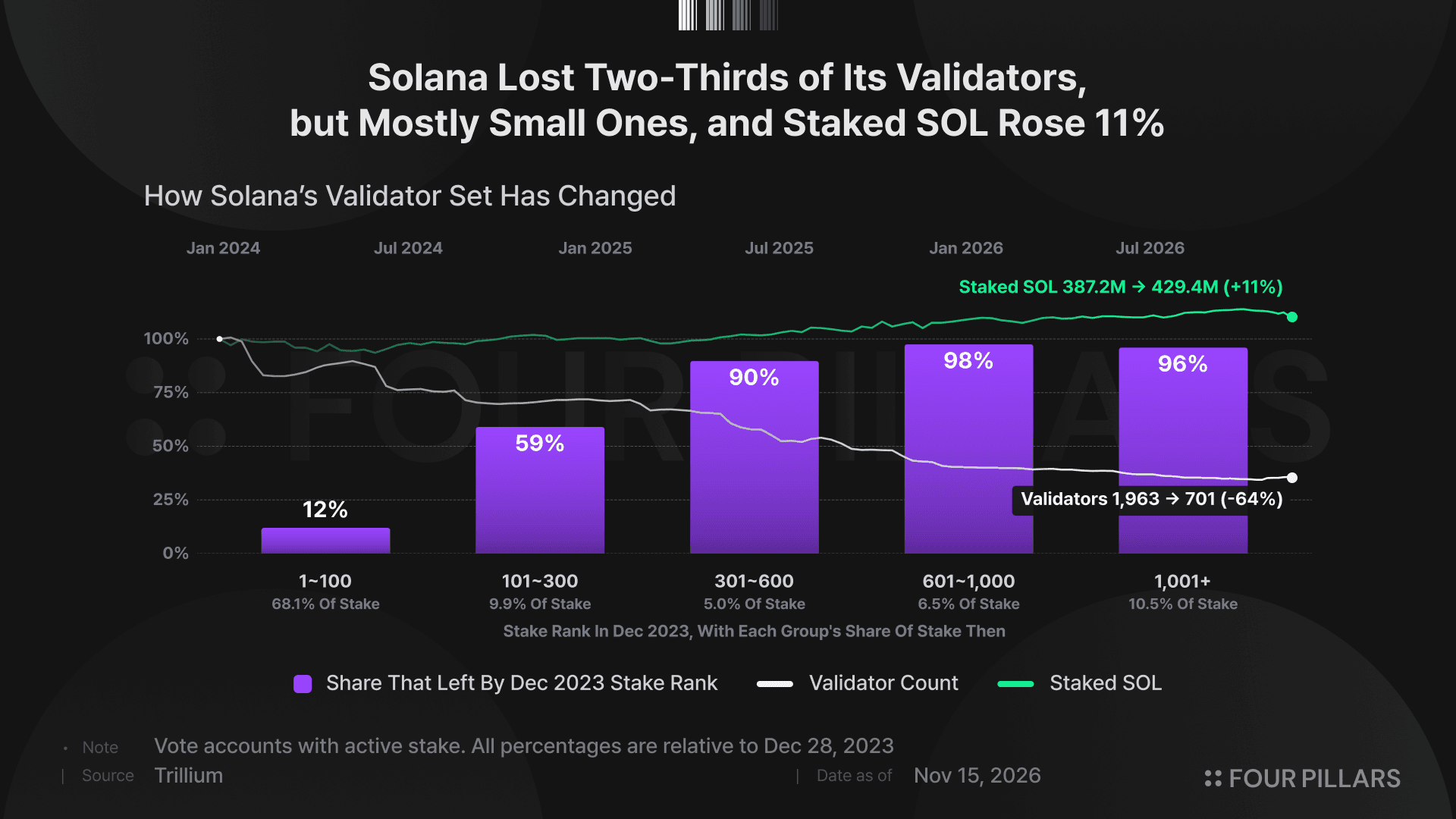
Solana’s active validator count fell 64% in less than three years, from 1,963 on December 28, 2023, to 701 on November 15, 2026. Yet the Solana Foundation continues to scale back the delegation program that helped keep validator numbers up. Blockchain networks have long pursued decentralization and wider distribution. Are those goals losing their appeal?
Validators with less stake accounted for most exits
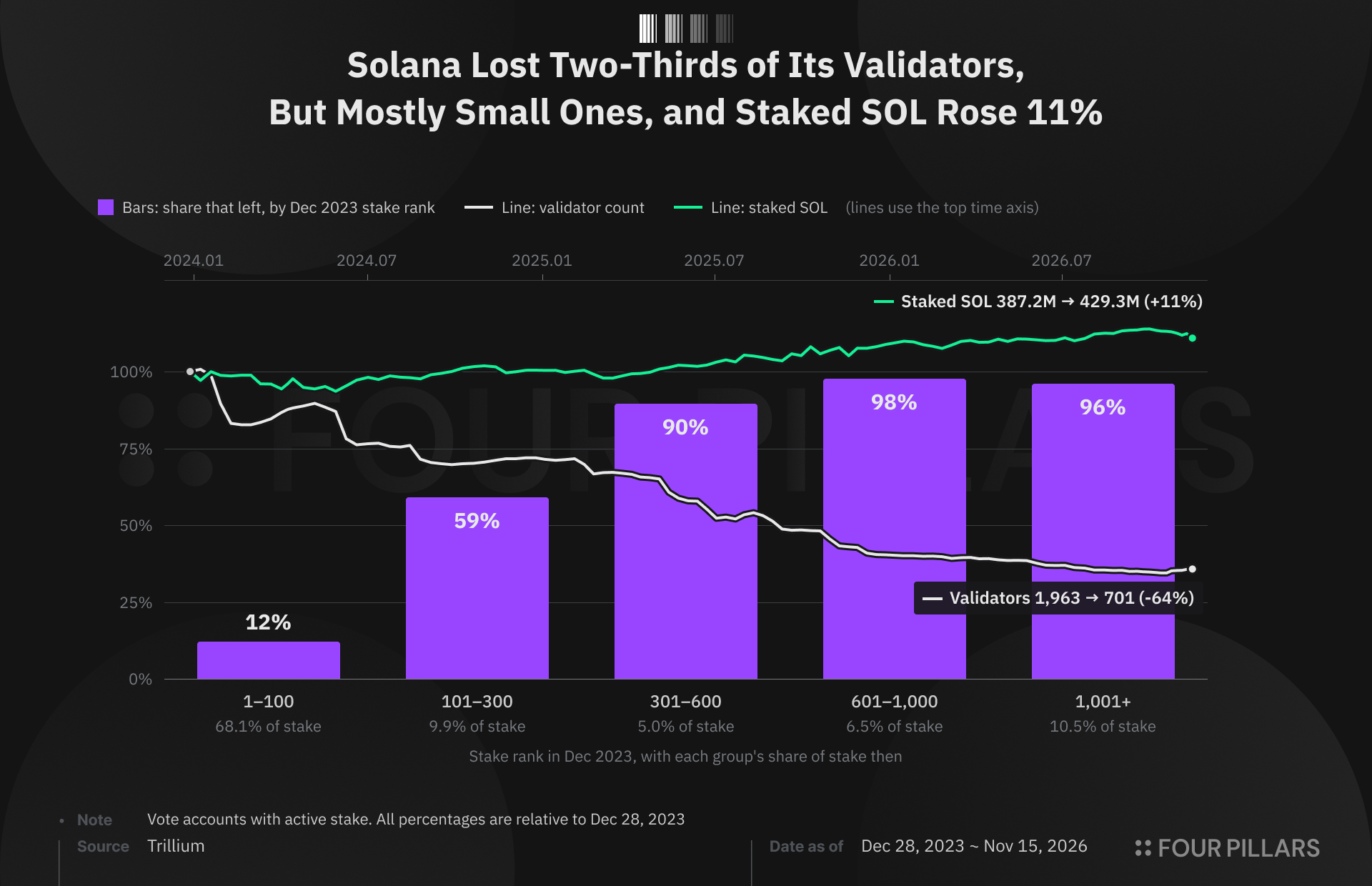
Of the 1,963 validators with stake in December 2023, 1,713 left. The 701 supporting the network at the end of the period included 250 from the original group and 451 that joined later. To assess what these exits mean for a proof-of-stake (PoS) network, we need to know both how many validators left and what happened to their stake.
Only 12 of the top 100 validators by stake in December 2023 left. None of those 12 vote accounts listed an operator name, so some operators may have switched accounts. Among the 1,663 validators ranked 301st or lower by stake, 95% left. Most small validators running on little stake shut down their nodes.
Over the same period, total stake on Solana rose about 11%, from 387.20 million to 429.33 million SOL. The share of total supply staked barely changed, edging down from about 68% to 67%. The Foundation reduced its delegations by about 41 million SOL, which means stake from other sources grew by about 83 million SOL.
By validator count, Solana became less distributed and less decentralized. It retained the security it derives from staked SOL.
The Foundation scales back its delegation program
Counting validators that both joined and left during the period brings total exits to 2,576. Of those, 1,280 had less than 20% of their peak stake just before they stopped operating. Losing delegated stake cuts rewards and makes it harder to cover the cost of running a node. Given Solana’s demanding hardware requirements, that loss of income can force a validator to shut down.
Of the validators that left, 1,243 had between 50,000 and 100,000 SOL at their peak. The stake rankings offer a clue to what sustained so many validators at that level. In December 2023, the 700 validators ranked 301st through 1,000th received about 70% of their combined stake through the Solana Foundation Delegation Program (SFDP). The way the Foundation allocated stake may also explain why so many validators in that group had between 60,000 and 70,000 SOL.
The timing of the exits also lines up with changes to the Foundation’s delegation rules. The first half of 2024 saw 865 exits, the highest half-year total. The revised rules applied from epoch 578 in February 2024. Another 451 validators left in the second half of 2025. That October, the Foundation began reducing its matching ratio from 1:1 to 0.5:1 and its matching cap from 100,000 to 50,000 SOL. According to the Foundation, the SFDP’s share of total stake fell from about 44.4% at launch to about 5.9% by November 2025.
This pattern suggests that as the Foundation scaled back its stake subsidies, validators that could neither attract enough outside stake nor sustain themselves through self-delegation dropped out. Operators that had the greatest difficulty replacing Foundation delegations with their own SOL or outside delegations would have found it hardest to keep their nodes running.
What a maturing PoS network looks like
What do we mean by distribution and decentralization? A network with more validators is more physically distributed and decentralized. If most of their stake comes from a single foundation, however, political power is still concentrated. On Solana, the Foundation’s share of stake has fallen sharply and stake from outside the Foundation has grown. In that sense, political power is more widely distributed today. The network looks less distributed by node count, yet the power to decide who can afford to participate as a validator has shifted from the Foundation to the market.
With the Foundation providing a smaller share of stake on Solana, validators depend more on the SOL they can stake themselves and the delegations they can attract from others. As a PoS network matures, outside delegators naturally take on the role its foundation played in supplying early stake.
The legacy of distribution and decentralization
For many people, decentralization and distribution have long been measures of a blockchain’s value. Today, both seem to carry less weight as ends in themselves.
Of the many layer 1 blockchains that launched in quick succession, only a handful remain. Each survived because it could make a distinct case for itself. They now see building on the strengths that set them apart as their best chance of survival.
Trustlessness and censorship resistance remain Ethereum’s highest priorities. Ethereum now has ways to uphold those values beyond decentralization and distribution. It is already reducing its validator count through consolidation. After the transition to zero-knowledge (ZK) proofs, a few operators with high-performance hardware will handle most block production and proof generation. As long as Ethereum preserves trustlessness and censorship resistance, it has little reason to decentralize every part of the network.
Solana aims to build Internet Capital Markets where people can trade any asset. Such markets need operators whose infrastructure can maintain low latency and high throughput even when trading surges. That helps explain why the Solana Foundation described the validator set that emerged from the cuts as “smaller, but economically stronger.” Maintaining a large validator set comes with costs and trade-offs. Solana has chosen to bear less of that cost than it once did.
Distribution and decentralization gave blockchain networks a way to show why people needed them. As the hype has faded, networks have found different reasons for people to use them. They have begun to reconsider how much decentralization is worth paying for. Decentralization is no longer an article of faith for every blockchain.