


Table of Contents
- Key Takeaways
- 1. Infrastructure is judged by what grows on top of it
- 2. Applications redrawing asset flows
- 2.1 Umbra: Solana's first confidential financial layer
- 2.2 Hydex: A DeFi hub bringing confidentiality into diverse domains
- 2.3 Stealf, Dinario, and Anonmesh: Expansion into payments and finance
- 3. New mechanisms of price discovery and capital formation
- 3.1 Crafts: Solana's first sealed-bid token launchpad
- 3.2 Seedplex: Confidential fundraising and DAO
- 3.3 Undesk: An onchain OTC desk
- 4. New information markets
- 4.1 Opportunity markets
- 4.2 Evolved prediction markets
- 5. Confidentiality in the gaming domain
- 6. The contours of an confidential capital market
- 6.1 Composability created by the Confidential Token Standard
- 6.2 The first signs of synergy between applications
- 6.3 In closing
Researcher

Related Projects

Key Takeaways
- The Arcium ecosystem is not a single application but takes the form of an application network, with 7 categories being built in parallel.
- Each application leverages different aspects of Arcium's multi-party computation (MPC). Examples include confidential balances based on Confidential Token Accounts, token launchpads built on sealed-bid auctions, prediction markets based on confidential betting, and asymmetric information market mechanisms. All of these are applications that were difficult to implement on existing transparency-based blockchains, or that proved unworkable from a user experience standpoint.
- In addition, Arcium's Confidential Token Standard (C-SPL) strengthens composability across applications in the ecosystem. This forms a new layer of capital markets on top of Solana, generating synergies that go beyond a simple sum of features.
1. Infrastructure is judged by what grows on top of it
In the previous article, we covered how Arcium has met the five conditions required to become general-purpose confidential computation infrastructure through multi-party computation. Yet the value of infrastructure is ultimately judged by what gets built on top of it. The crypto ecosystem has too often witnessed infrastructure adorned with lofty descriptors but rarely used in practice.
Source: Arcium
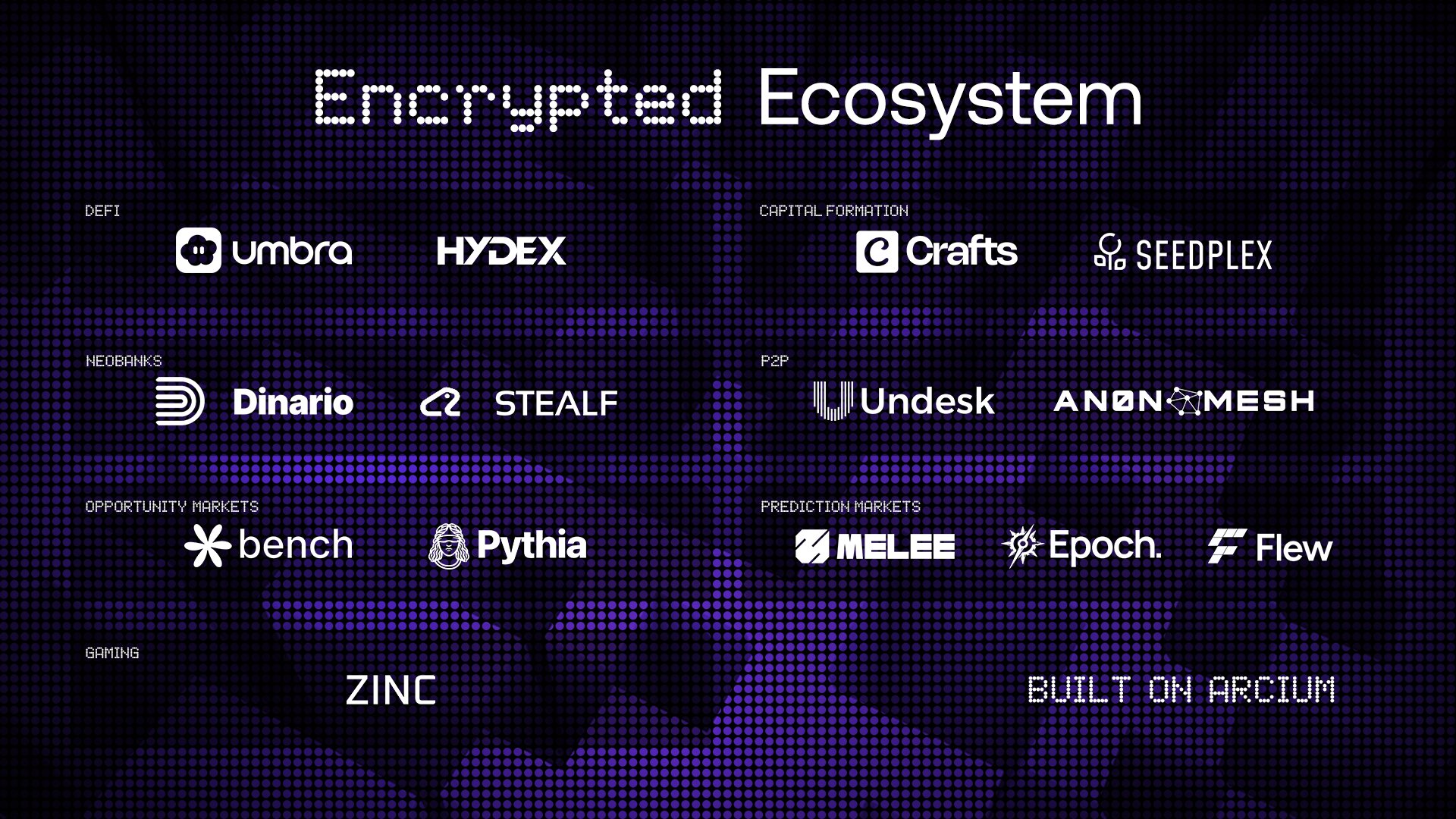
Arcium is showing a different trajectory in this regard. Since the Mainnet Alpha launch in February 2026, more than 12 projects across 7 categories have been built on Arcium in parallel, ranging from DeFi to capital formation, neobanks, P2P, opportunity markets, prediction markets, and gaming. These applications have collectively raised over $7.5 million in funding, and Umbra, the first application, gathered roughly $155 million in commitments, going down as the most successful ICO in Solana’s ecosystem history.
What deserves more attention than these numbers is the nature of the applications themselves. These are applications that could not exist without Arcium. Multi-party applications requiring confidential shared state, which were difficult to implement using zero-knowledge proofs alone, along with new market mechanisms that could not be expressed through existing Solana DeFi primitives, are now being implemented on this foundation.
This ecosystem composition resembles a generational shift among crypto founders. Where first-generation projects dealt with isolated confidential states such as shielded transactions, Arcium provides an environment where multiple parties can perform computations together while each preserves their own secrets. This means new application categories and mechanisms such as dark pools, sealed-bid auctions, confidential voting, and hidden information games, which were difficult to even attempt in the previous generation, are now being opened up. This is also a catalyst for more institutions and enterprises to bring their businesses onchain.
This article looks at the garden growing on Arcium through three branches. The first is the group that makes the flow and holding of assets confidential. The second is the group that redesigns the mechanisms of price discovery and capital formation. The third is the group that turns the structure of information asymmetry itself into a market. At the end, I analyze the synergies these create together and look at what shape Arcium's confidential capital markets is actually taking.
2. Applications redrawing asset flows
The first branch consists of applications that make the holding and movement of assets themselves confidential. These applications aim to address the most fundamental shortcoming of Solana DeFi, namely that "how much I hold and where I send it are all public." In this area, Umbra sits at the center, with other applications gradually stacking up on top of it.
2.1 Umbra: Solana's first confidential financial layer
Source: Umbra
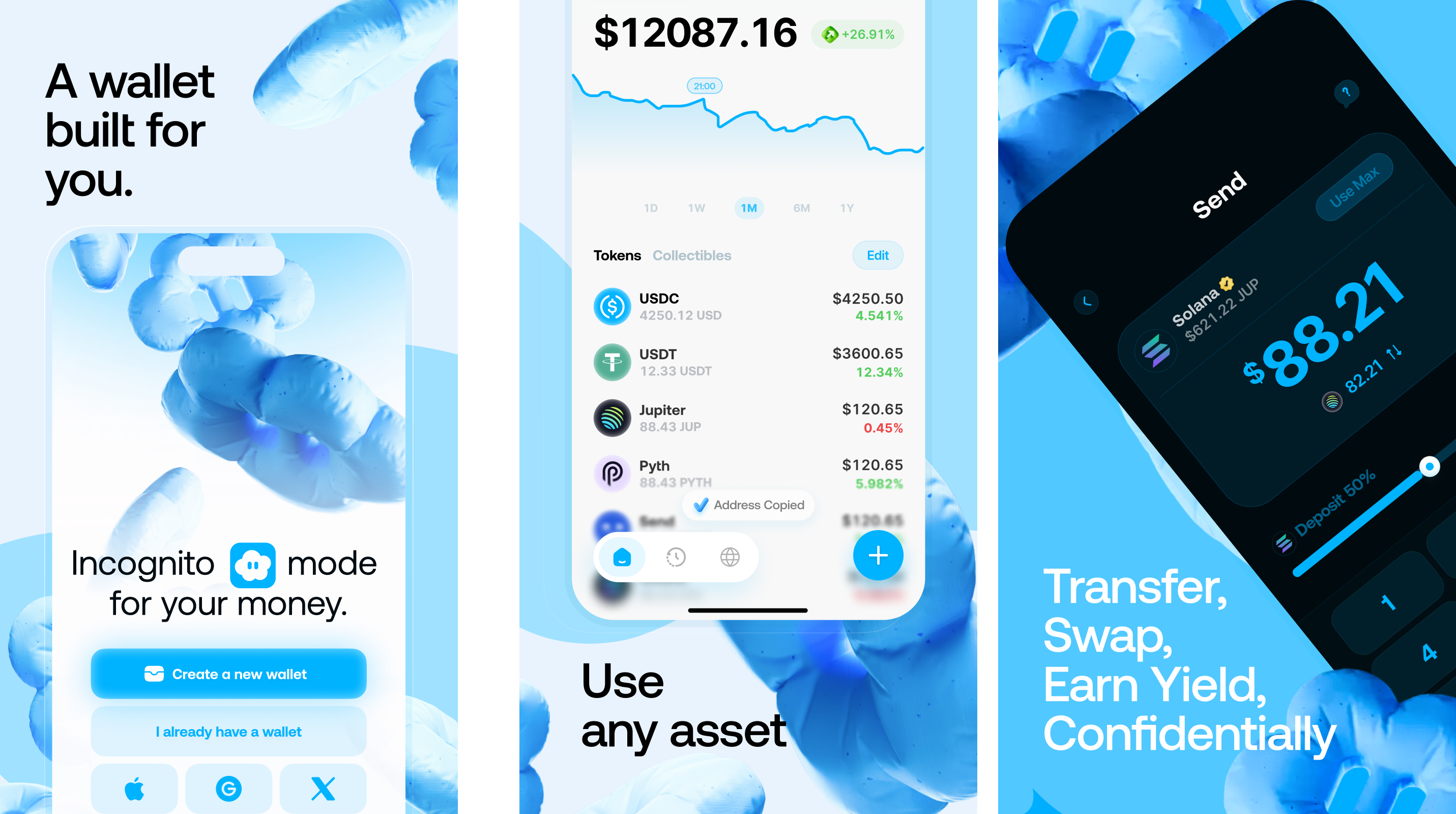
Umbra is the first application to reach a live state on Arcium Mainnet Alpha, and a public launch for general users was completed in March 2026. It functions as a confidential financial layer providing confidential transfers, swaps, and confidential balances on Solana. It is currently accessible via web extension, the Solana Seeker dApp store, iOS (Testflight), and Android (Google Play Store), with a web app planned for support soon.
The key to understanding how Umbra works lies in the fact that it treats balance confidentiality and transactional relationship confidentiality as separate tools.Balances are kept confidential, handled by Arcium's multi-party computation. When a user's tokens are moved into a shielded pool, an Confidential Token Account is created for the (wallet, token) pair, and the balance is processed only in confidential form within the multi-party computation execution environment. Transactional relationship confidentiality is handled by zero-knowledge proofs. When tokens deposited in the shielded pool are withdrawn to a separate address, the proof verifies validity without revealing which deposit in the pool the withdrawal originated from. Users can combine these two tools to hide only the balance, only the transaction path, or both. Compared to Tornado Cash or Railgun, which obscured only transaction relationships, or Solana's Token-2022 confidential transfers, which obscured only balances, this represents a meaningful structural advance.
On the user experience side, the way gas fees are handled deserves note. One chronic problem with protocols building with confidentiality has been that during the withdrawal step, the very first transaction in which a new address receives tokens to pay gas fees becomes a clue that re-links the new address to the existing one. Umbra solves this problem by adopting a structure in which a separate relayer network submits transactions on behalf of users and covers the gas fees. It also includes built-in compliance tools such as user-generated viewing keys, risk screening, and geo-blocking, aiming for a middle ground that maintains strong confidentiality while allowing selective disclosure when needed.
It is also worth noting that Umbra is evolving beyond a simple end application into middleware for the Solana ecosystem. Umbra provides a TypeScript-based software development kit that allows other Solana applications to integrate confidential payments, DeFi interactions, and confidential balance management through function calls, without having to build their own infrastructure.
The core of Umbra's structure is that Confidential Token Accounts can be owned by Solana's Program Derived Addresses. In other words, smart contracts can directly hold and manage confidential balances. Solutions that only provide UTXO-based shielded pools, such as Railgun or Tornado Cash, require users to withdraw funds at the user level before interacting with other DeFi protocols. Since this breaks the anonymity set, DeFi integration was difficult. Umbra's structure bypasses this limitation, opening a path for natural integration with DeFi primitives such as automated market makers, lending protocols, and liquidity pools.
2.2 Hydex: A DeFi hub bringing confidentiality into diverse domains
Hydex is one of the projects with the broadest product lineup on Arcium, positioning itself as a confidential interoperability layer between Zcash and Solana. The team is bringing together various primitives that connect Zcash's strong confidentiality with Solana's high performance and liquidity.
Let's first look at two products that are already live on mainnet. The first is hySOL, a Liquid Staking Token (LST). When a user deposits SOL, they receive hySOL in return, and the deposited SOL is delegated to validators through Solana's standard SPL Stake Pool program. The decisive difference from typical Solana LSTs is that staking rewards are paid in ZEC instead of SOL. Arcium is used as the RNG (random number generation) component in this structure.
The significance of this becomes clearer in the context of Hydex's positioning as a Zcash-Solana interoperability layer rather than viewing hySOL alone. From a SOL holder's perspective, it becomes a new form of cross-chain yield asset that delegates assets to Solana validators while accumulating rewards in ZEC. From a Zcash holder's perspective, it becomes a channel that allows participation in the benefits of ZEC reward flows without exposure to SOL delegation. In other words, hySOL operates as a hybrid LST that bridges capital flow between the two ecosystems by separating and combining the SOL pool with ZEC rewards.
The second live product is Hydentity, a solution that goes beyond simply encrypting Solana's .sol domains and extends the domain itself into a confidential asset custody and withdrawal gateway. It works through a combination of three tools.
- Through integration, zero-knowledge proofs verify that deposits and withdrawals under the domain are valid, while severing the link between origin and destination.
- Relayer-based gas abstraction circumvents the issue where a new address gets re-linked to the existing one when receiving gas fees during withdrawal.
- Arcium confidential instruction execution applies domain-level policies in confidential state.
Originally, .sol domains are tools that map a user's wallet address to a human-friendly name, but this very mapping has the side effect of making user activity identifiable. Hydentity reinterprets the domain itself as a kind of confidentiality vault.
Source: Hydex
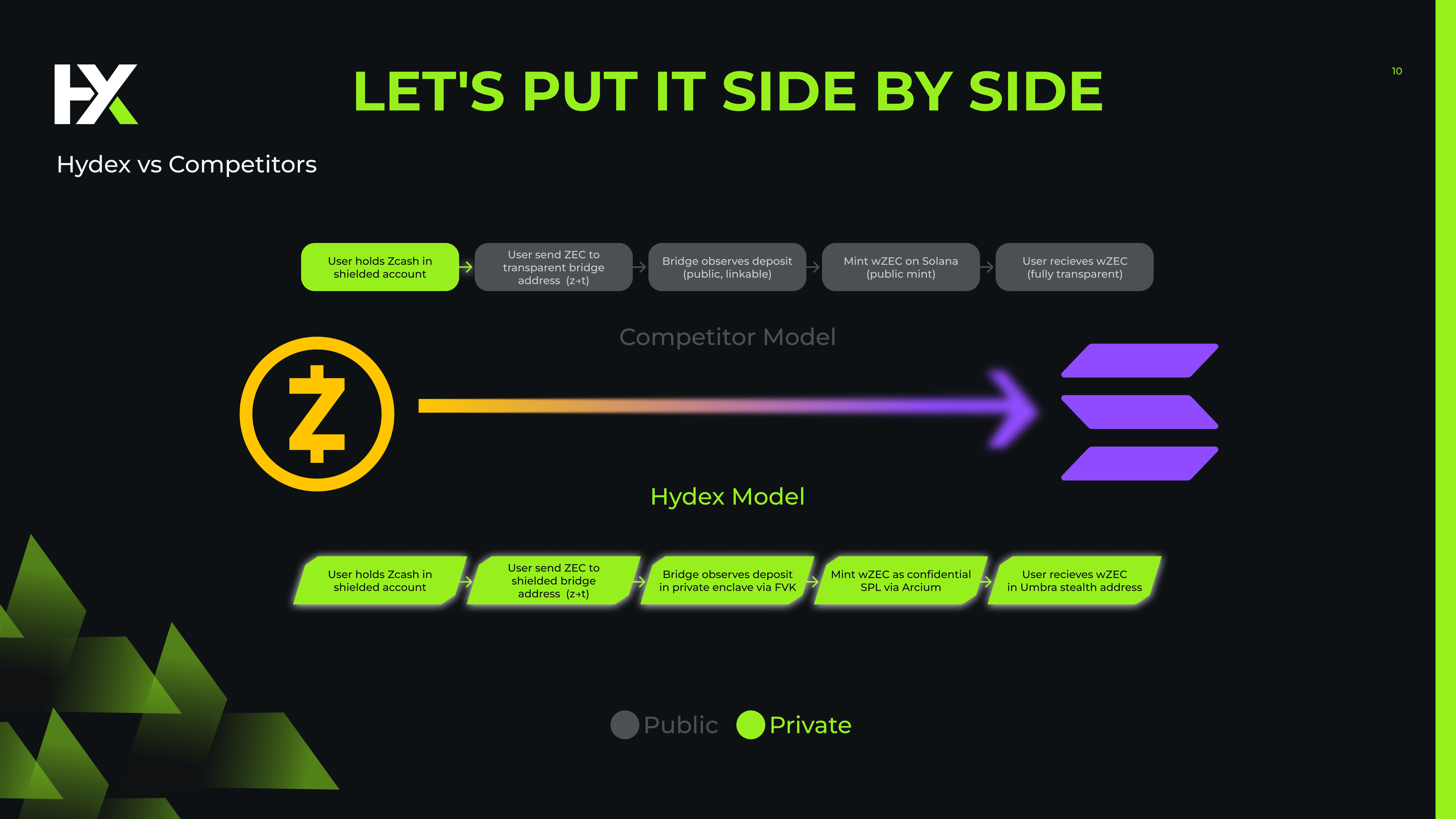
Hydex Bridge is a bidirectional bridge that moves Zcash's shielded ZEC into wrapped sZEC on Solana without exposing the connection between sender and recipient. In terms of key management, Hydex Bridge uses 2-of-3 FROST threshold signing to prevent any single operator from unilaterally approving withdrawals, and it isolates sensitive key material such as Zcash's UFVK (Unified Full Viewing Key) so that it is handled only inside a Trusted Execution Environment (TEE). To summarize, the structure mobilizes threshold signatures, TEEs, and Arcium's infrastructure together to remove single points of trust in the flow that connects Zcash-side shielded notes to Solana-side sZEC issuance. This design allows Zcash users to access Solana DeFi liquidity without losing the confidentiality provided by the shielded pool.
Hydex Router is being designed to maintain the optimal route discovery offered by existing Solana routers like Jupiter, while processing the routing input itself within the multi-party computation environment, thereby blocking mempool exposure.
Hydex Router and Bridge are currently in development, with additional information to be released going forward.
2.3 Stealf, Dinario, and Anonmesh: Expansion into payments and finance
The trend of making asset holdings and movements confidential is extending beyond projects like Umbra and Hydex into payment and financial applications that reach end users directly. These applications share a common trait: rather than building their own confidential infrastructure, they focus on their own business domains on top of the layer Arcium provides.
Source: Stealf
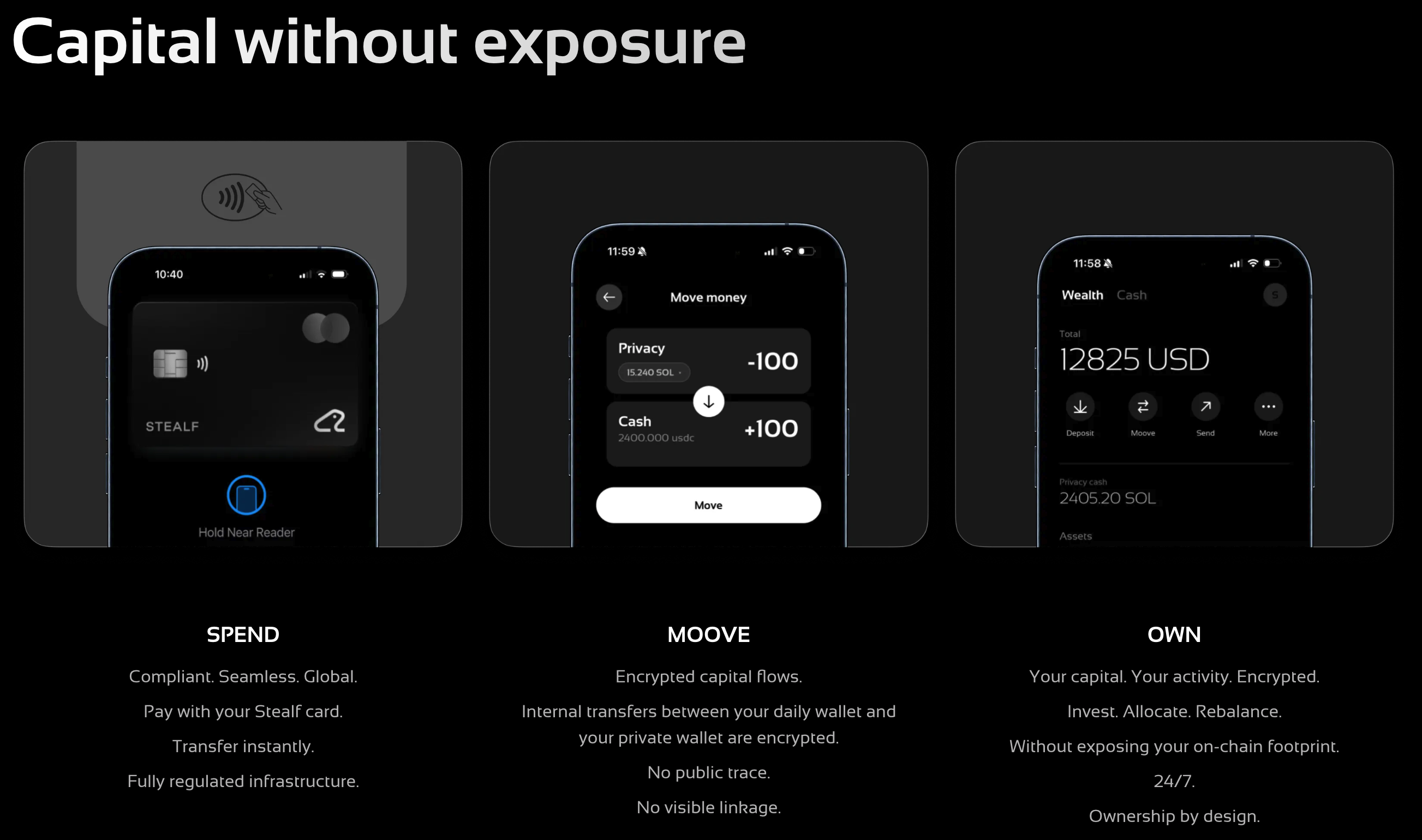
Stealf is a confidential neobank application built on Arcium. Its core design is a dual wallet model that allows users to operate a Cash wallet and a Stealth wallet simultaneously. This approach can resolve some of the practical trade-offs users face when using confidential applications. Treating all activity as confidential is unnecessary in some scenarios and may pose compliance issues in others. Conversely, making all activity public creates problems such as identification through transaction pattern analysis, exposure of asset size, and unintended information disclosure to counterparties. Stealf utilizes Turnkey's non-custodial infrastructure and banking partner Rain's infrastructure for the Cash wallet, while combining Umbra and Arcium's MPC engine for the Stealth wallet.
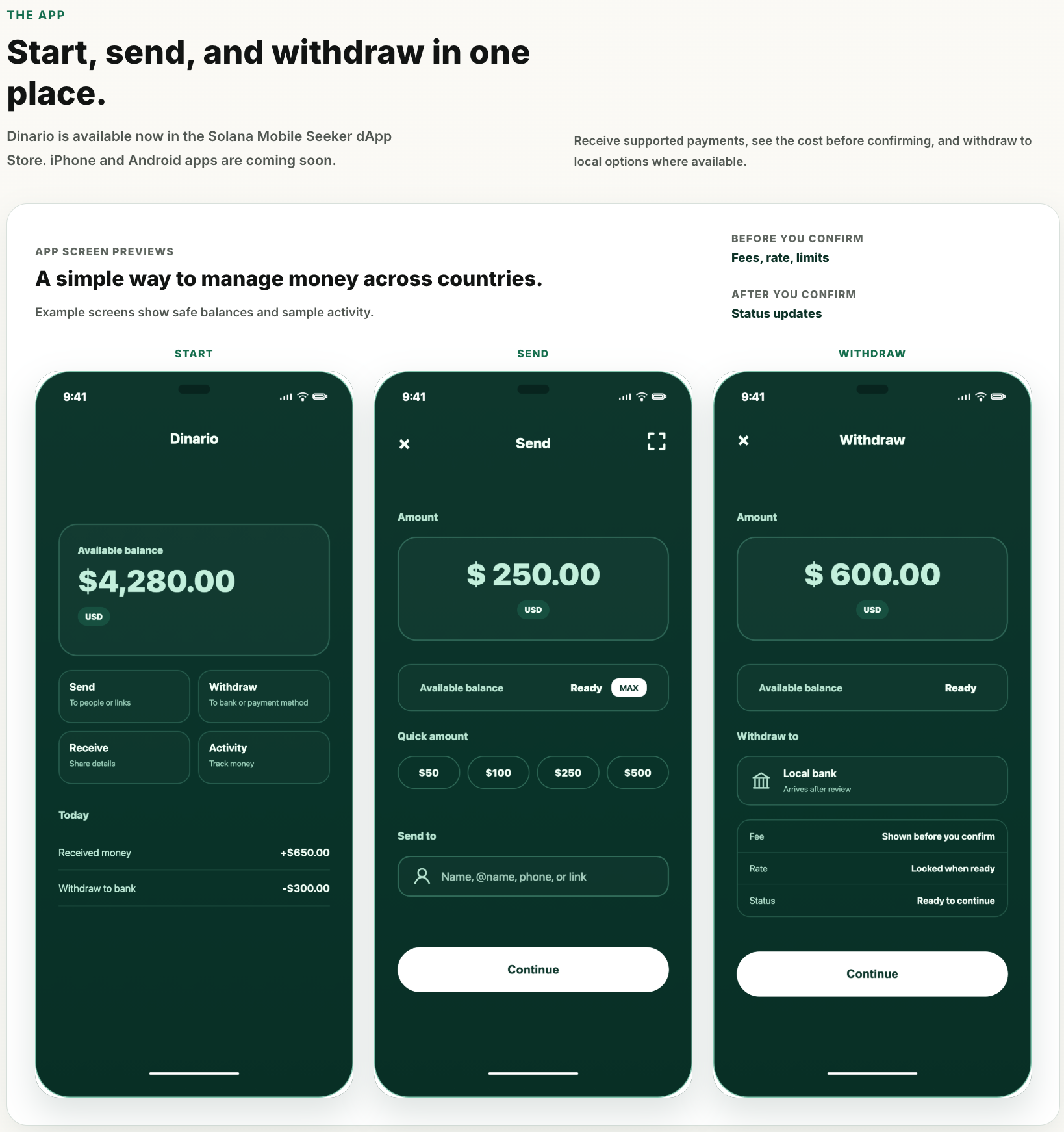
Source: Dinario
Dinario is a confidential-first off-ramp application targeting the Latin American market, allowing users to convert crypto into fiat currency without exposing their main wallet. It works through ephemeral keys and Arcium's RescueCipher encryption. When a user attempts an off-ramp, Dinario uses a one-time generated ephemeral key pair to process the transaction, and sensitive data such as the user's bank account information is encrypted with RescueCipher. RescueCipher is an encryption mechanism optimized for the multi-party computation environment, allowing direct computation in a confidential state while ensuring sufficient security. Dinario has announced plans to eventually adopt the Confidential Token Standard to support confidential transfers within the application, aiming to become Latin America's first confidentially B2B payments application. In Latin America, where stablecoin use is rapidly spreading due to inflation and exchange rate instability, but where concerns about government financial surveillance are also significant, there appears to be real demand for payment infrastructure that satisfies compliance while preventing arbitrary exposure of transaction information.
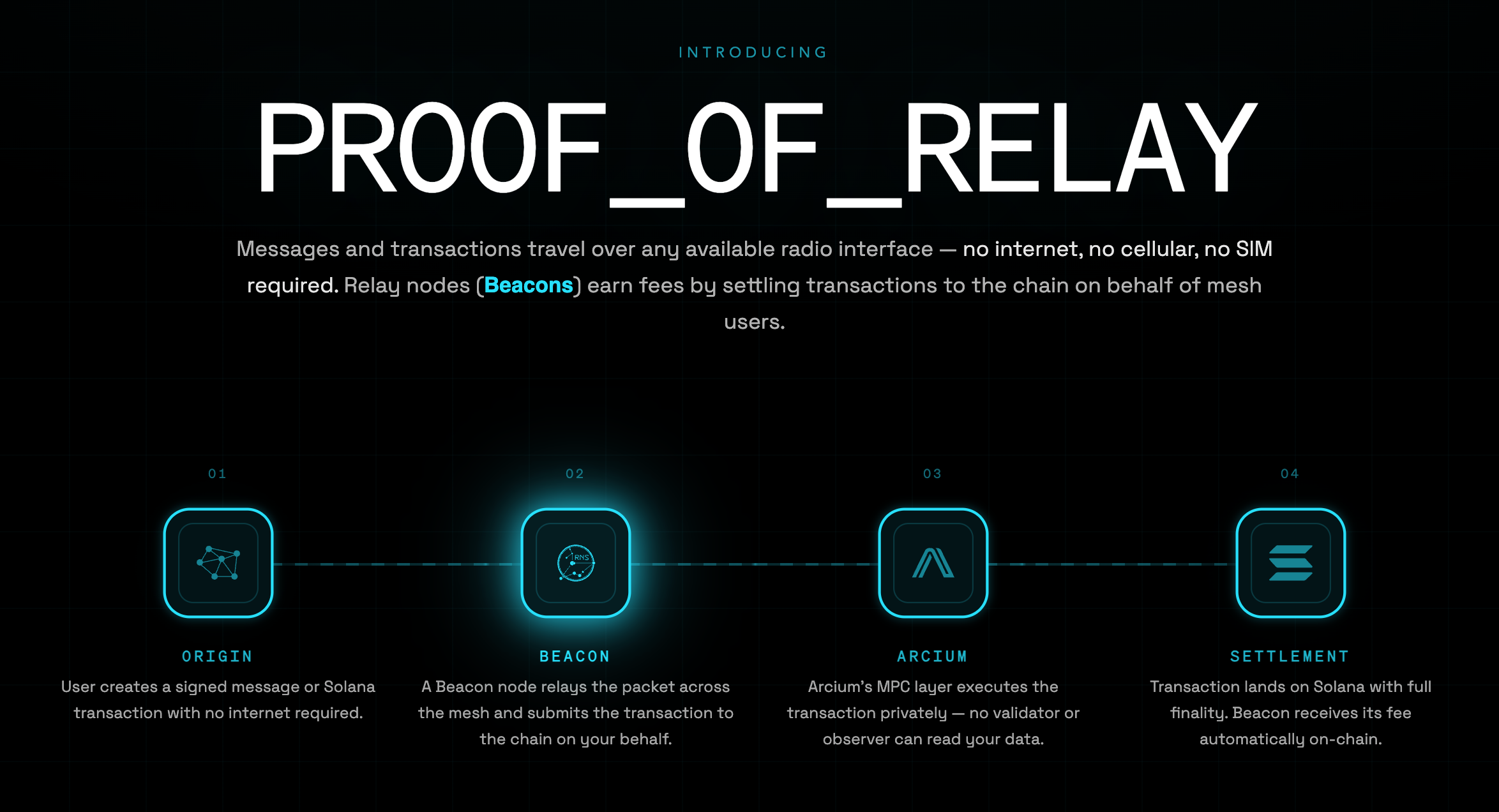
Source: Anonmesh
Anonmesh is an even more distinctive application that supports offline P2P payments and messaging via any available radio interface (e.g., Bluetooth Low Energy) through Reticulum Network. This means it enables direct payments and message exchanges between two nearby devices without an internet connection. This holds practical value when considering communication outages caused by natural disasters, environments where the internet is censored in certain regions, and situations with limited internet access such as outdoor festivals or aircraft cabins. Anonmesh uses Arcium's MPC to keep device-to-device communication confidential and plans to leverage the Confidential Token Standard once released to implement confidential token transfers.
These three applications all focus on their own business domains on top of the layer Arcium provides, rather than building their own infrastructure. This shows that confidentiality is no longer a problem to be solved from scratch at the application layer, but is becoming infrastructure that can be called as middleware.
3. New mechanisms of price discovery and capital formation
The second branch consists of applications that redesign not the holding or movement of assets, but the very mechanisms of discovering asset prices and forming capital. The applications in this area directly express market designs that are validated mechanisms in traditional finance but were difficult to implement onchain due to blockchain transparency.
3.1 Crafts: Solana's first sealed-bid token launchpad
Crafts is a project that implements a sealed-bid auction mechanism for token launches on Solana. Sealed-bid auctions are a validated mechanism in traditional finance, handling hundreds of billions of dollars in transactions annually across government bond issuances, spectrum license auctions, and IPOs, but they have been almost absent onchain.
We already know the consequences of the absence of sealed-bid auctions. The ICO and token launch markets have suffered from issues such as bot sniping, gas fee competition, and insiders with informational advantages. As a result, token prices were artificially inflated and dropped quickly without proper price discovery, repeating a familiar pattern.
Crafts solves this problem by keeping bid information confidential with Arcium. The price and quantity of bidders cannot be seen by anyone until the auction ends. When the auction ends, the multi-party computation sorts all bids and calculates the clearing price. Every participant who bid at or above the clearing price wins an allocation, and all of them pay only the clearing price rather than what they actually bid. Participants who bid below the clearing price get their bids refunded. The only things revealed externally are the clearing price and the allocation results.

Source: Crafts
Crafts announced ReFiHub, a real energy asset project, as the first project on its launchpad in April. This round was introduced as Solana's first equity-linked token fundraise conducted on Crafts' Stakeholder Token Standard, and starting from this, the sealed-bid mechanism appears poised to be formally introduced to Solana. Crafts is making a noteworthy attempt that could serve as an alternative to the current bot-friendly token launch environment.
3.2 Seedplex: Confidential fundraising and DAO
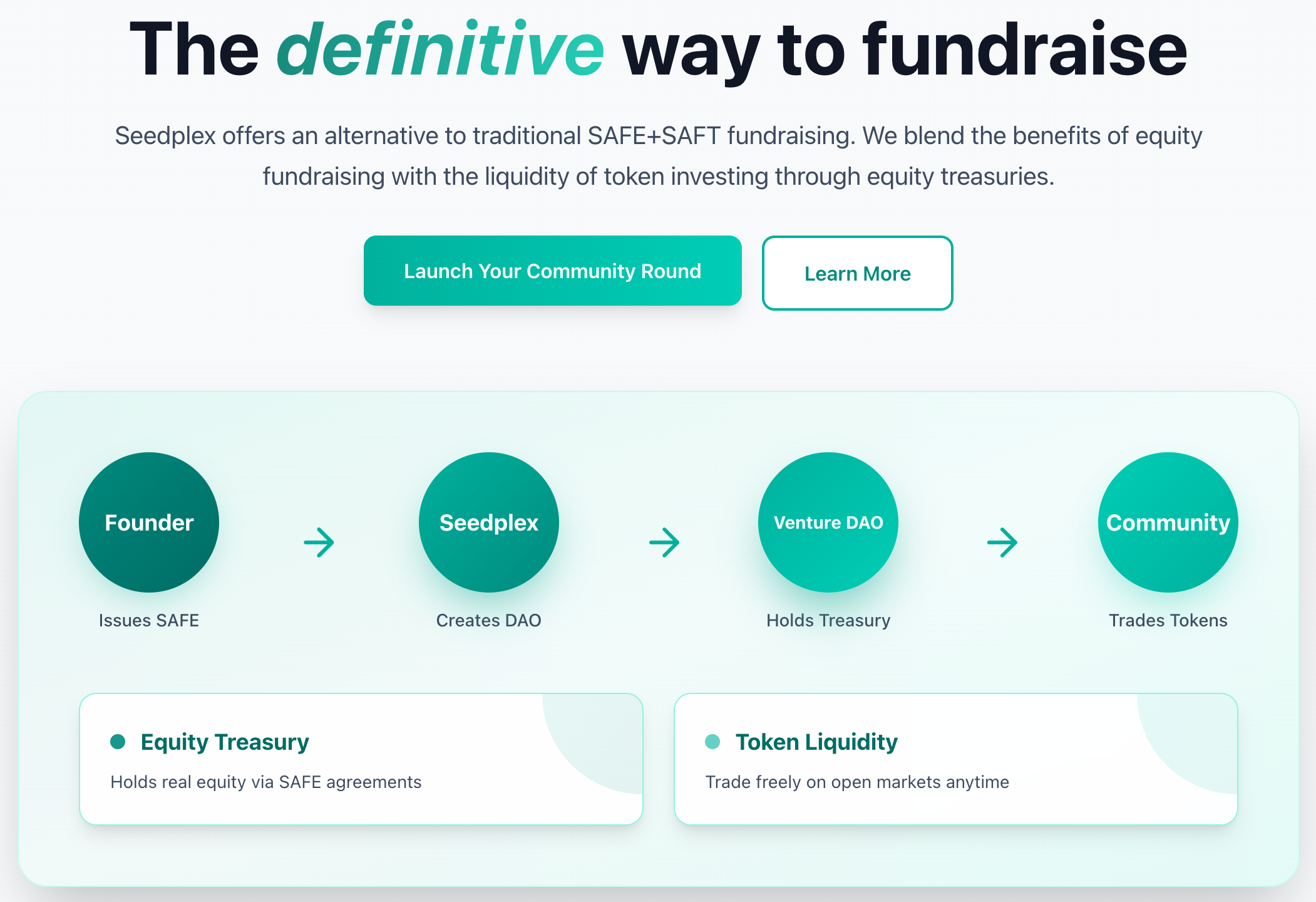
Source: Seedplex
Seedplex is a project that extends the concept of sealed-bid auctions beyond token launches into the broader fundraising space. The team aims for a fundraising and DAO platform where confidentiality is the default.
Let's look at how it works step by step. In the fundraising stage, Seedplex keeps both user deposit amounts and bid sizes confidential through confidential balances based on the Confidential Token Standard. What is observable from the outside is only the cumulative amount raised. How much each individual participant contributed and who participated at which stage is not exposed at all.
In traditional onchain fundraising, the movement of whale wallets contributing large amounts is immediately reflected in the price, triggering chase buying and chase selling. There is also the problem of information asymmetry where the bid information of early participants distorts the decision-making of subsequent participants. Seedplex's confidential fundraising can be a structural solution to both of these problems.
On the governance side, it combines confidential voting with selective decryption. In typical autonomous organization voting, the voting intentions of large token holders are revealed in real time, frequently giving rise to a bandwagon phenomenon based on herd mentality where other participants follow along. In addition, for politically sensitive matters, public voting prevents candid expression of opinions due to fear of retaliation. Confidential voting solves these problems with a commit-reveal structure. On top of this, Seedplex has incorporated a selective decryption feature that allows specific information to be disclosed when there are compliance requirements, in order to ensure regulatory friendliness.
3.3 Undesk: An onchain OTC desk
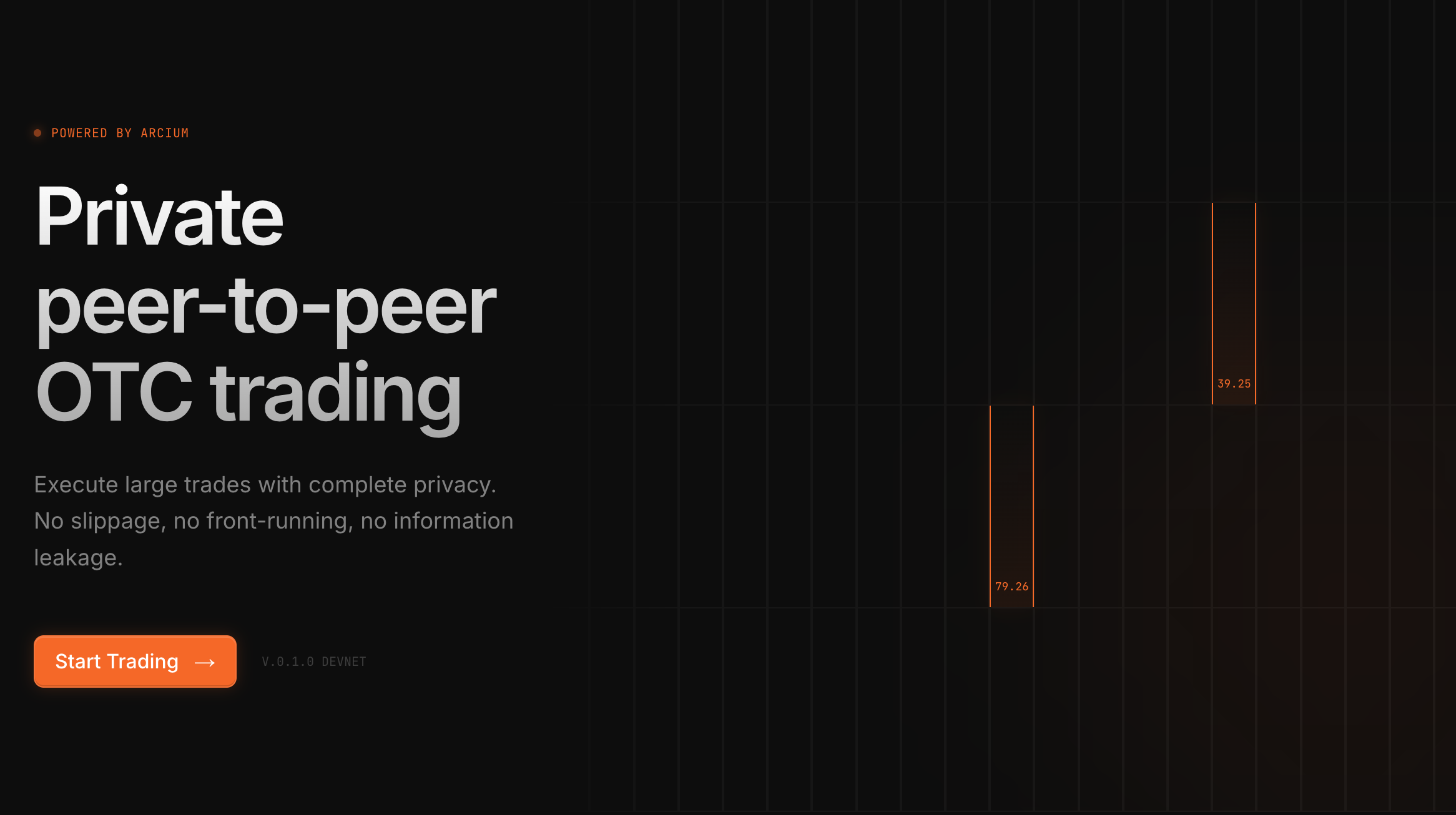
Source: Undesk
Undesk is a fully P2P, non-custodial Over-the-Counter (OTC) desk operating on Solana. It aims to provide an environment where traders can negotiate and execute large trades without exposing their price, quantity, or strategy.
Let's think about why an OTC desk is needed. On existing onchain exchanges, all orders are immediately publicized, making traders attempting to take large positions easy victims of slippage, front-running, and MEV. This is not just an issue of individual trader losses but also a structural barrier preventing institutional investors from entering onchain. In traditional finance, a significant volume of trades takes place in dark pools to prevent the exposure of institutional investor positions.
Undesk keeps all quotes confidential while performing the matching and execution itself within Arcium's multi-party computation network. Counterparties cannot see each other's quotes or sizes until a trade is executed, and external observers cannot either. Only after a trade is executed are the results settled onchain. This is an application in the same vein as the dark pool demo released by the Arcium team on Solana's public testnet in May 2025, but developed in a more P2P negotiation-centric form. Undesk is set to enter devnet in a live state soon, and if it generates meaningful trading volume, it could become one of the first infrastructures enabling institutional trading on Solana.
Looking at these three projects together, a common pattern emerges. They are all bringing market mechanisms validated in traditional finance onchain in a confidential form, and the result is not simply a confidential version of existing Solana DeFi but a new form of capital market design.
4. New information markets
The third branch is the newest area, consisting of applications that utilize markets in which information itself is traded, rather than assets or capital. In this area, the confidential shared state provided by Arcium's multi-party computation is not a simple feature addition but a factor that determines the very possibility of the market's existence.
4.1 Opportunity markets
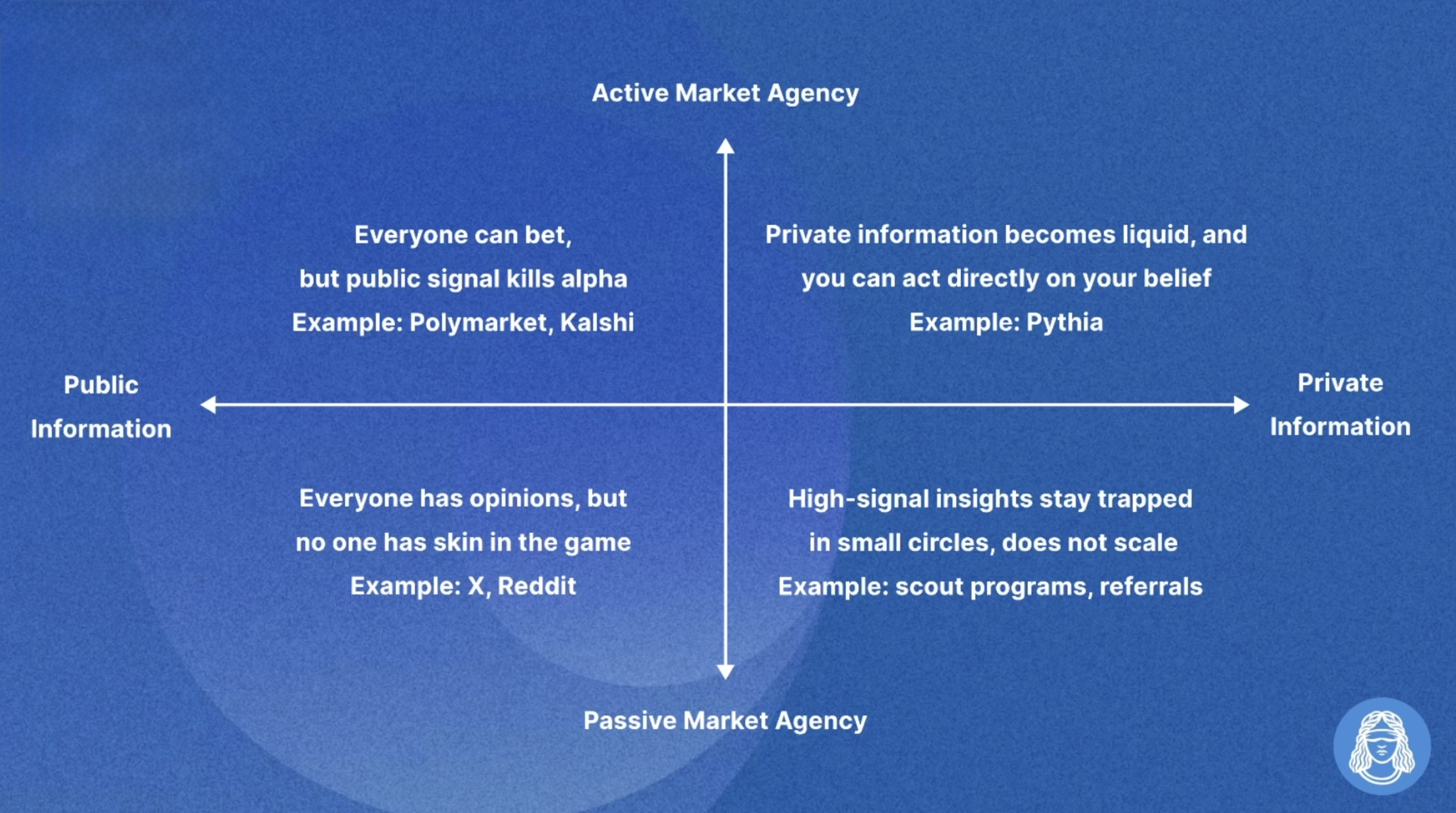
Opportunity Markets are a market category proposed by Paradigm in August 2025, a mechanism designed to address the limitations of existing prediction markets and opinion markets. Bench and Pythia, which we look at in this section, represent two branches of attempts to implement this Paradigm design on Arcium.
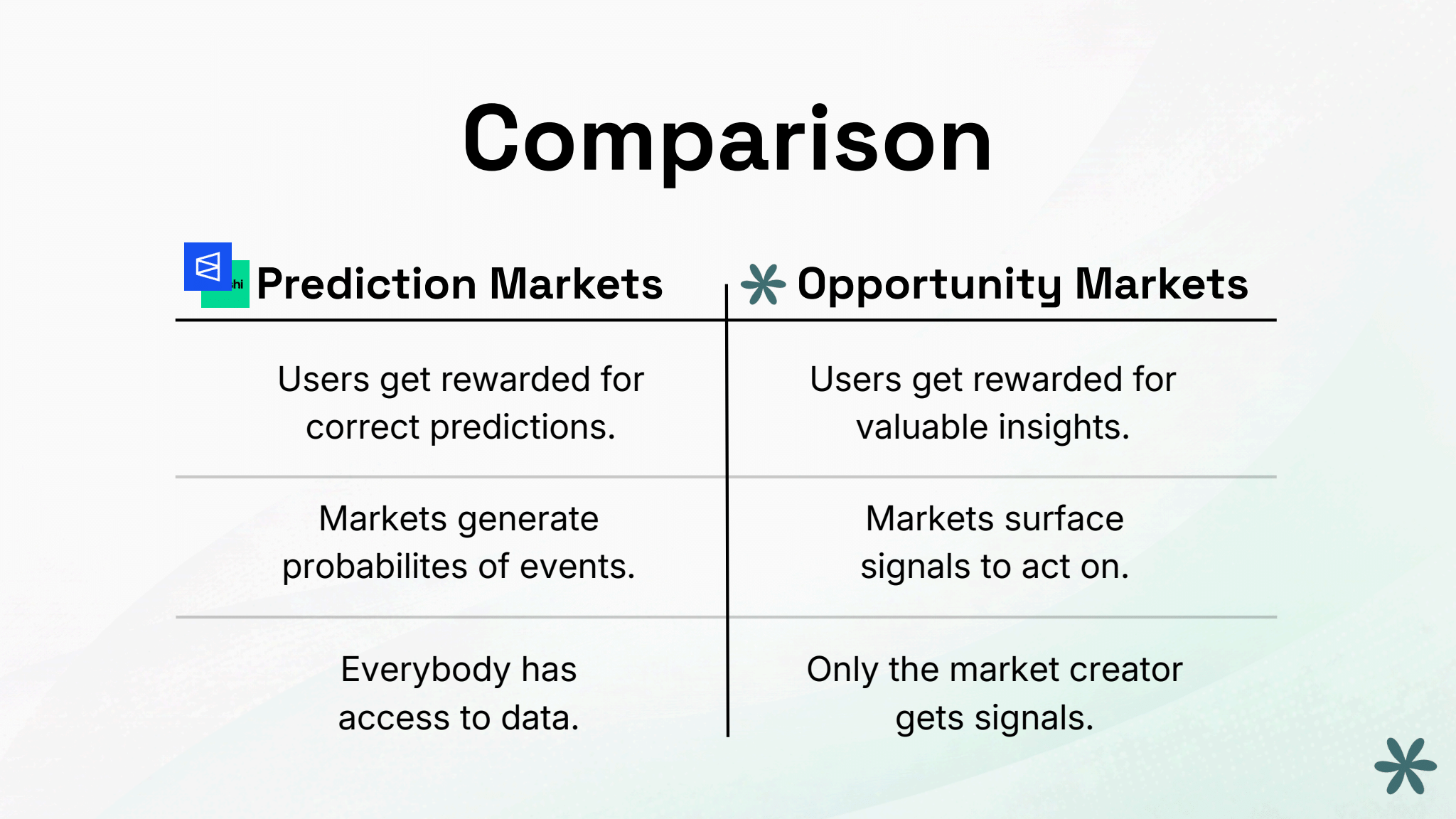
To understand this, it is necessary to compare three forms of information markets.
- First, prediction markets are markets where bets are placed on external truths, such as election results, sports results, or economic data.
- Second, opinion markets have no external truth, and the collective opinion itself is the outcome. These suffer from herd mentality issues caused by real-time public voting.
- Third, opportunity markets are markets where institutions obtain actionable insights from external scouts. The targets include unknown artists, early-stage startups, experimental research, and emerging trends.
Source: Arcium
Bench is the first application to implement this opportunity market category. Let us explain Bench's mechanism using an example given by Paradigm. A music label opens a market titled "Will artist X be signed within 2025?" and pre-deposits $25,000 worth of liquidity. People knowledgeable about music (scouts) buy shares in the markets of artists they consider promising and bet on them. As scouts increase and prices rise, the label sees that signal and investigates the artist. If a contract is actually signed, the scouts who bought early take the payout. In effect, a distributed scouting program is in operation.
For this design to work, one decisive condition is required. Only the market creator should be able to see the price signal, and even scouts should not know how their position is being valued for a certain period. If a trader sees their own execution details immediately, they can backtrack the market price from that, and the moment that happens, the premise of "a confidential information channel exclusive to the sponsor" collapses. At the same time, if other scouts' positions are visible, herd mentality occurs and the signal value of the market itself disappears. This is a problem that cannot be solved by zero-knowledge proofs alone. Confidential shared state that combines the secret inputs of multiple parties at once and exposes the result only to the sponsor is required, and Arcium's multi-party computation can fulfill this role.
Bench has notably adopted a no-loss opportunity market model. Participants, that is, scouts, stake tokens when providing their insights to the market, but they do not lose their principal even if their insight turns out to be incorrect. The reward source is pre-deposited by the market creator (e.g., a company conducting hiring, or a fund seeking investment opportunities) and is distributed only to the scouts who provided the most useful insights. This can be read as a choice to lower the entry barrier to information provision and draw in more undisclosed insights. However, the specific mechanism for evaluating the "usefulness" of information has not been sufficiently disclosed externally, and this seems to be a point that needs to be resolved through future information disclosure.
Source: Arcium
Pythia is a project that approaches the same opportunity market category through the opposite mechanism design. While Bench focused on lowering the entry barrier to secure quantity of insights, Pythia focuses on securing quality of insights through betting that involves potential losses. Scouts stake tokens on their opinions, with losses following incorrect judgments. The provision of information itself becomes a signal that involves taking on risk.
The most central challenge of these two projects is preserving the information asymmetry between institutions and scouts. Insights provided by scouts should be exposed only to the market creator and should not be visible to other scouts or external observers. At the same time, insight prices and position sizes also need to remain confidential for a certain period. This is a structure that cannot be implemented without the confidential shared state provided by Arcium's multi-party computation.
4.2 Evolved prediction markets
In the prediction market space, three projects, Melee, Epoch, and Flew, are being built on Arcium. Although three projects are growing simultaneously within one category, each has different challenges and designs.

Source: Melee
Melee's identity is captured well in its self-styled slogan: a combination of Polymarket and Pump.fun. Melee adopts a design that combines prediction market with Pump.fun’s bonding curve-based price discovery mechanism and speculative upside. Unlike Polymarket, which forms prices through order matching on a CLOB, Melee is designing its own AMM variant tailored to prediction markets, Prediction Market Maker (PMM), assigning a separate bonding curve to each market.
The most distinctive differentiator is bonding curve-based price discovery. Typical prediction markets adopt a model where the token price for each outcome is locked between $0 and $1, but Melee assigns a separate bonding curve to each market. The earlier you enter, the lower the price at which you can buy more shares, and as subsequent buyers grow, your potential return multiplies like a token. This takes on the character of a memecoin launchpad where you take a position early and bet on the market's growth, rather than a typical prediction market bet. In addition, the outcomes that can be bet on per market are not binary yes/no but can go up to 32, and users can purchase options on a single outcome or on multiple outcomes. Market creation has a roadmap that begins with whitelisted creators and gradually transitions to permissionless, adopting a creator-friendly model where market creators earn revenue from the trading volume their own audience generates.
The problem Melee aims to solve lies in the the resolution stage. Polymarket has long been mired in controversy because of its optimistic oracle model, in which disputes are settled by a weighted vote of UMA token holders. The structural issue is that UMA voters may simultaneously hold betting positions in the very market they are voting on, or in related markets, which gives them an incentive to vote in a way that favors their own positions rather than to verify the facts.
A representative example occurred in March 2025, in a market worth roughly seven million dollars on whether a minerals deal between the United States and Ukraine would take place. The market was resolved as Yes even though no agreement had actually been reached. According to reporting by external analysts, one UMA whale used about five million UMA tokens spread across three accounts to cast votes amounting to roughly 25% of that dispute. Polymarket acknowledged that the outcome ran "against the expectations of our users and our own clarification," but refused refunds on the grounds that it was not a "market failure," and much of the community classified the incident as a governance attack. There are other well-known cases, such as the Zelensky suit market, and together they have brought into sharper focus the structural weaknesses of open prediction markets like Polymarket.
Melee aims to address this problem through Arcium. UMA itself does use a commit-reveal scheme, which keeps vote contents confidential during the commit phase, but each holder's betting position is already exposed onchain from the outset, so other voters can effectively predict and follow the direction a large holder is likely to vote. Arcium takes the dispute resolution vote itself in a confidential form, so that individual votes are never exposed in plaintext, even after the result is announced. This eliminates the very basis for strategies in which a large holder signals to other voters, or conversely hides among the majority to avoid being slashed. It structurally blocks voter collusion and herding, which are the greatest weaknesses of token weighted governance.
Source: https://epoch.market/markets
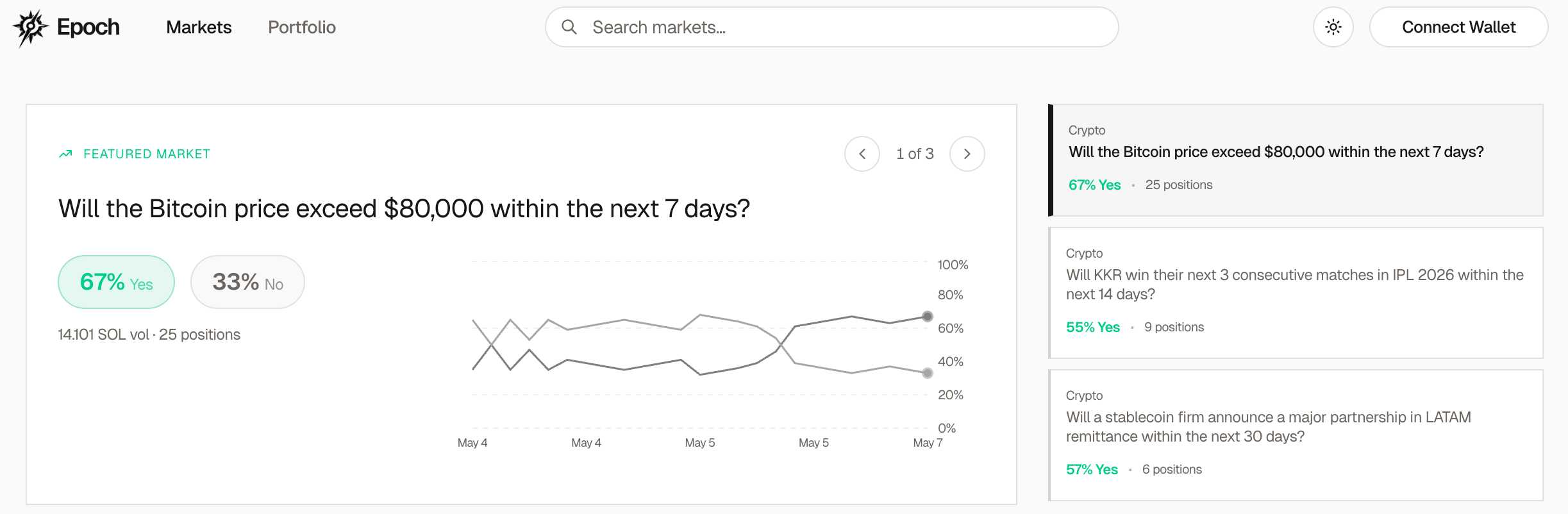
Epoch is a prediction market project that advocates end-to-end confidentiality, aiming to process all stages from deposit to withdrawal in a confidential state, not just the betting stage. Epoch has a structure where validators, operators, and even the team itself cannot know which user took which position. Its stance is to make confidentiality the foundation of the protocol rather than a toggleable add-on feature.
The primary motivation for Epoch is the front-running problem. In the case of public liquidity pool-based prediction markets, the moment a bet enters, bots read the intent and move ahead of it, so by the time the user's trade is executed, the market has already moved against the user. This is a weakness of existing onchain prediction markets in general, including Polymarket, and it is also the structural barrier that has prevented user groups with significant exposure burdens, such as politicians, institutions, and influencers, from fully entering onchain prediction markets. Just as Polymarket made it difficult for these user groups to actually use it due to its permanent public betting record, it is worth watching whether Epoch can newly attract these user groups with end-to-end confidentiality a key feature.
Source: Flew
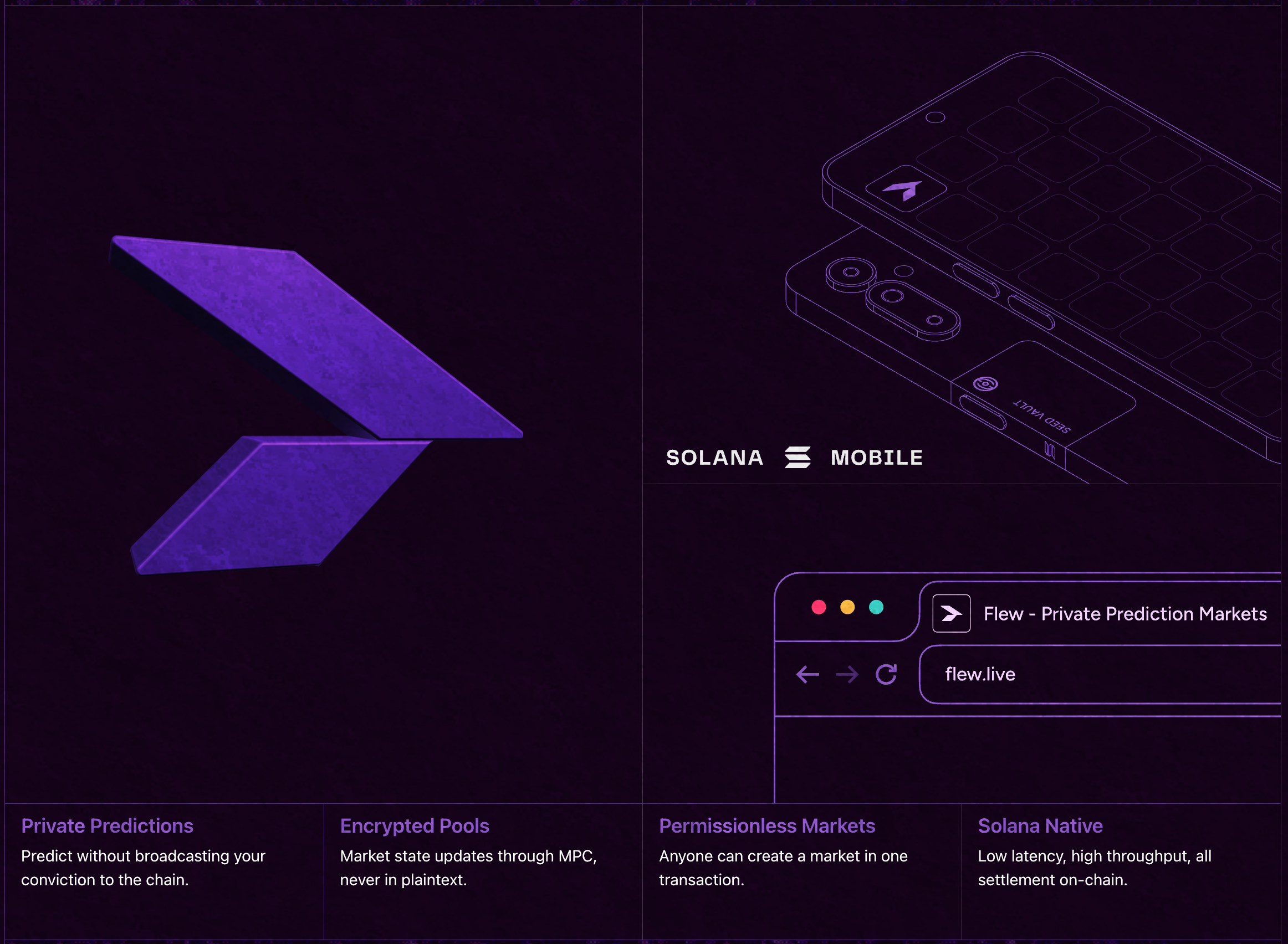
Flew is another project in the same confidential prediction market category that has entered devnet, adopting a pool-based settlement model. All bets enter the YES/NO pools confidential, the pool ratios are not visible externally during the live stage, and at the time of resolution, Arcium's multi-party computation decrypts the pool state and payout ratios needed for settlement. This is structurally similar to parimutuel betting.
The breadth of confidentiality applied is also wide. Flew processes individual bets so that the plaintext itself is not exposed onchain or in intermediate states, while the pool aggregation also remains in a confidential state throughout the live stage. The key differentiator on the market microstructure side lies in the market creation structure. Flew has a permissionless structure where anyone can create a market, and market creators deposit a bond determined by the market policy into a vault. The bond functions as an accountability mechanism for market creators within the market policy system.
The very fact that these three projects are being built on the same infrastructure simultaneously is itself suggestive. Arcium does not produce a single winner-takes-all application but provides an environment where applications with different design choices can compete and coexist on the same technical foundation.
5. Confidentiality in the gaming domain
Source: zinc.cash
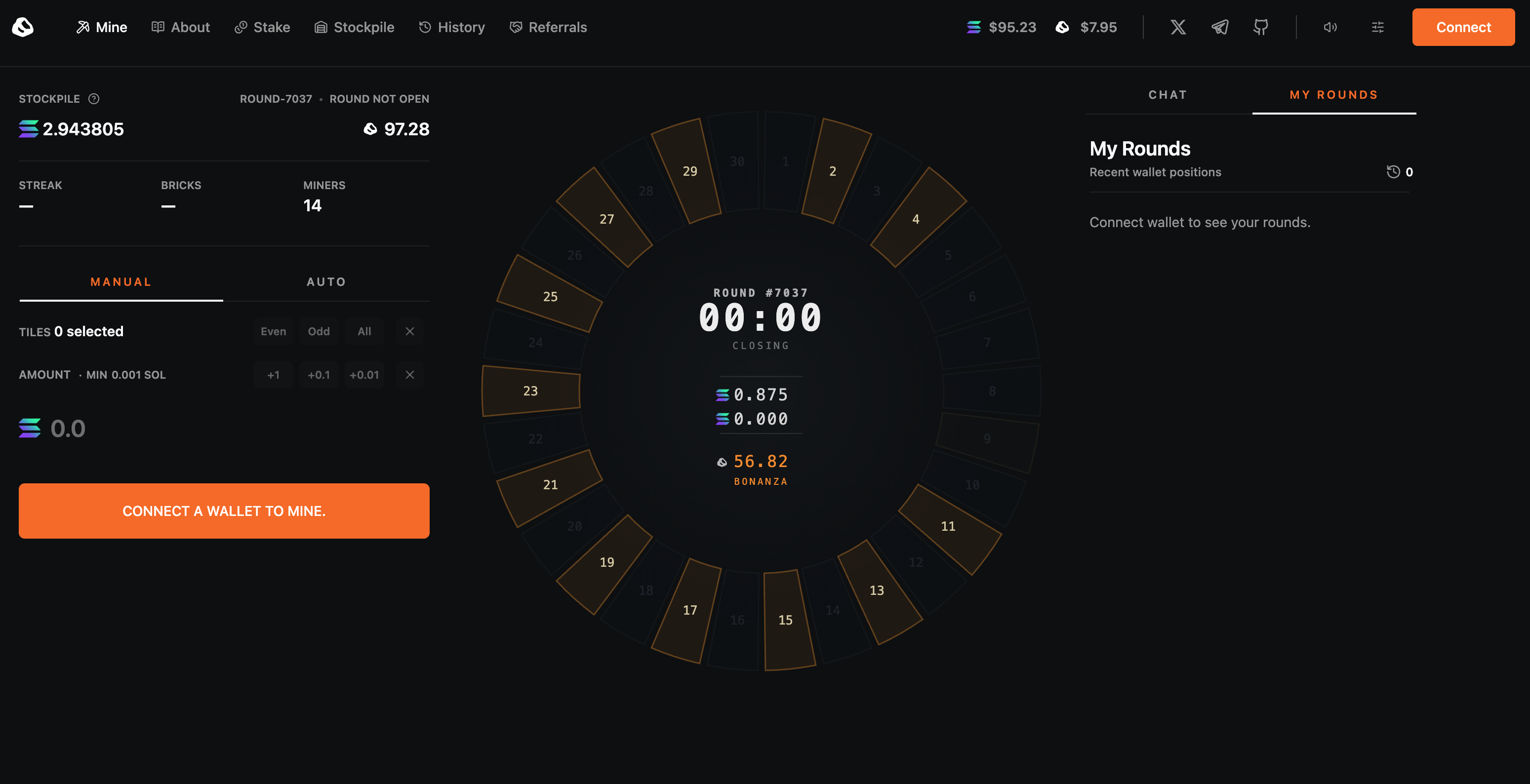
ZINC is an confidential proof-of-work–based token mining game, currently operating in Public Beta on Solana.
The basic mechanics are simple. The board has 30 tiles, and rounds run every 30 seconds. Each round, a miner picks anywhere from 1 to 30 tiles and bets SOL on them. At the end of the round, a single winning tile is randomly revealed, and the miners who selected that tile split the SOL accumulated on the losing tiles in proportion to how much SOL they themselves deployed.
The core property of this structure is that a miner's tile selection is not visible to other participants. ZINC uses Arcium in four main ways.
- The winning tile for each round is randomly selected through multi-party computation.
- Each player's tile selection is kept confidential, preventing other participants from copying strategies or front-running.
- The winner of the jackpot, which triggers with a 1-in-900 probability, is selected through multi-party computation.
- The same approach is applied when determining a winner in the Wildcat round, which occurs in roughly one out of every four rounds.
On top of this, multi-party computation is also used to add a small random jitter to the Bricks accrued each round, a safeguard that prevents tile selection information from being reverse-engineered out of the Bricks formula.
What makes ZINC meaningful is not simply that the game is live, but the way Arcium's infrastructure functions as a precondition for the game mechanics themselves. If tile selections were public, bots could monitor a large miner's choices and deploy even more SOL on the same tile to dilute the winner's share, or exploit informational advantages to copy other participants' strategies. ZINC closes this gap at the design level through Arcium, and in doing so demonstrates that "hidden information games" extend beyond card games into mining, betting, and strategy categories. Given that gaming is one of the main entry paths for general users into blockchain, the trajectory of projects like ZINC can also contribute to broadening the user base of the Arcium ecosystem as a whole.
6. The contours of an confidential capital market
So far, I have looked at the projects within the Arcium ecosystem divided into four branches. Each is an independent application, but a more important question lies elsewhere. What can these create together?
6.1 Composability created by the Confidential Token Standard
To answer this question, the first thing to address is the role of the Confidential Token Standard. The Confidential Token Standard is not simply a standard that adds confidentiality to Solana's regular token standard (SPL), but token infrastructure that enables composability across the entire ecosystem.
Suppose a user holds USDC in Stealf's confidential wallet. This user wants to participate in a sealed-bid token launch on Crafts. After receiving the tokens, they swap them for another token in Umbra's shielded pool, and they put the resulting assets into Hydex's hySOL staking. At every stage, the asset's balance and trading volume remain confidential.
Such a workflow becomes possible only when the Confidential Token Standard plays the role of an inter-application token standard. If each application processes tokens in different formats, a disconnect arises where assets must be decrypted into public state every time they are moved from one application to another, which becomes a weakness that breaks the anonymity set. The Confidential Token Standard removes this disconnect by having all applications share the same Confidential Token Standard.
In addition, since the Confidential Token Standard allows program-derived addresses to own confidential token accounts, composability of confidential assets at the smart contract level becomes possible. An environment is created where automated market makers can manage confidential balances, lending protocols can handle confidential collateral, and liquidity pools can issue confidential liquidity provider (LP) tokens. This is a new area of utility that Solana DeFi has not had until now.
6.2 The first signs of synergy between applications
As the ecosystem matures further, direct synergies between applications are starting to emerge. The most visible example is the SDK that Umbra announced together with the launch of its consumer wallet. This SDK allows other Solana applications to integrate confidential payments, shielded DeFi interactions, and confidential balance management through function calls, without having to build their own infrastructure. Since Umbra has been recruiting SDK integration partners since right after launch, which applications get on top of this layer over the next few quarters will be a key indicator for gauging Umbra's evolution into middleware.
Another visible synergy is observed within Hydex itself. When the sZEC liquidity created by Hydex Bridge is combined with hySOL's confidential LST, Zcash users can be exposed to Solana staking yields without taking their assets out of the shielded pool. This shows that Hydex itself can operate not as a single application but as a small, self-sufficient confidential capital market layer.
Similar patterns are possible in other areas. When Dinario provides off-ramp services in Latin America, it can use Umbra's shielded pool as the user's funding source. Users can legally withdraw fiat currency without exposing their main wallet to Dinario. When Anonmesh's offline payments are combined with Umbra, flows become possible where the payments themselves are settled through the shielded pool after internet connection is restored.
Another synergy possibility lies between Undesk and Crafts. If Undesk becomes a platform for large token transactions as an OTC desk, the OTC market that forms right after Crafts' sealed-bid token launches can naturally flow into Undesk. This creates a structure where both the primary market (launch) and secondary market (OTC) of tokens operate while maintaining confidentiality.
Such synergies are not spontaneous. They are possible because each project is being built on the same technical foundation while sharing the same composability standard. This is why it is reasonable to view that Arcium is not simply hosting 12 separated projects, but is forming a single integrated confidential capital market layer.
6.3 In closing
In the previous article, I used the analogy of clothes getting wet in a drizzle to talk about why confidentiality must be guaranteed at the infrastructure level. The analogy was that umbrellas should be spread across the entire street rather than each individual user preparing their own.
The projects examined this time are people opening up umbrellas one by one on that street. Activities are taking place across various areas including finance, capital formation, payments, information markets, prediction markets, and gaming. These appear to unfold independently of each other, but in that they operate on a single infrastructure, the result is the same as the entire street being covered with umbrellas.
Over the past six months, as the confidentiality narrative has risen in the crypto market, we have seen the prices of many confidentiality-related tokens surge. However, prices ultimately follow what grows on top of them. Whether the garden growing on Arcium can develop into true capital market infrastructure will be answered by the application traction over the next few quarters.
The report is based on the independent research of the author sponsored/funded by Arcium. The author of this report may have personal holdings or financial interests in assets or tokens discussed herein. However, the author affirms that no transactions have conducted using material non-public information obtained in the course of research or drafting. This report is intended solely for general information purposes and does not constitute legal, business, investment, or tax advice. It should not be used as a basis for making any investment decisions or as guidance for accounting, legal, or tax matters. Any references to specific assets or securities are made for informational purposes only and should not be construed as an offer, solicitation, or recommendation to invest. The opinions expressed herein are those of the author and may not reflect the views of any affiliated institutions, organizations, or individuals. The opinions and analyses expressed herein are subject to change without prior notice. In addition, beyond the individual disclosures included in each report, Four Pillars, may hold existing or prospective investments in some of the assets or protocols discussed herein. Furthermore, FP Validated, a division of Four Pillars, may already be operating as a node in certain networks or protocols discussed herein or may do so in the future. Please see below links in the footer for FP Validated's participating network disclosures and for broader disclosure details.


