


Table of Contents
Researcher


1. [News] Part of Project Hangang Phase 2; Deposit Token Payments to Launch at GS25 Stores Nationwide in H2
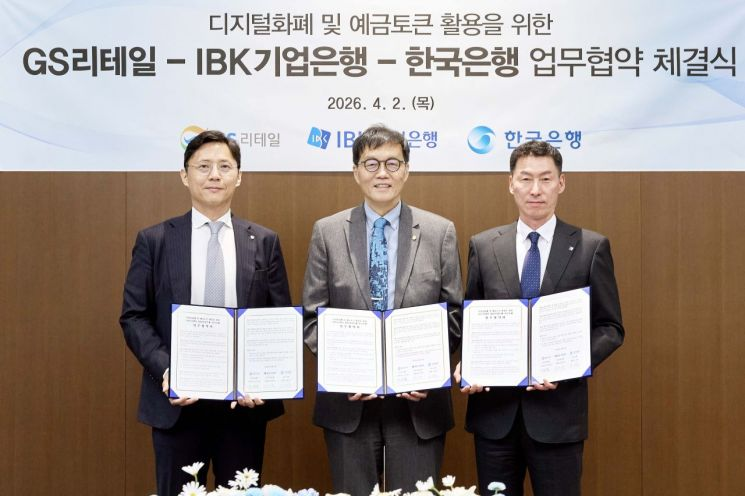
Source: IBK Bank, GS Retail, and Bank of Korea to Establish Digital Currency Payment System
IBK Industrial Bank of Korea has signed a memorandum of understanding (MOU) with GS Retail and the Bank of Korea for the utilisation of digital currency and deposit tokens. The agreement is part of the second phase of the Bank of Korea's Project Hangang, aiming to verify digital currency payment infrastructure in real-world distribution channels. The three institutions will collaborate on establishing a payment and settlement system based on digital currency and deposit tokens, creating a payment environment within GS25 stores, and jointly researching and developing commercially viable business models. Actual payments are expected to begin at GS25 stores nationwide in the second half of the year.
The pilot is significant in that it moves beyond finance-sector-centred experiments to verify the effectiveness of a deposit token-based payment system in actual retail settings. Deposit tokens, bank deposits issued in token form for use in payments, are being examined as an alternative that can deliver both efficiency and stability compared to existing payment and settlement systems. An IBK representative stated, "This agreement will serve as an opportunity for digital currency to present a new standard for financial infrastructure by combining with distribution channels," adding that "we will continue to expand innovative services based on deposit tokens."
2. [Commentary] Project Hangang Shifts from 'Technical Proof' to 'Retail Payment Reality'
The selection of GS25 as a pilot channel in Project Hangang Phase 2 means deposit tokens are leaving the laboratory and entering a payment environment that consumers interact with daily. Phase 1's live-transaction pilot last year saw 81,000 participants (by digital wallet) process 114,880 transactions, but participating merchants were primarily small-scale and the scope was limited. GS25 operates approximately 17,000 stores nationwide and handles millions of small-value transactions daily. Verifying whether deposit token payments work at this scale is an effort to close the gap between technical feasibility and commercial viability.
Project Hangang's design philosophy aligns with the BIS's "unified ledger" vision. Wholesale CBDC (wCBDC) serves as the anchor, with commercial bank deposit tokens issued and circulated on top, and tokenised asset (bond, equity) settlement occurring on the same infrastructure. The Phase 2 additions of P2P transfers, biometric authentication, and automatic deposit-to-deposit token conversion represent efforts to raise the user experience to mobile banking standards. Pilots applying blockchain to government treasury fund execution and EV charging infrastructure are designed to demonstrate that the value of programmable money extends beyond simple payments to conditional execution. Notably, the recently nominated BOK governor candidate Shin Hyun-song, the BIS Monetary and Economic Department director who led the design of this very unified ledger model, is likely to further strengthen Project Hangang's momentum.
Compared to Japan's DCJPY, which took a bottom-up path by building the tokenised deposit network first and addressing interbank settlement retroactively, Korea's model has the central bank designing the infrastructure and sequentially integrating commercial banks and distribution channels. The GS25 pilot represents the "retail payment verification" stage of this model.


