


Table of Contents
- Key Takeaways
- 1. STRC: Strategy’s BTC Acquisition Engine
- 1.1 Overview of STRC
- 1.2 STRC Reference Price: $100
- 1.3 Where Do the Dividends Come From?
- 1.4 STRC Metrics
- 2. Has STRC Killed the DeFi Ecosystem?
- 3. The STRC-Based DeFi Ecosystem
- 3.1 Issuance
- 3.2 Tokenization
- 3.3 Yield
- 4. STRC Has Instead Revitalized the DeFi Ecosystem
Researcher


Key Takeaways
- One of the hottest topics in the DeFi ecosystem these days is Strategy’s STRC. STRC is a floating-rate perpetual preferred stock issued by Strategy, and it aims to provide an annual dividend of around 11.5% centered on a reference price of $100.
- Looking at the period since STRC launched last August, total DeFi TVL, which reached $136B last August, has now fallen by 46% to $73B. During that time, the size of STRC increased by as much as 270%. Did STRC kill DeFi?
- Considering 1) that the decline in DeFi TVL is not large compared with the overall decline in token prices, and 2) that there are actually yield-bearing stablecoins whose TVL has risen as much as STRC’s, the claim that STRC’s emergence killed the DeFi ecosystem does not seem very reasonable.
- STRC has instead led to the emergence of new types of DeFi protocols onchain, such as Apyx and Saturn, and has brought vitality to various protocols derived from them. The STRC-based onchain ecosystem can be divided into three layers: 1) Issuance, 2) Tokenization, and 3) Yield.
- The size of stablecoins issued based on STRC is over $680M, and the tokenized amount is also over $130M. STRC-based assets are also exerting significant influence in yield-structuring protocols such as Pendle and Strata. Although there are sustainability concerns around STRC, separate from that, I would argue that STRC has not killed DeFi. Rather, it has revitalized the ecosystem.

These days, one of the hottest topics in the DeFi ecosystem is Strategy’s STRC. STRC is a floating-rate perpetual preferred stock issued by Strategy, and it aims to provide an annual dividend of around 11.5% centered on a reference price of $100.
A mechanism designed to guide it toward a specific price, combined with a high dividend rate, is enough to appeal to existing crypto investors who seek a high-risk, high-return profile. In fact, some in the crypto community have been saying that the launch of STRC caused DeFi users to leave DeFi in order to buy STRC.
Has STRC really killed the DeFi ecosystem? How is STRC being used within the DeFi ecosystem? Recently, STRC also plunged sharply. What impact does this instability in STRC have on the DeFi ecosystem? This article aims to find answers to these questions.
I covered the sustainability of MSTR and STRC in a recent article I wrote, so I recommend reading it before reading this piece.
1. STRC: Strategy’s BTC Acquisition Engine
1.1 Overview of STRC
Strategy is the world’s first and largest BTC treasury company. Its core objective is to raise capital, accumulate BTC, and provide investors with economic exposure to BTC. Strategy raises capital through cash flow from its existing software business, as well as through financial engineering methods that combine common stock, preferred stock, and debt. Among these, STRC is a floating-rate perpetual preferred stock issued by Strategy.
A floating-rate perpetual preferred stock? The terminology may seem difficult. Let’s break it down one by one.
- STRC is a “preferred stock.” Preferred stock is a security that sits somewhere between common stock and bonds. Although voting rights are limited, it has a higher claim on cash flows than common stock. In other words, when a company pays dividends or is liquidated, preferred stock has a higher priority than common stock.
- STRC is a “perpetual” preferred stock. Like most listed preferred stocks, it is perpetual and has no maturity date. Unlike bonds, there is no maturity date at which investors can demand repayment of principal.
- STRC offers a floating rate. As we will examine later, STRC is designed to move around a target price of $100, and the floating rate is one of the mechanisms that makes this possible.
These characteristics show why Strategy prefers issuing STRC rather than other securities.
- If Strategy raises capital through convertible bonds, they have a maturity date. If that maturity arrives when the price of Bitcoin has fallen, repayment or share dilution could place a significant burden on Strategy. STRC is a financial engineering tool that reduces maturity risk in exchange for providing a high dividend rate.
- The denominator of BPS is calculated using ADSO, which includes other assets that can be converted into shares, such as convertible bonds and convertible preferred stock. Because STRC is non-convertible preferred stock, it does not dilute the denominator, which gives it an advantage for BPS.
1.2 STRC Reference Price: $100
STRC is designed around a reference price of $100.
- STRC > $100: Strategy can lower the dividend rate to induce a price decline, and it can also increase supply by issuing additional STRC. In addition, Strategy has the right to redeem STRC in cash at $101 per share, which has the effect of capping the upper end of STRC’s price at $101.
- STRC < $100: Strategy can increase the dividend rate to induce a price increase. In addition, STRC has a liquidation preference of $100 per share, which serves as a mechanism that can guide STRC’s price toward $100.
For reference, STRC currently pays an annual dividend of 11.50% based on $100.
1.3 Where Do the Dividends Come From?
Strategy pays STRC holders a monthly cash dividend equivalent to 11.50% annually based on $100. The current outstanding size of STRC is approximately $10.43B, which creates a massive annual dividend cost of around $1.20B. Where exactly do these dividends come from?
1.3.1 MSTR Common Stock ATM Issuance
Strategy’s primary goal is not simply to increase the number of BTC held by the company, but to increase Bitcoin per share, or BPS. If this condition is met, Strategy can raise capital by gradually issuing and selling MSTR near the market price.
The key condition is as follows.
BPS increases only when the BTC that can be purchased with the cash raised from selling new shares is greater than the existing BTC per share claimed by the newly issued shares.
For example, assume there is a company valued at mNAV = 1.1 as shown below.
- Value of BTC holdings: $1,000
- Number of shares: 100
- Current share price: $11
- mNAV: 1.1
If this company issues 10 shares at the current share price and uses the proceeds to buy BTC:
- Value of BTC holdings: $1,110
- Number of shares: 110
- Current share price: $11
- mNAV: approximately 1.09
If we calculate BPS here, the company previously held $10 worth of BTC per share, but afterward it would hold $10.09 worth of BTC per share. Put differently, for it to be advantageous to raise capital through common stock ATM issuance and buy BTC, mNAV must basically be above 1.
However, Strategy is not a simple company. Unlike in the past, debt and preferred stock have now been added to Strategy’s capital structure. As a result, Strategy cannot increase BPS through MSTR ATM issuance simply under the condition that mNAV > 1.
When debt and preferred stock exist, part of the BTC held by Strategy effectively belongs to preferred shareholders or creditors who have priority claims over common shareholders. Therefore, the pure BTC share represented by one share of MSTR declines, which means Strategy needs to conduct MSTR ATM issuance when mNAV is higher than 1 in order to increase BPS.
In its Q1 earnings presentation this year, Strategy announced a new mNAV threshold of 1.22. In other words, given Strategy’s current capital structure, MSTR ATM issuance needs to occur when mNAV is at least 1.22 in order to avoid harming BPS. If this condition is satisfied, Strategy can raise capital through MSTR ATM issuance and use it as a source of funding for STRC dividends.
For reference, please see the content I recently wrote for an explanation of why the 1.22 threshold was introduced.
Strategy currently holds $900M in USD reserves, which can cover 6.3 months of interest and dividend payments.
1.3.2 BTC Sales
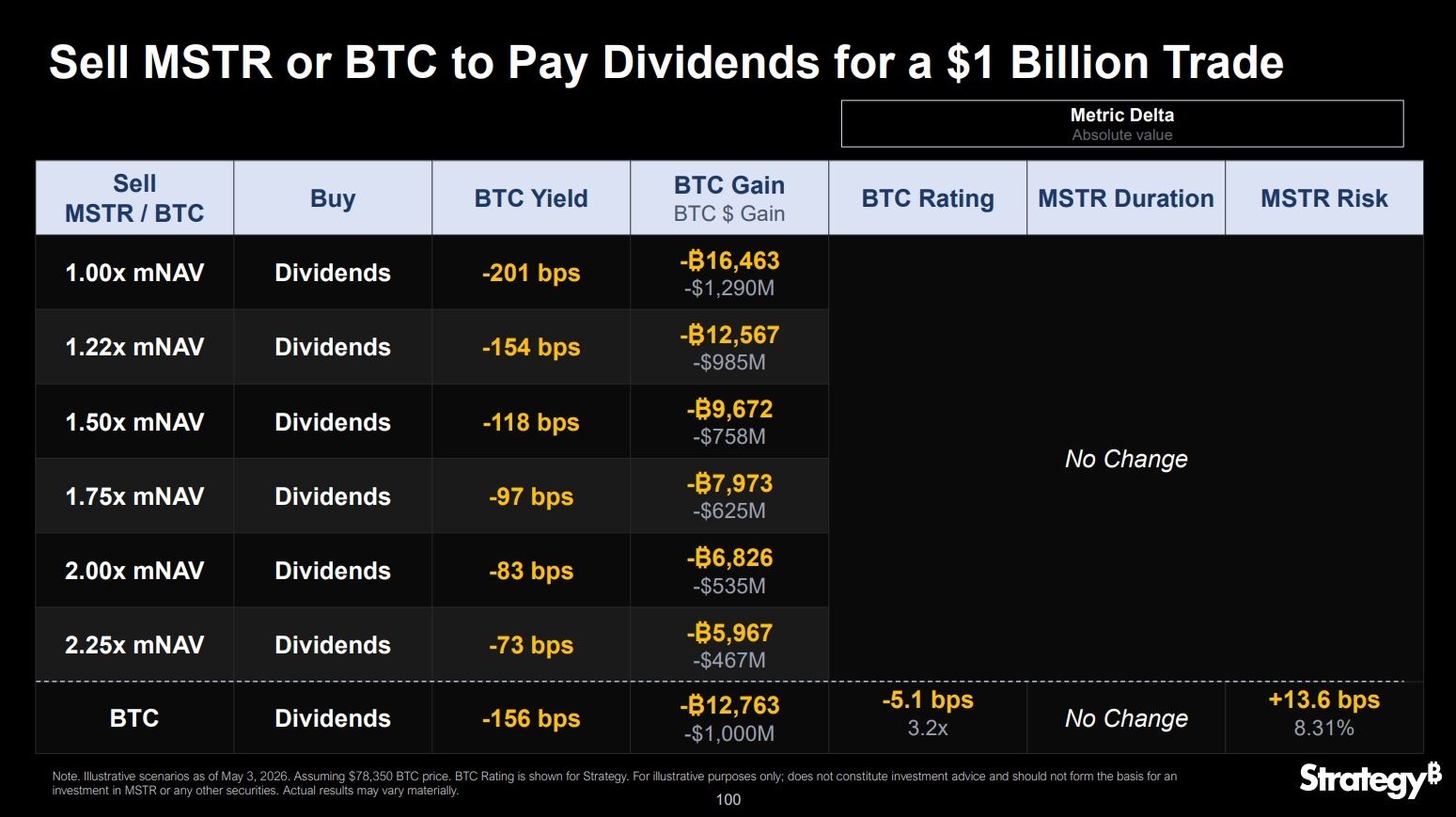
In its Q1 2026 earnings presentation, Strategy did not say that it would “never sell BTC.” Instead, it stated that “depending on the situation, selling BTC may be better from a BPS perspective,” implying the possibility that it could sell BTC to fund STRC dividends.
Source: Strategy
In fact, during the Q1 2026 call, when discussing an example of covering $1B in dividends, the transaction of selling BTC to pay the dividends was described as a BTC yield loss of -156bp. Strategy stated that this would have almost the same effect as covering the dividend through MSTR ATM issuance at an mNAV of 1.22x.
To explain this differently, if MSTR’s mNAV is below 1.22, MSTR ATM issuance could actually cause greater BPS loss for MSTR shareholders than selling BTC.
Strategy explained the possibility of selling BTC in connection with maximizing BPS for common shareholders. It also explained that if dividends are covered through BTC sales and STRC issuance continues afterward, Strategy could potentially repurchase more BTC than it had sold, thereby increasing BPS over the long term.
In fact, through its SEC 8-K filing on June 1, Strategy sold 32 BTC worth $2.5M, which also created a major shock in the market.
1.3.3 Issuance of Junior Preferred Stock
According to STRC’s filings, Strategy can fund STRC dividends through ATM issuance of preferred stocks that rank junior to STRC, such as STRK and STRD. In other words, junior preferred stock ATM issuance is a possible funding source according to the filings. However, from an actual operating perspective, there has so far been no confirmed case in which dividend payments were actually made from proceeds raised through junior preferred stock ATM issuance, apart from MSTR common stock ATM issuance.
1.4 STRC Metrics
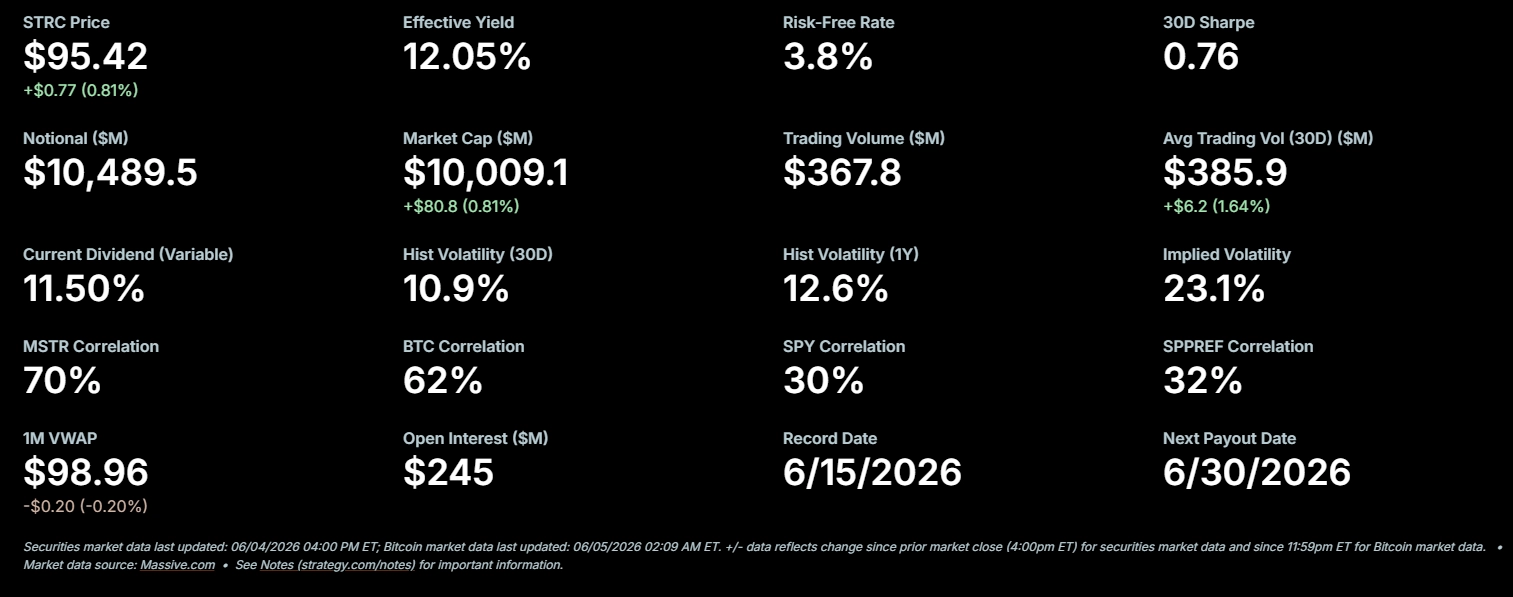
Let’s look at STRC-related metrics up to today. As of June 5, 2026.
Source: Strategy
- STRC was issued on July 29, 2025, and the initial issuance consisted of 28,011,111 shares at $90 per share.
- The current effective yield is 12.05%, which is slightly higher than the 11.50% dividend rate based on $100 because it reflects the current share price.
Source: strc.live
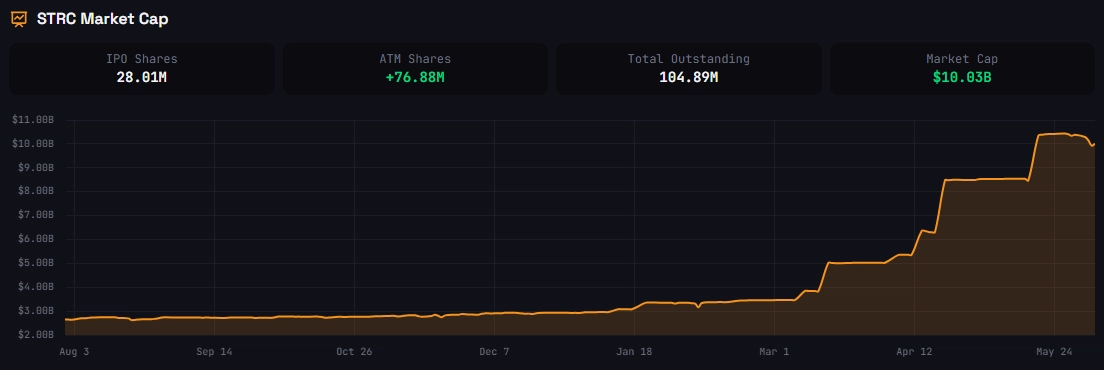
- Approximately 76.88M STRC shares have been issued through ATM issuance so far, and the current market capitalization is approximately $10.03B.
Source: strc.live
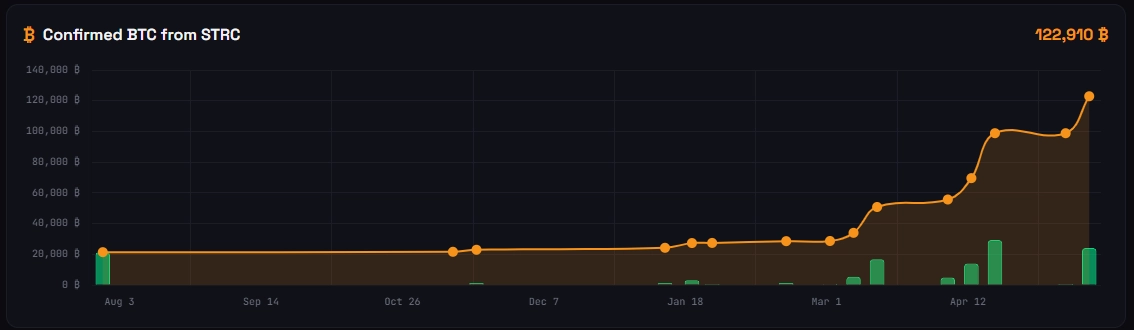
- Based on compiled SEC filing data, Strategy purchased 122,910 BTC with the capital raised from STRC.
In summary, as nearly one year has passed since STRC was launched, STRC issuance has steadily increased, and dividend payments have also been made consistently every month. However, after Strategy’s recent sale of 32 BTC, the situation has worsened. Some critics argue that STRC’s structure is risky and close to a Ponzi scheme.
2. Has STRC Killed the DeFi Ecosystem?
The explanation of STRC was lengthy. Now, I would like to examine what impact the emergence of STRC has had on the onchain DeFi ecosystem.
Because STRC offers a high APY of 11.5% based on a $100 reference price, it can look like a sufficiently attractive option from the perspective of DeFi users. This is because it pays nearly three times the yield of other stablecoin products with high TVL, such as sUSDS, SyrupUSDC, Aave, and sUSDe.
Did DeFi users really all move over to STRC?
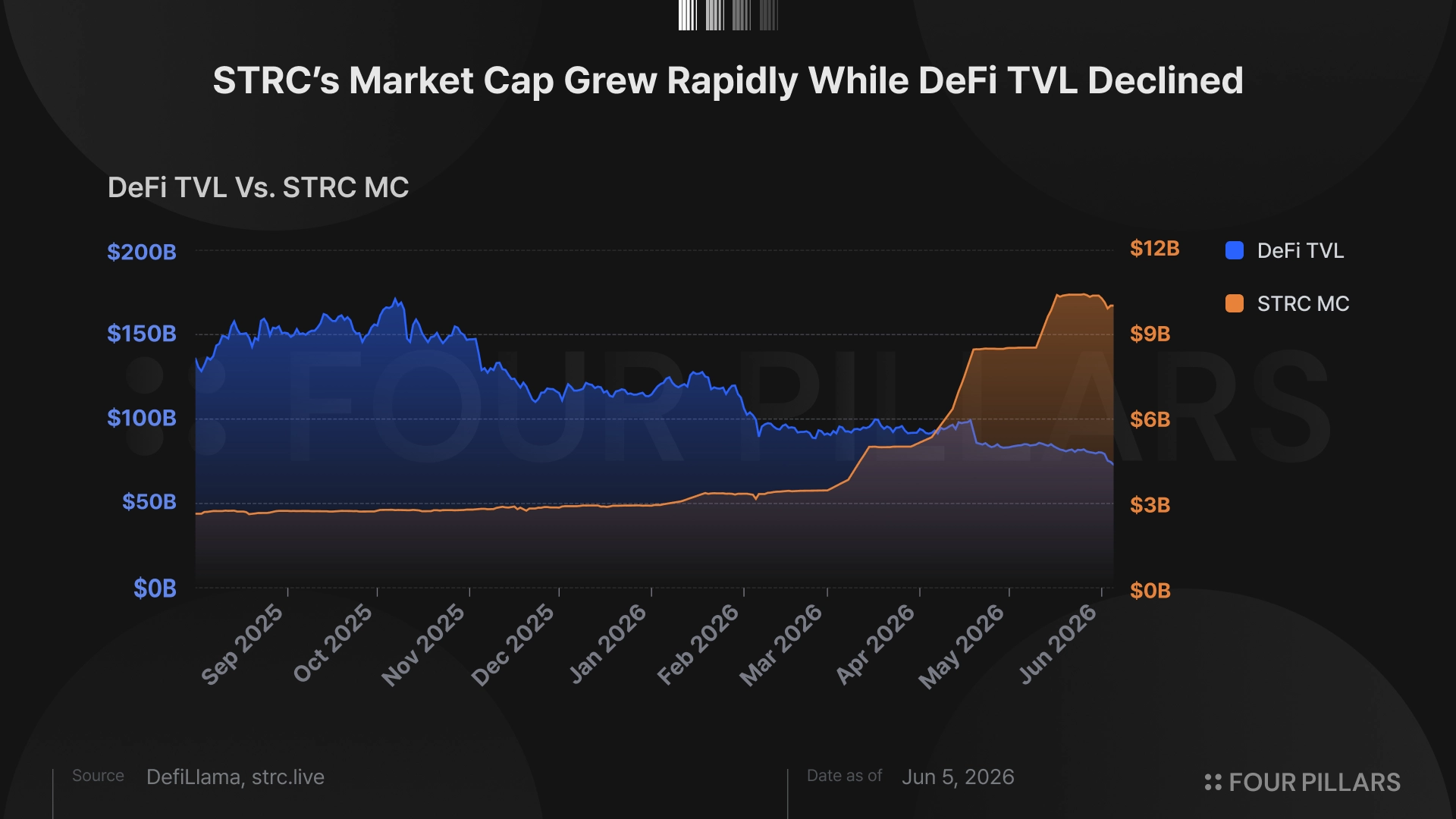
What has happened to DeFi TVL since last August, when STRC was launched? Total DeFi TVL, which reached $136B last August, has now fallen by 46% to $73B. During that same period, the size of STRC increased by 270%. Looking only at this data, it seems as if DeFi users moved over to STRC.
However, DeFi TVL includes not only assets with stable value, such as stablecoins, but also many other cryptocurrencies whose values fluctuate. Since BTC also fell by 46% over the same period, this needs to be examined more closely.
If we look only at yield-generating stablecoins over the same period, the results are shown above. Of course, there are asset classes whose TVL declined significantly, such as Aave USDC and sUSDe. Conversely, however, stablecoins such as sUSDS and SyrupUSDC grew substantially in size, to a degree comparable to STRC.
Therefore, taken together, considering 1) that the decline in DeFi TVL is not large compared with the overall decline in token prices, and 2) that there are actually yield-bearing stablecoins whose TVL has risen as much as STRC’s, the claim that the emergence of STRC killed the DeFi ecosystem does not seem very reasonable.
3. The STRC-Based DeFi Ecosystem
STRC has instead led to the emergence of new types of DeFi protocols onchain and has brought vitality to various protocols derived from them.
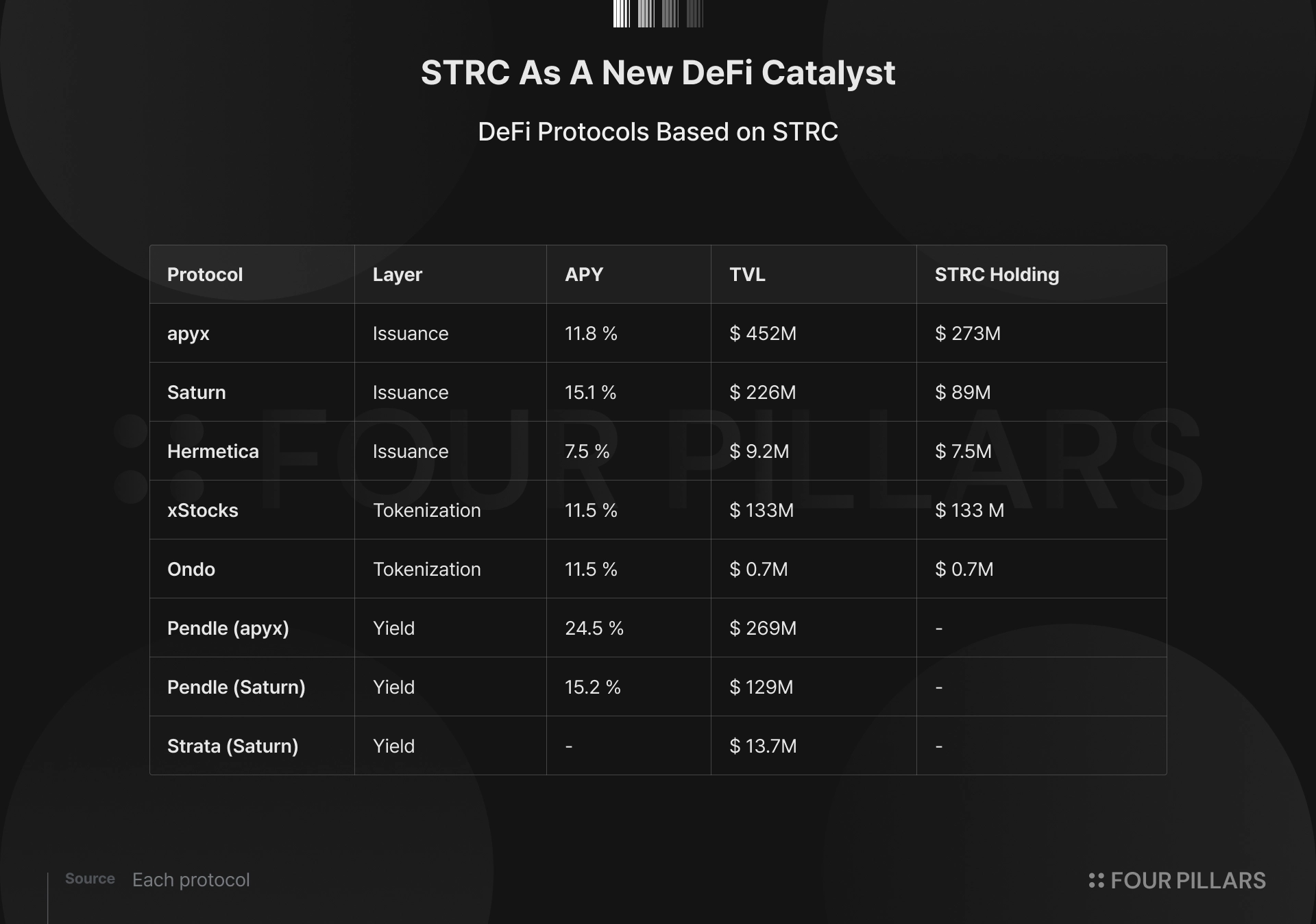
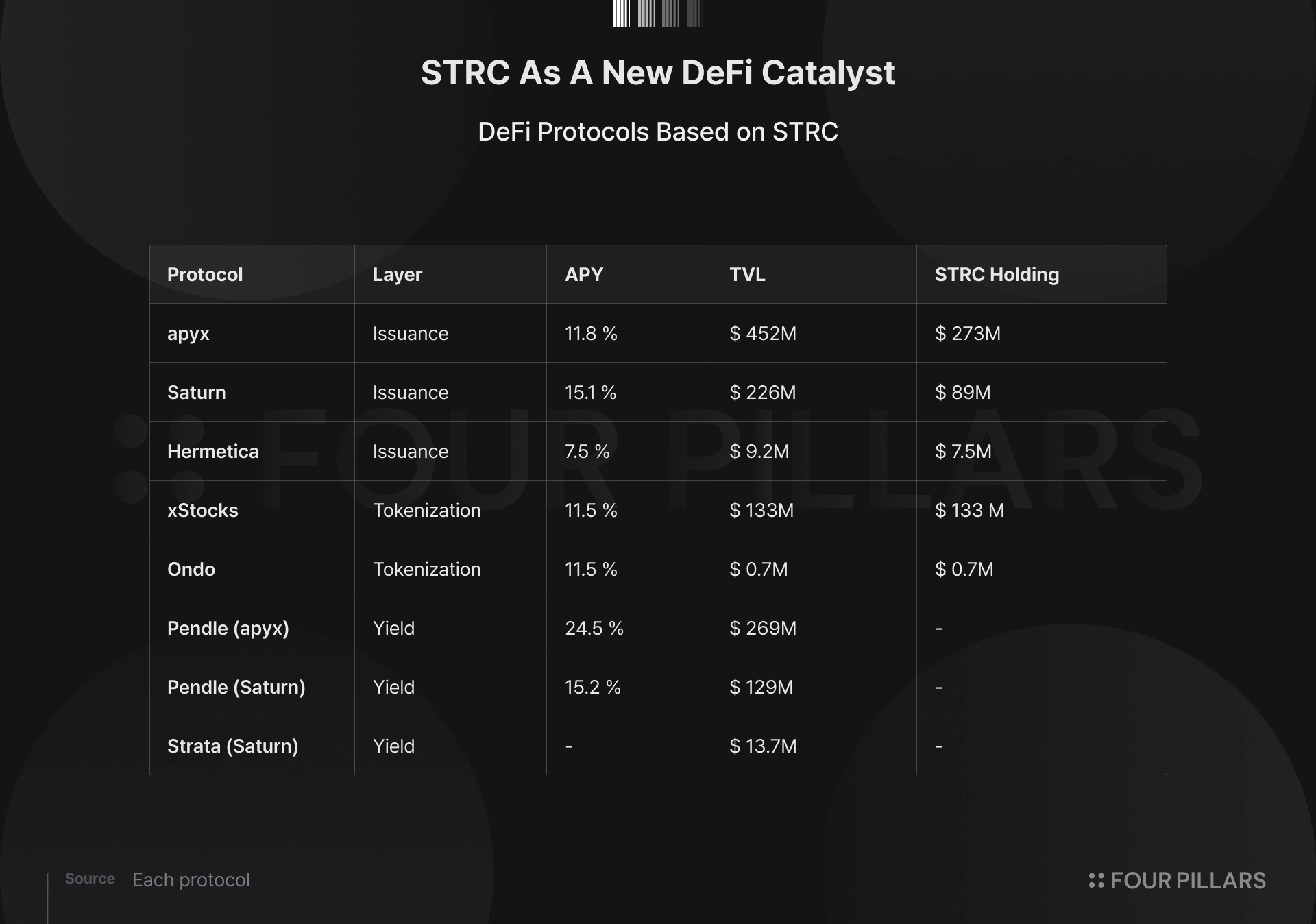
The onchain ecosystem activated around STRC can be broadly divided into three layers:
- Issuance: Protocols that issue stablecoins and yield-bearing stablecoins based on STRC
- Tokenization: Platforms that tokenize STRC preferred stock and provide it onchain
- Yield: Protocols that structure the yield of stablecoins based on STRC
3.1 Issuance
STRC is a product that offers a high annual yield of 11.50% based on a $100 reference price. This makes it a highly attractive form of collateral to use as the underlying asset for yield-bearing stablecoins.
- Apyx: Apyx issues apxUSD, its base synthetic dollar token, and apyUSD, its yield-bearing dollar token. Both tokens are backed by the same collateral composition, consisting of 61.4% STRC and 38.6% cash.
- Saturn: Saturn issues two types of yield-bearing stablecoins: USDat, which is based on US T-bills, and sUSDat, which is based on STRC.
- Hermetica: Hermetica is fundamentally collateralized by a Bitcoin-based basis trade, similar to Ethena, but STRC has been included as one of its sources of return.
The total amount of STRC held as collateral by these three protocols is approximately $370M, which represents a fairly meaningful scale.
For reference, as the price of STRC has fallen significantly recently, STRC-based stablecoins have also been affected. In Apyx’s case, it entered an undercollateralized state in which the value of collateral was lower than the size of issued stablecoins, and various other controversies have also emerged. In Saturn’s case, it still maintains collateralization of over 100%, but its STRC-based sUSDat is currently depegged.
3.2 Tokenization
Onchain users can access STRC not only indirectly through STRC-based stablecoins, but also directly onchain through products tokenized by tokenization platforms.
Backed Finance’s xStocks and Ondo Global Markets both tokenize and provide STRC. For reference, their tokenization method is an indirect tokenization structure, in which an overseas SPV acquires STRC and tokenizes a derivative contract based on it, allowing users to receive rights to the returns.
The amount of STRC tokenized onchain by these two platforms combined is also quite meaningful, at approximately $134M.
3.3 Yield
STRC-based yield-bearing tokens are being offered to investors with various risk and reward profiles through yield-structuring protocols.
- Pendle: Pendle allows the yield and principal components of yield-bearing tokens to be split and traded separately as YT and PT. Pendle is integrated with both Apyx and Saturn, and nearly $400M in combined scale is being structured and distributed through Pendle.
- Strata: Strata is a protocol that separates yield-bearing tokens into senior and junior tranches based on their risk and reward profiles. Strata works with Saturn to offer srUSDat, the senior tranche, and jrUSDat, the junior tranche. jrUSDat is structured to absorb risk in exchange for receiving a higher yield. In fact, during the recent STRC crash, jrUSDat absorbed the risk, allowing srUSDat holders to avoid losses. This serves as evidence that Strata is actually functioning well.
4. STRC Has Instead Revitalized the DeFi Ecosystem
STRC has led to the emergence of onchain DeFi protocols specialized in STRC, such as Apyx and Saturn. STRC-based stablecoins have built up more than $680M in issuance, and the amount tokenized and circulated onchain is approximately $130M. Combined, these two figures amount to around 8% of the total STRC issued.
Source: Pendle Finance
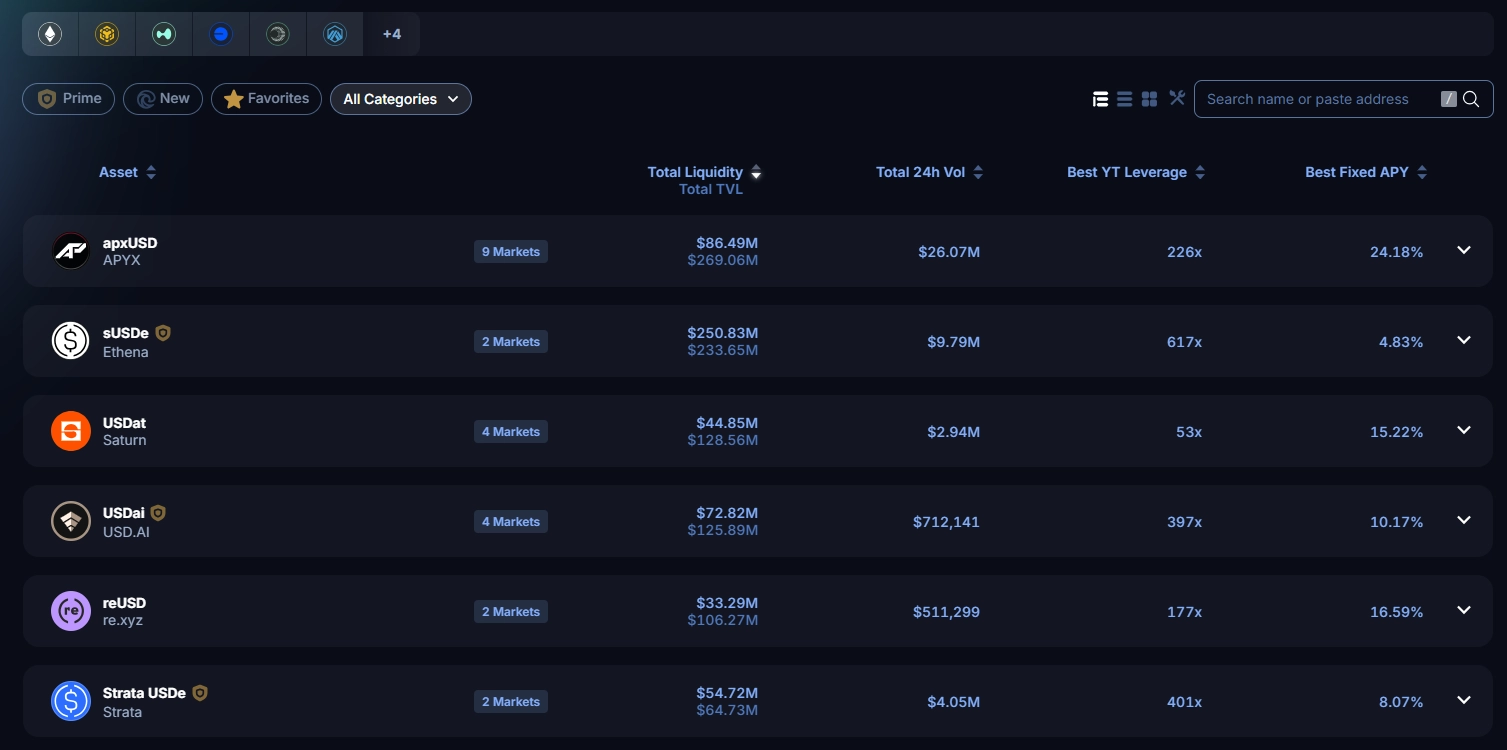
The impact of STRC’s emergence on yield-structuring protocols such as Pendle and Strata has also been substantial. By TVL, structured products based on apxUSD and USDat rank first and third, respectively, on Pendle Finance. On Strata, Saturn USDat-based tranche products account for around 15% of Strata’s total TVL.
Taken together, STRC is circulating onchain in various forms, including 1) collateral for yield-bearing stablecoins, 2) a tokenized underlying asset, and 3) yield-structured products. We can see that the scale of the onchain economy activated around STRC is quite meaningful relative to the amount issued in traditional markets. In other words, I would argue that STRC has revitalized the DeFi ecosystem rather than killed it.
Separately, there has recently been debate over the sustainability of STRC, and DeFi protocols are therefore going through a difficult period. I hope market conditions recover quickly and that STRC and the STRC-based DeFi ecosystem become even more active.
The author of this report may have personal holdings or financial interests in assets or tokens discussed herein. However, the author affirms that no transactions have conducted using material non-public information obtained in the course of research or drafting. This report is intended solely for general information purposes and does not constitute legal, business, investment, or tax advice. It should not be used as a basis for making any investment decisions or as guidance for accounting, legal, or tax matters. Any references to specific assets or securities are made for informational purposes only and should not be construed as an offer, solicitation, or recommendation to invest. The opinions expressed herein are those of the author and may not reflect the views of any affiliated institutions, organizations, or individuals. The opinions and analyses expressed herein are subject to change without prior notice. In addition, beyond the individual disclosures included in each report, Four Pillars, may hold existing or prospective investments in some of the assets or protocols discussed herein. Furthermore, FP Validated, a division of Four Pillars, may already be operating as a node in certain networks or protocols discussed herein or may do so in the future. Please see below links in the footer for FP Validated's participating network disclosures and for broader disclosure details.


