


Table of Contents
Researcher

Related Projects

Why the milestone represents the blockchain’s real superpower
I just returned from Asia, where I spent time with Ethereum developers and ecosystem leaders. A special call-out to Nonce Classic, Four Pillars, and DSRV in Seoul, as well as our friends at SNZ and the recently opened Ethereum Community Hub in Hong Kong. This hub is Asia's first permanent, physical Ethereum community space, supported by the Ethereum Foundation.
What struck me most was not just the energy, but the seriousness and ambition of the people building there. I came away deeply impressed and inspired by the caliber of projects, the experimentation, and the long-term thinking emerging from the Ethereum ecosystem globally.
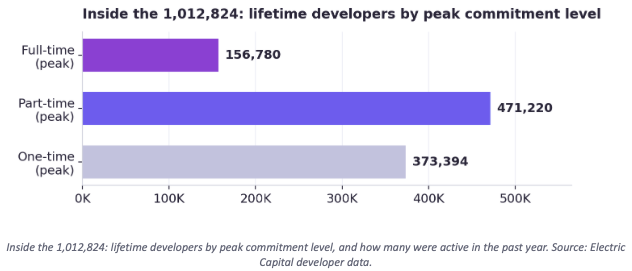
And it gave a human face to a number: Ethereum has now crossed one million lifetime developers — 1,012,824 distinct people who have contributed to the ecosystem , according to data from Electric Capital. No other ecosystem in crypto is close.
A Milestone Worth Pausing On
A million is a round number, and round numbers can be hollow. This one is not. Behind it sits the single largest pool of technical talent ever assembled around an open, permissionless blockchain network — and, more importantly, a pool that keeps deepening and broadening.
Of those million, about 232,000 developers were active in the past twelve months.
Why Ethereum: The Question that Actually Matters
For years, crypto discourse has revolved around speed, fees, and throughput. Every new chain claims it is “faster than Ethereum.” But the most important question in crypto has never been which chain is fastest. It is a different one:
“Where do the best builders choose to build for the long term?”
And on that question, Ethereum remains in a category of its own. The advantage is not simply technological. It is institutional, cultural, economic, and compositional — the result of a decade-long accumulation of developers, infrastructure, standards, tooling, liquidity, research, applications, and social coordination that no other ecosystem has replicated.
Ethereum has become the default operating system for programmable finance and internet-native capital formation.
What the Million Are Building Today — and Why It Deepens the Moat
A million developers matters most because of what they are working on right now. The center of gravity today is the hardest, highest-stakes problems in the industry: core protocol scalability, privacy, quantum resistance, and the agentic systems that will run on top.
Glamsterdam — innovating without breaking what's sacred. The upcoming Glamsterdam upgrade, targeted for 2026, shows how Ethereum advances while protecting its core values. Its headline changes — enshrined proposer-builder separation (ePBS) and block-level access lists (BALs) that unlock parallel execution and much higher throughput, alongside the potential for a higher gas limit — will meaningfully raise Layer 1 capacity. Scaling for tomorrow's requirements while safeguarding credible neutrality, security, and MEV fairness — that is the moat in motion.
Synchronous composability — making many rollups feel like one chain. Composability has always been Ethereum's superpower; the next leap is extending it across Layer 2s. Native and "based" rollups, paired with synchronous composability, solve this. A contract on one rollup can call a contract on mainnet or another rollup inside a single atomic transaction. No bridges. No waiting. Efforts at Linea, the Ethereum Economic Zone, Gnosis, Zisk, and Ethereum Foundation collaboration, are pairing this design with real-time proving. The result: dozens of rollups stop feeling like separate networks and start behaving like one chain. That is the direct answer to the fragmentation critics point to.
Quantum resistance — Ethereum's clearest lead. No major ecosystem is better prepared for the post-quantum era. The "Lean Ethereum" roadmap, a dedicated Ethereum Foundation Post-Quantum Security team stood up in early 2026, the pq.ethereum.org hub, and more than ten client teams already running weekly post-quantum interoperability devnets add up to a coordinated, open-source migration targeted for roughly 2029. When quantum risk becomes real, the institutions that custody trillions will care about one thing above all: which chain prepared first and most thoroughly.
The Moat Beyond Developers: Composability, Standards, and Trust
This developer talent compounds because of how Ethereum is built. Its deepest network effect is not liquidity but the depth of its composability: applications behave like interoperable financial Lego blocks — lending, stablecoins, exchanges, wallets, tokenized assets, oracles, and Layer 2 rollups — all interacting through shared standards, so a developer never starts from zero. The EVM is crypto’s application layer, and Solidity skills carry across Base, Arbitrum, Optimism, Polygon, zkSync, Scroll, Linea, and hundreds more networks.
Learning the Ethereum stack maximizes optionality, which feeds the flywheel — more developers, more tooling, more liquidity, more institutions, and back to more developers who will build composable protocols and assets. Liquidity begets liquidity. Composability begets composability.
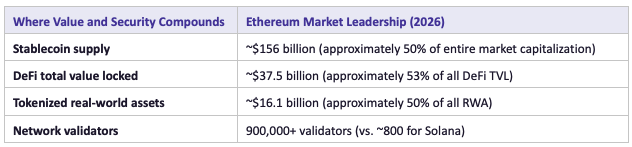
And Ethereum dominates where value actually lives, not just where activity is loudest:
Three forces deepen that lead:
Credible neutrality — Ethereum is secured by more than 900,000 validators versus roughly 800 for Solana, the kind of decentralization and platform neutrality that large institutions price highly.
Modularity — rather than fragmenting Ethereum, rollups like Base, Arbitrum, and Optimism extend it into an increasingly well connected modular internet economy that inherits mainnet security.
And culture — Ethereum disproportionately attracts best in class researchers, cryptographers, and EIP standards authors who set the direction for the whole industry. This last advantage is the hardest of all to fork.
There Is Only One Ethereum
There is a difference between generating onchain activity and becoming the long-term coordination layer for internet-native finance — the layer trusted by the world’s largest financial institutions. Ethereum dominates the mindshare of the largest asset owners, who prioritize trust, security, and liquidity. I witnessed this first-hand during my time at BlackRock, from a front-row seat.
In technology markets, ecosystems consolidate around standards, liquidity, and developer mindshare over time. That is Ethereum’s moat.
After spending time with these developers, builders and ecosystem leaders in Seoul and Hong Kong, I am more convinced than ever of Ethereum’s competitive advantage. I met the talent building the next generation of financial infrastructure — our industry’s future founders and the architects of agentic finance. These are the people and teams who will change the world.
Ethereum’s future is happening now.
The author of this report may have personal holdings or financial interests in assets or tokens discussed herein. However, the author affirms that no transactions have conducted using material non-public information obtained in the course of research or drafting. This report is intended solely for general information purposes and does not constitute legal, business, investment, or tax advice. It should not be used as a basis for making any investment decisions or as guidance for accounting, legal, or tax matters. Any references to specific assets or securities are made for informational purposes only and should not be construed as an offer, solicitation, or recommendation to invest. The opinions expressed herein are those of the author and may not reflect the views of any affiliated institutions, organizations, or individuals. The opinions and analyses expressed herein are subject to change without prior notice. In addition, beyond the individual disclosures included in each report, Four Pillars, may hold existing or prospective investments in some of the assets or protocols discussed herein. Furthermore, FP Validated, a division of Four Pillars, may already be operating as a node in certain networks or protocols discussed herein or may do so in the future. Please see below links in the footer for FP Validated's participating network disclosures and for broader disclosure details.


