


Table of Contents
- Key Takeaways
- 1. Korea recognizes Ethereum's status, with MetaMask at the gateway
- 2. From a ‘Wallet’ to an ‘Open Money Platform’
- 2.1 Once a wallet takes the lead, its ‘inertia’ is hard to reverse
- 2.2 What an ‘Open Money Platform’ is
- 2.3 The same abstraction, a different foundation: self-custody changes the model
- 2.4 The conditions of self-custody, and MetaMask's response
- 3. MetaMask and the next stage of Korea's onchain economy
Researcher



Key Takeaways
- Ethereum's status as infrastructure is being confirmed, and MetaMask sits at the gateway. Mirae Asset Securities defined Ethereum as a "global settlement layer and supreme court." Network activity is at an all-time high. MetaMask is the gateway that has occupied that position the longest and at the broadest scale on top of this infrastructure.
- MetaMask is moving beyond a simple wallet toward an open money platform. Swaps, perpetual futures, prediction markets, and Mastercard merchant payments are integrated into a single interface, while self-custody keeps asset control in the user's hands. It pursues the same abstraction as super apps like Robinhood and Revolut, but the direction of asset control is the opposite.
- MetaMask is already preparing for the next stage of Korea's onchain economy. As the leading wallet among Korean users, the habits and inertia built on top of it only grow stronger over time. The self-custody infrastructure integrating trading, payments, and asset management is already in place. Ready to move fastest the moment the regulatory environment opens up.
1. Korea recognizes Ethereum's status, with MetaMask at the gateway
In February 2026, Mirae Asset Securities, part of one of Korea's largest financial groups, published a 62-page report titled ‘This Is Ethereum's Year’. The report defined Ethereum as a "global settlement layer and supreme court." The fact that Korean and global institutions reached the same conclusion at the same time suggests that Ethereum is moving beyond a simple investment asset and gaining recognition as infrastructure.
The report's logic is clear. Annual settlement volume for Ethereum-based stablecoins exceeded $33 trillion. That puts it at a level comparable to Visa and Mastercard. Monthly active addresses rose 114 percent year-over-year and reached a new high. The price remains about 60 percent below its all-time high, but the network's economic activity has entered its strongest period on record. The report called this gap the ‘Great Divergence’.
Of course, not everyone can walk straight into a supreme court. You need a pass. In the onchain economy, that pass, and the starting point, is the wallet. Every transaction, every signature, and every asset transfer begins at the wallet and returns to it. As Delphi Digital's Robbie Petersen argued in the ‘Fat Wallet Thesis’, as protocol and application layers become commoditized, distribution and order flow become the scarcest resources in the onchain economy. These ultimately accrue to the front end closest to the end user, namely the wallet. A tool once taken for granted has become the most important point of value capture in the onchain stack.
Order flow: the full routing process from the moment a user creates and signs a transaction until that transaction is included in a block and recorded onchain.
If the wallet is the main point of value capture in the onchain economy, then MetaMask is the wallet that has occupied that position the longest and at the broadest scale. Built by Consensys, the company founded in 2014 by Ethereum co-founder Joseph Lubin, MetaMask was the industry's first self-custody Ethereum wallet when it launched in 2016. It remains the most widely used point of access to onchain activity in the world.
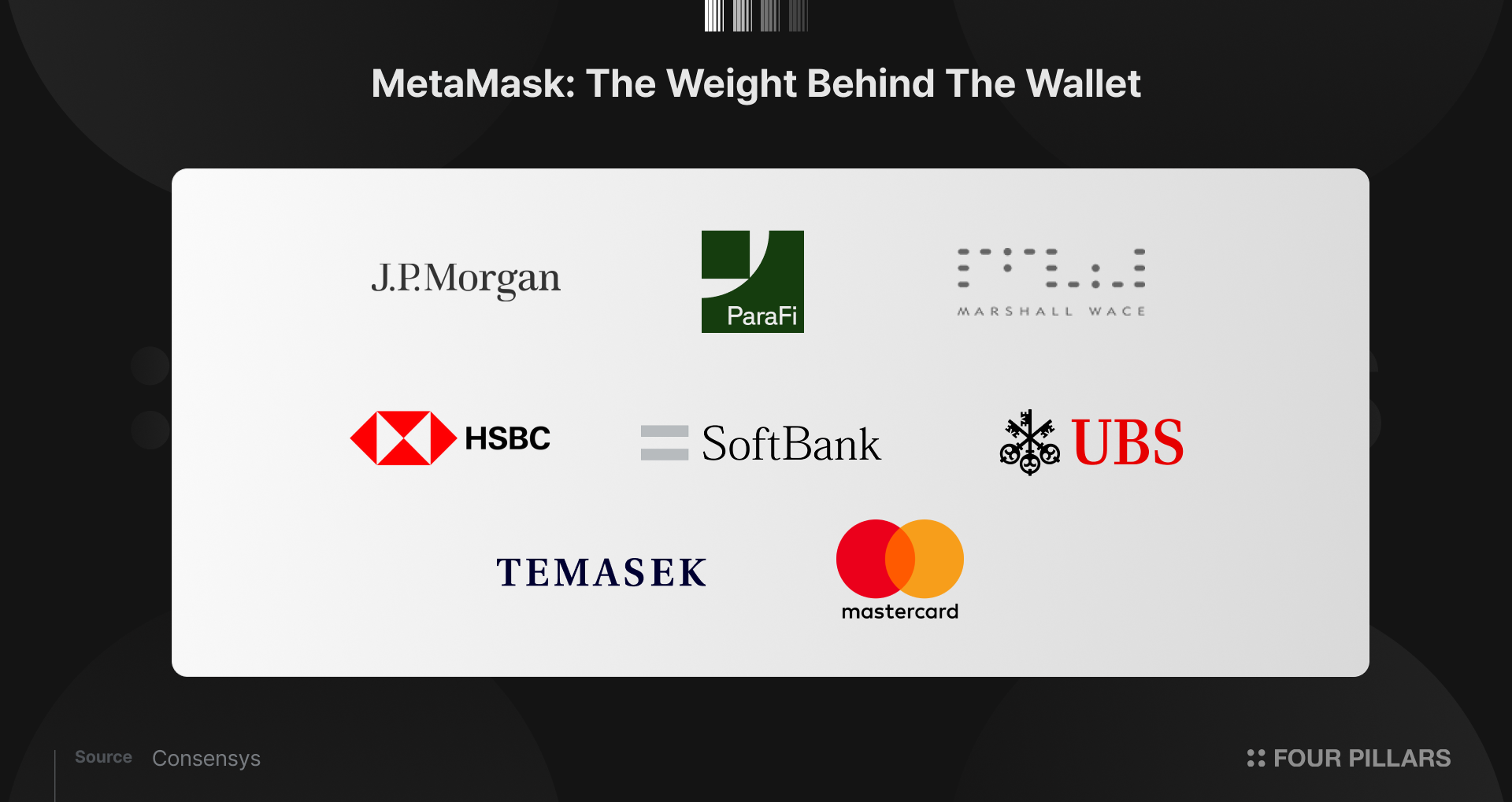
Consensys' funding record reflects this position. In its 2022 Series D round, the company raised $450 million led by ParaFi Capital at a $7 billion valuation. But the institutional backing extends well beyond a single round. Since 2021, J.P. Morgan, Mastercard, UBS, and HSBC have all invested directly in Consensys, alongside Temasek and SoftBank Vision Fund 2. This investor lineup, closer to a consortium of global financial institutions than the crypto side, shows that the traditional financial establishment has placed a direct bet on MetaMask's parent company.
From this position, MetaMask is moving beyond a simple wallet and becoming an open money platform that integrates trading, asset management, and payments while preserving self-custody. This article examines the structure of that shift and what it means for Korea’s onchain economy.
2. From a ‘Wallet’ to an ‘Open Money Platform’
2.1 Once a wallet takes the lead, its ‘inertia’ is hard to reverse
In the blockchain industry, the center of value capture has moved from protocols to applications and then to wallets. Wallets have begun to absorb core dApp functions such as swaps, bridges, and staking, and they now control the user interface directly.
The strongest moat around a wallet is inertia. Unless there is an exceptional shift, such as overwhelming infrastructure-level performance or unusually aggressive incentives, users do not change familiar workflows. This is not a simple preference. It is a pattern of behavior shaped by repeated experience and accumulated trust. In a web3 environment where technical features are easy to copy, this temporal depth becomes the strongest moat. A late entrant cannot change an already fixed trajectory by adding a few features.
Inertia keeps users in place, but what keeps a wallet ahead is functional depth. Feature lists no longer differentiate products now that protocols, dApps, and wallets crowd the market. What matters now is identifying the nature of the target market with precision and building depth around it. Differentiation no longer comes from adding features. It comes from aiming directly at core demand.
2.2 What an ‘Open Money Platform’ is
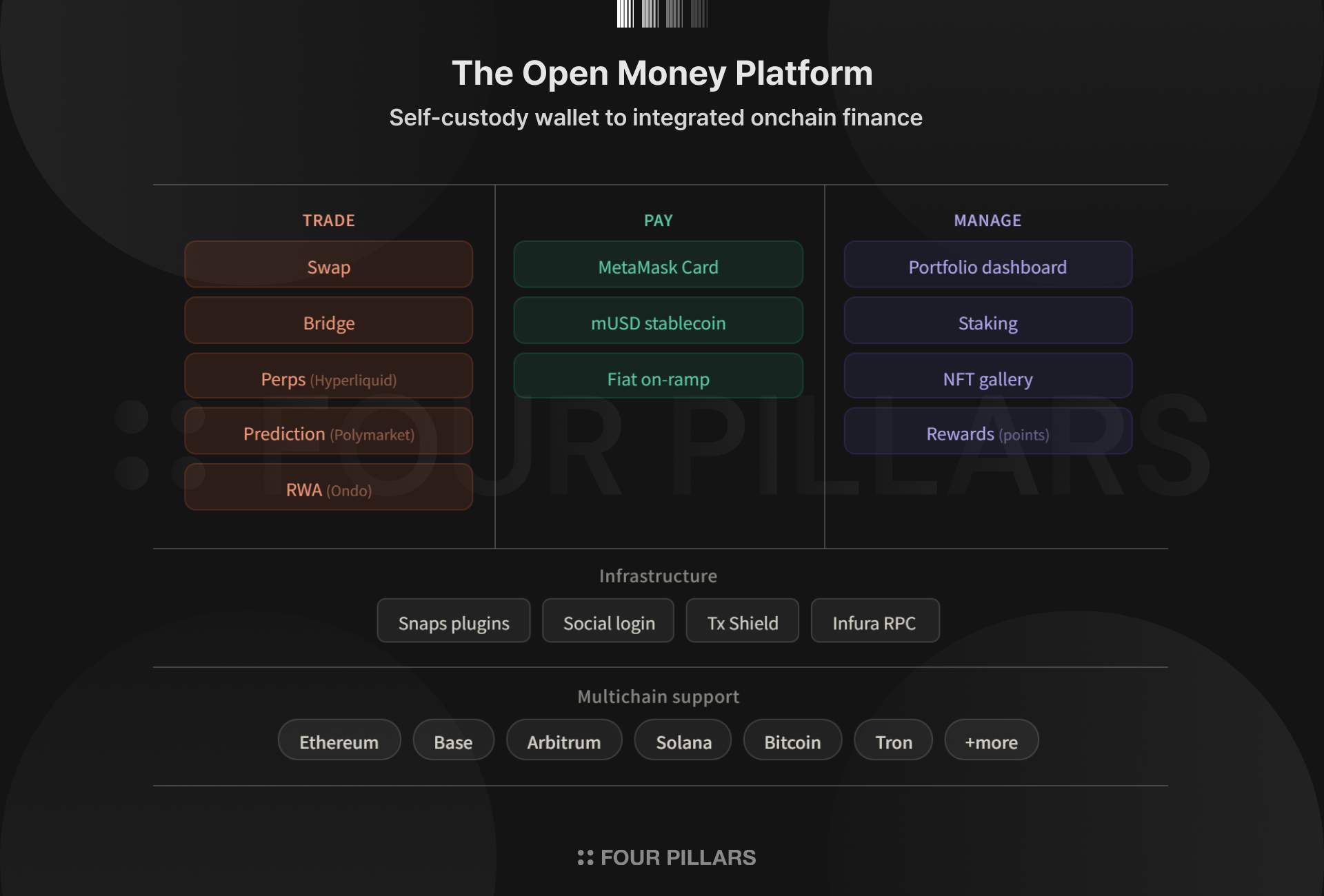
MetaMask has effectively become the default onchain gateway for users in Korea as well as globally, and it is now redefining itself. Beyond its earlier identity as an "Ethereum wallet," the new category it is pursuing is an open money platform. The core idea is to integrate trading, asset management, and payments into a single interface, built on a permissionless structure where anyone can access the onchain economy without prior approval. Its product strategy has two main tracks.
The first is trading. Starting with swaps, MetaMask is expanding native integrations with major decentralized exchanges, or DEXs, and prediction market protocols, building a single point of access for onchain trading.
Source: MetaMask
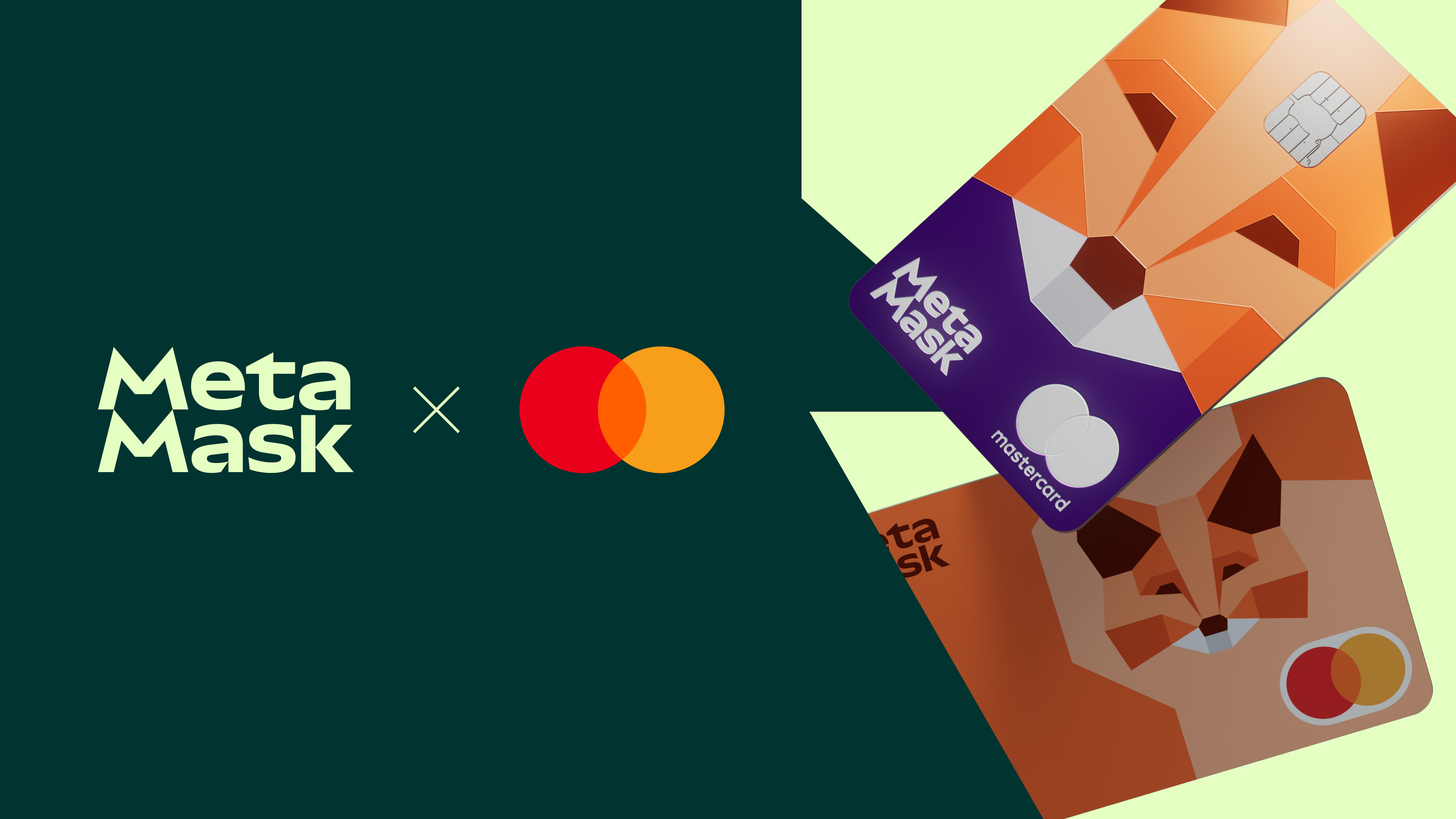
Second is payments. A representative example is the MetaMask Card, first piloted in the EU and UK in 2024 through a partnership with Mastercard, before expanding across Europe, North America, and Latin America, including Canada and the U.S. It lets users spend assets from their self-custody wallet directly at more than 150 million merchants worldwide. Because assets remain in the user's wallet until the moment of payment, the card removes the exchange deposit step that conventional crypto cards have required. A Korea launch date has not yet been announced.
Source: MetaMask
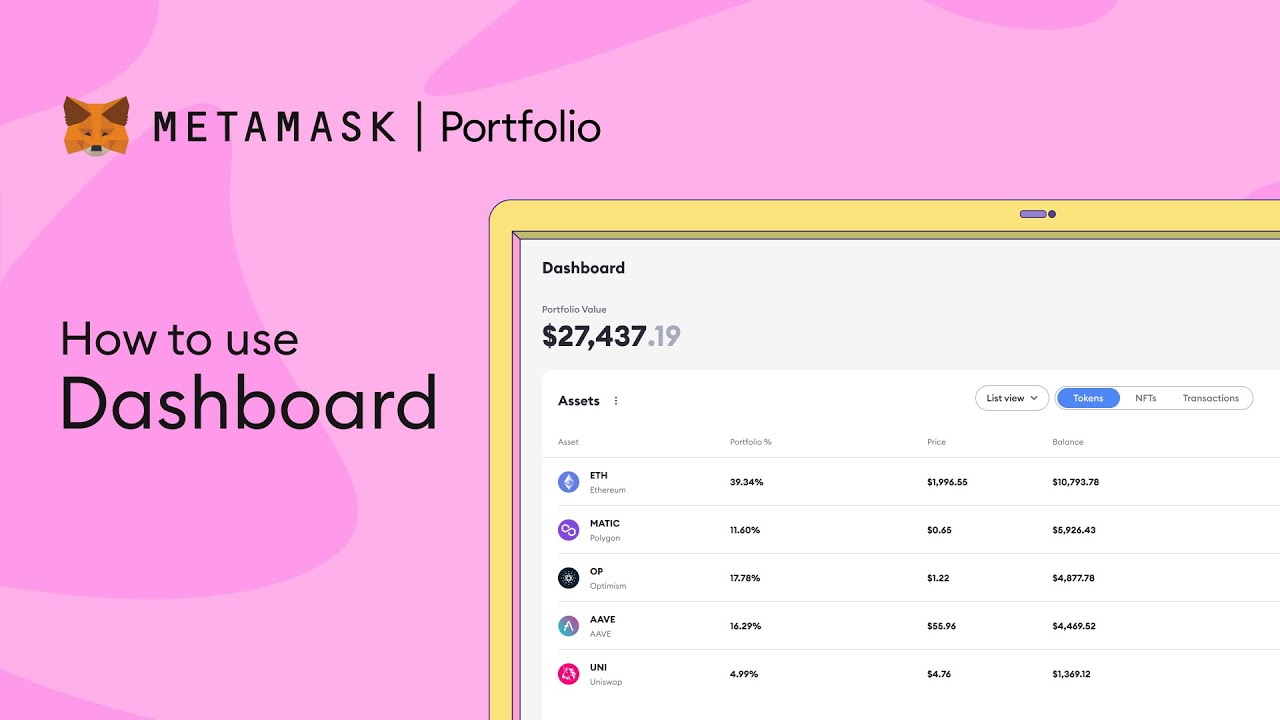
This push is supported by broader infrastructure expansion. MetaMask is building out a wider onchain finance platform: MetaMask Portfolio enables multichain asset management, Snaps introduces plugin extensibility, and the acquisition of Web3Auth adds social login.This shift is being executed in products, not left as a slogan.
At first glance, this may resemble the fintech super app playbook, collapsing financial complexity into a single interface. But the underlying architecture is fundamentally different. In a super app, the platform holds custody of user assets. In MetaMask, the user does.
2.3 The same abstraction, a different foundation: self-custody changes the model
Global fintech super apps have expanded by abstracting away complexity. Korean users are already familiar with this model. Toss, for example, combines transfers, investing, insurance, and payments in a single app. Its monthly active users are about 27 million, more than half of Korea’s population.
Robinhood allowed users to trade stocks, exchange-traded funds, options, and crypto without commissions in a single app. With more than 27 million funded accounts, what the app abstracted away was the difference in user experience across financial products. It erased the boundary between buying a stock and buying crypto, so users could trade without thinking about the product category.
Revolut integrated bank accounts, cards, foreign exchange, crypto, and stocks into one app, reaching more than 68 million individual users and operating in more than 40 countries. What the company abstracted away was the complexity of global financial infrastructure. Frictions around cross-border remittances, multi-currency accounts, and exchange rate management were pushed behind a single interface.
Neither service is available in Korea yet. Even so, the direction they established, abstracting financial complexity and maximizing the time users spend inside one app, has become the main pattern in global fintech. MetaMask’s open money platform looks similar on the surface. But its structure rests on a different foundation.
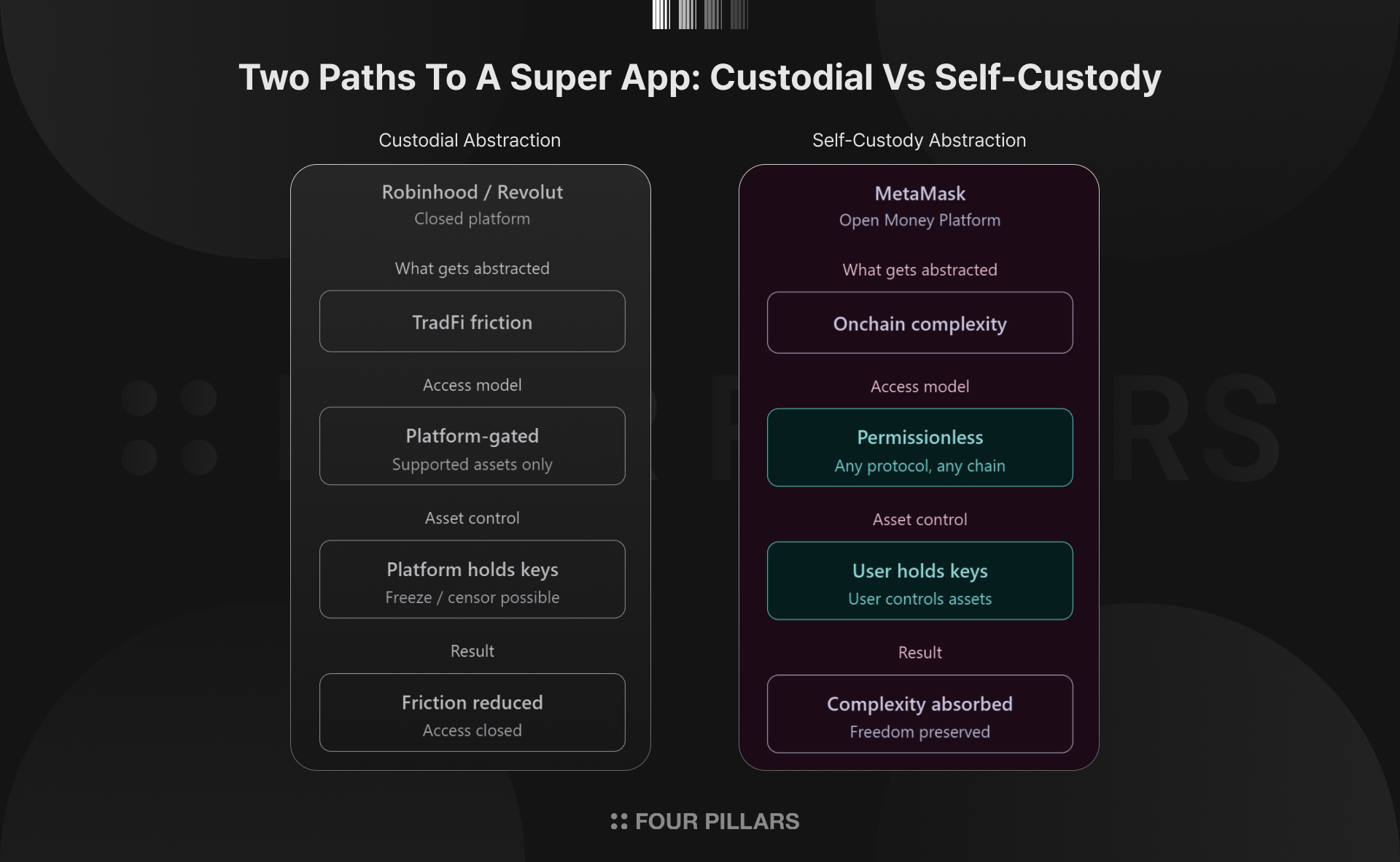
The difference lies in who controls the assets. On Robinhood, the user’s assets are held by Robinhood. The same is true on Revolut. The platform is both intermediary and custodian. In that structure, abstraction increases convenience, but final control over the assets remains with the platform.
MetaMask’s open money platform pursues the same degree of abstraction, but reverses the direction of asset control. Swaps, bridges, and payments are integrated into one interface, but the assets remain under the control of the user’s private key alone. Because the platform does not custody the assets, it cannot freeze them or restrict access. Complexity is absorbed, but control stays with the user. In this structure, self-custody is not a constraint. It is a precondition.
This structural difference appears in the speed of service expansion. For a Web2-based super app to offer onchain services, it first needs regulatory approvals, custody licenses, and compliance systems in each market. Each added service brings another licensing barrier. MetaMask approaches this differently. Starting from a non-custodial wallet as its onchain-native base, it has been able to add swaps, bridges, perpetual futures through Hyperliquid integration, prediction markets through Polymarket integration, and merchant payments through its Mastercard partnership. MetaMask also operates within each market's regulatory framework. The difference is not whether regulation exists, but where the company starts. Starting with onchain infrastructure and then applying compliance is not the same as securing compliance first and building infrastructure from scratch. The destination may be the same, but the pace is different.
2.4 The conditions of self-custody, and MetaMask's response
The core of self-custody is clear. As long as users hold their private keys themselves, no platform can freeze their assets or restrict access. This is why self-custody is a precondition for onchain abstraction.
Historically, that precondition came with entry barriers. The complexity of key management, friction in the signing process, and user responsibility for phishing all limited the wider adoption of self-custody wallets. MetaMask has been narrowing this gap in a systematic way.
Source: CoinDesk
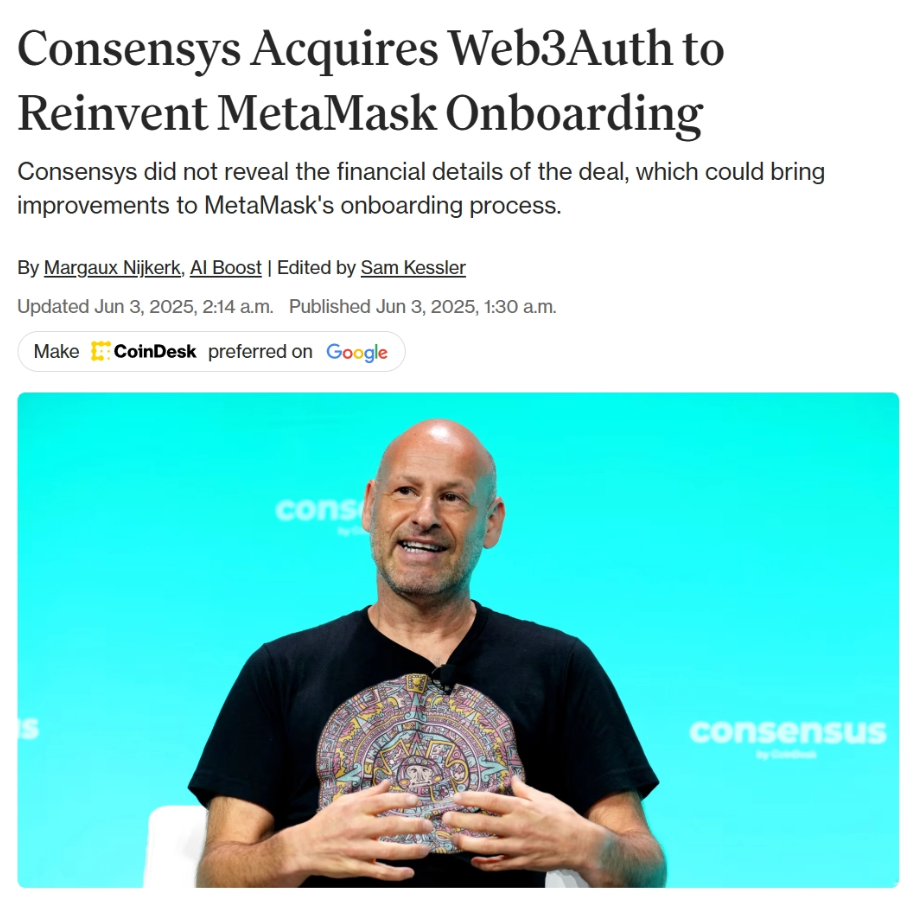
The first step is lowering the entry barrier. Social login and seedless recovery, introduced through the acquisition of Web3Auth, remove the burden of managing seed phrases. Users can create and recover wallets through familiar social accounts, while control of the private key still remains with the user. The onboarding experience becomes similar to a custodial service, but the structure remains self-custody.
The second step is building a safety layer. Transaction Shield offers compensation of up to $10,000 per month, creating a layer of protection against risks that can arise in onchain activity. This gives users a basis for participating more safely even in a self-custody environment.
These two efforts move in the same direction. They preserve the principle of self-custody while bringing the user experience closer to the level of custodial platforms. Control of the key stays with the user, while the friction of handling the key is reduced. This is the main execution task within the open money platform vision, and it is the clearest answer MetaMask is offering today.
3. MetaMask and the next stage of Korea's onchain economy
Korea is one of the most active digital asset markets in the world. But activity still centers on exchanges. As Ethereum begins to be recognized as a global settlement layer, the Korean market is entering an early phase of moving from exchange-centered activity to onchain-native activity.
What matters in this transition is the first gateway users encounter when they enter the onchain economy. MetaMask is already in that position. It has the highest usage share among Korean users, and the habits and infrastructure formed on top of it create structural inertia that grows stronger over time.
The open money platform that MetaMask is building starts from this gateway. Trading, asset management, and payments are integrated into one interface, while control over assets remains with the user. Depending on Korea’s regulatory environment, the timing of some features may vary. But that is a condition shared by all participants as onchain finance comes into contact with the existing regulatory system.
More important is the direction. As Korea’s onchain economy expands, MetaMask has already prepared the infrastructure that users and partners will need: a self-custody platform that integrates trading, payments, and asset management. On Ethereum’s settlement layer, MetaMask is advancing the next stage of Korea’s onchain economy through execution rather than plans alone.
The report is based on the independent research of the author sponsored/funded by Consensys. The author of this report may have personal holdings or financial interests in assets or tokens discussed herein. However, the author affirms that no transactions have conducted using material non-public information obtained in the course of research or drafting. This report is intended solely for general information purposes and does not constitute legal, business, investment, or tax advice. It should not be used as a basis for making any investment decisions or as guidance for accounting, legal, or tax matters. Any references to specific assets or securities are made for informational purposes only and should not be construed as an offer, solicitation, or recommendation to invest. The opinions expressed herein are those of the author and may not reflect the views of any affiliated institutions, organizations, or individuals. The opinions and analyses expressed herein are subject to change without prior notice. In addition, beyond the individual disclosures included in each report, Four Pillars, may hold existing or prospective investments in some of the assets or protocols discussed herein. Furthermore, FP Validated, a division of Four Pillars, may already be operating as a node in certain networks or protocols discussed herein or may do so in the future. Please see below links in the footer for FP Validated's participating network disclosures and for broader disclosure details.


